The Challenger Sale in 2026: Take Control of the Conversation
The Challenger Sale wins by teaching, tailoring, and taking control—not by building rapport and pitching features. Here's how to run the method in 2026.
TL;DR
- The Challenger Sale method says the best reps don't build relationships and wait for demand—they teach prospects something new, tailor the message to the buyer, and take control of the conversation, including price.
- It beats the classic "Relationship Builder" approach in complex B2B deals because buyers now self-educate and resent generic pitches.
- "Taking control" is not being aggressive. It's leading the agenda, talking money early, and pushing back when the customer is wrong.
- The method only works on top of accurate contact data and tight buyer research—you can't reframe a problem for a person you can't reach.
- Below: the five seller profiles, a side-by-side comparison, a step-by-step Challenger conversation, and the data foundation that makes it repeatable.
What is the Challenger Sale method?#
The Challenger Sale is a B2B selling model built on research from CEB (now part of Gartner) and popularized in the 2011 book by Matthew Dixon and Brent Adamson. Its core claim: in complex sales, the highest performers consistently behave like Challengers—they bring provocative insight, push the customer's thinking, and stay in command of the deal.
Think of it like a great physician versus an order-taker at a pharmacy counter. The order-taker gives you what you ask for. The physician tells you what's actually wrong, even when it's not what you wanted to hear, and you trust them more for it. The Challenger sells like the physician.
The method rests on three verbs:
- Teach — Lead with commercial insight the buyer didn't have. Show them a problem or cost they're underestimating.
- Tailor — Frame that insight for the specific person in the room: a CFO cares about margin, a VP of Ops cares about throughput.
- Take control — Drive the process. Talk about budget early, maintain assertive momentum, and don't let the deal drift.
That last verb is where most reps freeze, so it's the focus of this guide.
)
What are the five Challenger Sale profiles?#
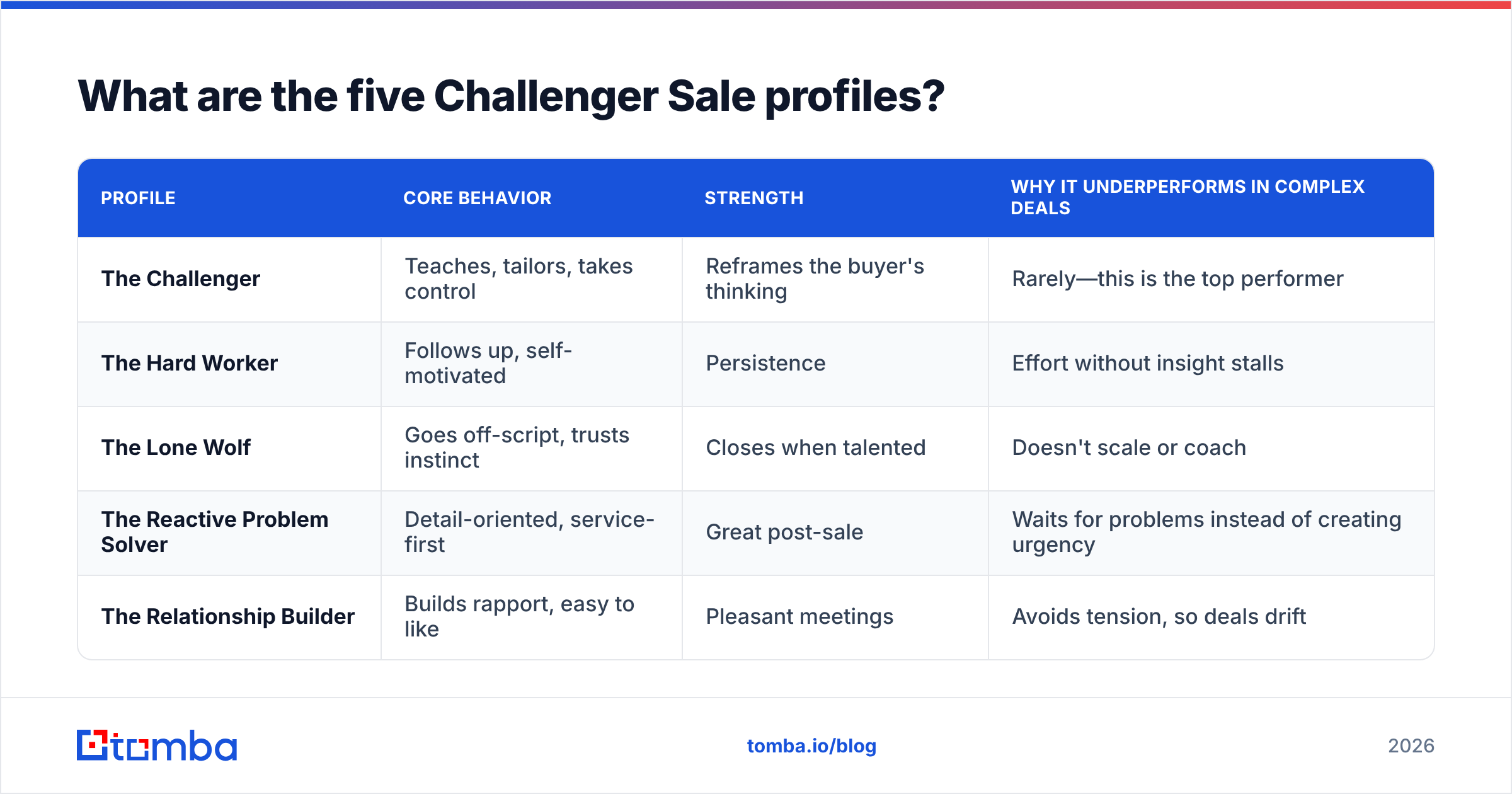
The original research grouped B2B sellers into five profiles based on observed behavior. Only one reliably wins complex deals.
| Profile | Core behavior | Strength | Why it underperforms in complex deals |
|---|---|---|---|
| The Challenger | Teaches, tailors, takes control | Reframes the buyer's thinking | Rarely—this is the top performer |
| The Hard Worker | Follows up, self-motivated | Persistence | Effort without insight stalls |
| The Lone Wolf | Goes off-script, trusts instinct | Closes when talented | Doesn't scale or coach |
| The Reactive Problem Solver | Detail-oriented, service-first | Great post-sale | Waits for problems instead of creating urgency |
| The Relationship Builder | Builds rapport, easy to like | Pleasant meetings | Avoids tension, so deals drift |
The counterintuitive finding: the Relationship Builder—the profile most sales managers historically tried to hire—was the worst performer in complex sales. Being liked is not the same as being trusted to challenge.
Why does "taking control" matter most in 2026?#
Because the buyer has already done the homework, and a passive seller adds nothing.
By 2026, most B2B buyers complete a large share of their research before they ever talk to a rep—reading reviews on G2, comparing vendors, and forming opinions in buying committees that now routinely include six to ten people. If your contribution is to confirm what they already Googled, you're a human brochure.
Taking control reverses that. It means:
- Setting the agenda before the call, not asking "so what did you want to cover?"
- Talking about money early, so budget isn't a surprise that kills the deal in week six.
- Pushing back when the customer's stated requirement is the wrong one—respectfully, with evidence.
- Maintaining momentum with clear next steps and deadlines instead of "let me follow up next quarter."
A useful reframe: control is about the process, never the person. You are assertive about the path to a decision and generous with the customer's intelligence. Aggression repels committees; confident direction reassures them.
How do you run a Challenger conversation step by step?#
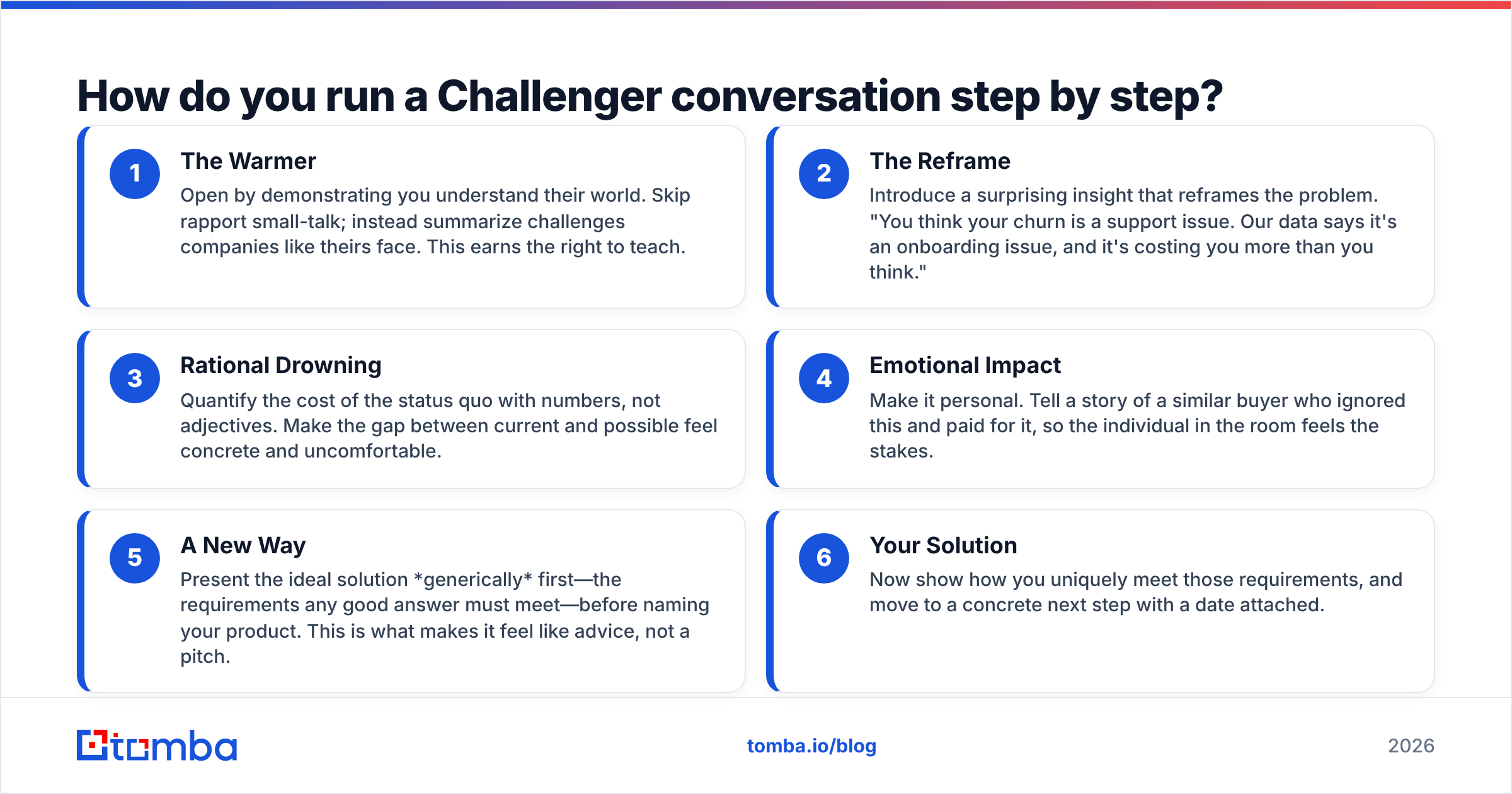
Here's a six-stage structure you can map onto a discovery or pitch call. Each stage builds tension and then resolves it toward your solution.
- The Warmer — Open by demonstrating you understand their world. Skip rapport small-talk; instead summarize challenges companies like theirs face. This earns the right to teach.
- The Reframe — Introduce a surprising insight that reframes the problem. "You think your churn is a support issue. Our data says it's an onboarding issue, and it's costing you more than you think."
- Rational Drowning — Quantify the cost of the status quo with numbers, not adjectives. Make the gap between current and possible feel concrete and uncomfortable.
- Emotional Impact — Make it personal. Tell a story of a similar buyer who ignored this and paid for it, so the individual in the room feels the stakes.
- A New Way — Present the ideal solution generically first—the requirements any good answer must meet—before naming your product. This is what makes it feel like advice, not a pitch.
- Your Solution — Now show how you uniquely meet those requirements, and move to a concrete next step with a date attached.
Notice your product shows up in stage six, not stage one. The Challenger earns the pitch by first changing how the buyer sees their own situation.
Challenger Sale vs. the Relationship Builder approach#
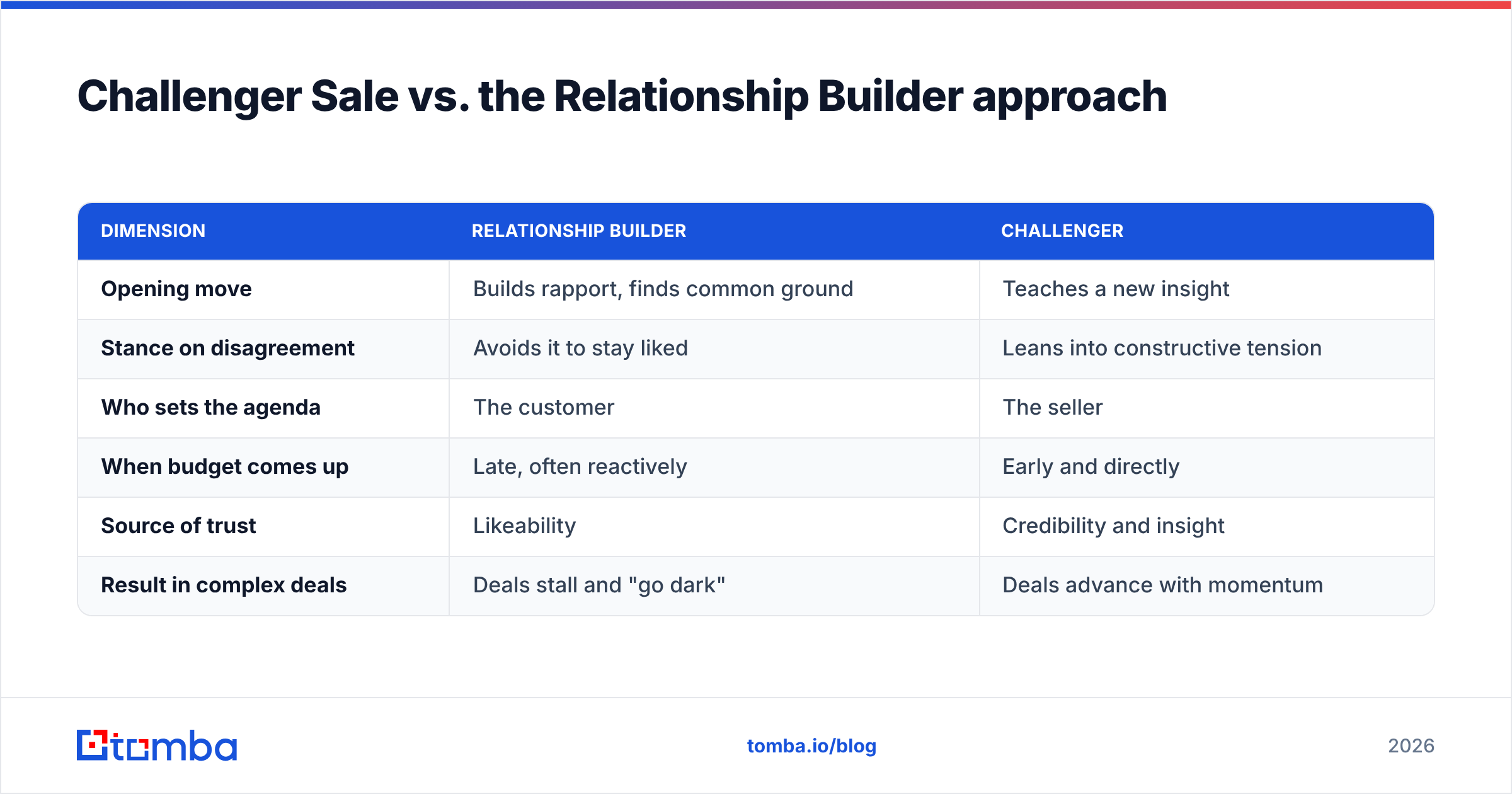
Both can be friendly. The difference is what happens when tension appears.
| Dimension | Relationship Builder | Challenger |
|---|---|---|
| Opening move | Builds rapport, finds common ground | Teaches a new insight |
| Stance on disagreement | Avoids it to stay liked | Leans into constructive tension |
| Who sets the agenda | The customer | The seller |
| When budget comes up | Late, often reactively | Early and directly |
| Source of trust | Likeability | Credibility and insight |
| Result in complex deals | Deals stall and "go dark" | Deals advance with momentum |
The Relationship Builder isn't useless—rapport still helps in transactional or relationship-heavy renewals. But for net-new complex sales, the data has been consistent for over a decade: insight beats affability.
)
Where does data fit into the Challenger Sale method?#
Everywhere. The method assumes you can reach the right person with a tailored insight—and that assumption collapses without solid prospecting data.
Consider the mechanics:
- Teaching requires you to know the account well enough to say something they don't already know. That's research enrichment.
- Tailoring requires you to know who is in the room—the CFO's priorities differ from the VP of Ops'. You need accurate names, titles, and reachable contact details.
- Taking control requires volume and timing: enough qualified conversations that you can afford to walk away from a deal that won't move, which is itself a form of control.
You can't reframe a problem for someone whose email bounces. This is the unglamorous foundation under the methodology. Before the insight, you need the contact. A reliable email finder turns a target account list into reachable decision-makers, and data enrichment fills in the titles and firmographics that let you tailor the message to each persona.
Teams running outbound at scale usually pair Challenger messaging with a clean B2B database so every reframe lands in a real inbox. A strong insight sent to a stale list is just expensive noise—and it quietly drags down your response rate while you blame the script.
What are the most common Challenger Sale mistakes?#
The method is simple to describe and easy to botch. The usual failure modes:
- Confusing control with aggression. Interrupting and steamrolling a buying committee gets you removed from the shortlist. Control is calm direction, not volume.
- Teaching trivia instead of commercial insight. "Did you know our platform has 200 integrations?" is not an insight. "Your current process is leaking 14% of pipeline at handoff" is.
- Reframing without proof. A provocative claim with no data behind it reads as a stunt. Rational Drowning exists for a reason—bring numbers.
- Skipping the tailor step. Delivering the CFO pitch to the end user wastes your best insight on the wrong incentive.
- Building the insight on bad data. If your account research is wrong, your reframe is wrong, and you lose credibility in the first ninety seconds.
The through-line: the Challenger earns the right to take control by being more prepared than the buyer, not louder.
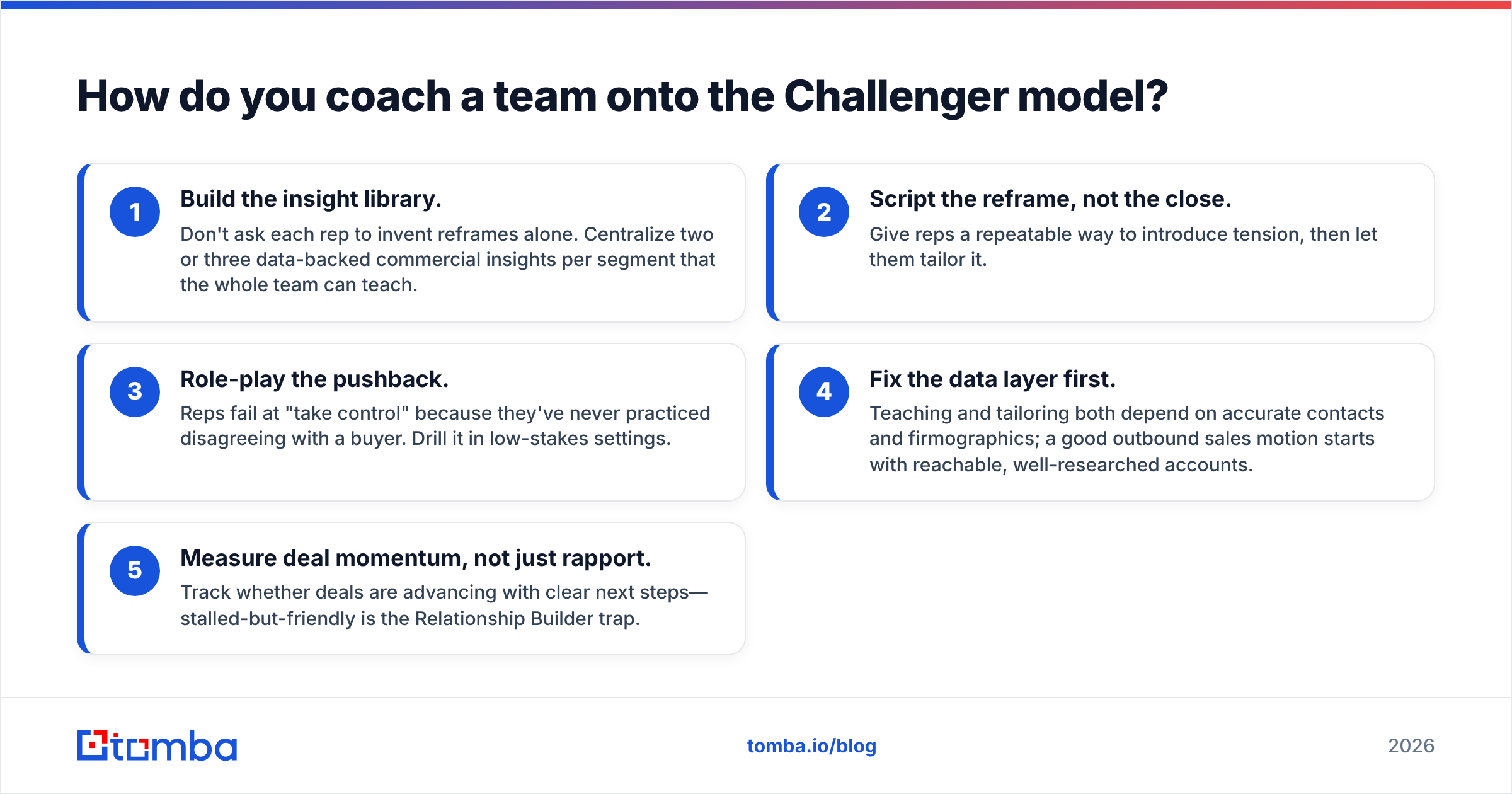
How do you coach a team onto the Challenger model?#
Adopting Challenger is an organizational change, not a script swap. A practical rollout:
- Build the insight library. Don't ask each rep to invent reframes alone. Centralize two or three data-backed commercial insights per segment that the whole team can teach.
- Script the reframe, not the close. Give reps a repeatable way to introduce tension, then let them tailor it.
- Role-play the pushback. Reps fail at "take control" because they've never practiced disagreeing with a buyer. Drill it in low-stakes settings.
- Fix the data layer first. Teaching and tailoring both depend on accurate contacts and firmographics; a good outbound sales motion starts with reachable, well-researched accounts.
- Measure deal momentum, not just rapport. Track whether deals are advancing with clear next steps—stalled-but-friendly is the Relationship Builder trap.
For deeper background on the underlying research and the buying-committee dynamics that make this work, HubSpot's sales blog and HubSpot resources are a solid, vendor-neutral starting point, and the original Challenger Sale framework is well documented.
Is the Challenger Sale still relevant in 2026?#
Yes—arguably more than in 2011. The forces that made it work have only intensified: bigger buying committees, more self-education, more skepticism toward generic pitches, and AI-generated outreach flooding inboxes. In a world where buyers can get a polished product summary from a chatbot, the one thing they can't easily get is a credible expert who reframes their problem and tells them something true that they didn't want to hear.
That's the Challenger's durable edge. The tooling around it has modernized—insight is now data-driven, tailoring is powered by enrichment—but the human behavior at the center is the same: teach, tailor, take control.
Putting it into practice#
Start small. Pick one segment, build one data-backed reframe, and rehearse taking control of the budget conversation. Then make sure that insight actually reaches the right person.
That last step is where most Challenger rollouts quietly fail—great messaging sent to unreachable or mistargeted contacts. Tomba's Email Finder gets you verified, professional emails for the exact decision-makers your reframe is built for, so your insight lands in the right inbox instead of bouncing. Plans start with a free tier (25 searches/month) and scale to Starter at $49/mo when you're ready to run the play across your whole account list. Build the insight, find the buyer, and take control of the conversation.
// get started
Find, verify and enrich your first contacts today
Start on the free plan with 25 searches a month, then scale when your team is ready.
Free plan · No credit card required · GDPR & CCPA
// about the author