Clay vs Cognism 2026: Which B2B Data Platform Wins?
Clay and Cognism solve B2B data differently—one automates enrichment waterfalls, the other sells verified contact data. Here's how they actually compare in 2026.
Clay and Cognism get mentioned in the same breath, but they are not the same kind of product. One is an automation canvas that orchestrates dozens of data vendors. The other is a single contact-data provider with strong European coverage. Picking between them without understanding that difference is how teams overspend by five figures a year.
This breakdown compares Clay vs Cognism on what actually matters: pricing, data accuracy, coverage, workflow model, and the hidden costs nobody puts on the pricing page.
TL;DR: Clay vs Cognism in 30 seconds#
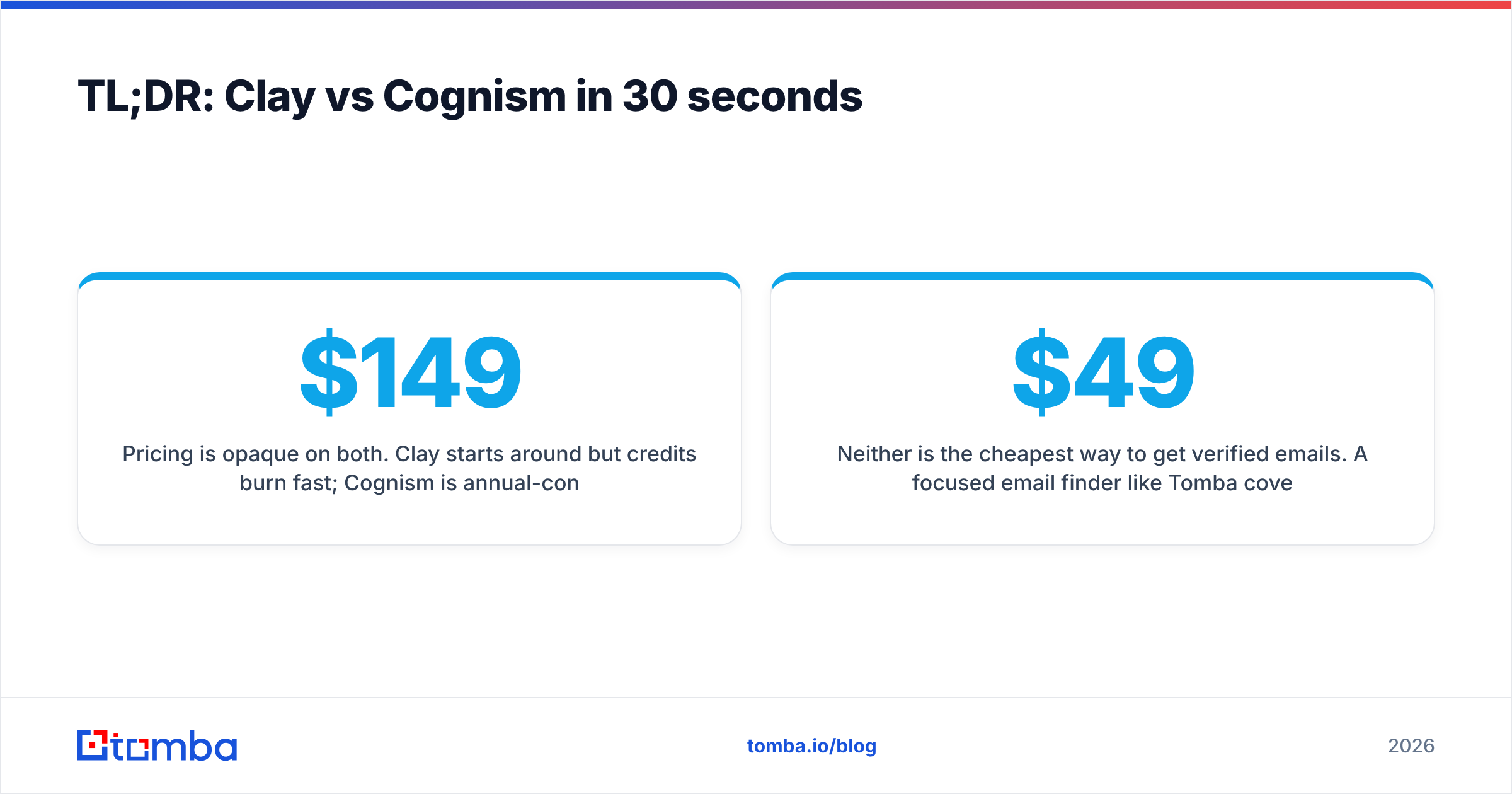
- Clay is an enrichment engine, not a database. It runs "waterfalls" across 50+ providers, so you pay for orchestration plus the underlying data credits. Best for RevOps teams that want to build custom workflows.
- Cognism is a data provider. You buy verified emails and phone-verified mobile numbers (Diamond Data) with strong EMEA coverage. Best for outbound teams that want clean records out of the box.
- Pricing is opaque on both. Clay starts around $149/mo but credits burn fast; Cognism is annual-contract, seat-based, and routinely lands in the $15k–$40k/year range.
- Neither is the cheapest way to get verified emails. A focused email finder like Tomba covers the find-and-verify job from $49/mo, and you can layer it under Clay or alongside Cognism.
- The honest answer: Clay if you love building, Cognism if you sell into Europe, and a dedicated finder underneath either when cost-per-verified-contact is the metric you care about.
What is Clay and what is Cognism?#
Clay is a spreadsheet-meets-automation tool. You drop in a list of companies or people, then chain "enrichment" steps that call external APIs—email finders, firmographic providers, AI scrapers—and write the results back into columns. The killer feature is the waterfall: if provider A can't find an email, Clay automatically asks provider B, then C, until it gets a hit. You are essentially renting a data-orchestration layer.
Cognism is a B2B sales-intelligence database. You search its contact pool, apply filters (title, industry, region, tech stack), and export verified records into your CRM or sequencer. Its differentiator is Diamond Verified phone numbers—mobiles a human or system has actually checked—and GDPR-aligned European data that many US-first vendors lack.
Here is the core distinction, in plain terms:
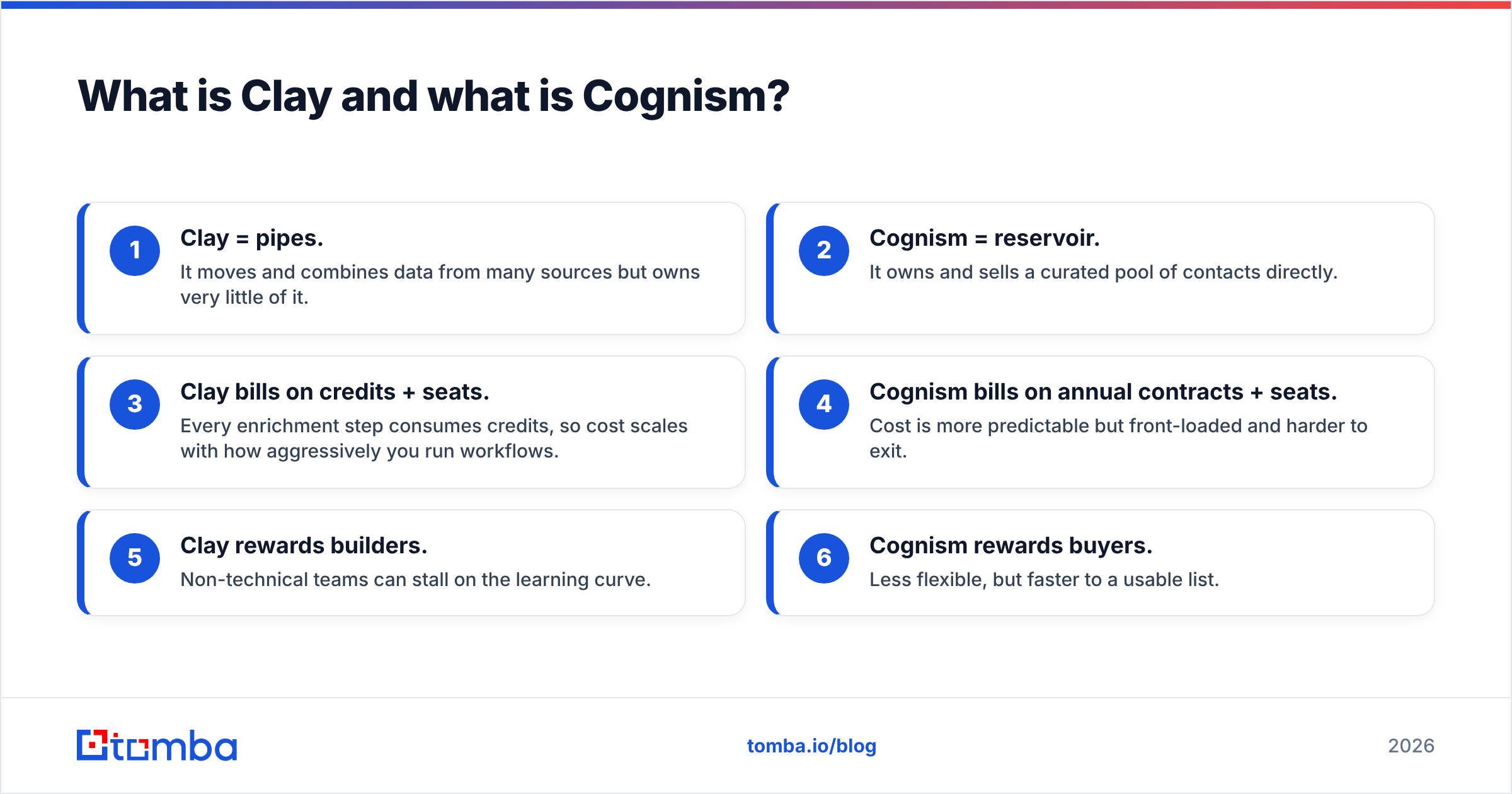
- Clay = pipes. It moves and combines data from many sources but owns very little of it.
- Cognism = reservoir. It owns and sells a curated pool of contacts directly.
- Clay bills on credits + seats. Every enrichment step consumes credits, so cost scales with how aggressively you run workflows.
- Cognism bills on annual contracts + seats. Cost is more predictable but front-loaded and harder to exit.
- Clay rewards builders. Non-technical teams can stall on the learning curve.
- Cognism rewards buyers. Less flexible, but faster to a usable list.
If you only remember one thing: you can actually run Cognism inside Clay as one waterfall step. They are not always either/or.
/blog/generated/memes/2026-06-23/clay-vs-cognism-meme-1.png
How do Clay and Cognism compare on pricing?#
Both vendors hide real numbers behind "talk to sales," but here is the publicly reported shape of each in 2026. Treat these as directional, not contractual.
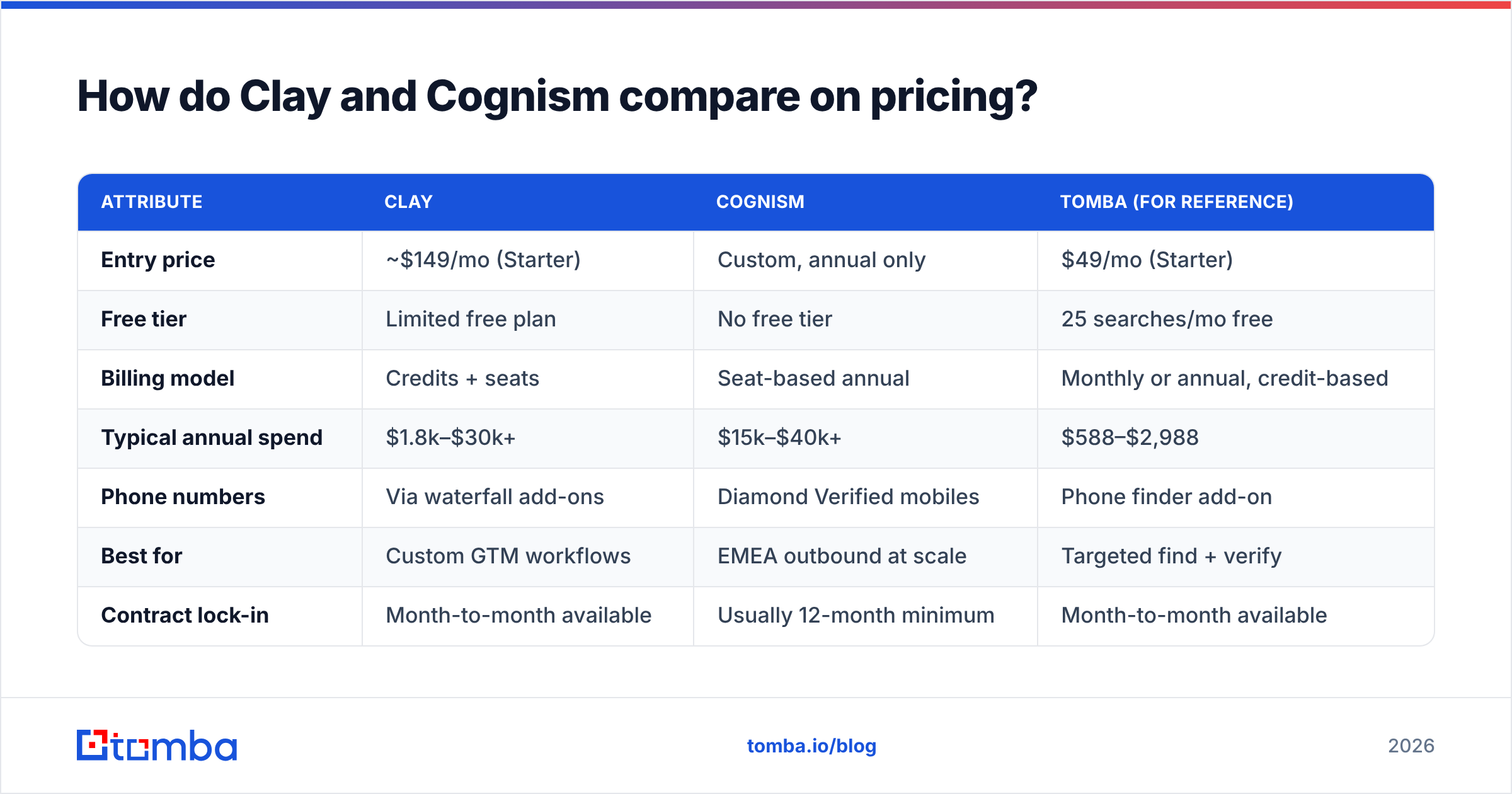
| Attribute | Clay | Cognism | Tomba (for reference) |
|---|---|---|---|
| Entry price | ~$149/mo (Starter) | Custom, annual only | $49/mo (Starter) |
| Free tier | Limited free plan | No free tier | 25 searches/mo free |
| Billing model | Credits + seats | Seat-based annual | Monthly or annual, credit-based |
| Typical annual spend | $1.8k–$30k+ | $15k–$40k+ | $588–$2,988 |
| Phone numbers | Via waterfall add-ons | Diamond Verified mobiles | Phone finder add-on |
| Best for | Custom GTM workflows | EMEA outbound at scale | Targeted find + verify |
| Contract lock-in | Month-to-month available | Usually 12-month minimum | Month-to-month available |
The trap with Clay is credit math. A single enrichment row can consume credits from multiple providers, so a "cheap" plan evaporates once you run waterfalls across 10,000 prospects. The trap with Cognism is the floor: there is no small plan, and you commit for a year before you know whether coverage fits your territory.
For a transparent point of comparison, Tomba pricing publishes every tier publicly—Free, Starter $49/mo, Growth $99/mo, Pro $249/mo, Enterprise custom—so you can model cost-per-contact before you buy. That predictability is exactly what credit-and-contract models obscure.
Which has better data accuracy and coverage?#
It depends on geography and job-to-be-done, and anyone who gives you a single percentage is selling something.
Cognism wins on European mobile data. Its Diamond Data process phone-verifies numbers, and its compliance posture (GDPR, notification of prospects in some regions) makes it a default for teams selling into the UK, DACH, and the Nordics. If a dialer-heavy SDR team in EMEA is the use case, Cognism's verified mobiles are genuinely hard to beat.
Clay wins on flexibility, not on owning the best data. Because it waterfalls across many vendors, Clay's effective accuracy can exceed any single provider—but only if you configure the waterfall well and pay for premium sources inside it. Out of the box, Clay is only as accurate as the providers you wire in.
A few realities both vendors gloss over:
- Catch-all domains break naive verification. Plenty of corporate domains accept every address, so a "valid" result can still bounce. You want a tool that explicitly handles this—see how a dedicated catch-all verifier scores these instead of guessing.
- Coverage decays. People change jobs ~20% a year, so any database is stale the day after it's built. Continuous re-verification matters more than headline match rates.
- US vs EMEA is a real split. US-first tools often thin out in Europe; EMEA-first tools (like Cognism) can be lighter on long-tail US SMBs.
Independent buyer reviews on G2 are useful here precisely because they segment by company size and region—read the 3-star reviews, not the 5-star ones, to find the coverage gaps that match your territory.
What does each tool actually feel like to use?#
Clay feels like a powerful, slightly intimidating spreadsheet. The upside is near-infinite: AI columns, conditional logic, web scraping, and integrations with HubSpot, Salesforce, and your sequencer. The downside is time-to-value. New users routinely spend a week learning waterfalls, credit budgeting, and table design before the first clean list ships. Clay knows this—its community and templates exist precisely to flatten that curve. Check the product directly at clay.com to gauge whether the canvas model fits your team.
Cognism feels like a search engine for people. Filter, preview, export, done. The learning curve is shallow, which is the entire point for SDR managers who want reps prospecting on day one rather than building pipelines. The tradeoff is rigidity: you work within Cognism's filters and data, and custom enrichment logic isn't the product. See their positioning at cognism.com.
Put bluntly: Clay is a platform you operate; Cognism is a list you consume.
Clay vs Cognism: who should pick which?#
Match the tool to the team, not the hype.
Choose Clay if:
- You have a RevOps or growth engineer who enjoys building systems.
- Your ICP changes often and you need custom enrichment logic per campaign.
- You want one canvas to combine many vendors and reduce single-source risk.
- You're comfortable managing credit budgets month to month.
Choose Cognism if:
- You sell into Europe and need compliant, phone-verified mobiles.
- You want reps prospecting immediately with minimal setup.
- Predictable (if large) annual budgeting is acceptable.
- Your motion is dialer- and SDR-heavy rather than workflow-heavy.
Choose a focused email finder (under or beside either) if:
- Cost-per-verified-email is your north-star metric.
- You mainly need accurate B2B emails and verification, not a full platform.
- You want to start free and scale spend linearly, not in $15k jumps.
This last option is the one most "Clay vs Cognism" comparisons skip. You don't always need the orchestration layer or the enterprise contract—you need verified contacts. A purpose-built email finder plus an email verifier often covers 80% of the job at a fraction of the price, and slots in as a Clay waterfall step or a Cognism supplement rather than a replacement.
/blog/generated/memes/2026-06-23/clay-vs-cognism-meme-2.png
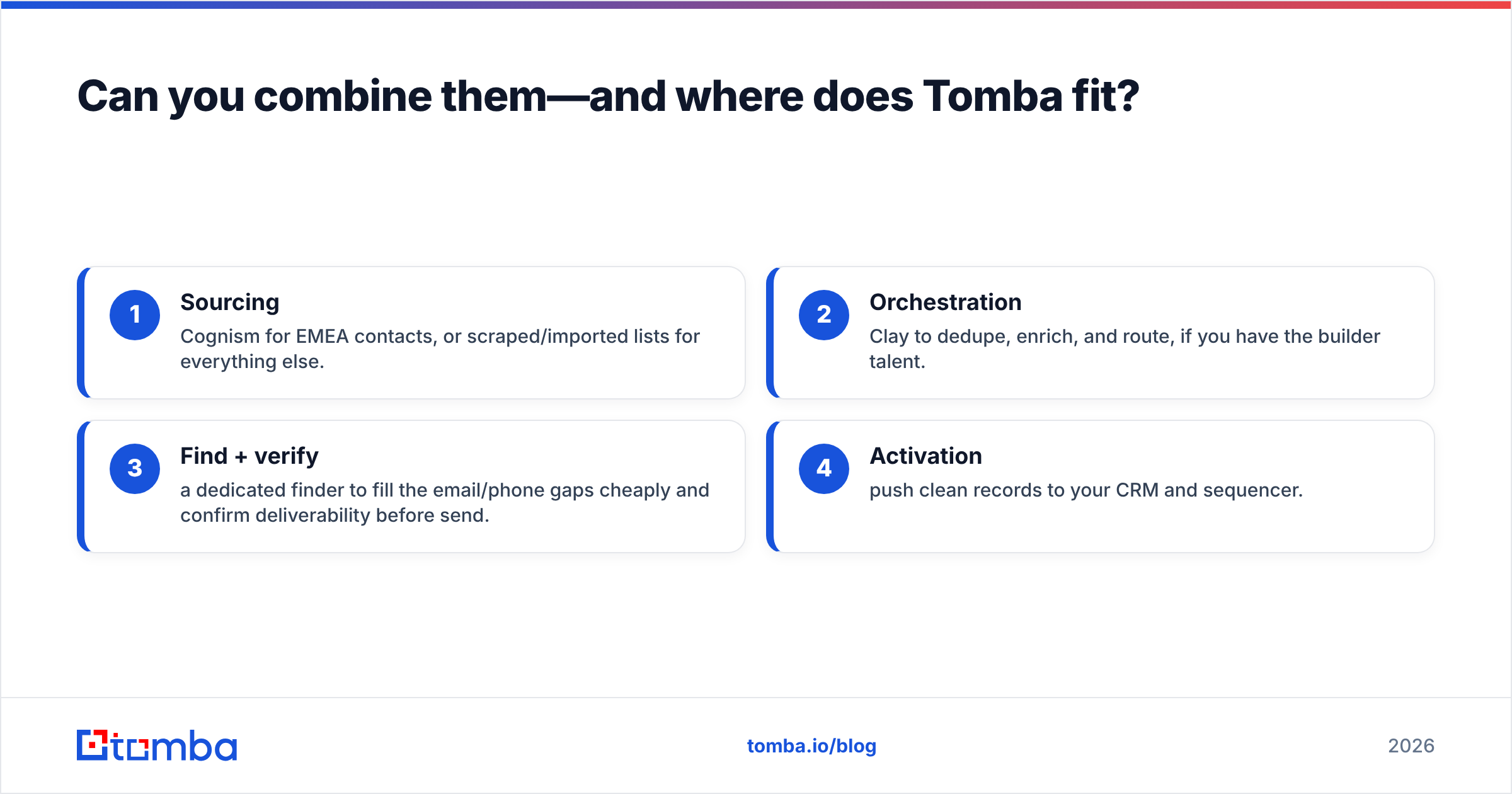
Can you combine them—and where does Tomba fit?#
Yes, and the best teams do. A common 2026 stack looks like this:
- Sourcing — Cognism for EMEA contacts, or scraped/imported lists for everything else.
- Orchestration — Clay to dedupe, enrich, and route, if you have the builder talent.
- Find + verify — a dedicated finder to fill the email/phone gaps cheaply and confirm deliverability before send.
- Activation — push clean records to your CRM and sequencer.
Tomba lives in step three, and it's also a sane standalone for teams that don't need Clay or Cognism at all. Beyond the core finder, it offers domain search for company-wide patterns, a bulk email finder for list jobs, and a full email finder API so you can wire it directly into Clay's HTTP enrichment step—paying Tomba's transparent per-credit rate instead of premium marketplace markups.
The strategic point: data tooling is not one purchase. Decoupling "where I source contacts" from "how I verify them" usually lowers total cost and raises deliverability, because you stop paying enterprise prices for a commodity step.
Final verdict: Clay vs Cognism in 2026#
There's no universal winner—there's a winner for your motion.
- Building a custom GTM machine with technical owners? Clay.
- Running EMEA outbound that lives on verified mobiles? Cognism.
- Optimizing cost-per-verified-contact, or feeding either platform cheaper data? A dedicated finder belongs in your stack regardless.
The mistake is treating this as a two-horse race when it's really three jobs—source, orchestrate, verify—that different tools do best. Map your spend to those jobs and the "versus" question mostly dissolves.
If verified emails at a predictable price is the part you're trying to solve, start with the Tomba Email Finder. Find professional addresses by domain, name, or company, verify them before you send, and connect it to Clay or your CRM through the API—on a Free tier you can test today and a Starter plan at $49/mo when you scale. That's the part of the Clay vs Cognism debate you can settle this afternoon, without a sales call or an annual contract.
// get started
Find, verify and enrich your first contacts today
Start on the free plan with 25 searches a month, then scale when your team is ready.
Free plan · No credit card required · GDPR & CCPA
// about the author