Client Acquisition Emails: The 2026 Playbook That Wins Clients
Most client acquisition emails get deleted in seconds. Here's the 2026 framework for targeting, copy, and follow-up that actually books meetings.
Client Acquisition Emails: The 2026 Playbook That Wins Clients
TL;DR
- Client acquisition emails are cold outreach messages sent to prospects who have never heard of you, with one job: start a conversation that ends in a signed client.
- The biggest lever is not copy — it's targeting. A mediocre email to the right person beats a brilliant email to the wrong one.
- The winning structure in 2026 is short, specific, and personalized at the opening line: trigger, relevance, soft ask.
- Follow-up is where 80% of replies come from. One email is a coin flip; a 4-touch sequence is a system.
- Clean, verified contact data is the foundation. Bad addresses tank your deliverability before your words ever land.
If you sell a service — agency work, consulting, freelance, SaaS onboarding, B2B anything — client acquisition emails are still the highest-leverage channel you have in 2026. They scale, they're measurable, and they cost almost nothing per send. But "cheap to send" is exactly why everyone abuses them, and why most land in trash. This guide breaks down what separates a reply-getting outreach engine from yet another ignored cold blast.
What are client acquisition emails?#
Client acquisition emails are personalized cold emails written to convert a stranger into a paying client. They differ from newsletters (sent to people who opted in) and from transactional emails (triggered by an action). Here, the recipient didn't ask to hear from you — so you have to earn the reply in the first two sentences.
Think of it like knocking on a stranger's door at dinner time. If you launch into a five-minute pitch, the door closes. If you lead with something that proves you know exactly who they are and why you're worth 30 seconds, you get to keep talking. The email is the knock; the goal is the conversation, not the close.
There are three jobs a single acquisition email has to do, in order:
- Get opened — that's your subject line and sender reputation.
- Get read — that's your opening line and how relevant it feels.
- Get a reply — that's your ask, and how small and specific it is.
Most people obsess over job three and neglect one and two. That's backwards.
Why do most client acquisition emails fail?#
Most acquisition emails fail for one of four reasons, and almost none of them are about clever wording.
- Wrong target. You emailed a junior coordinator about a six-figure decision, or a company that already solved the problem you sell.
- No relevance signal. The email could have been sent to 10,000 people, and the reader can tell instantly.
- Bad data. The address bounced, hit a spam trap, or landed in a catch-all that silently swallowed it.
- No follow-up. You sent once, got silence, and assumed "not interested" when it was really "not right now, and I forgot."
That third point quietly kills more campaigns than bad copy ever will. If even 8% of your list bounces, mailbox providers start treating your domain as a spammer, and your good emails to valid prospects stop reaching the inbox too. This is why verifying your list with an email verifier before any send isn't optional housekeeping — it's deliverability insurance. Google's own Postmaster guidelines are explicit that low spam rates and clean sending behavior are what keep you in the inbox.
How do you find the right prospects to email?#
Targeting starts with a precise Ideal Customer Profile and ends with verified contact details for the specific human who can say yes.
Start by defining the profile in plain attributes: industry, company size, role, tech stack, recent trigger events (new funding, a new hire in a relevant role, a product launch). Then you need a way to turn that profile into actual names and email addresses. This is where a domain search earns its keep — point it at a target company's website and pull the email patterns and people that match the roles you care about. For one-off lookups, an email finder gets you a specific person's address from their name and company.
Here's the practical workflow most acquisition teams run in 2026:
- Build a target account list from your ICP — 100 to 500 companies you'd genuinely love as clients.
- Identify the decision-maker at each, not just any contact.
- Find and verify the email so you're not burning sends on bounces.
- Enrich the record with role, seniority, and a personalization hook.
- Segment so each batch gets a message written for that segment.
The difference between a list you bought and a list you built this way is the difference between shouting in a stadium and having a quiet word with the right person.
What does a high-converting client acquisition email look like?#
A high-converting acquisition email is short, leads with the prospect (not you), and asks for one small, specific thing. The classic structure is four parts:
1. Personalized opener. One line that proves this isn't a blast. Reference a trigger — their recent hire, a podcast they were on, a problem their industry is facing this quarter.
2. Relevance bridge. Connect that opener to a problem you solve. Two sentences max.
3. Proof, lightly. One concrete result for a similar client. Numbers beat adjectives. "Cut their onboarding time 40%" beats "we're a leading provider."
4. Soft ask. Not "book a 30-minute demo." Try "Worth a quick reply if this is on your radar?" Lower the cost of saying yes.
Here's a skeleton you can adapt:
Subject: quick question about {{their initiative}}
Hi {{first name}}, saw {{Company}} just {{trigger event}} — usually that means {{predictable pain}} is about to land on your team's desk.
We helped {{similar company}} handle exactly that and {{specific result}}.
Worth a short reply if it's relevant? No pitch deck, just an idea or two.
Notice what's missing: no "I hope this email finds you well," no three paragraphs about your company history, no five links. Every sentence either earns the next sentence or gets cut.
Which framework should you use: AIDA, PAS, or BAB?#
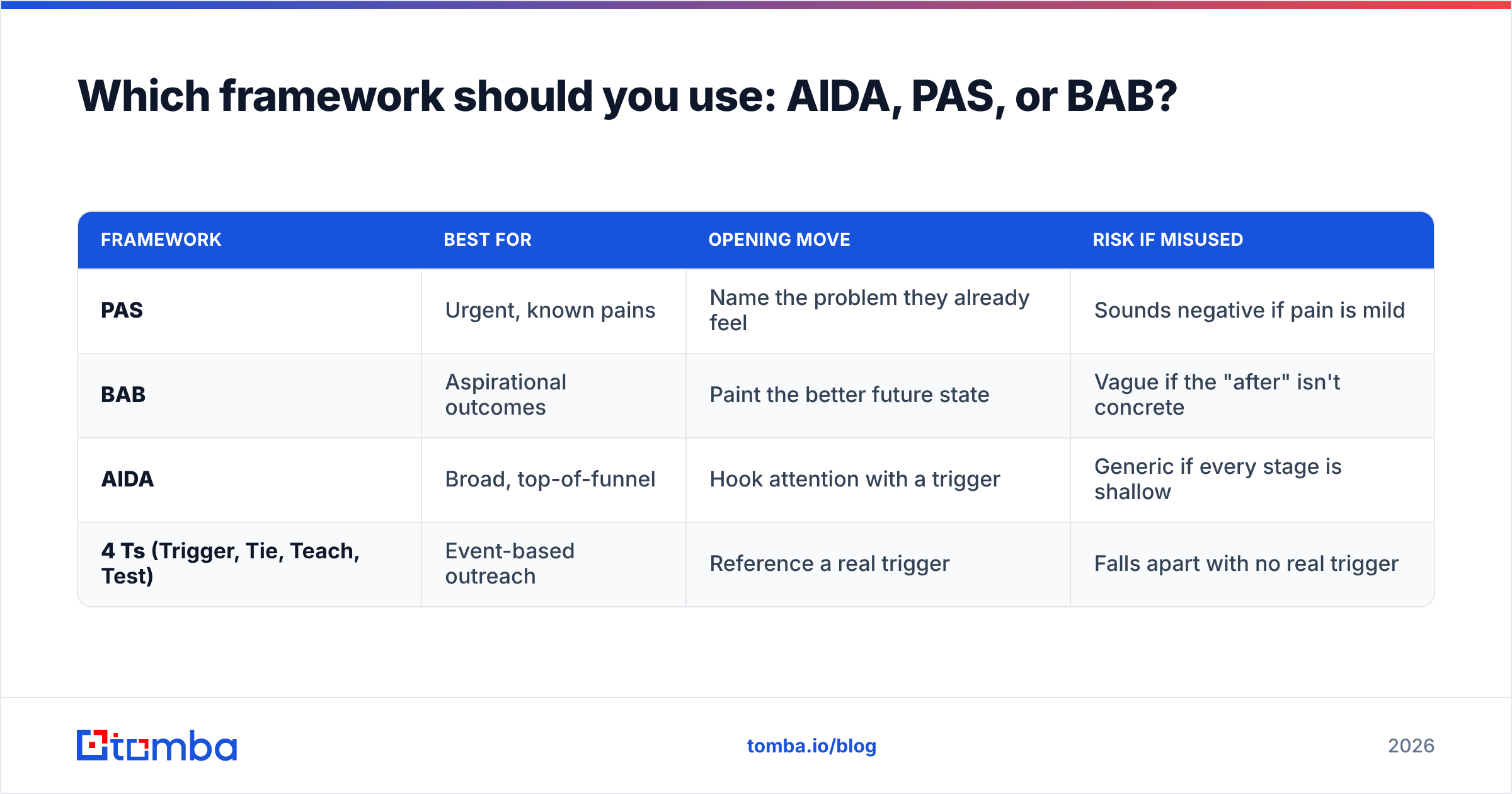
Use PAS (Problem–Agitate–Solution) for pain-driven sales and BAB (Before–After–Bridge) for transformation-driven sales; AIDA works as a general-purpose fallback. The right one depends on what your prospect feels most.
| Framework | Best for | Opening move | Risk if misused |
|---|---|---|---|
| PAS | Urgent, known pains | Name the problem they already feel | Sounds negative if pain is mild |
| BAB | Aspirational outcomes | Paint the better future state | Vague if the "after" isn't concrete |
| AIDA | Broad, top-of-funnel | Hook attention with a trigger | Generic if every stage is shallow |
| 4 Ts (Trigger, Tie, Teach, Test) | Event-based outreach | Reference a real trigger | Falls apart with no real trigger |
Don't overthink it. Pick one, write 20 emails with it, measure reply rates, then test a second framework against the first. The framework is scaffolding — the personalization is what actually moves the number. If you want a faster starting point, a library of proven cold email templates gives you structures to adapt rather than blank-page paralysis.
How important is the follow-up sequence?#
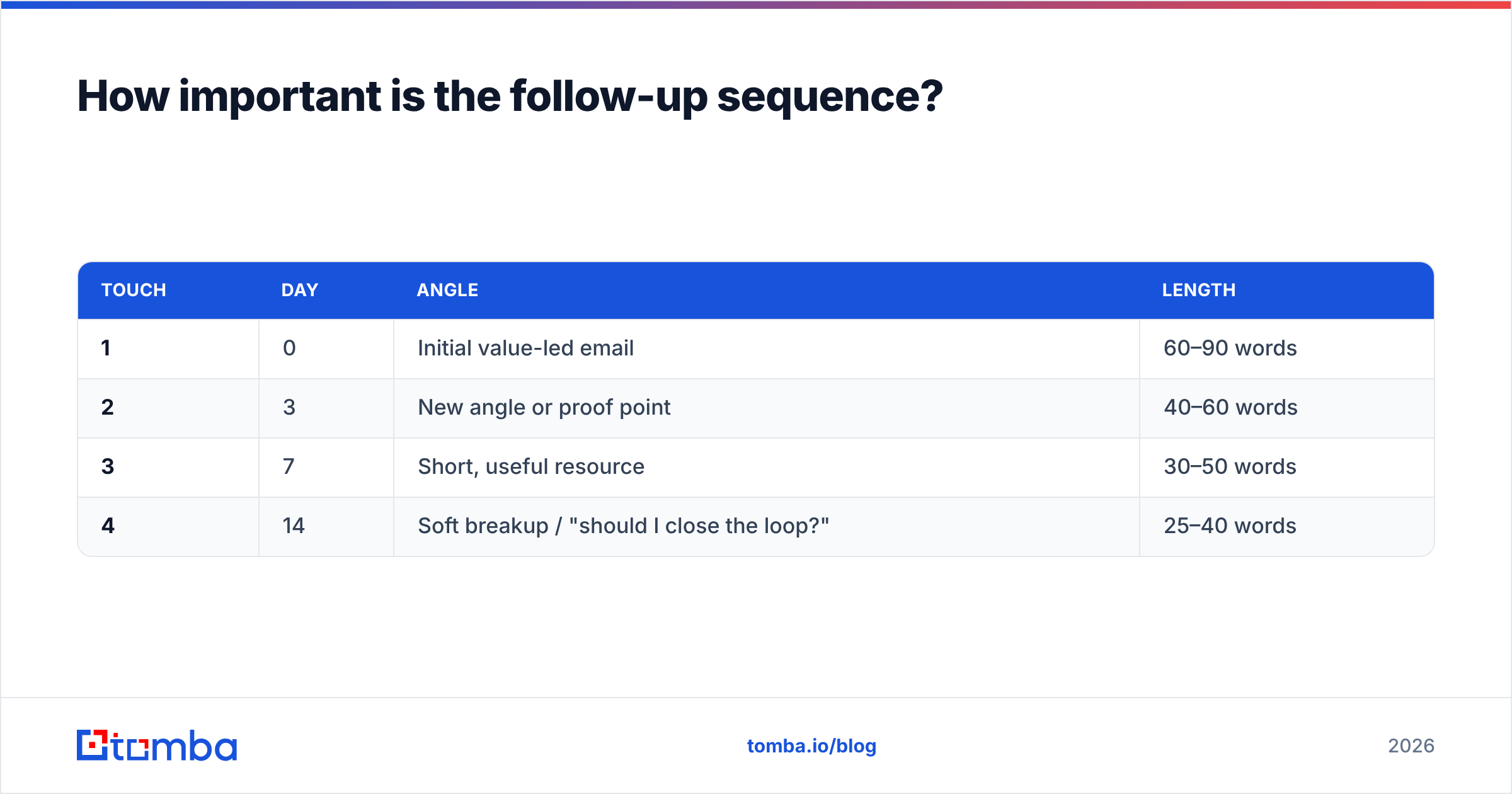
Follow-up is where the majority of your replies come from — typically more than half arrive after the first email. Treating outreach as a single send is the most common and most expensive mistake in client acquisition.
A sane 2026 cadence looks like this:
| Touch | Day | Angle | Length |
|---|---|---|---|
| 1 | 0 | Initial value-led email | 60–90 words |
| 2 | 3 | New angle or proof point | 40–60 words |
| 3 | 7 | Short, useful resource | 30–50 words |
| 4 | 14 | Soft breakup / "should I close the loop?" | 25–40 words |
Each follow-up must add something — a new angle, a relevant case study, a useful link — never just "bumping this to the top of your inbox." That phrase signals you have nothing new to say. The breakup email is quietly the highest performer in many sequences, because loss aversion is real: people who ignored four value emails will sometimes reply to "I'll assume the timing's off and stop reaching out" just to keep the door open.
Keep follow-ups in the same thread when possible, and cap the sequence. Sending touch number seven to someone who never engaged isn't persistence, it's a deliverability liability. If your reply data is consistently weak, the problem is usually upstream — targeting or data quality — not that you sent too few follow-ups.
What tools do you need to run this at scale?#
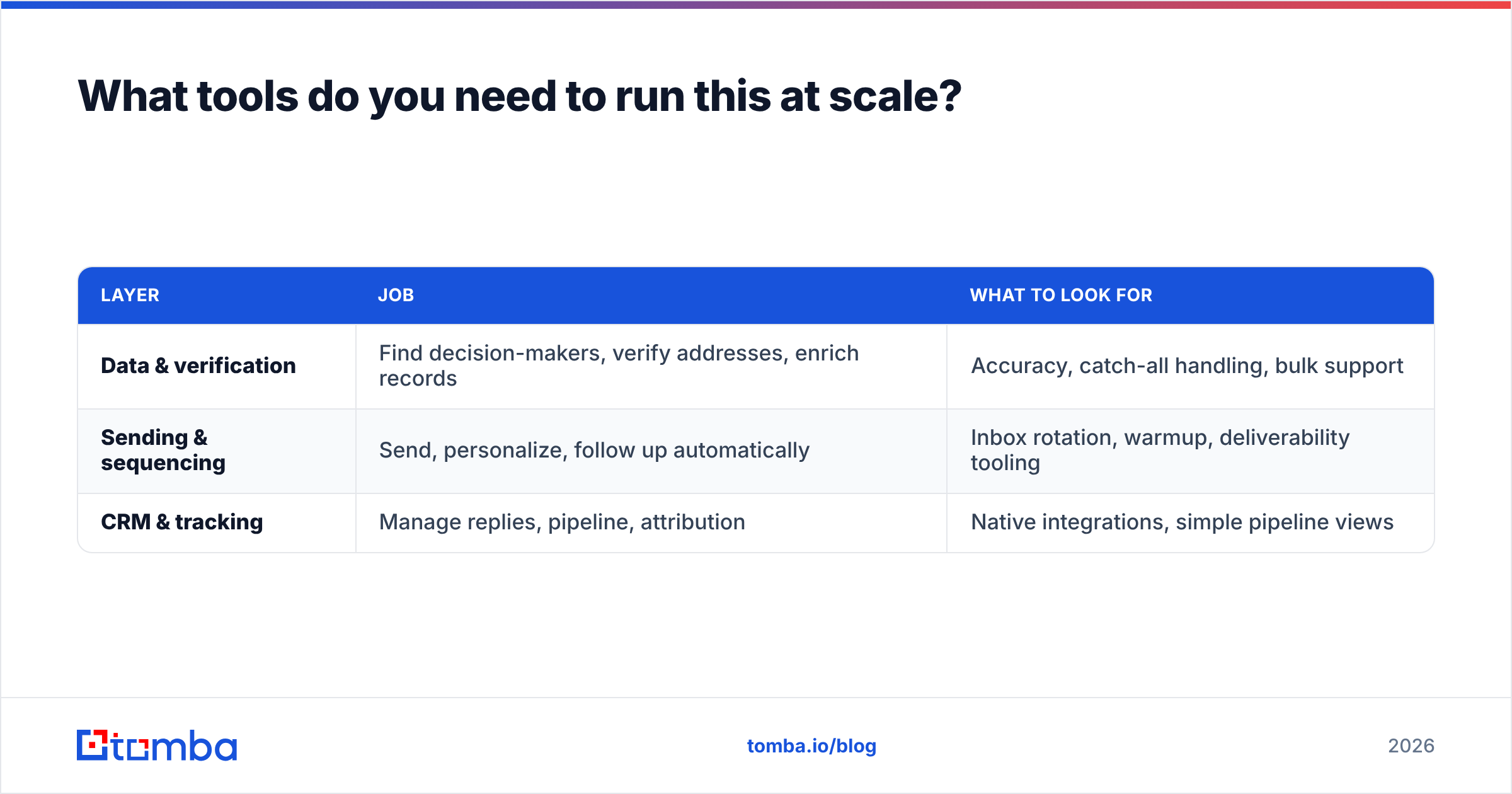
You need three categories of tool: a data source to find and verify contacts, a sending platform to sequence and personalize, and a CRM to track what happens next. Here's how the stack typically breaks down.
| Layer | Job | What to look for |
|---|---|---|
| Data & verification | Find decision-makers, verify addresses, enrich records | Accuracy, catch-all handling, bulk support |
| Sending & sequencing | Send, personalize, follow up automatically | Inbox rotation, warmup, deliverability tooling |
| CRM & tracking | Manage replies, pipeline, attribution | Native integrations, simple pipeline views |
For the data layer, accuracy is everything — a list that's 95% verified versus 80% verified is the difference between a healthy domain and a blacklisted one. Tomba covers finding and verifying in one place: the email finder for individual lookups, bulk email finder for whole account lists, and a catch-all verifier for those tricky domains that accept everything and confirm nothing. You can wire it into your existing workflow through Tomba's HubSpot integration or push results straight into a sheet.
Tomba's pricing scales with volume rather than locking core features behind a wall: a free tier with 25 searches a month to test, then $49/mo Starter, $99/mo Growth, and $249/mo Pro as your sending grows. You can see the full breakdown on the Tomba pricing page. Compared with bundled all-in-one platforms that charge for seats you won't use, paying for data accuracy specifically tends to be the better dollar when acquisition is your priority.
For the sending and CRM layers, established platforms like HubSpot handle sequencing and pipeline tracking well, and most teams already live in one. The point isn't to buy the most tools — it's to make sure each layer is genuinely good at its one job, with verified data feeding the whole thing.
How do you measure if your client acquisition emails are working?#
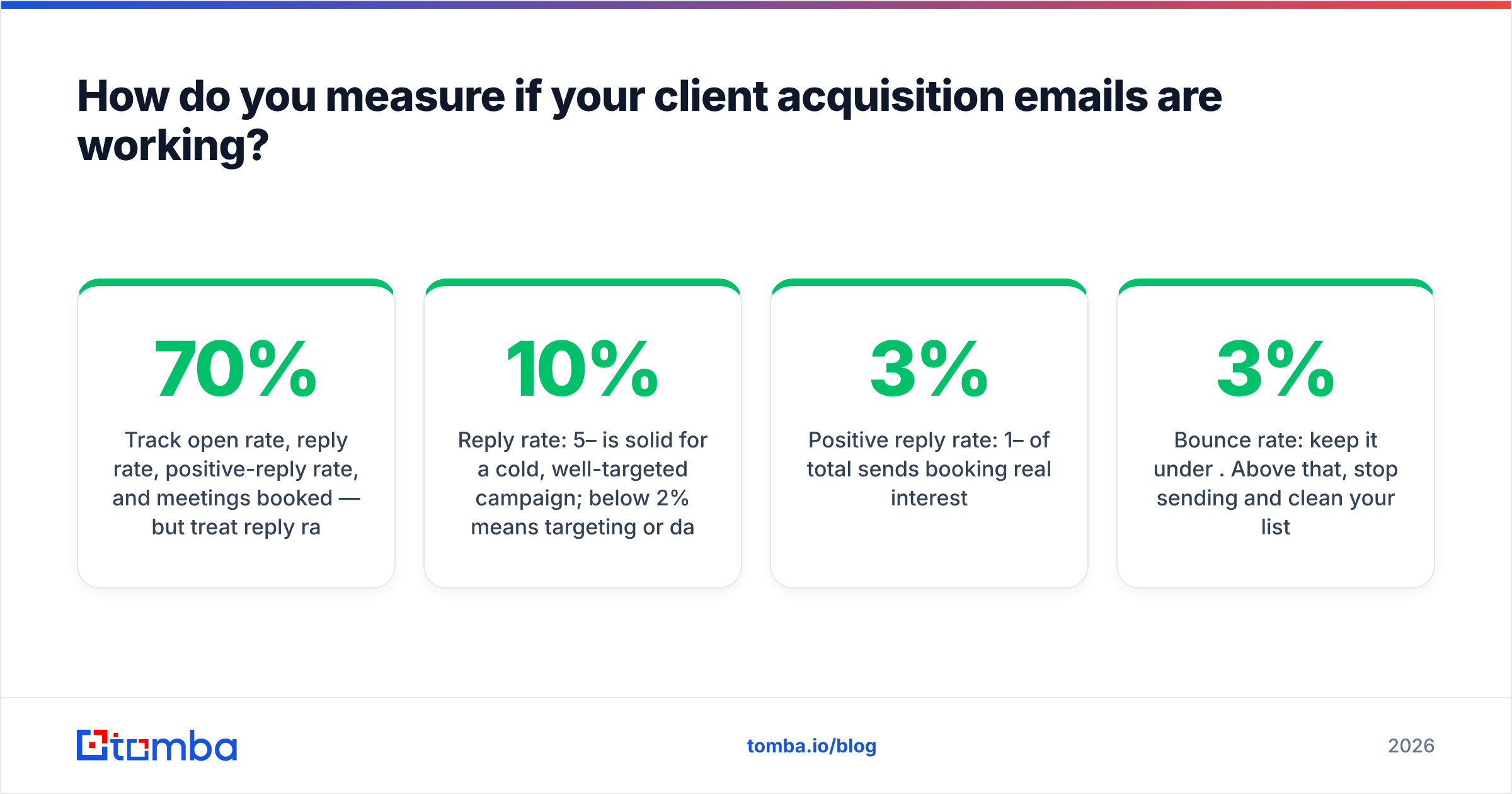
Track open rate, reply rate, positive-reply rate, and meetings booked — but treat reply rate and meetings as the real scoreboard. Opens have become unreliable since Apple Mail Privacy Protection started auto-loading tracking pixels, so a 70% "open rate" can be mostly noise.
Benchmarks worth aiming for in cold B2B acquisition:
- Reply rate: 5–10% is solid for a cold, well-targeted campaign; below 2% means targeting or data is broken.
- Positive reply rate: 1–3% of total sends booking real interest.
- Bounce rate: keep it under 3%. Above that, stop sending and clean your list.
- Meetings booked per 100 sends: the only metric that pays your bills.
When a campaign underperforms, diagnose in this order: deliverability first (are you even landing?), then targeting (right people?), then copy (last, despite being where everyone starts). A/B test one variable at a time — subject line or opener or ask — never all three at once, or you'll learn nothing.
If you want to dig into individual metrics, Tomba's glossary breaks down terms like response rate and sender reputation in plain language, and a sender reputation checker tells you whether your domain is healthy before you scale up volume.
What mistakes should you avoid in 2026?#
The fastest ways to torpedo a client acquisition campaign:
- Sending to unverified lists. One bad batch can blacklist your domain for weeks. Verify first, always.
- Over-personalizing the wrong things. Mentioning their dog from LinkedIn is creepy; mentioning their recent funding round is relevant.
- Writing for yourself, not them. If the first word is "I" or "We," rewrite it.
- No clear single ask. Two CTAs equals zero CTAs.
- Ignoring follow-up. One-and-done outreach wastes 70% of the replies you'd otherwise earn.
- Scaling before the message works. Prove a sequence converts on 50 prospects before blasting 5,000.
The teams that win at acquisition email in 2026 aren't sending more — they're sending better to fewer, righter people, with clean data underneath it all.
Start with the foundation that makes everything else work#
Great copy and smart sequencing are multipliers — but they multiply against zero if your contact data is wrong. Before you write a single subject line, make sure you're reaching real people at real addresses. Start free with the Tomba Email Finder: find verified decision-maker emails from a name and company, confirm they're deliverable, and build a target list that actually converts. Twenty-five searches a month costs nothing to test, and it's the difference between client acquisition emails that book meetings and ones that bounce. Build the list right, and the rest of the playbook finally pays off.
// get started
Find, verify and enrich your first contacts today
Start on the free plan with 25 searches a month, then scale when your team is ready.
Free plan · No credit card required · GDPR & CCPA
// about the author