Client Acquisition Rate: How to Measure & Improve It in 2026
Your client acquisition rate tells you how efficiently leads turn into paying customers. Here's how to calculate it, benchmark it, and lift it in 2026.
TL;DR
- Client acquisition rate is the percentage of qualified prospects who become paying clients over a set period:
(new clients ÷ qualified leads) × 100. - A "good" rate is relative — most B2B teams land between 1% and 5% at the top of funnel and 15%–30% from sales-qualified opportunity to close.
- The biggest lever is rarely the pitch. It's data quality, targeting, and speed-to-lead — the boring inputs that decide whether your funnel leaks.
- Dirty contact data quietly taxes every stage: bounced emails, wrong personas, and stale records drag your rate down before a rep ever talks to a buyer.
- Tools that find and verify accurate contact data — like a email finder and email verifier — raise the rate by feeding clean inputs into the top of the funnel.
What is client acquisition rate?#
Client acquisition rate is the share of qualified prospects who turn into paying clients in a given window. Think of it like a restaurant's table-turn rate: you can have a packed waiting list (leads), but what matters is how many of those waiting parties actually get seated, order, and pay (clients). A long line means nothing if half the guests leave before sitting down.
Technically, it's a conversion ratio that measures funnel efficiency between two defined points — usually qualified lead to closed-won. It answers one blunt question: of the people worth pursuing, how many did we actually win?
The formula is simple:
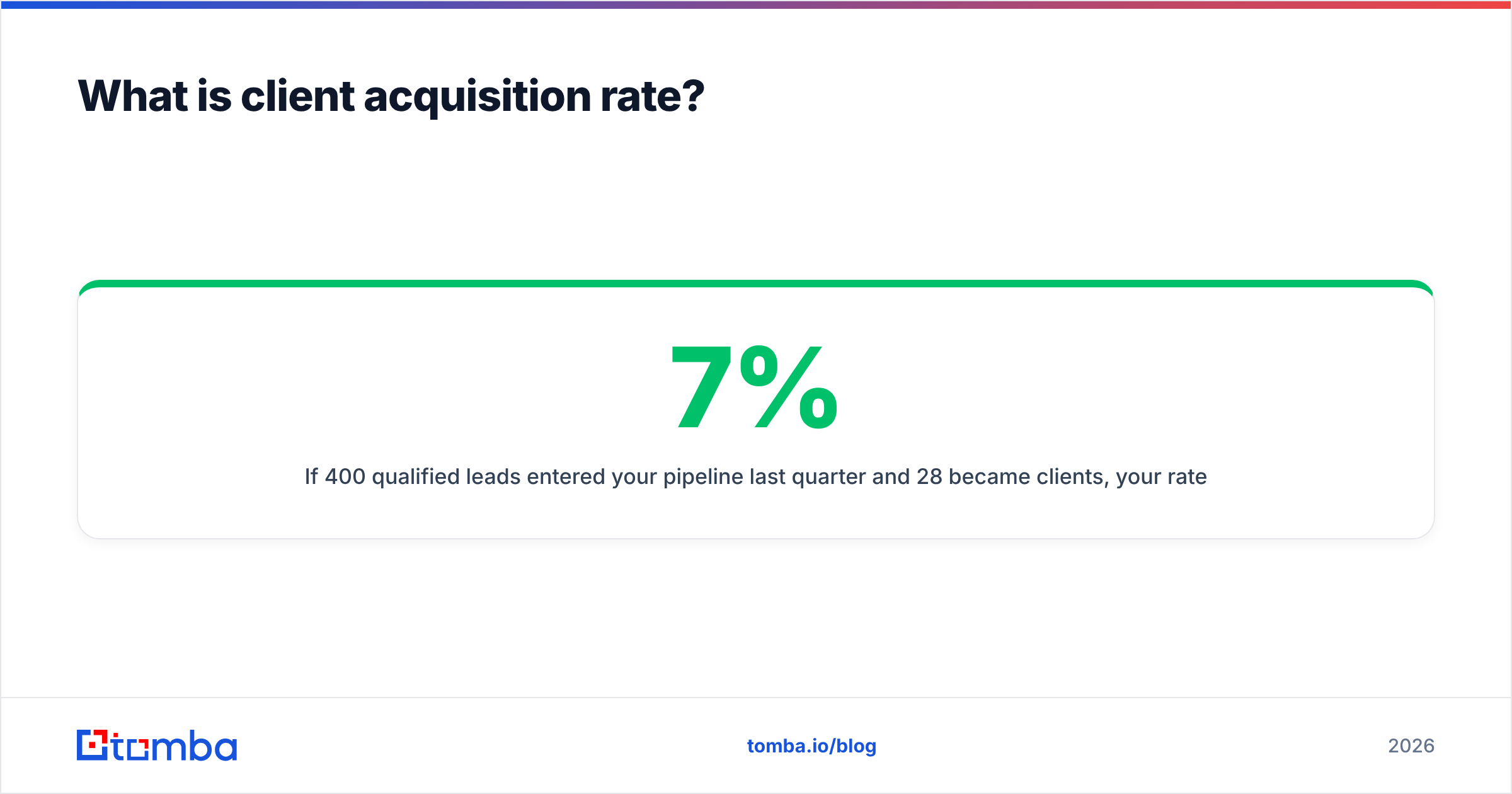
Client Acquisition Rate = (New Clients ÷ Qualified Leads) × 100If 400 qualified leads entered your pipeline last quarter and 28 became clients, your rate is 7%. The number itself is less useful than the trend and the segment. A 7% blended rate can hide a 14% rate from referrals and a 2% rate from cold outbound — and you'd want to know that before doubling your ad spend.
How do you calculate client acquisition rate correctly?#
Most teams calculate it wrong by being sloppy about the denominator. "Leads" is not one thing. Be explicit about which stage you're measuring, because the rate changes dramatically depending on where you start counting.
Here are the four most common variants, and when each one matters:
- Lead-to-client rate — every raw inbound or sourced contact divided by clients won. Useful for marketing efficiency, but noisy because it includes unqualified junk.
- MQL-to-client rate — starts from a marketing qualified lead. Cleaner, because it filters out people who'll never buy.
- SQL-to-client rate — starts from a sales-qualified opportunity. This is the number most sales leaders care about, since it isolates closing skill and fit.
- Cohort acquisition rate — tracks a fixed group of leads from a single month or campaign through to close, so you don't mix fast and slow deals in the same bucket.
Pick one primary definition, document it, and keep it stable. The classic mistake is changing the denominator mid-year and then celebrating a "30% improvement" that's really just a math change. Consistency beats cleverness here.
)
A second trap is timing. Deals don't close the same week they enter the funnel, so a naive "this month's clients ÷ this month's leads" understates your rate when you're growing and overstates it when you're shrinking. Use cohorts, or at least lag the denominator by your average sales-cycle length.
What is a good client acquisition rate in 2026?#
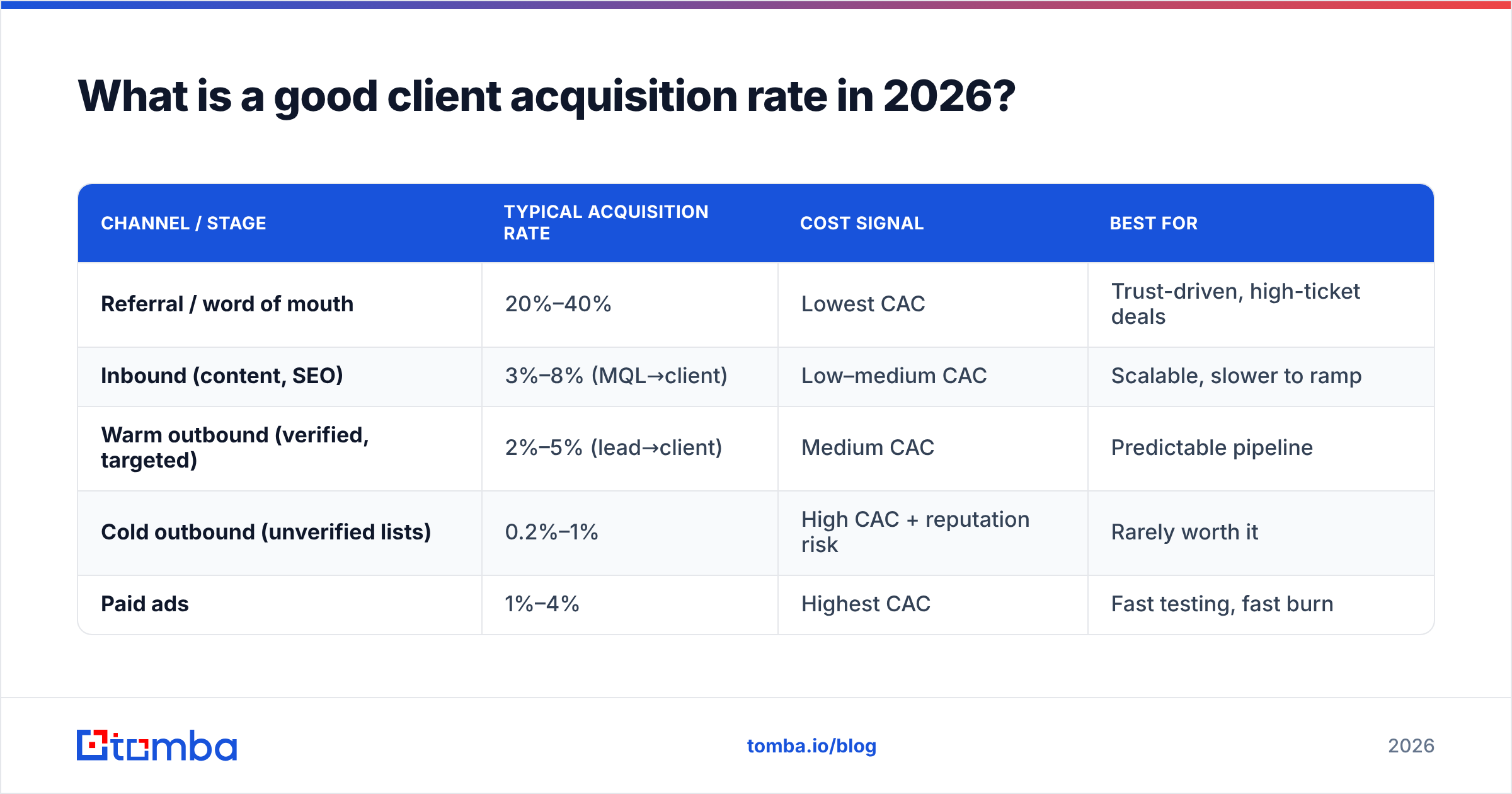
There's no universal benchmark — it depends on channel, deal size, and motion. A self-serve $30/month product and a $90k enterprise contract live in different universes. That said, here are realistic ranges B2B teams see across channels in 2026.
| Channel / stage | Typical acquisition rate | Cost signal | Best for |
|---|---|---|---|
| Referral / word of mouth | 20%–40% | Lowest CAC | Trust-driven, high-ticket deals |
| Inbound (content, SEO) | 3%–8% (MQL→client) | Low–medium CAC | Scalable, slower to ramp |
| Warm outbound (verified, targeted) | 2%–5% (lead→client) | Medium CAC | Predictable pipeline |
| Cold outbound (unverified lists) | 0.2%–1% | High CAC + reputation risk | Rarely worth it |
| Paid ads | 1%–4% | Highest CAC | Fast testing, fast burn |
Two takeaways. First, referrals crush everything on rate and cost — which is why retention and advocacy belong in any acquisition conversation. Second, the gap between "warm verified outbound" and "cold unverified outbound" is enormous: roughly a 5–10x difference driven almost entirely by data quality and targeting, not by reps suddenly getting better at talking.
For a sanity check on your own numbers, compare against published funnel benchmarks from sources like HubSpot's research and analyst data from Gartner. Use them as direction, not gospel — your ICP and price point will move the goalposts.
Why is your client acquisition rate lower than it should be?#
The rate is usually capped by inputs, not effort. Before you rewrite scripts or retrain the team, audit the four most common leaks:
- Bad data at the top. If 20%–30% of your contact list bounces or routes to the wrong person, you've thrown away a third of your funnel before the first touch. Bounces also wreck your sender reputation, which quietly suppresses every future email.
- Wrong-fit targeting. Volume hides a multitude of sins. Pumping 5,000 poorly matched contacts into outreach produces a big top-of-funnel number and a tiny acquisition rate. Fewer, better-fit prospects almost always win.
- Slow follow-up. Speed-to-lead is one of the most reliable predictors of conversion. A lead contacted within five minutes converts at multiples of one contacted the next day. Most teams measure pipeline obsessively and ignore response latency entirely.
- No verification step. Sending to unverified addresses spikes bounces, gets your domain flagged, and lands real prospects in spam — so even your perfect-fit buyers never see the message.
Notice that three of those four are data problems, not selling problems. That's the uncomfortable truth: your acquisition rate is often decided in a spreadsheet long before a rep opens their inbox.
)
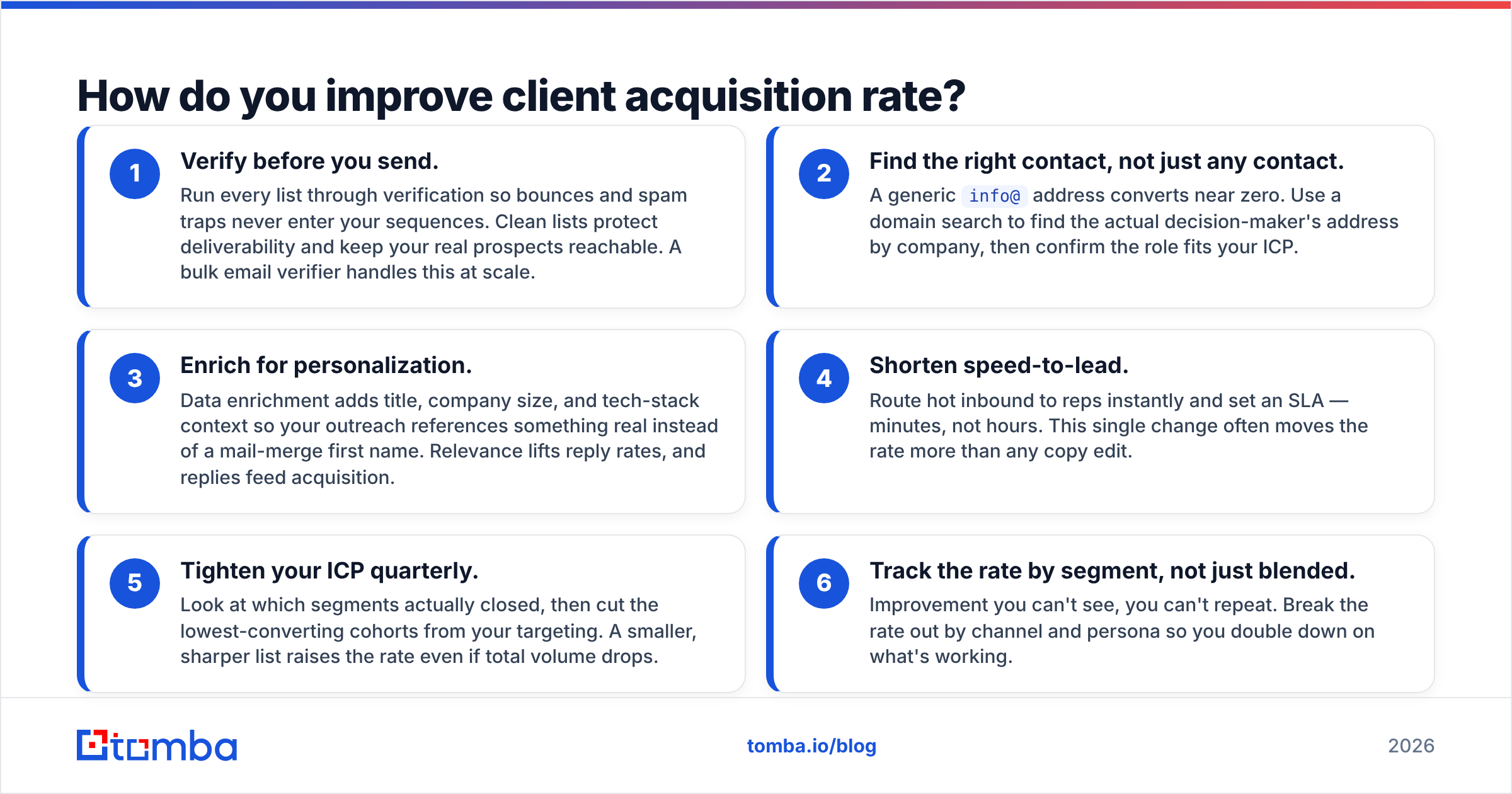
How do you improve client acquisition rate?#
Fix the inputs first, then optimize the conversation. Improvement compounds when you attack the funnel in the right order — clean data, then sharp targeting, then fast and relevant follow-up.
Here's a practical playbook, sequenced by leverage:
- Verify before you send. Run every list through verification so bounces and spam traps never enter your sequences. Clean lists protect deliverability and keep your real prospects reachable. A bulk email verifier handles this at scale.
- Find the right contact, not just any contact. A generic
info@address converts near zero. Use a domain search to find the actual decision-maker's address by company, then confirm the role fits your ICP. - Enrich for personalization. Data enrichment adds title, company size, and tech-stack context so your outreach references something real instead of a mail-merge first name. Relevance lifts reply rates, and replies feed acquisition.
- Shorten speed-to-lead. Route hot inbound to reps instantly and set an SLA — minutes, not hours. This single change often moves the rate more than any copy edit.
- Tighten your ICP quarterly. Look at which segments actually closed, then cut the lowest-converting cohorts from your targeting. A smaller, sharper list raises the rate even if total volume drops.
- Track the rate by segment, not just blended. Improvement you can't see, you can't repeat. Break the rate out by channel and persona so you double down on what's working.
The throughline: better data makes every downstream step work harder. You can't out-pitch a list of wrong people at dead addresses.
How does contact-data tooling fit in?#
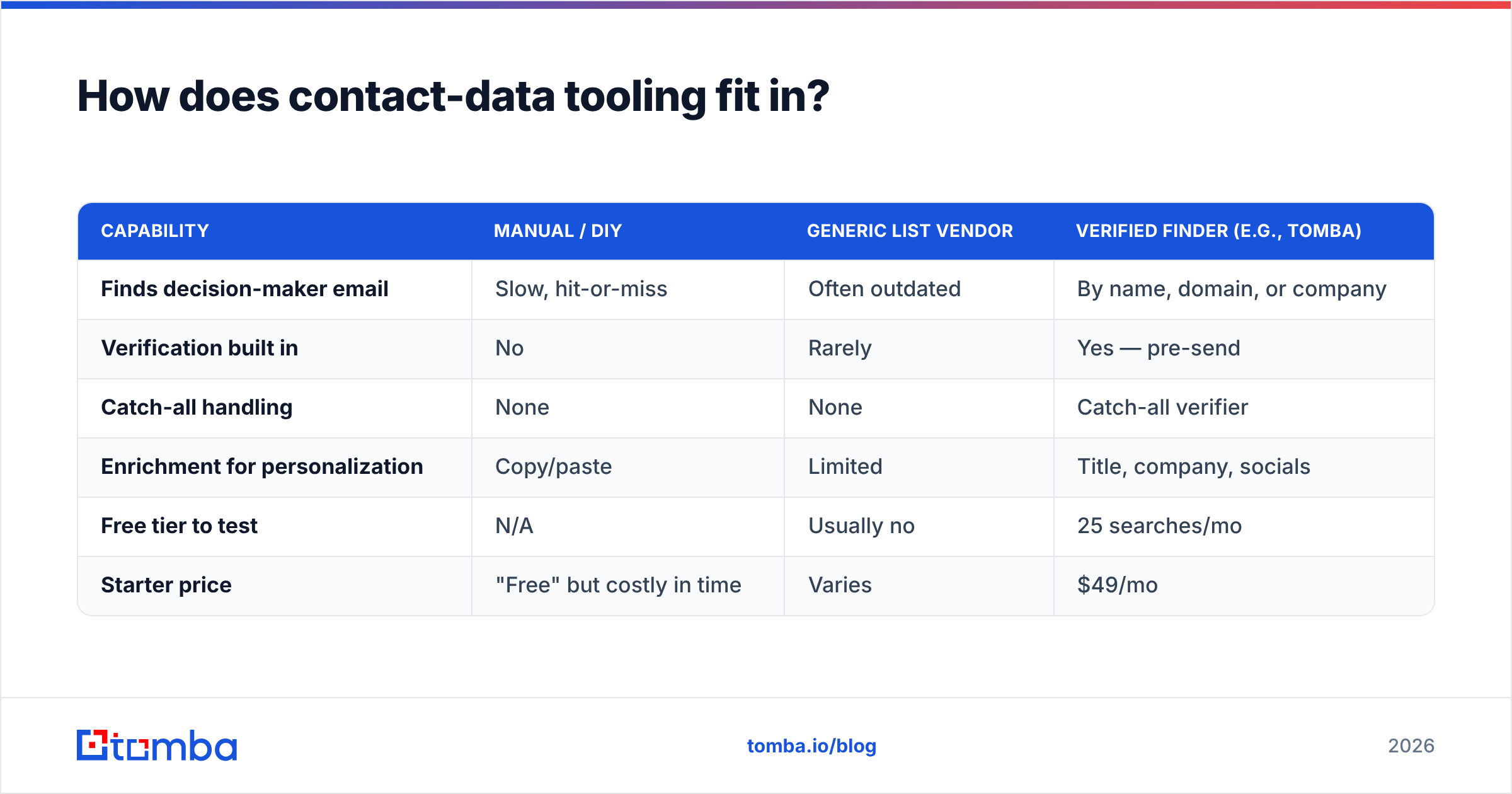
Tooling lifts acquisition rate by improving the inputs to the funnel, not by replacing your sales process. The right stack finds accurate decision-maker contacts, verifies them, and enriches them — so reps spend time selling instead of chasing dead ends. Here's how the categories compare on what actually moves the rate.
| Capability | Manual / DIY | Generic list vendor | Verified finder (e.g., Tomba) |
|---|---|---|---|
| Finds decision-maker email | Slow, hit-or-miss | Often outdated | By name, domain, or company |
| Verification built in | No | Rarely | Yes — pre-send |
| Catch-all handling | None | None | Catch-all verifier |
| Enrichment for personalization | Copy/paste | Limited | Title, company, socials |
| Free tier to test | N/A | Usually no | 25 searches/mo |
| Starter price | "Free" but costly in time | Varies | $49/mo |
The point isn't that a tool magically closes deals. It's that the cheapest way to raise your acquisition rate is usually to stop wasting the top of your funnel on bounces and wrong personas. When the contacts entering your pipeline are accurate, verified, and well-matched, the same team converts more of them — that's the whole game.
You can see full plan details on the Tomba pricing page, including the free tier worth testing before you commit budget.
How do you track client acquisition rate over time?#
Set up a simple, stable dashboard and resist the urge to redefine it. A useful tracking setup has four parts:
- A locked definition — one primary rate (e.g., SQL-to-client), documented so everyone calculates it the same way.
- Cohort views — group leads by entry month so slow deals don't distort the current period.
- Segment splits — channel, persona, and deal size, because the blended number hides your best and worst motions.
- A leading indicator — pair the lagging acquisition rate with something faster, like reply rate or speed-to-lead, so you spot trouble before the quarterly close.
Pair this with your win rate and customer acquisition cost. Acquisition rate tells you how many convert; CAC tells you what it cost; win rate tells you how well you close what you pursue. Together they keep you from optimizing one number at the expense of the others — for example, juicing rate by only chasing tiny easy deals that wreck your economics. For deeper definitions of these metrics, Salesforce's sales glossary is a solid reference.
What's the fastest win for most teams?#
Clean your data and contact the right person, fast. If you do nothing else from this article, do that. Most acquisition-rate problems trace back to two failures: reaching the wrong people, and reaching the right people at the wrong (dead) address. Both are fixable in a week, not a quarter.
Start by verifying your existing list, finding the actual decision-makers you've been missing, and routing hot leads to reps in minutes. Those three moves consistently outperform script rewrites and new ad creative — because they fix the funnel's inputs instead of polishing its middle.
If your acquisition rate has plateaued and you suspect bad data is the culprit, start at the source. The Tomba Email Finder finds verified, decision-maker email addresses by name, domain, or company — and the free tier (25 searches a month) is enough to test whether cleaner inputs lift your rate before you spend a dollar. Find the right people, verify them, and let your existing process do what it already does well. That's how you move the number that matters.
// get started
Find, verify and enrich your first contacts today
Start on the free plan with 25 searches a month, then scale when your team is ready.
Free plan · No credit card required · GDPR & CCPA
Get the Tomba newsletter
Product and data updates
// about the author