Clodura.ai vs Findymail 2026: Which Email Finder Wins?
Clodura.ai bundles a B2B database with sequences; Findymail is a lean, accuracy-first email finder. Here's an honest 2026 breakdown of pricing, data, and which one fits your outbound stack.
Clodura.ai vs Findymail: The Honest 2026 Comparison
The Cloduraai vs Findymail choice comes down to one question. Do you want an all-in-one sales platform with a built-in database? Or a focused tool that does one job — finding verified emails — without the bloat? The two sit at opposite ends of the email-finding market. Pick the wrong one, and you waste both budget and deliverability.
TL;DR — Clodura.ai vs Findymail at a glance#
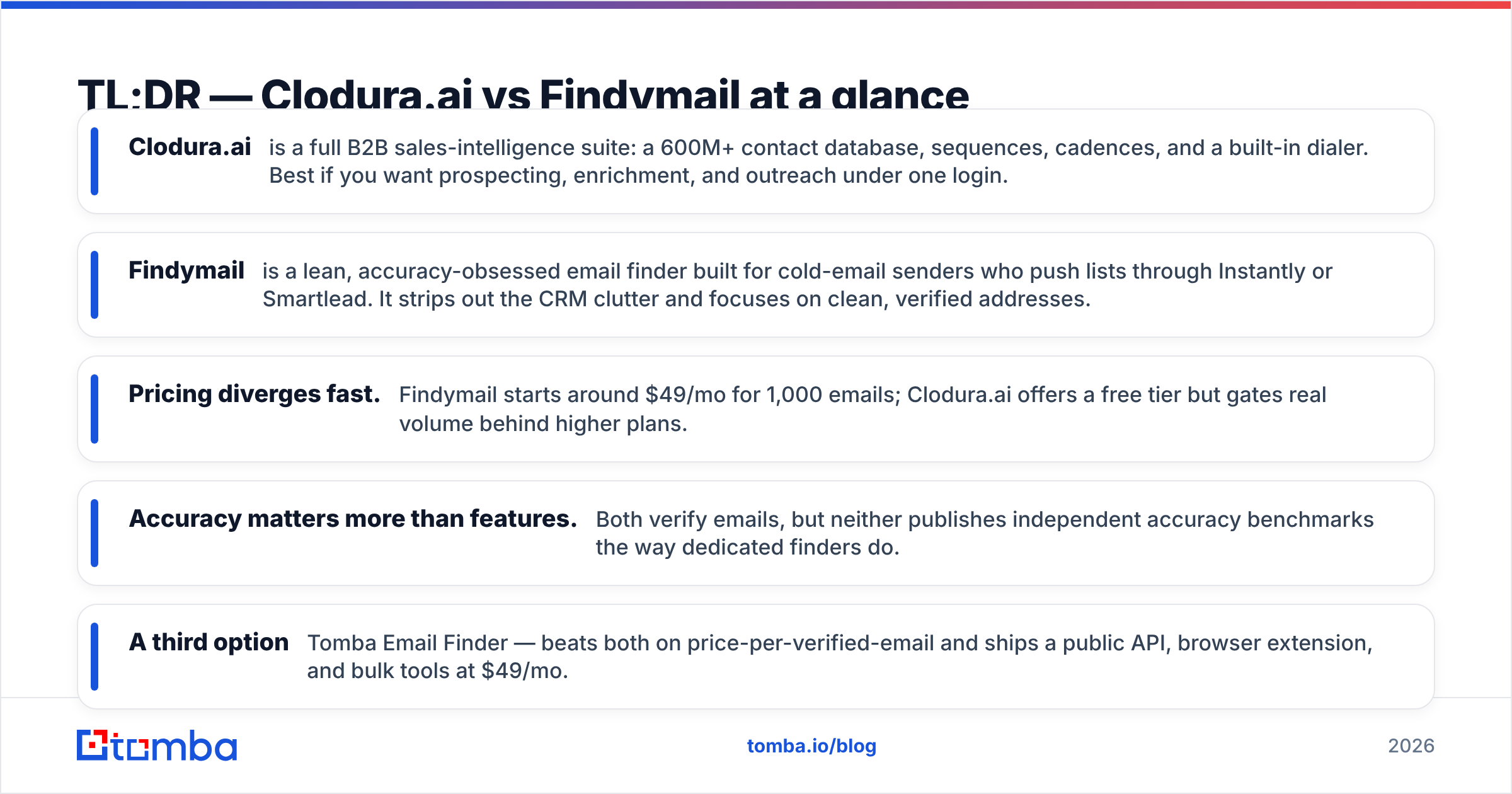
- Clodura.ai is a full B2B sales-intelligence suite. It packs a 600M+ contact database, sequences, cadences, and a built-in dialer. Pick it if you want prospecting, enrichment, and outreach under one login.
- Findymail is a lean, accuracy-first email finder. It targets cold-email senders who push lists through Instantly or Smartlead. It drops the CRM clutter and focuses on clean, verified addresses.
- Pricing diverges fast. Findymail starts around $49/mo for 1,000 emails. Clodura.ai offers a free tier but gates real volume behind higher plans.
- Accuracy matters more than features. Both verify emails. But neither publishes independent accuracy benchmarks the way dedicated finders do.
- A third option — Tomba Email Finder — beats both on price-per-verified-email. It ships a public API, browser extension, and bulk tools at $49/mo.
What is Clodura.ai and who is it for?#
Clodura.ai is a sales-intelligence platform, not just an email finder. Think of it like a Swiss Army knife. The email-finding blade is one of many tools folded into a single handle. It also includes a prospect database, email sequences, a meeting scheduler, and a sales-cadence engine.
Its core pitch is the built-in database. That's roughly 600 million B2B contacts and 120 million direct dials, according to the company. The data is paired with technographic and intent signals. You search the database, build a list, and launch outreach without leaving the app. For a small team that wants to avoid five separate subscriptions, that consolidation is the main draw.
The trade-off is depth versus focus. Clodura.ai spreads engineering across sequences, dialers, and analytics. So its email-verification layer is one feature among many, not the whole product. Maybe your only need is "give me a correct email for this person." If so, you may be paying for a dashboard full of features you never open.

What is Findymail and who is it for?#
Findymail takes the opposite approach: do one thing well. It's an email finder built for cold-email operators. They care about list hygiene because their sender reputation depends on it. The product centers on a verification engine. The company claims it keeps bounce rates low. It also ships native integrations with Smartlead, Instantly, and Lemlist.
If Clodura.ai is a Swiss Army knife, Findymail is a chef's knife — narrow, sharp, and built for one motion. You upload a list of names and domains, or scrape from LinkedIn Sales Navigator with its extension. Findymail then returns verified emails, ready to drop into a sending platform. There's no dialer, no CRM, no intent data. That's the point.
This focus appeals to agencies and lead-gen shops that run high-volume campaigns. For them, a 3% bounce rate can blacklist a domain. The downside is simple. You still need a separate database or scraping source to find prospects first, because Findymail is a finder, not a discovery engine.
Cloduraai vs Findymail: full feature and pricing comparison#
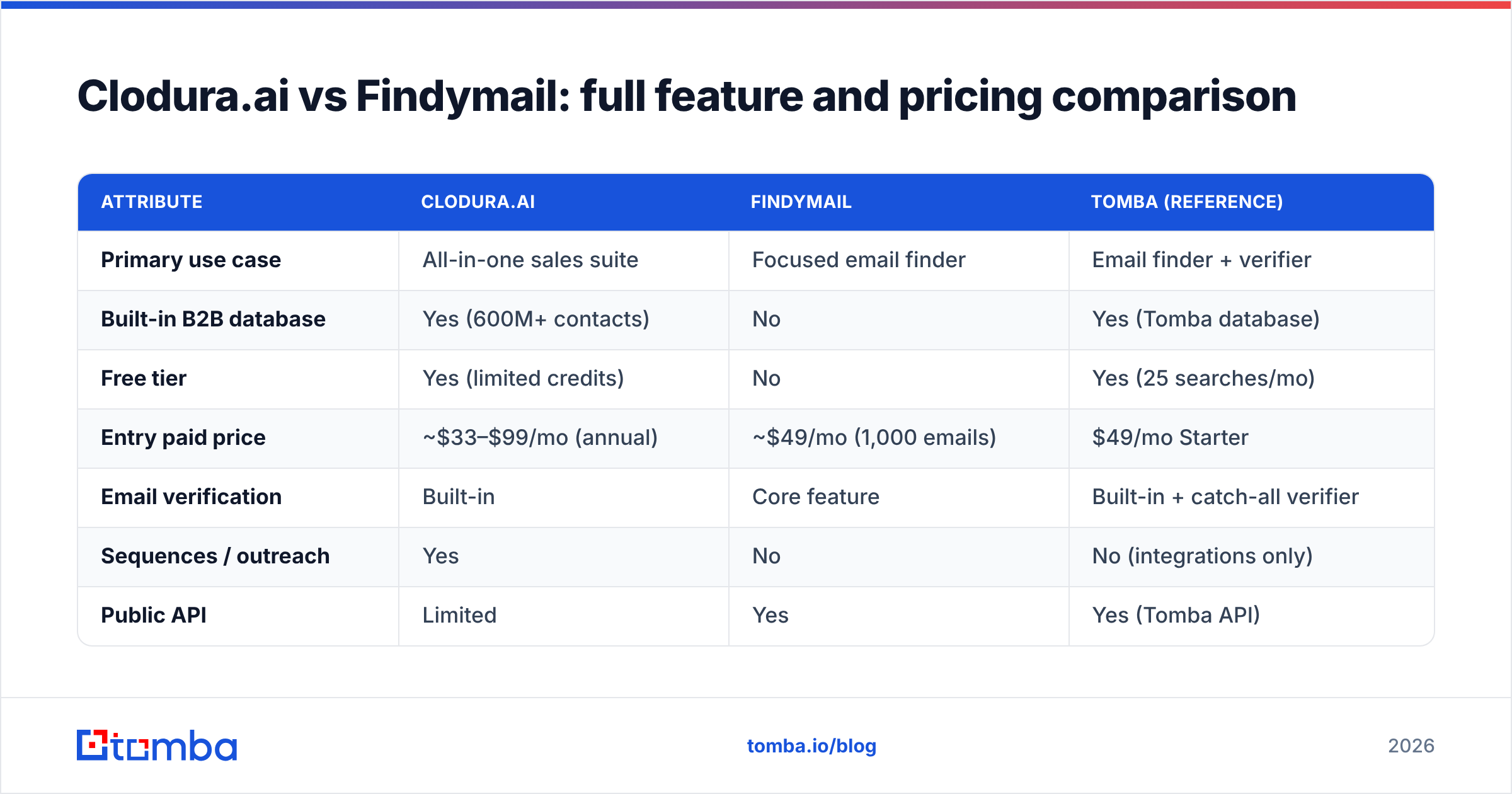
Here's where the two tools actually differ. Pricing reflects publicly listed plans as of 2026. Always confirm on each vendor's site before buying, since tiers shift.
| Attribute | Clodura.ai | Findymail | Tomba (reference) |
|---|---|---|---|
| Primary use case | All-in-one sales suite | Focused email finder | Email finder + verifier |
| Built-in B2B database | Yes (600M+ contacts) | No | Yes (Tomba database) |
| Free tier | Yes (limited credits) | No | Yes (25 searches/mo) |
| Entry paid price | ~$33–$99/mo (annual) | ~$49/mo (1,000 emails) | $49/mo Starter |
| Email verification | Built-in | Core feature | Built-in + catch-all verifier |
| Sequences / outreach | Yes | No | No (integrations only) |
| Public API | Limited | Yes | Yes (Tomba API) |
| Browser extension | Yes | Yes (Sales Nav) | Yes (Chrome extension) |
| Bulk processing | Yes | Yes | Yes (bulk email finder) |
| Best for | Teams wanting one platform | Cold-email agencies | API-first + lean teams |
The pattern is clear. Clodura.ai wins on breadth — you get discovery, enrichment, and sending in one subscription. Findymail wins on simplicity and list cleanliness. Both lag dedicated finders in one area: transparent, published accuracy data and per-credit value at the entry tier.
Is Clodura.ai or Findymail more accurate?#
Accuracy is the metric that actually decides your bounce rate. It's also the hardest to verify from marketing pages. Both vendors verify emails before returning them. But neither publishes an independent, third-party accuracy benchmark you can audit.

Here's the practical reality. Clodura.ai's accuracy is tied to how fresh its database records are. Large databases drift as people change jobs. So a contact that was correct last quarter may bounce today. Findymail's accuracy comes from real-time verification at lookup time. That tends to produce cleaner lists — but only for prospects you already have names and domains for.
The honest test is your own. Pull 100 known contacts and run them through each tool. Measure how many returned addresses are correct, how many are "guesses," and how many bounce when you send. Some tools return a confidence score and separate verified from catch-all addresses, the way an email verifier does. That gives you far more control than a binary "found / not found" result.
One more accuracy trap is catch-all domains. Many B2B domains accept every address at the SMTP layer. So a naive verifier marks them "valid" when they may still bounce. Tools with a dedicated catch-all finder flag these. Then you can route them to a slower, safer warmup track instead of blasting them.
How do the data sources differ?#
This is the structural difference between the two products. Clodura.ai owns and maintains its own database. It's a discovery engine first, so it has to source, store, and refresh hundreds of millions of records. Findymail keeps no searchable database. It finds and verifies on demand from the inputs you provide.
That difference dictates workflow:
- With Clodura.ai, you start inside the tool. Search by title, industry, geography, or technographic filter, build a list, then enrich and verify. Discovery and finding happen together.
- With Findymail, you start outside the tool. Scrape Sales Navigator, export a CRM list, or pull a prospect file, then feed it in for finding and verification. Discovery happens elsewhere.
- With a finder like Tomba, you can do either. Search by company with domain search, or feed names through the API and extension. The data provenance is documented at where Tomba gets data.
If your team has no prospect source, Clodura.ai's bundled database saves you a step. If you already scrape or buy lists, Findymail's pay-for-what-you-verify model is leaner and usually cheaper at volume.
Which tool is better for cold email deliverability?#
For pure deliverability, Findymail's narrow focus gives it an edge. Verification is its entire reason to exist. Clean lists protect sender reputation, and Findymail was built around that single promise.
That said, deliverability is bigger than any finder. No tool fixes a cold domain with bad SPF/DKIM records or a missing warmup schedule — not these two, not any. Pair whichever finder you choose with proper authentication and a warmup ramp. The finder's job ends when it hands you a verified address. For the downstream side, see how reputation and authentication interact in the email deliverability fundamentals.
The honest takeaway: both tools beat guessing email patterns by hand. But a verified list is the floor, not the ceiling. Authentication, a steady sending ramp, and content quality carry the rest.
Cloduraai vs Findymail: pros and cons#
Clodura.ai — pros
- One subscription covers discovery, enrichment, sequences, and dialing.
- Large built-in database removes the need for a separate prospecting source.
- Intent and technographic signals help prioritize accounts.
Clodura.ai — cons
- You pay for features you may never use if you only need emails.
- Database freshness varies; older records drift and bounce.
- The learning curve is steeper than a single-purpose finder.
Findymail — pros
- Accuracy-first verification keeps bounce rates low.
- Clean, native integrations with Instantly, Smartlead, and Lemlist.
- Simple, predictable pricing tied to emails verified.
Findymail — cons
- No built-in database — you must source prospects elsewhere.
- No outreach, CRM, or dialer; it's a finder only.
- No free tier to test before committing.
How does Tomba compare to both?#
Maybe you want Findymail's accuracy focus but Clodura.ai's database and API access — without either one's gaps. Then Tomba is worth a direct look. It sits in the middle: a dedicated finder and verifier with its own data, a public API, and a genuine free tier.
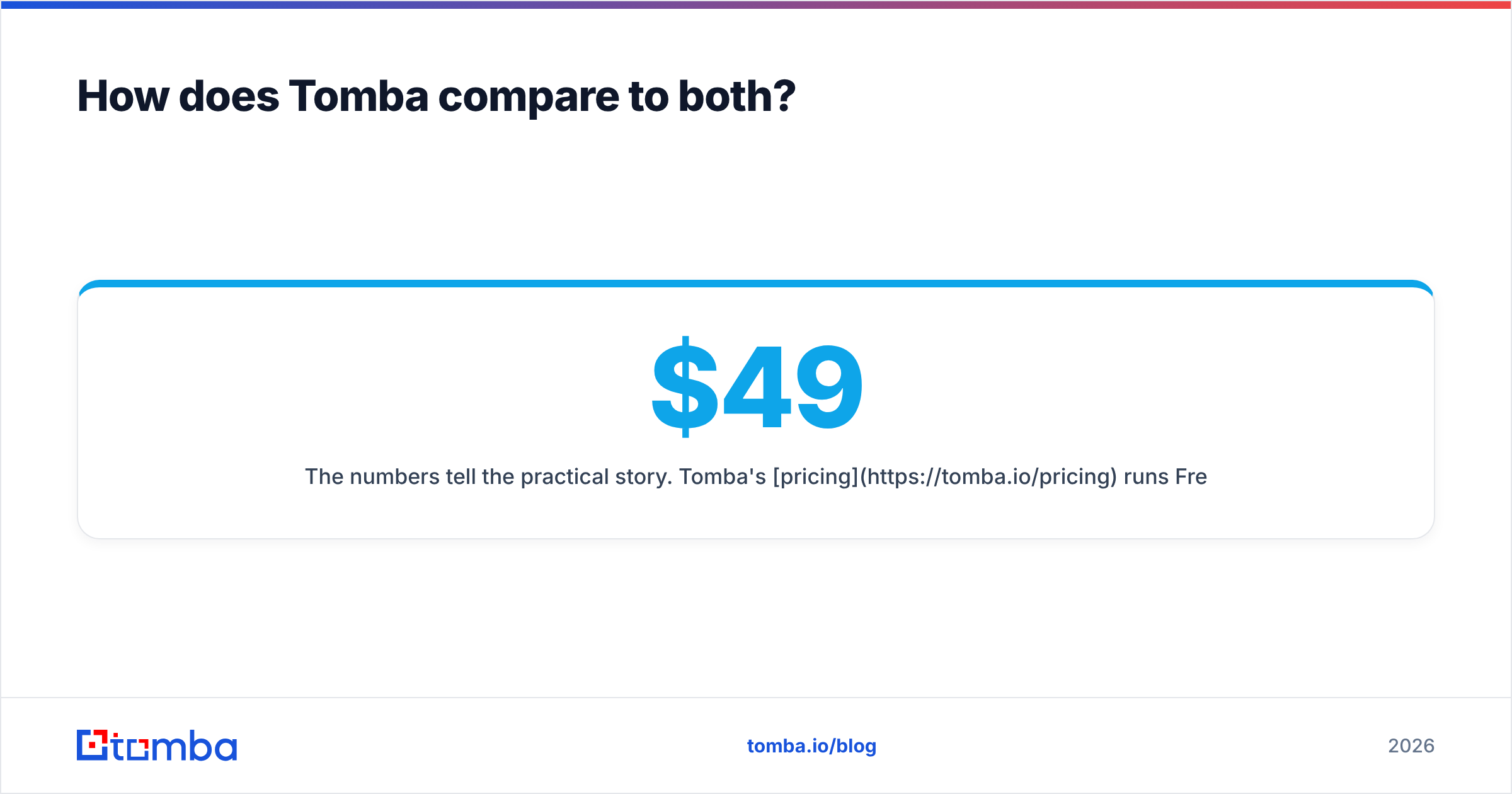
The numbers tell the practical story. Tomba's pricing runs Free (25 searches/mo), Starter $49/mo, Growth $99/mo, and Pro $249/mo, plus custom Enterprise plans. That entry price matches Findymail. It also includes a verifier, domain search, bulk tools, and a Chrome extension in the same plan. And unlike Findymail, there's a free tier to test accuracy on your own list before paying.

Against Clodura.ai, Tomba trades the dialer and sequence engine for a sharper finding-and-verifying core. It also adds a documented email finder API that drops into your own stack. Say your team already owns a CRM and a sending platform and just needs a reliable address-finding layer. Then Tomba is the cleaner fit.
You can cross-check all three on independent review sites like G2 before deciding. Real user reviews surface support quality and edge-case bounce rates that vendor pages never mention. Also confirm current plans directly on Clodura.ai and Findymail, since tiers and credit limits change quarter to quarter.
Which should you choose?#
Decide by your starting point, not by feature count:
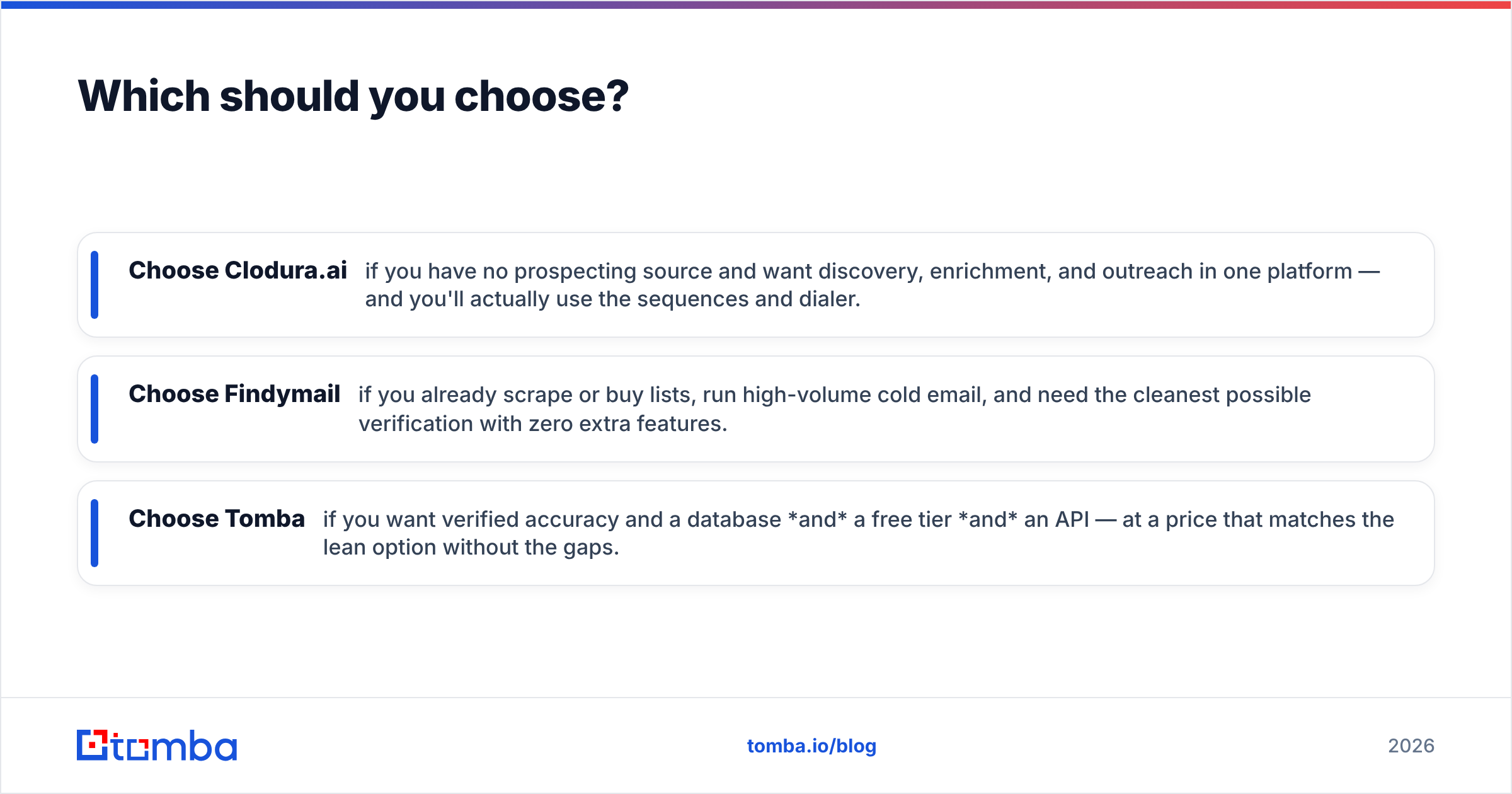
- Choose Clodura.ai if you have no prospecting source and want discovery, enrichment, and outreach in one platform — and you'll actually use the sequences and dialer.
- Choose Findymail if you already scrape or buy lists, run high-volume cold email, and need the cleanest possible verification with zero extra features.
- Choose Tomba if you want verified accuracy, a database, a free tier, and an API — at a price that matches the lean option without the gaps.
The worst outcome is paying suite prices for a finder feature. The second worst is paying finder prices and still needing a separate database. Map the tool to the job, run a 100-contact accuracy test on real data, and let bounce rate — not the feature list — make the call.
Start finding verified emails free#
If you want to test accuracy before committing a dollar, start with the Tomba Email Finder. The free tier gives you 25 searches a month. That's enough to run a side-by-side accuracy test against Clodura.ai and Findymail on your own prospect list. Find emails by name, company, or domain, then verify them in the same workflow. Push clean addresses into your sending platform, confident that your bounce rate stays where it belongs. When you're ready to scale, the $49/mo Starter plan keeps the per-verified-email cost low — without locking you into a suite you don't need.
// get started
Find, verify and enrich your first contacts today
Start on the free plan with 25 searches a month, then scale when your team is ready.
Free plan · No credit card required · GDPR & CCPA
// about the author