Clodura.ai vs LeadMine 2026: Which B2B Lead Tool Wins?
Clodura.ai bundles a sales-intelligence suite; LeadMine keeps it lean. We compare accuracy, pricing, and data depth in 2026 — plus the leaner option both miss.
Clodura.ai vs LeadMine 2026: Which B2B Lead Tool Wins?
Picking between Clodura.ai and LeadMine comes down to one honest question: do you want a full sales-intelligence suite, or do you just want clean, verified email addresses without paying for nine features you'll never open? This guide compares both on data accuracy, pricing, depth, and real-world fit — and shows where a focused email finder beats both.
TL;DR#
- Clodura.ai is a broad sales-intelligence platform: a 600M+ contact database, intent signals, sequences, and a built-in dialer. Great if you want one tool to run the whole top of funnel.
- LeadMine is a lightweight email finder and lead search tool with a Chrome extension and credit-based pricing. Simpler, cheaper to start, far fewer moving parts.
- Accuracy is the real battleground. Both publish confidence scores, but neither verifies as aggressively as a dedicated finder-plus-verifier stack.
- Budget reality: Clodura.ai is priced for teams; LeadMine for individuals and small squads.
- The leaner pick: if your only job is finding and verifying emails by domain or name, a focused tool like Tomba Email Finder covers it from a free tier up to $49/mo — without the suite tax.
What is Clodura.ai?#
Clodura.ai positions itself as an all-in-one sales prospecting platform. The pitch is breadth: a large B2B contact and company database, buyer-intent data, an email sequencer, a power dialer, and direct-dial phone numbers — all under one login. You can build a list, enrich it, sequence it, and call it without leaving the app.
That breadth is the appeal and the catch. If your team genuinely uses sequences, intent, and dialing, consolidating into one platform reduces tool sprawl. If you only need contact data, you're paying for a control panel full of switches you never flip. You can see the current feature set on the Clodura.ai homepage.
What is LeadMine?#
LeadMine is a more focused lead-generation tool built around two jobs: searching for business leads by title, company, industry, or location, and finding the email address behind a name and domain. It ships a Chrome extension and an email-verification step, and it sells on a straightforward credit model.
LeadMine doesn't try to be your dialer or your sequencer. For a solo founder or a small outbound team that already has a CRM and a sending tool, that narrower scope is a feature, not a gap. Details live on the LeadMine site.

Clodura.ai vs LeadMine: the core comparison#
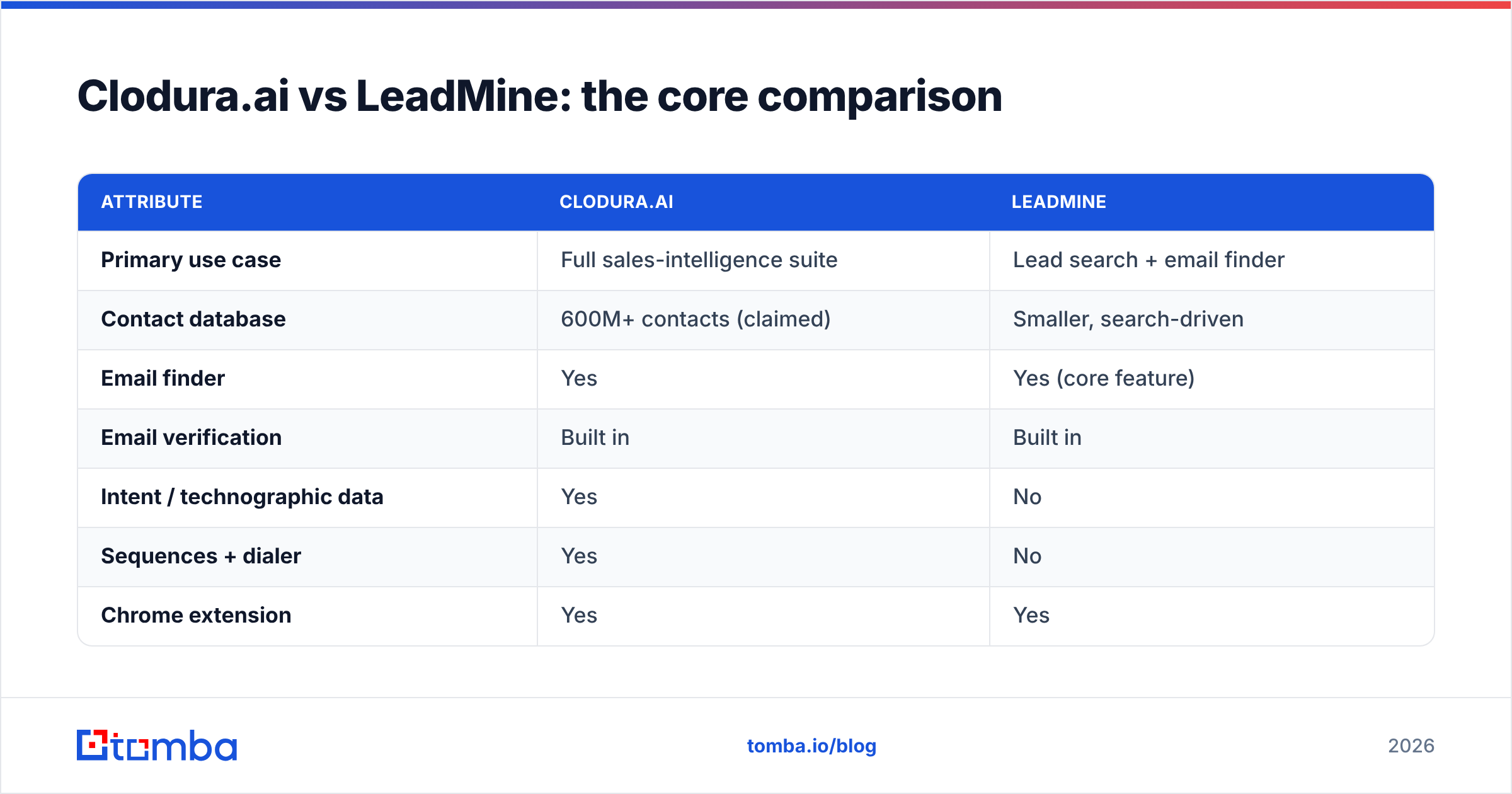
Here's the head-to-head on the attributes that actually change your results. Treat published database sizes as marketing figures — what matters is coverage in your target segment and how many emails survive verification.
| Attribute | Clodura.ai | LeadMine |
|---|---|---|
| Primary use case | Full sales-intelligence suite | Lead search + email finder |
| Contact database | 600M+ contacts (claimed) | Smaller, search-driven |
| Email finder | Yes | Yes (core feature) |
| Email verification | Built in | Built in |
| Intent / technographic data | Yes | No |
| Sequences + dialer | Yes | No |
| Chrome extension | Yes | Yes |
| Entry pricing | Team-oriented, higher | Credit-based, lower |
| Free option | Limited free plan | Free trial credits |
| Best for | Teams consolidating tools | Solo / small outbound teams |
Which one has better data accuracy?#
Accuracy depends less on database size than on how hard a tool re-checks an address before handing it to you. A 600M-record database that returns a stale or catch-all address still costs you a bounce — and bounces hurt sender reputation, which drags down every future campaign.
Both Clodura.ai and LeadMine attach confidence scores and run a verification pass. In practice, the safest workflow with either tool is to run found emails through an independent email verifier before you load them into a sequence. That second pass catches the catch-all and role-based addresses that single-tool verification tends to wave through. If you want to understand why catch-all domains are so risky, a dedicated catch-all verifier is the honest way to test them.

Which one is cheaper?#
LeadMine wins on entry cost. Its credit-based model lets an individual start small and scale spend with usage, which suits founders and freelancers running occasional campaigns.
Clodura.ai is priced for teams that will use the full suite. If you're paying a team-tier subscription but only touching the contact database, your effective cost per usable email is high. The rule of thumb: match the bill to the features you actually run, not the features on the pricing page.
When should you choose Clodura.ai?#
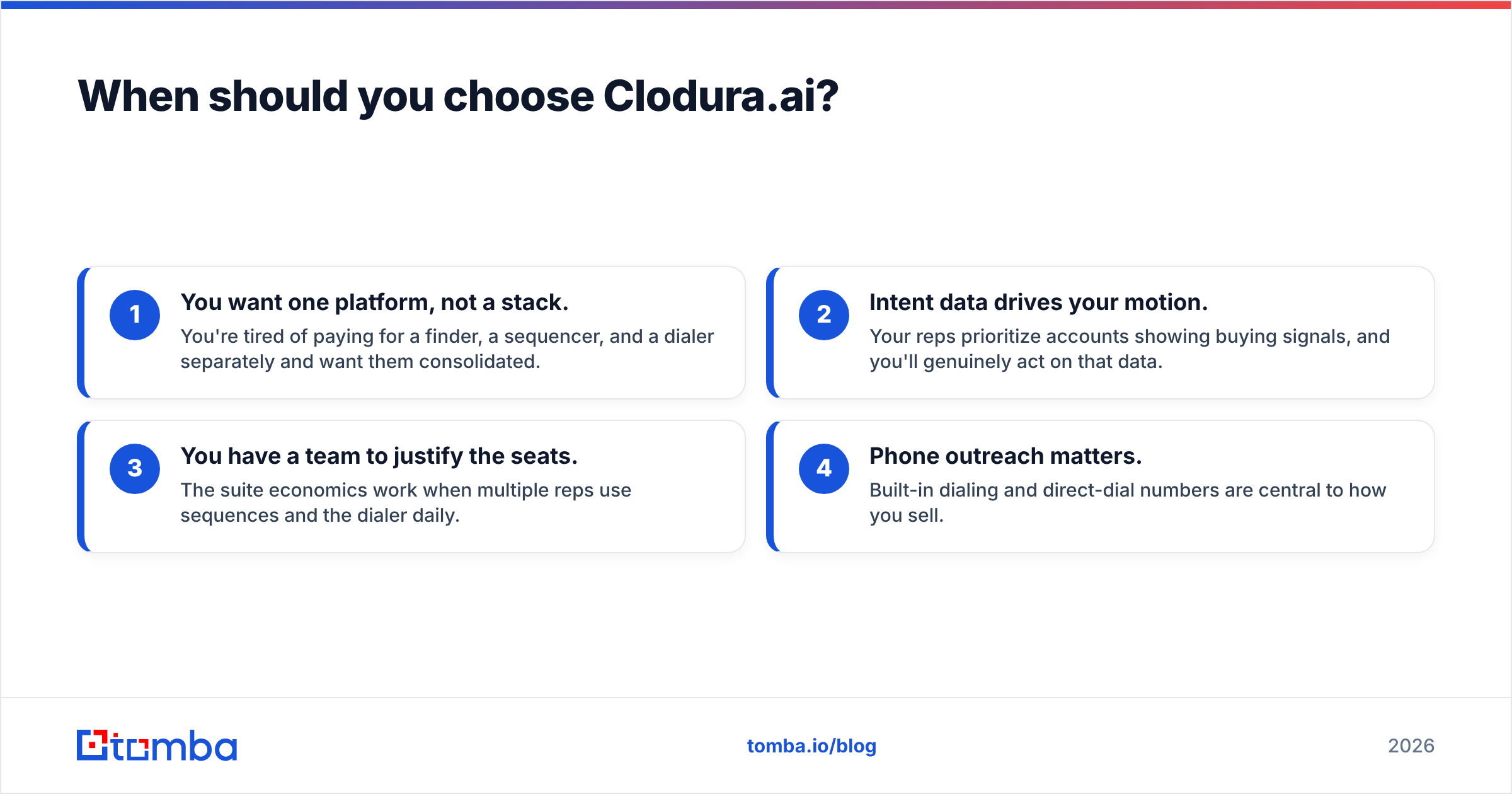
Pick Clodura.ai when these are true:
- You want one platform, not a stack. You're tired of paying for a finder, a sequencer, and a dialer separately and want them consolidated.
- Intent data drives your motion. Your reps prioritize accounts showing buying signals, and you'll genuinely act on that data.
- You have a team to justify the seats. The suite economics work when multiple reps use sequences and the dialer daily.
- Phone outreach matters. Built-in dialing and direct-dial numbers are central to how you sell.
If three of those four ring true, the consolidation is worth it. If only one does, you're over-buying.
When should you choose LeadMine?#
Pick LeadMine when:
- You mostly need emails, not a suite. Your CRM and sending tool already exist; you just need contacts to feed them.
- You're solo or small. Credit pricing keeps spend proportional to a tiny team's volume.
- You prospect in bursts. Occasional campaigns don't justify a recurring team subscription.
- Simplicity is the point. Fewer features means less onboarding and a lower chance of paying for shelfware.
Is there a leaner alternative to both?#
Yes — and it's worth naming, because the Clodura.ai vs LeadMine debate quietly assumes you must choose between "huge suite" and "small finder." If your real job is find emails, verify them, move on, a focused email-finding platform usually delivers more usable contacts per dollar than either.
That's the gap Tomba fills. It's built around the email-finding workflow rather than wrapped around a dialer:
- Domain search pulls every discoverable address on a company domain, with patterns and confidence scores — the fastest way to map an account.
- Email finder resolves a specific name + domain into a verified address.
- Email verifier and the catch-all verifier run the second-pass validation that protects deliverability.
- Bulk email finder handles list-scale work without a per-seat suite contract.
- A documented email finder API, Chrome extension, and Google Sheets add-on let you wire finding into whatever stack you already run.
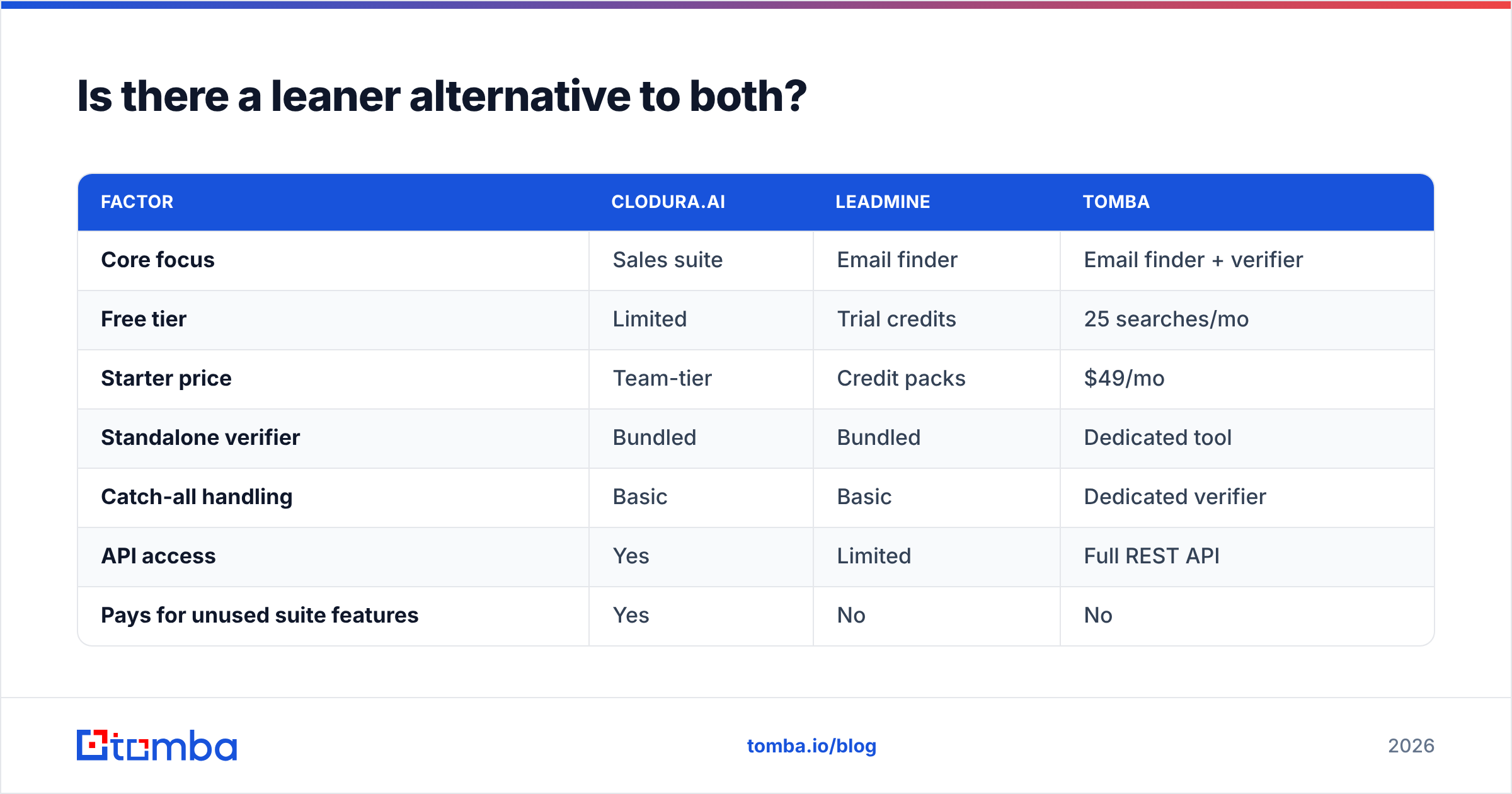
Here's how the three approaches line up on the dimension most teams actually care about — cost to get verified emails into a campaign.
| Factor | Clodura.ai | LeadMine | Tomba |
|---|---|---|---|
| Core focus | Sales suite | Email finder | Email finder + verifier |
| Free tier | Limited | Trial credits | 25 searches/mo |
| Starter price | Team-tier | Credit packs | $49/mo |
| Standalone verifier | Bundled | Bundled | Dedicated tool |
| Catch-all handling | Basic | Basic | Dedicated verifier |
| API access | Yes | Limited | Full REST API |
| Pays for unused suite features | Yes | No | No |
For most outbound teams, the unused-features line is the deciding one. You can review the full Tomba pricing — Free (25 searches/mo), Starter $49/mo, Growth $99/mo, Pro $249/mo, and Enterprise — and compare the per-email cost against a team suite you'd only half-use.
How accurate are these email finders, really?#
No finder is 100% accurate, and any vendor claiming otherwise is selling. What separates a good tool from a risky one is the verification layer and transparent sourcing. Tomba publishes where its data comes from, which matters because data provenance predicts how an address will behave six months from now.

The practical test for any of these tools is simple: run a sample of 100 known-good contacts, find their emails, then verify with an independent tool. Count the valid hits and the bounces. That number — not the database headline — is your real accuracy. Cross-referencing tool ratings on G2 before you trust a single vendor's marketing is also worth ten minutes.
Side-by-side: who wins each category?#

- Breadth of features: Clodura.ai. Nothing else here ships intent, sequences, and a dialer in one box.
- Lowest entry cost: LeadMine, for true individuals.
- Cost per verified email: Tomba, because you don't subsidize features you skip.
- Verification depth: Tomba, with a dedicated verifier and catch-all checker.
- Phone outreach: Clodura.ai, the only one with a native dialer.
- Simplicity: tie between LeadMine and Tomba, with Tomba edging ahead on API and integrations.
There's no universal winner — there's a winner for your motion. If you're running a multi-channel team that lives in one platform, Clodura.ai earns its price. If you need a cheap email finder for occasional bursts, LeadMine is fine. If your bottleneck is consistently getting clean, verified addresses into campaigns at a sane cost, a focused finder beats both.
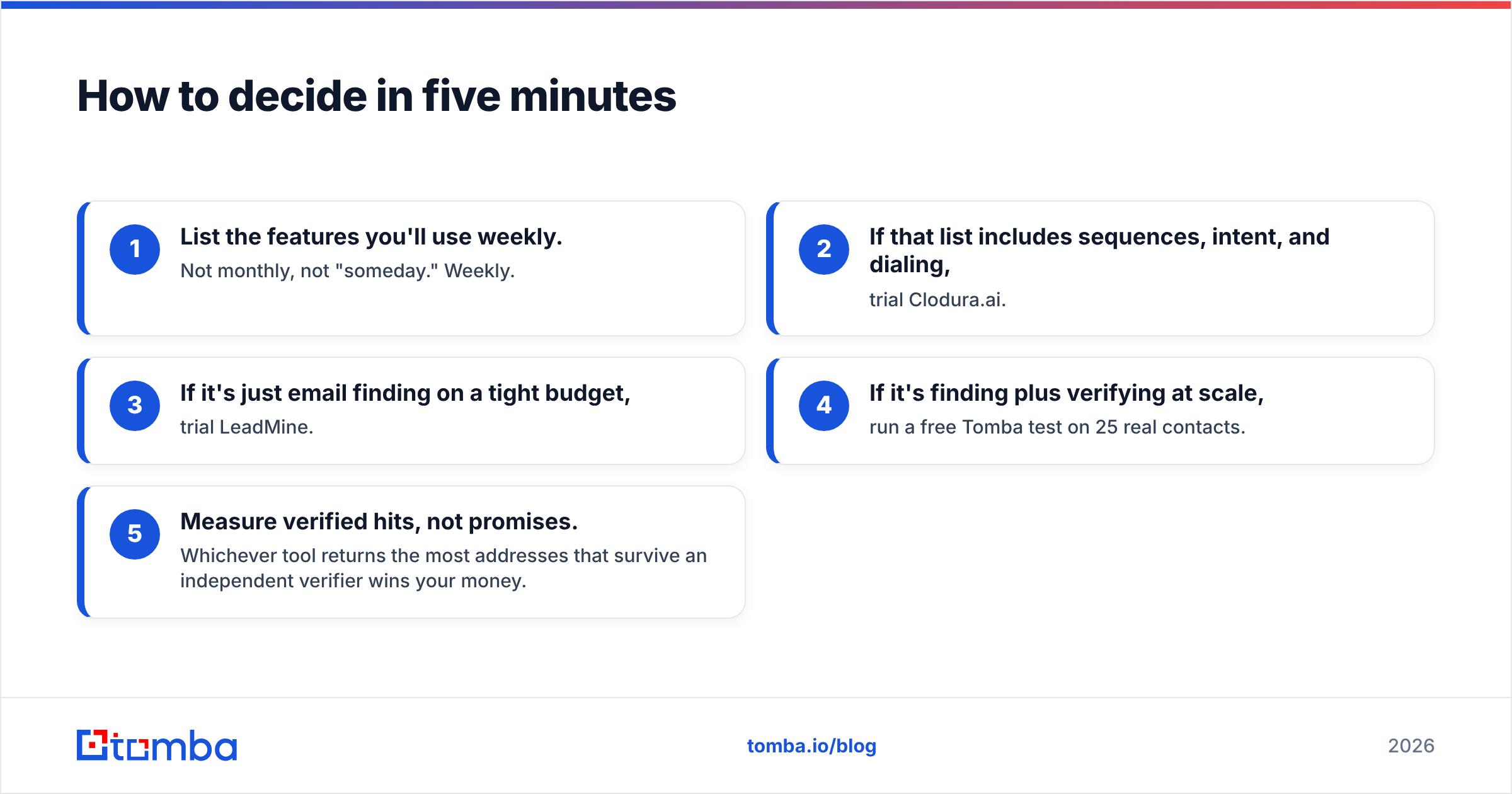
How to decide in five minutes#
- List the features you'll use weekly. Not monthly, not "someday." Weekly.
- If that list includes sequences, intent, and dialing, trial Clodura.ai.
- If it's just email finding on a tight budget, trial LeadMine.
- If it's finding plus verifying at scale, run a free Tomba test on 25 real contacts.
- Measure verified hits, not promises. Whichever tool returns the most addresses that survive an independent verifier wins your money.
The bottom line#
Clodura.ai and LeadMine solve different problems wearing similar labels. Clodura.ai is a suite; LeadMine is a lean finder. Both are reasonable inside their lane. But if your real job is turning names and domains into verified, send-ready emails — without paying a suite tax or babysitting confidence scores — start with the tool built for exactly that.
Run a free test with the Tomba Email Finder: 25 searches a month at no cost, a dedicated verifier and catch-all checker behind it, and a full API when you're ready to scale. Find the emails, verify them, and keep your sender reputation intact — then decide whether you ever needed the bigger suite at all.
// get started
Find, verify and enrich your first contacts today
Start on the free plan with 25 searches a month, then scale when your team is ready.
Free plan · No credit card required · GDPR & CCPA
// about the author