Cold Email in 2026: The Complete Guide to Replies That Convert
Cold email still outperforms most channels in 2026 — if you fix targeting, deliverability, and copy. Here's the full playbook, with a framework and benchmarks.
TL;DR
- A solid cold email strategy still books pipeline in 2026, but the bar moved. Generic blasts get filtered before a human ever sees them.
- Three levers decide everything — list quality, deliverability, and the first two sentences. Copy is the last problem to solve, not the first.
- Verify every address before you send. A list with 8%+ invalids will tank your sender reputation in a week.
- Expect 30–60% open, 5–15% reply on a tight, verified, well-targeted list. If you're below that, it's almost always targeting or deliverability — not your subject line.
- Warm the domain, keep volume sane (under ~40 sends/inbox/day), and follow up 3–4 times before you stop.
What is cold email, and does it still work in 2026?#
Cold email is a one-to-one business message sent to someone who hasn't asked to hear from you. It works only when you have a specific, relevant reason for reaching out. That last clause is the whole game. The difference between "cold email" and "spam" isn't the tool — it's whether the recipient could plausibly believe you researched them before hitting send.
Does it still work? Yes, but the easy version died. Inbox providers got much better at spotting low-effort outreach. Google and Yahoo's 2024 bulk-sender rules — authentication, low spam complaints, one-click unsubscribe — are now table stakes, and they're enforced. The teams winning in 2026 treat their cold email strategy like a precision channel: smaller lists, cleaner data, sharper relevance.
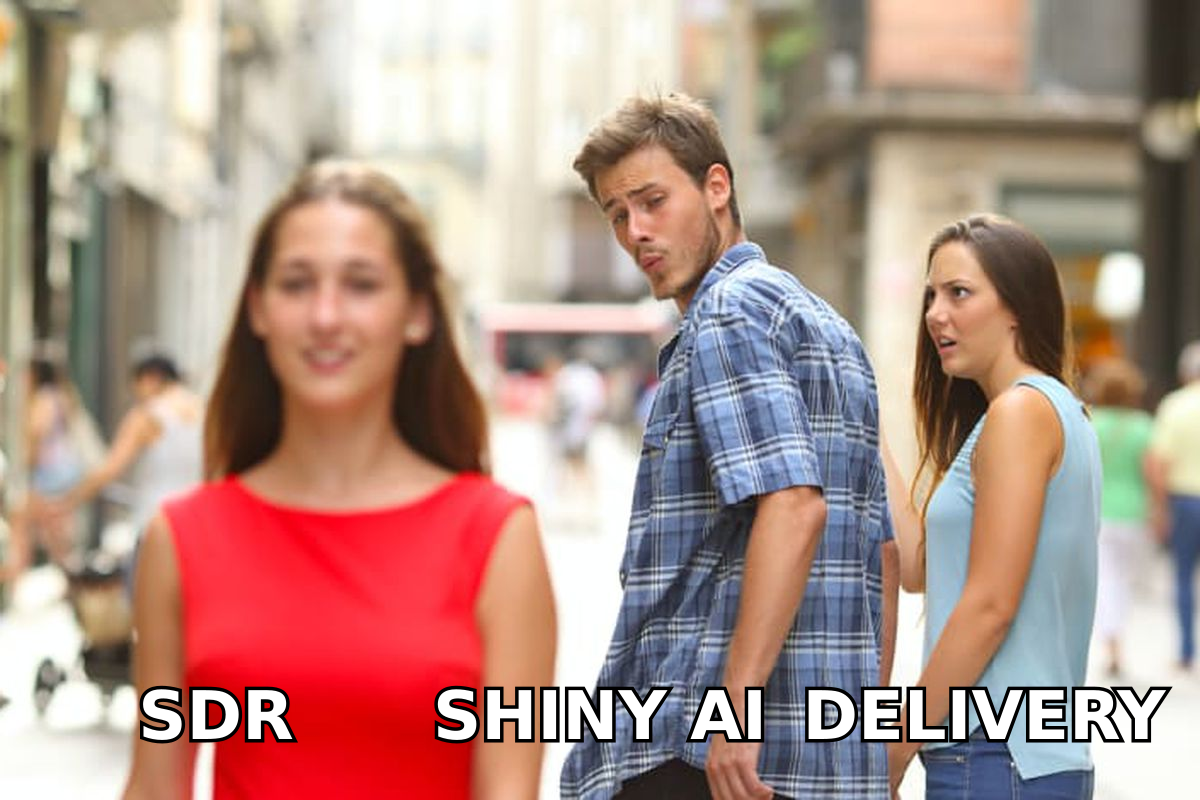
The trap most teams fall into: they buy a new sequencing tool every quarter and never fix the boring fundamentals. A better subject line cannot rescue an email that landed in spam.
What's the difference between cold email and spam?#
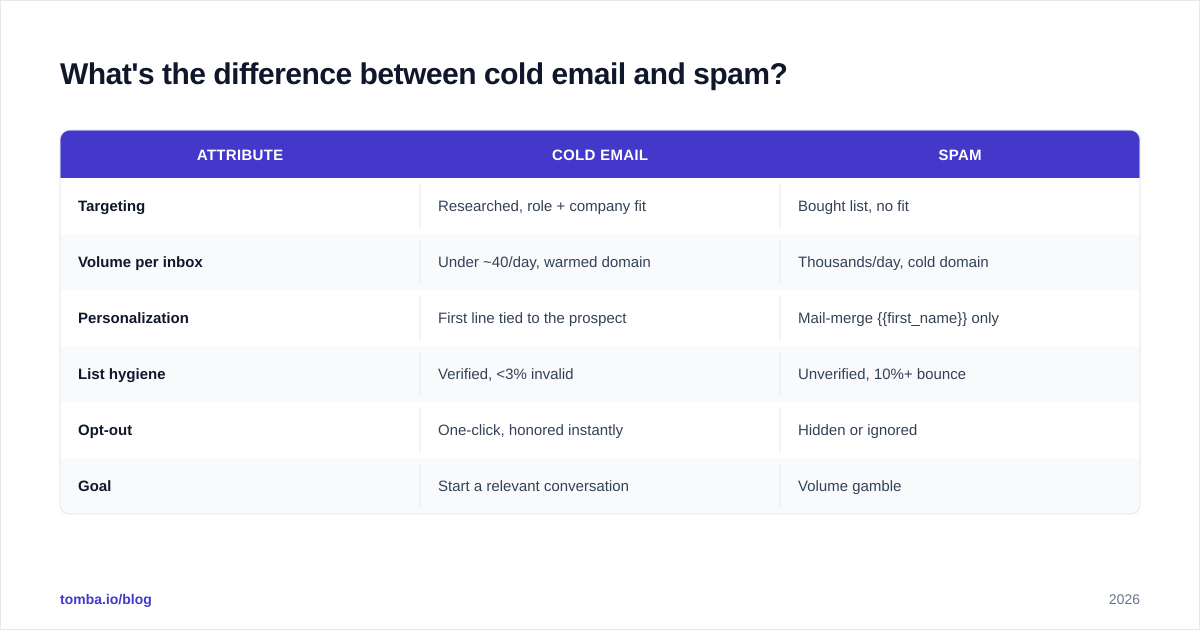
People conflate the two, so let's be precise. Under CAN-SPAM in the US and similar rules elsewhere, cold B2B email is permitted if you identify yourself, use a truthful subject, include a physical address, and honor opt-outs. In practice, the inbox provider — not the law — decides whether you reach the inbox.
| Attribute | Cold email | Spam |
|---|---|---|
| Targeting | Researched, role + company fit | Bought list, no fit |
| Volume per inbox | Under ~40/day, warmed domain | Thousands/day, cold domain |
| Personalization | First line tied to the prospect | Mail-merge {{first_name}} only |
| List hygiene | Verified, <3% invalid | Unverified, 10%+ bounce |
| Opt-out | One-click, honored instantly | Hidden or ignored |
| Goal | Start a relevant conversation | Volume gamble |
The honest reading: the work that keeps you out of the spam folder is the same work that gets you replies. Hygiene and relevance aren't compliance chores — they're the strategy.
How do you build a targeted cold email list?#
Your list is 60% of your result. A perfect email to the wrong person converts at zero. Start from a sharp Ideal Customer Profile — industry, company size, the specific role that owns the problem you solve — and resist the urge to widen it because "more contacts = more meetings." More wrong contacts means more spam complaints.
Sourcing flow that works in 2026:
- Define the segment narrowly enough that one email angle fits the whole list.
- Find the right people, not just any people at the account — match title to buying authority.
- Get the email, then verify it before it ever enters your sequence.
- Enrich with the one or two data points your first line will actually use.
For step 3, use a dedicated email finder to resolve names and domains into deliverable addresses, then run the whole list through an email verifier to strip invalids and risky catch-alls. Skipping verification is the single most common reason new domains get throttled. If you're pulling whole companies, a domain search gives you every public address on a domain plus the company's email pattern, so you can prioritize the right roles.
A note on volume math: if you have a 1,000-contact list and 9% are invalid, that's 90 hard bounces. Hit a few hundred of those across a fresh domain and providers will quietly start routing you to spam — including your good addresses. Verification isn't optional insurance; it's the thing protecting the deliverability you already earned.
What makes cold email deliverability actually hold up?#
Deliverability is whether your message reaches the inbox at all — and it's decided before anyone reads a word. Get this wrong and nothing else matters.
The non-negotiables in 2026:
- Authentication: SPF, DKIM, and DMARC set up correctly on your sending domain. Use a separate domain from your primary brand domain so a deliverability mistake never touches your main email.
- Domain warmup: ramp a new sending domain over 3–4 weeks before real volume. New domain + 200 sends on day one is the fastest way to a blocklist.
- Volume discipline: keep each inbox under roughly 30–40 cold sends per day. Spread across multiple inboxes if you need scale, not by cranking one inbox.
- Engagement signals: replies and opens lift you; spam complaints and deletions sink you. This is exactly why list quality and deliverability are the same problem.
- Monitoring: watch your reputation. Google Postmaster Tools shows your domain reputation and spam-complaint rate straight from the source — check it weekly.
If you want a quick sanity check on ramp pace, the email warmup calculator maps a sane volume curve for a new domain. And before a big send, confirm your records are clean rather than assuming — bad SPF is shockingly common.
What does a cold email that gets replies look like?#
Now — and only now — copy. A good cold email is short, specific, and asks for one small thing. The structure that consistently outperforms:
- Subject (2–4 words, lowercase-ish, no hype): reads like a colleague wrote it. "quick question, {company}" beats "Unlock 3x Pipeline Growth!!"
- First line (the make-or-break): prove you're not mail-merging. Reference something true and specific about them — a hire, a launch, a stack choice, a role change.
- Relevance bridge (1–2 sentences): connect their situation to the problem you solve. No feature dump.
- One ask: a low-friction question, not a 30-minute calendar demand. "Worth a quick look?" converts better than "Can we schedule a call?"
- Signature: real human, real company, one-click unsubscribe.
Keep it under ~90 words. The whole thing should be readable on a phone lock-screen preview. If your prospect has to scroll, you've already lost the skim.
For first lines at scale, the honest answer is you can't hand-write 500 of them — but you can template the structure and feed it one real variable per prospect. AI helps here if you supervise it; a tool like cold email AI drafts the skeleton, and you swap in the researched detail. If you'd rather start from proven structures, grab a few cold email templates and adapt rather than reinvent.
What loses in 2026: long intros about your company, three CTAs, "I hope this email finds you well," walls of bullet-pointed features, and any subject line with an exclamation mark or the word "free."
How many follow-ups should you send?#
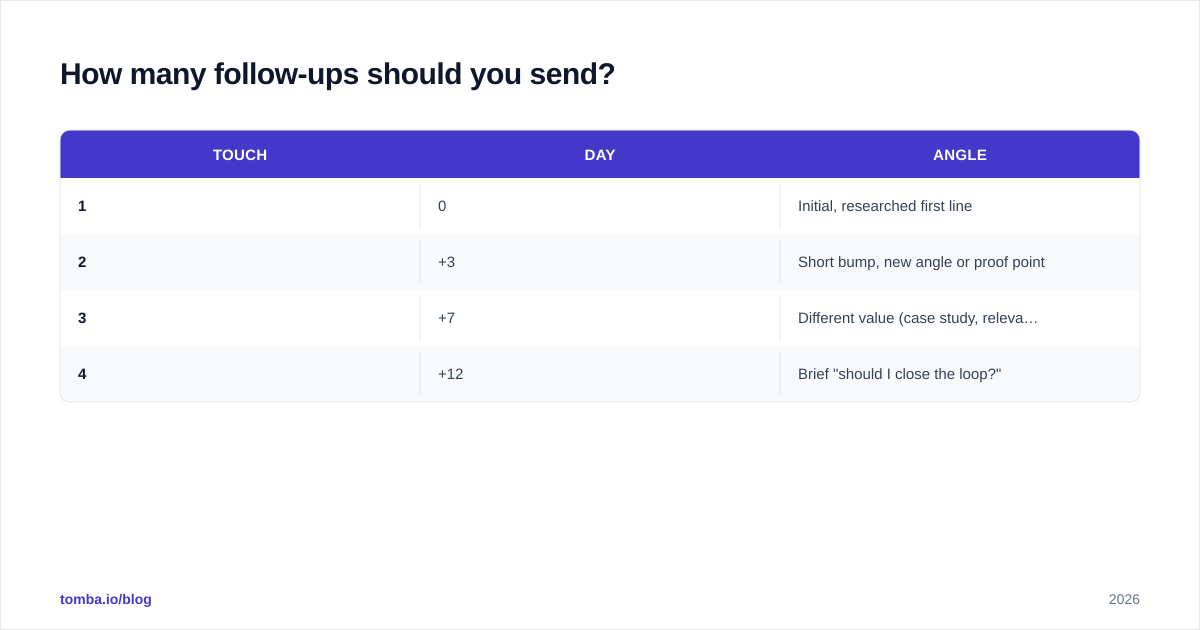
Most replies come from follow-ups, not the first touch — yet most people send once and quit. The data across major outreach studies (HubSpot, Salesloft, and others) consistently shows the bulk of positive replies arriving on touches two through four.
A sane cadence:
| Touch | Day | Angle |
|---|---|---|
| 1 | 0 | Initial, researched first line |
| 2 | +3 | Short bump, new angle or proof point |
| 3 | +7 | Different value (case study, relevant resource) |
| 4 | +12 | Brief "should I close the loop?" |
Rules that keep follow-ups from reading as nagging: each one adds new information, never just "bumping this," and every follow-up sits in the same thread. Four well-spaced, varied touches is the sweet spot — beyond that, reply rates drop and complaint risk climbs.
What benchmarks should you actually expect?#
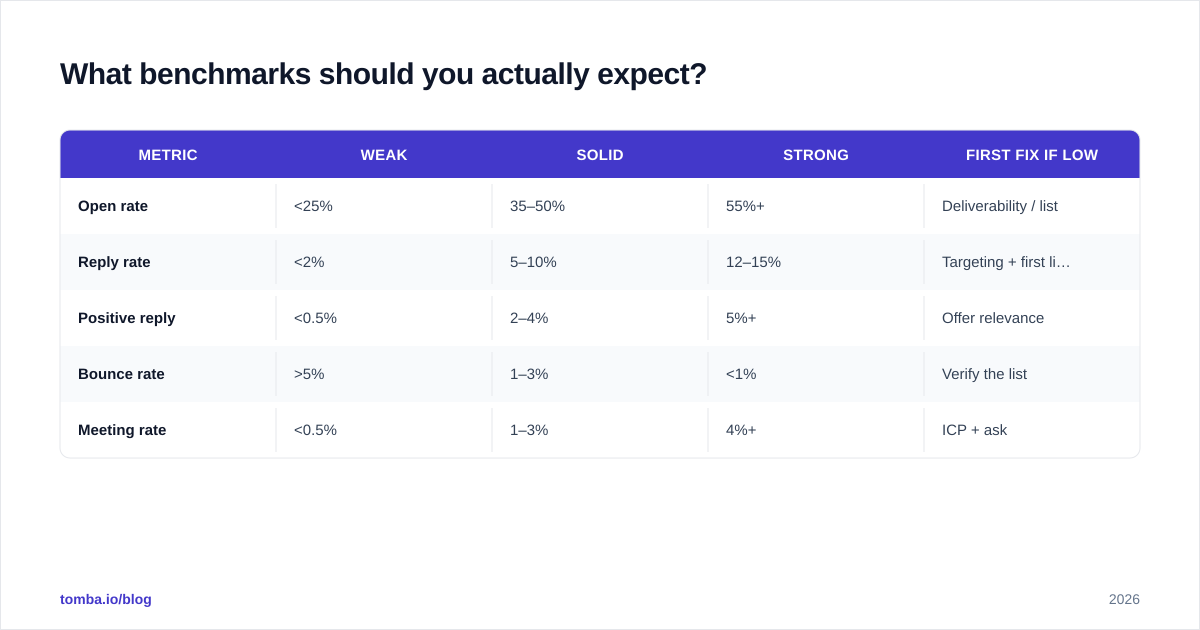
Hold yourself to numbers, not vibes. On a tight, verified, well-targeted list, realistic 2026 ranges:
| Metric | Weak | Solid | Strong | First fix if low |
|---|---|---|---|---|
| Open rate | <25% | 35–50% | 55%+ | Deliverability / list |
| Reply rate | <2% | 5–10% | 12–15% | Targeting + first line |
| Positive reply | <0.5% | 2–4% | 5%+ | Offer relevance |
| Bounce rate | >5% | 1–3% | <1% | Verify the list |
| Meeting rate | <0.5% | 1–3% | 4%+ | ICP + ask |
The diagnostic logic matters more than the exact figures. Low opens almost always mean a deliverability or list problem, not a subject-line problem. Low replies on healthy opens mean your targeting or first line is off. High bounce means you skipped verification. Fix in that order — top of the funnel first — because a brilliant CTA can't save an email no one received.
Cross-check your assumptions against neutral third-party data too. Sites like G2 aggregate real-user reports on tools and deliverability rates, which is a useful gut-check before you blame your copy.
What does the full cold email stack look like?#
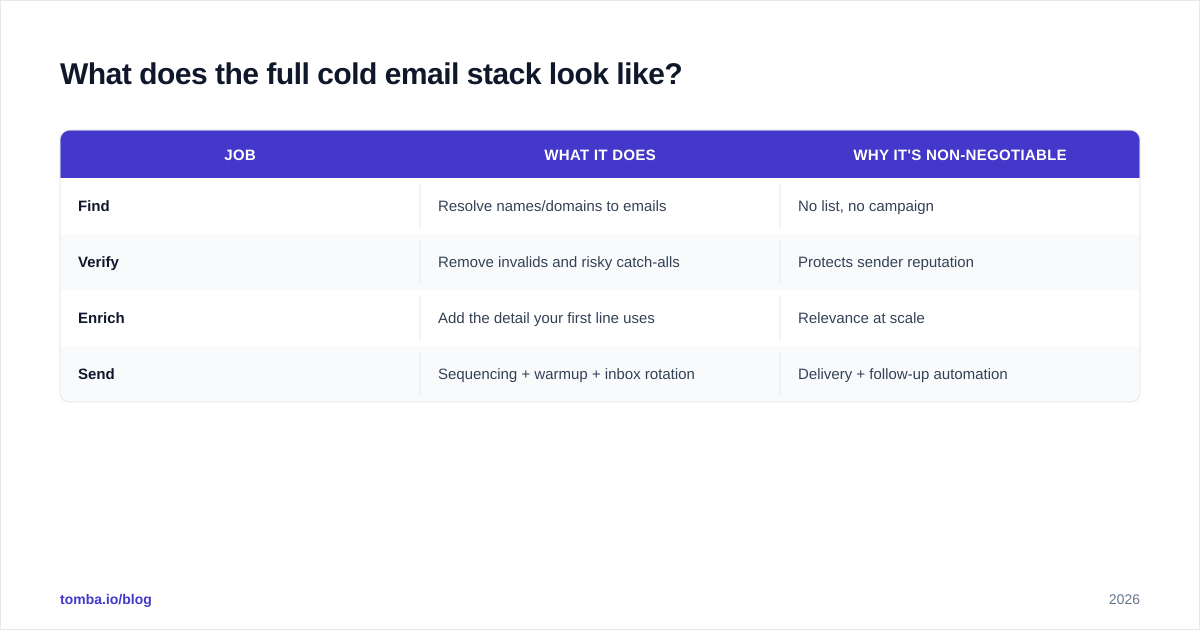
You don't need fifteen tools. You need four jobs covered, and several of them can sit in one platform:
| Job | What it does | Why it's non-negotiable |
|---|---|---|
| Find | Resolve names/domains to emails | No list, no campaign |
| Verify | Remove invalids and risky catch-alls | Protects sender reputation |
| Enrich | Add the detail your first line uses | Relevance at scale |
| Send | Sequencing + warmup + inbox rotation | Delivery + follow-up automation |
Find, verify, and enrich are where most teams cut corners and pay for it later. Get accurate data at the source and the sending layer takes care of itself. You can compare full Tomba pricing against piecing together three separate point tools — the Free tier (25 searches/mo) is enough to test data quality before committing, with Starter at $49/mo when you scale.
Cold email mistakes that quietly kill campaigns#
- Buying a list and skipping verification — the fastest path to a blocklist.
- Sending from your primary domain instead of a dedicated sending domain.
- Cranking one inbox to 200/day instead of warming and spreading volume.
- Writing about yourself in the first line instead of the prospect.
- Three CTAs in one email — pick one small ask.
- Quitting after one send when touches 2–4 carry the replies.
- Optimizing subject lines while ignoring a 9% bounce rate.
Notice the pattern: almost every failure is a data or deliverability failure wearing a "copy problem" costume.
Your cold email strategy starts with the data, not the copy#
A winning cold email strategy in 2026 is unglamorous. Narrow your ICP, find the right people, verify every address, warm your domain, send disciplined volume, write a researched first line, and follow up four times. Copy is the part everyone obsesses over. It's also the part that matters least until the first four steps are solid.
Get the foundation right and start where it actually moves the needle — accurate, verified contact data. Use the Tomba Email Finder to turn your target list into deliverable addresses, verify them in the same workflow, and walk into your next send with a list that protects your reputation instead of burning it. The teams booking meetings in 2026 aren't the ones with the cleverest subject lines. They're the ones whose emails actually arrive.
// get started
Find, verify and enrich your first contacts today
Start on the free plan with 25 searches a month, then scale when your team is ready.
Free plan · No credit card required · GDPR & CCPA
Get the Tomba newsletter
Product and data updates
// about the author