Cold Email Sequences & Cadence: A 2026 Sequence Playbook
A field-tested playbook for building cold email sequences and cadence in 2026 — touch counts, spacing, channel mix, and the metrics that prove it works.
TL;DR
- A cold email cadence is the planned schedule of touches — emails, calls, and social steps — that you run against a prospect over a fixed window, usually 2–4 weeks.
- In 2026, the sequences that convert are shorter and more relevant than the 9-email blasts of five years ago: 4–6 emails spaced 2–4 days apart, woven with 1–2 other channels.
- Spacing matters more than volume. Front-load value, leave breathing room, and stop when the data says you've exhausted the contact.
- Clean data is the multiplier. A perfect cadence sent to stale addresses still bounces — verify before you send.
- Measure reply rate and positive-reply rate per step, not just opens, and cut any step that doesn't earn its place.
What is a cold email cadence?#
A cold email cadence is the structured sequence of outreach touches you deliver to a prospect on a deliberate schedule. Think of it like a film score rather than a single note: each touch is timed to build on the last, and the spacing between them is as intentional as the words inside.
The terms get used loosely, so it helps to separate them. A sequence is the ordered list of messages and their content. A cadence is the timing layer — how many touches, on which days, across which channels. You can run the same sequence on a fast 10-day cadence or a slow 30-day one and get completely different results.
Most teams overbuild here. They add steps because a tool lets them, not because the extra touch earns a reply. The job of this playbook is to give you a cold email cadence you can defend touch by touch, where every send has a reason to exist.
Why does cadence matter more than the individual email?#
Because buyers rarely reply to the first message, and almost never to a sequence that feels like a machine grinding through a list.
The data backs the multi-touch approach. According to HubSpot's sales research, the majority of closed deals require multiple follow-ups, yet most reps stop after one or two. The gap between "sent one email" and "ran a disciplined cadence" is where pipeline lives.
But there's a ceiling. Past a certain touch count, each additional email pulls your reply rate down and your spam complaints up. The art is finding the point where persistence is still read as professional and not as harassment. That point is lower than most cold email gurus claim.
The other reason cadence beats any single email: it protects you from your own bad days. One weak subject line won't sink a well-spaced sequence, because the prospect gets several distinct angles. A single email gives you exactly one shot at one mood on one Tuesday.
How many touches should a cold email sequence have?#
Four to six emails, spread across a multichannel cadence of 7–12 total touches over 2–4 weeks. That's the range that holds up across most B2B use cases in 2026.
Here's the reasoning behind the numbers:
- Touches 1–2 carry your strongest value proposition and your most specific personalization. This is where reply rates are highest.
- Touches 3–4 reframe — new angle, new proof point, a case study or a different pain. You are not nagging; you are testing which message resonates.
- Touches 5–6 are the graceful exit: a short bump and a clear breakup email that often pulls more replies than any middle step.
Going beyond six emails rarely pays. The incremental reply rate flattens while your domain reputation absorbs more risk. If you find yourself building a 10-email monster, the honest fix is usually a better list, not more sends.
What does an optimal cadence schedule look like?#
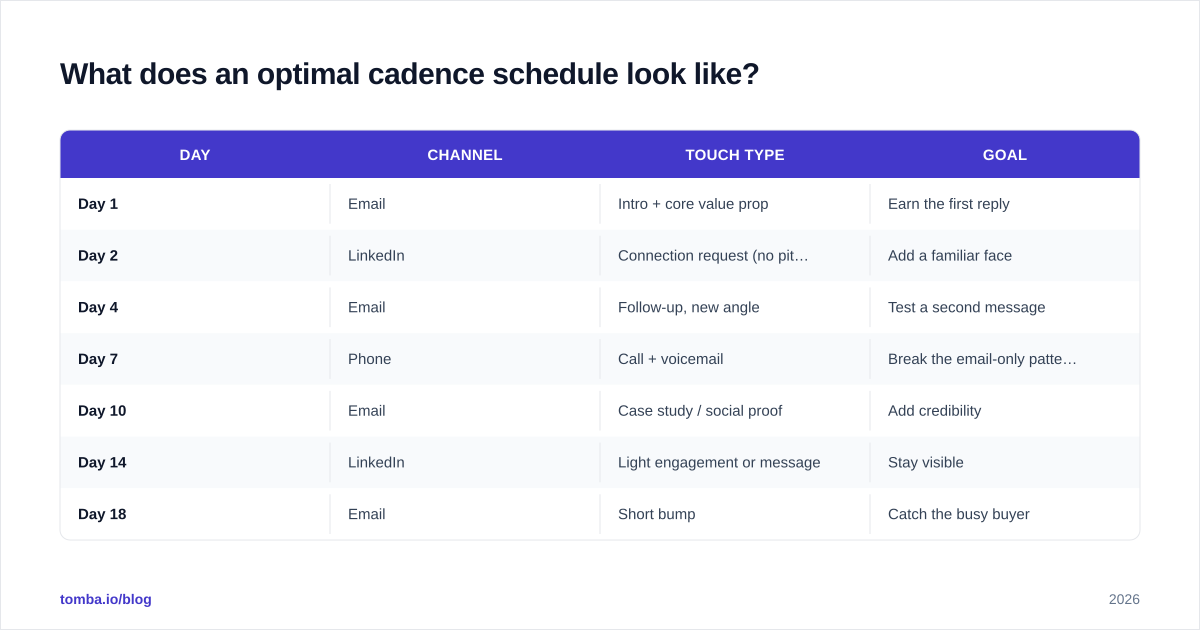
The schedule below is a proven starting template for a 21-day, multichannel cold email cadence. Adjust the spacing for your sales cycle — enterprise deals tolerate slower cadences, transactional ones reward speed.
| Day | Channel | Touch type | Goal |
|---|---|---|---|
| Day 1 | Intro + core value prop | Earn the first reply | |
| Day 2 | Connection request (no pitch) | Add a familiar face | |
| Day 4 | Follow-up, new angle | Test a second message | |
| Day 7 | Phone | Call + voicemail | Break the email-only pattern |
| Day 10 | Case study / social proof | Add credibility | |
| Day 14 | Light engagement or message | Stay visible | |
| Day 18 | Short bump | Catch the busy buyer | |
| Day 21 | Breakup email | Trigger loss aversion |
A few rules that make this schedule work:
- Never stack two touches on the same day unless one is purely passive (a profile view). It reads as desperate.
- Skip weekends for the first three touches; reply rates dip and your email just gets buried by Monday.
- Vary the send time across the sequence. If every email lands at 8:00 a.m., your pattern is obvious and easy to filter.
Single-channel vs. multichannel cadence: which wins?#
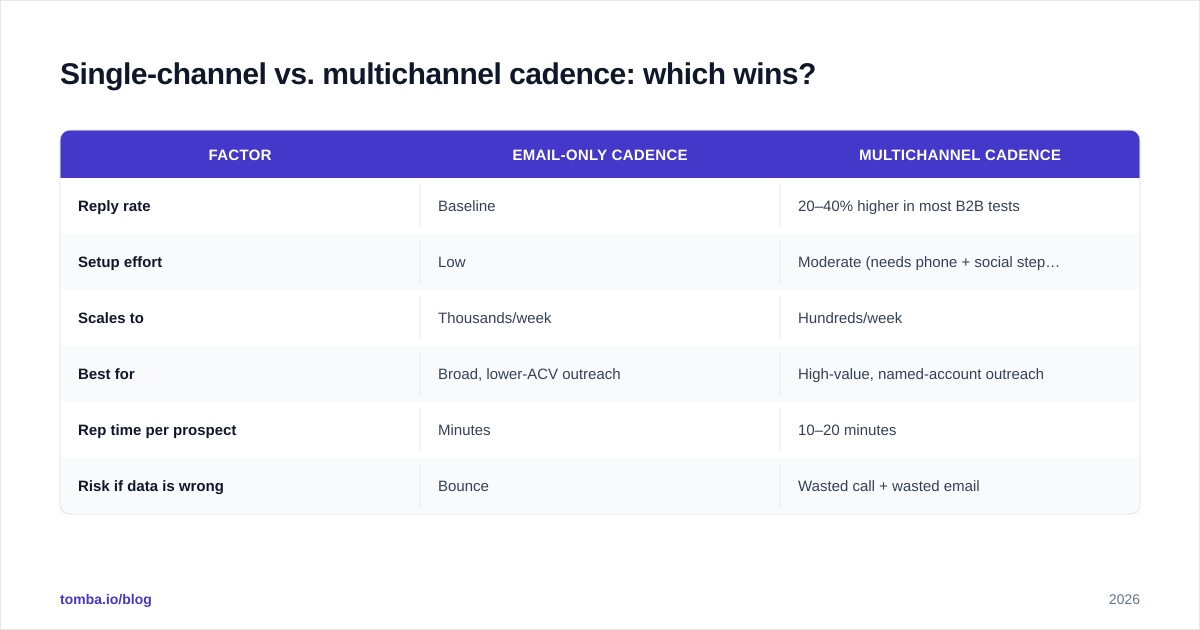
Multichannel wins on reply rate; single-channel email wins on simplicity and scale. The right answer depends on how many prospects you're working and how valuable each one is.
| Factor | Email-only cadence | Multichannel cadence |
|---|---|---|
| Reply rate | Baseline | 20–40% higher in most B2B tests |
| Setup effort | Low | Moderate (needs phone + social steps) |
| Scales to | Thousands/week | Hundreds/week |
| Best for | Broad, lower-ACV outreach | High-value, named-account outreach |
| Rep time per prospect | Minutes | 10–20 minutes |
| Risk if data is wrong | Bounce | Wasted call + wasted email |
If you're chasing a tight list of 200 named accounts, go multichannel and accept the per-prospect cost. If you're running volume against a broad ICP, a disciplined email-only cadence with sharp segmentation will outperform a sloppy multichannel one every time. Don't add channels you can't execute well — a half-hearted cold call hurts more than a skipped one.
For deeper benchmarks on what "good" looks like by industry, the reviews aggregated on G2's sales engagement category are a useful sanity check against vendor claims.
How do you keep a cadence out of the spam folder?#
Deliverability is the silent killer of cold email cadence. The cleverest sequence is worthless if it lands in Promotions or never arrives at all. Three levers control most of your outcome.
1. Warm the domain and watch volume. A new sending domain that fires 500 cold emails on day one is a spam filter's dream target. Ramp gradually and keep daily volume per inbox conservative. Our email warmup calculator helps you set a sane ramp curve before you scale the cadence.
2. Authenticate properly. SPF, DKIM, and DMARC are non-negotiable in 2026 — Google and Yahoo now enforce them for bulk senders. If you're unsure your records are right, the Wikipedia overview of DMARC is a solid primer before you touch DNS.
3. Verify every address before the first touch. Bounces above roughly 2–3% tank your sender reputation fast, and a bad reputation poisons the whole cadence. Run your list through an email verifier so you're spending touches on real inboxes, not catch-alls and traps. This single step protects every other investment you've made in the sequence.
A cadence is only as deliverable as the list under it. If you're seeing high opens but the replies never come, suspect placement before you blame your copy.
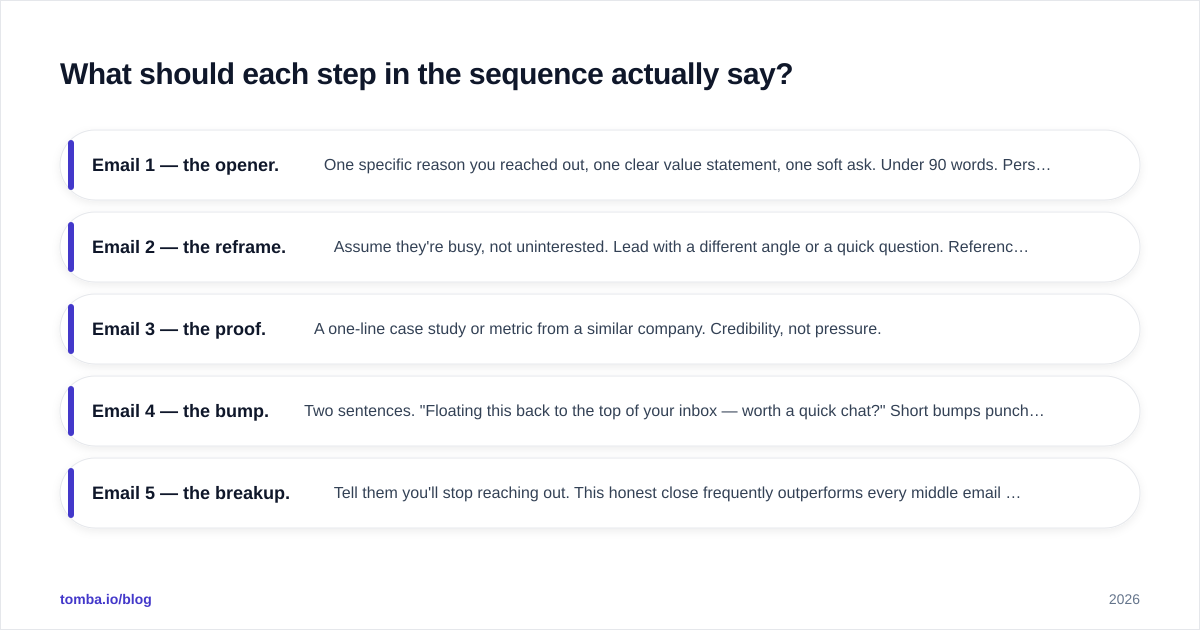
What should each step in the sequence actually say?#
Keep each message short, single-purpose, and visibly written for one person. The cadence gives you multiple at-bats, so resist the urge to cram everything into touch one.
- Email 1 — the opener. One specific reason you reached out, one clear value statement, one soft ask. Under 90 words. Personalize the first line with something real, not a mail-merge token.
- Email 2 — the reframe. Assume they're busy, not uninterested. Lead with a different angle or a quick question. Reference nothing from email 1 except continuity.
- Email 3 — the proof. A one-line case study or metric from a similar company. Credibility, not pressure.
- Email 4 — the bump. Two sentences. "Floating this back to the top of your inbox — worth a quick chat?" Short bumps punch above their weight.
- Email 5 — the breakup. Tell them you'll stop reaching out. This honest close frequently outperforms every middle email because it removes the pressure and triggers a "wait, don't go" reply.
If writing five distinct angles feels hard, start from proven structures. Our library of cold email templates gives you frameworks you can adapt rather than blank-page each step.

The temptation every quarter is to abandon a working cadence for whatever new tool promises to automate it away. Automation helps you execute a good sequence; it cannot invent one. Nail the message and the timing first, then let software scale what already works.
Which metrics tell you the cadence is working?#
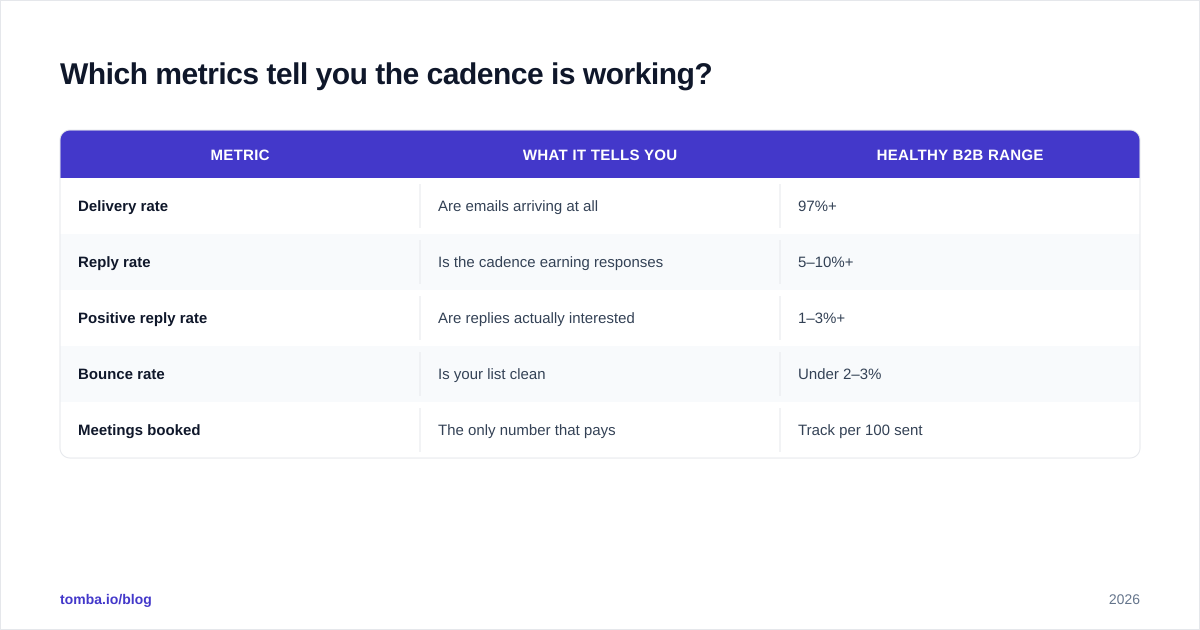
Track these per step, not just per campaign. The whole point of a structured cadence is that you can see exactly where prospects engage and where they fall off.
| Metric | What it tells you | Healthy B2B range |
|---|---|---|
| Delivery rate | Are emails arriving at all | 97%+ |
| Reply rate | Is the cadence earning responses | 5–10%+ |
| Positive reply rate | Are replies actually interested | 1–3%+ |
| Bounce rate | Is your list clean | Under 2–3% |
| Meetings booked | The only number that pays | Track per 100 sent |
Opens are no longer reliable — Apple Mail Privacy Protection and similar features inflate them with bot pre-fetches. Anchor on replies and meetings. If a specific step (say, email 4) produces almost no replies across hundreds of prospects, cut it. A leaner cadence that respects your prospects' time will beat a bloated one on every metric that matters.
When you do find a winning sequence, document the spacing and the per-step copy so the whole team runs the same proven cadence instead of improvising. Consistency is what turns one rep's good month into a repeatable system. For a deeper look at how outreach response benchmarks are defined, see Tomba's note on email response rate.
How do you scale a cadence without breaking it?#
Scale the inputs, protect the quality. The mistake is scaling the send volume while letting list quality and personalization collapse. That's how a 10% reply rate becomes 1%.
Three guardrails keep a cadence healthy as you grow:
- Spread volume across multiple inboxes and domains so no single sender carries reputation-killing load.
- Segment before you scale. A cadence written for VPs of Engineering should not go to office managers. Tighter segments keep relevance high even at volume.
- Refresh the list constantly. Contacts change jobs, domains go catch-all, and last quarter's clean list is this quarter's bounce pile. Re-verify before each major push.
Done right, scaling is mostly a data problem, not a copy problem. The cadence stays the same; you just need more of the right people to point it at.
Closing: build the cadence on a foundation of real contacts#
Every lever in this playbook — touch count, spacing, channel mix, deliverability — assumes one thing: that you're emailing real, current, reachable people. A flawless cold email cadence aimed at guessed addresses is just a faster way to wreck your sender reputation.
That's where the data layer earns its keep. Use the Tomba Email Finder to source verified professional email addresses by name, company, or domain before a single touch goes out, so your cadence spends its at-bats on inboxes that actually exist. Pair it with verification and you've removed the most common reason good sequences quietly fail. You can start free with 25 searches a month and see full Tomba pricing when you're ready to scale the list behind your cadence.
Build the sequence, respect the spacing, measure each step — and put it all on top of clean data. That's the whole game in 2026.
// get started
Find, verify and enrich your first contacts today
Start on the free plan with 25 searches a month, then scale when your team is ready.
Free plan · No credit card required · GDPR & CCPA
// about the author