ABM Account Prioritization: A 2026 Scoring Framework
Most ABM programs fail because every account looks important. Here's a 2026 scoring framework that ranks target accounts by fit, intent, and engagement — and tells reps which 50 to work this quarter.
TL;DR#
- ABM works only when reps focus on a small, ranked list — not the entire TAM.
- The 2026 prioritization model is a weighted blend of fit (40%), intent (30%), engagement (20%), and relationship (10%).
- Tier accounts into 1:1 (≤25), 1:few (~150), and 1:many (the rest) and refresh tiers every 30 days.
- Most teams over-weight intent signals and under-weight fit — fix the ratio before buying more tools.
- Pair the score with clean contact data so reps actually have someone to call when an account heats up.
What is ABM account prioritization?#
ABM account prioritization is the process of ranking target accounts from most to least likely to close, then concentrating sales and marketing effort on the top slice. It's the difference between an account-based program and an expensive spray-and-pray motion with a coat of paint.
The premise is simple: B2B revenue follows a power law. Five percent of your addressable market produces something like sixty percent of pipeline. If reps spend equal time on every named account, they spend most of their week on accounts that will never buy. Prioritization fixes that math.
A useful working definition has three parts:
- Selection — which accounts qualify for the program at all (the TAL — target account list).
- Scoring — a numeric value per account that reflects how worth-it they are right now.
- Tiering — bucketing scored accounts into Tier 1 (1:1), Tier 2 (1:few), and Tier 3 (1:many) so the play matches the investment.
If your "ABM program" stops at step 1, you have a named-account list, not ABM. The scoring and tiering are where the leverage lives.
Why do most ABM programs fail at prioritization?#
Three failure modes show up over and over in revenue operations audits.
Failure 1 — Everyone is Tier 1. Sales leadership refuses to cut the list because every logo looks strategic. You end up with 800 "priority" accounts and 12 reps. Math says each rep "owns" 67 priorities, which means they have none.
Failure 2 — Intent worship. Teams buy a 6sense alternative or Demandbase alternative, see a spike, and treat any account showing intent as a Tier 1. Intent without fit is a tire-kicker with a research budget. The Bombora-style surge data is useful as a tiebreaker, not as the primary signal.
Failure 3 — Score, no action. RevOps builds a beautiful 100-point model in Salesforce. Reps ignore it because the score doesn't tell them what to do today. A prioritization score that doesn't tie to a play is a dashboard ornament.
What signals actually predict ABM account fit?#
Fit is the foundation. Get fit wrong and every other signal becomes noise. Pull these from your CRM and a clean B2B database:
- Firmographics — employee count, revenue band, industry, sub-vertical, geography
- Technographics — current stack (CRM, MAP, data warehouse, payment processor), known gaps you fill
- Funding stage and trajectory — recent raise, runway, hiring velocity in target functions
- Org structure — does the buying committee shape match your closed-won base?
- Strategic moves — new C-level hire in your buyer persona, M&A, geographic expansion
You don't need ten signals. You need three or four that historically correlate with closed-won. Pull your last 200 won deals, pull 200 lost deals, and look for the variables that separate the two populations. That's your fit model. Everything else is opinion.
How do you weight fit, intent, and engagement in a 2026 ABM model?#
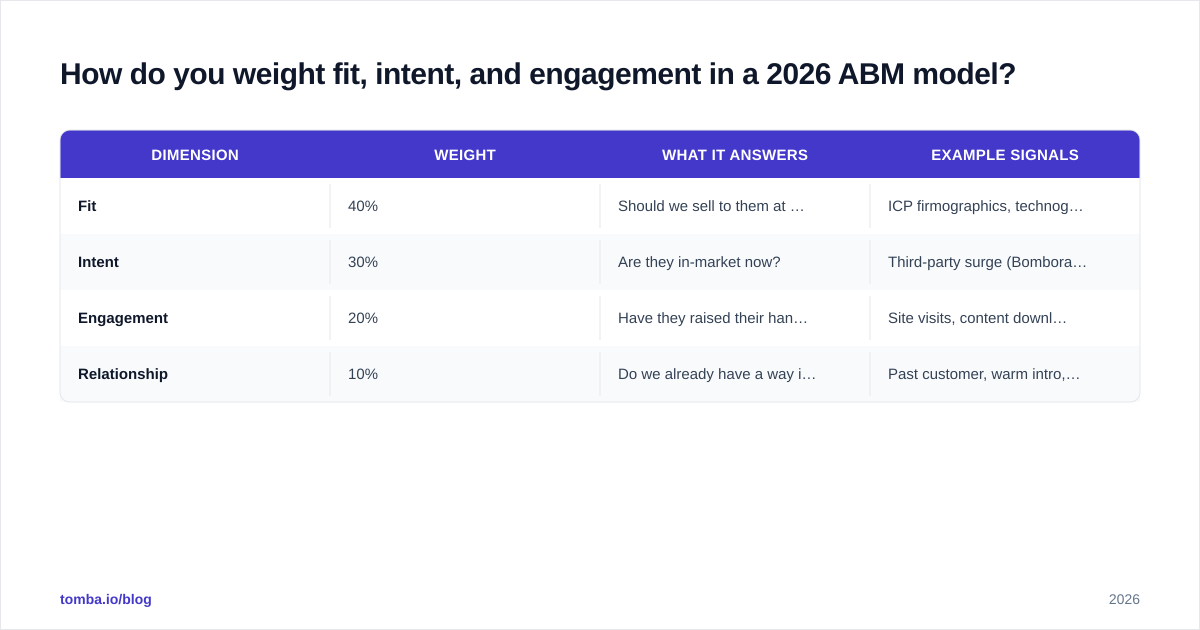
After auditing roughly 40 ABM programs in the last 18 months, here's the weighting that holds up across mid-market and enterprise:
| Dimension | Weight | What it answers | Example signals |
|---|---|---|---|
| Fit | 40% | Should we sell to them at all? | ICP firmographics, technographics, funding, org shape |
| Intent | 30% | Are they in-market now? | Third-party surge (Bombora), branded search, review-site visits, G2 category traffic |
| Engagement | 20% | Have they raised their hand? | Site visits, content downloads, demo requests, webinar attendance, email replies |
| Relationship | 10% | Do we already have a way in? | Past customer, warm intro, current champion at the account, vendor overlap |
The trap is letting intent creep above 30%. Intent data is loud and easy to over-weight because the dashboards are exciting. But fit is the only dimension where you actually control quality — you can't manufacture a $5B target if your sweet spot is $50M-$200M.
A worked example. An account scores 80/100 on fit, 20/100 on intent, 60/100 on engagement, 100/100 on relationship:
(80 × 0.40) + (20 × 0.30) + (60 × 0.20) + (100 × 0.10)
= 32 + 6 + 12 + 10
= 60
A 60 puts that account in Tier 2 — worth a 1:few play, not a custom executive program. If you'd weighted intent at 50%, that account would have scored even lower and might have been ignored entirely, despite being a strong-fit warm relationship. That's exactly the kind of misallocation a calibrated model prevents.
How do you tier accounts after scoring?#
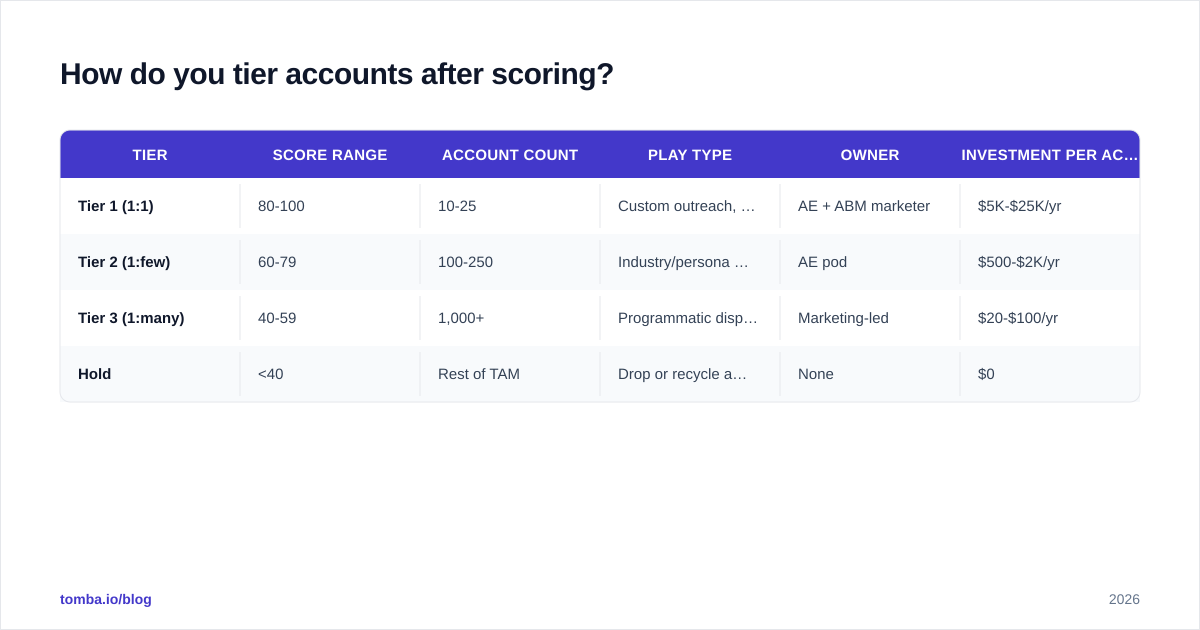
Once every account has a score, sort and tier. The cuts that hold up in practice:
| Tier | Score range | Account count | Play type | Owner | Investment per account |
|---|---|---|---|---|---|
| Tier 1 (1:1) | 80-100 | 10-25 | Custom outreach, exec sponsor, named research | AE + ABM marketer | $5K-$25K/yr |
| Tier 2 (1:few) | 60-79 | 100-250 | Industry/persona pods, semi-custom campaigns | AE pod | $500-$2K/yr |
| Tier 3 (1:many) | 40-59 | 1,000+ | Programmatic display, vertical content, light nurture | Marketing-led | $20-$100/yr |
| Hold | <40 | Rest of TAM | Drop or recycle after 90 days | None | $0 |
The count caps matter. Tier 1 over 25 accounts per AE is fiction — no rep can run a custom motion against more. If you have 12 reps, that's 300 Tier-1 accounts company-wide, hard ceiling.
Refresh tiers monthly. An account that scored 55 in March can spike to 78 in April if their CFO posts a "we're evaluating" comment on LinkedIn and three buying-committee members hit your pricing page. Promote it. Likewise, Tier 1 accounts that go cold for 90 days get demoted — protecting AE attention is the whole point.
Where does data quality break the model?#
A scoring model is only as good as the contact data feeding it. Three places teams quietly bleed accuracy:
Stale firmographics. A company that was 200 employees in 2024 is 800 employees today, but your CRM still shows 200. They jumped out of your ICP band 18 months ago and nobody noticed. Re-enrich your TAL quarterly with a data enrichment source you trust.
Missing buying committee contacts. The score says Tier 1, the rep opens the account, and there are two contacts: an intern from 2022 and a sales engineer who left. A great score with no working email is a dead end. Run every Tier 1 and Tier 2 account through an email finder to fill in the buying committee — typically Economic Buyer, Champion, User, and Technical Buyer — before the AE touches it.
Catch-all and role-based contamination. A "VP of Marketing" hit that turns out to be marketing@ does nothing for personalized 1:1 outreach. Layer a catch-all verifier so deliverability for Tier 1 plays stays above 95%.
The unglamorous truth: the team that wins ABM in 2026 isn't the one with the smartest model. It's the team whose model runs on contacts that actually exist.
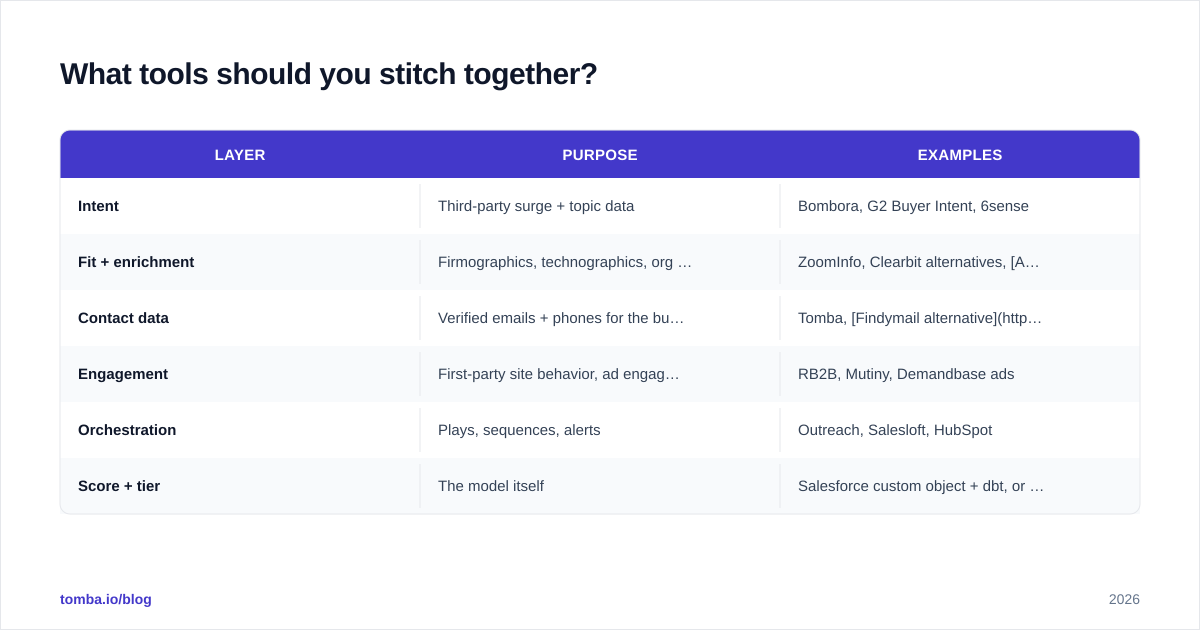
What tools should you stitch together?#
You don't need an end-to-end ABM platform. Most programs do better with composable pieces:
| Layer | Purpose | Examples |
|---|---|---|
| Intent | Third-party surge + topic data | Bombora, G2 Buyer Intent, 6sense |
| Fit + enrichment | Firmographics, technographics, org charts | ZoomInfo, Clearbit alternatives, Apollo alternative stacks |
| Contact data | Verified emails + phones for the buying committee | Tomba, Findymail alternative options |
| Engagement | First-party site behavior, ad engagement | RB2B, Mutiny, Demandbase ads |
| Orchestration | Plays, sequences, alerts | Outreach, Salesloft, HubSpot |
| Score + tier | The model itself | Salesforce custom object + dbt, or a RevOps tool like Calixa/Pocus |
The most common over-spend is buying a $90K orchestration platform before nailing the score. Build the model in a spreadsheet first, validate it against six months of closed-won, then automate.
How do you operationalize the score for reps?#
A score in a CRM column is invisible. Plays make it usable. Three concrete moves:
- Daily Tier 1 alert. Slack or email summarizing every Tier 1 account with a score change ≥ 5 points, intent spike, or new buying-committee hire. Reps open the day with a focused list, not a CRM safari.
- Tier-1 dossier auto-build. When an account hits Tier 1, fire an automation that pulls org chart, recent news, tech stack, and verified contacts (the email finder API is a clean way to enrich on-trigger) into a Notion or Salesforce doc. Reps stop wasting two hours on research per account.
- Quarterly tier review. Every quarter, RevOps and sales leadership review tier movement: which accounts moved up, which went cold, which closed. If <10% of Tier 1 closed in a quarter, the model is wrong or the plays are wrong — investigate before adjusting weights.
External reading on the play layer, if you want to go deeper: HubSpot's ABM guide and Gartner's research on account-based strategies are both reasonable second opinions.
How do you measure whether prioritization is working?#
Four metrics, reviewed monthly:
- Tier 1 meeting rate — % of Tier 1 accounts with at least one buying-committee meeting in the last 90 days. Target: >60%.
- Tier 1 pipeline conversion — % of Tier 1 accounts that became opportunities in the last 180 days. Target: >25%.
- Score-to-close correlation — closed-won accounts should cluster in the top score band. If your top decile closes at the same rate as your fourth decile, the model isn't predictive — rebuild.
- Coverage gap — % of Tier 1 and Tier 2 accounts with at least four verified buying-committee contacts. Target: >90%. Below 80% and your AEs are working ghosts.
The score-to-close correlation is the honest one. Everything else can be gamed by activity. If reps with the highest scores aren't closing at higher rates, the prioritization model is decorative.
How is ABM prioritization different in 2026?#
Three shifts changed the playbook this year.
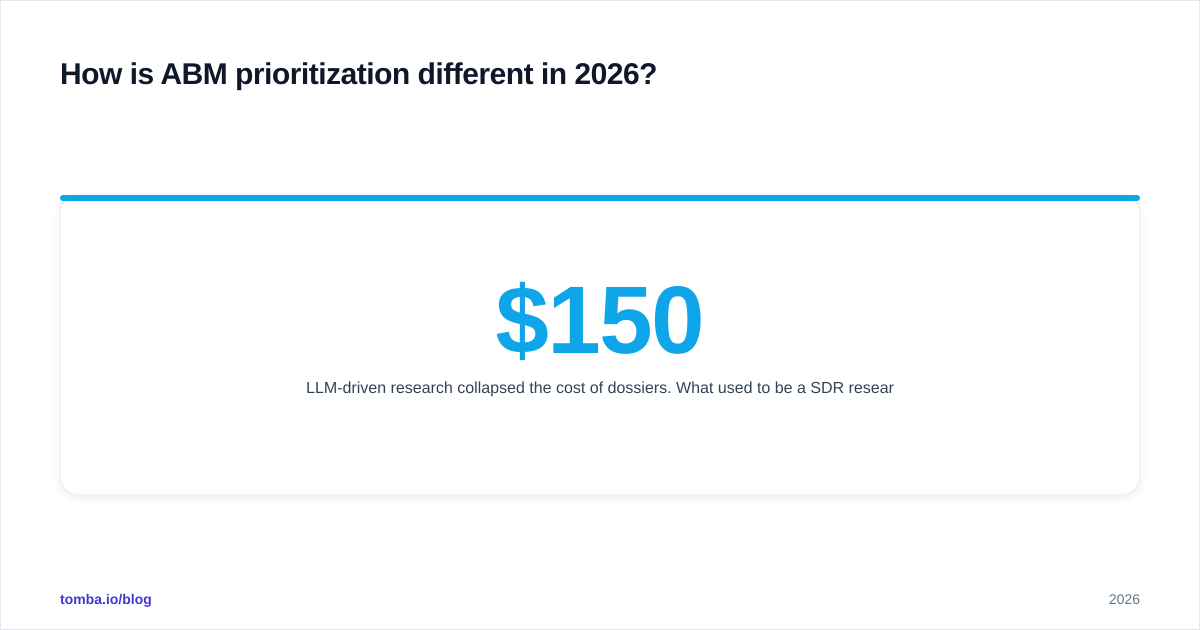
LLM-driven research collapsed the cost of dossiers. What used to be a $150 SDR research hour is now a $0.40 API call. You can afford to build Tier 1 dossiers for 250 accounts, not 25. That pushes the practical Tier 1 cap up and changes the count math above.
First-party intent matters more. With Bombora-style third-party intent now table stakes, the differentiation moved to first-party signals: visitor reveal, ad engagement, podcast listens, content depth. Programs that lean on first-party intent — sometimes via tools that reveal anonymous traffic — see roughly 2x conversion vs third-party-only programs.
Buying committees got bigger and quieter. Gartner pegs the average B2B buying committee at 6-10 stakeholders, and most never engage with sales until late. That means your engagement signal is structurally weaker than it was three years ago. Lean harder on fit and on multi-threaded outreach into the full committee — not just the champion who answered the demo request.
Build the list, then work the list#
If you take one thing from this piece: cut your priority list smaller than feels comfortable, score honestly, and make sure every account on the list has a real person attached to it. The teams that win ABM in 2026 aren't the ones running the fanciest score — they're the ones whose reps know which 50 accounts they're working this quarter and have a verified contact for the economic buyer at each one.
That last piece is where most programs quietly fall over. If you want a fast way to fix the contact-coverage gap on your Tier 1 and Tier 2 lists, the Tomba Email Finder will pull verified buying-committee emails by domain and role — feed it your scored TAL and you'll have working pipeline data inside an afternoon. Free tier is 25 searches; the Starter plan at $49/mo covers most pod-sized programs, with Growth at $99/mo if you're running 1:few at scale. Pricing details are on Tomba pricing.
// get started
Find, verify and enrich your first contacts today
Start on the free plan with 25 searches a month, then scale when your team is ready.
Free plan · No credit card required · GDPR & CCPA
// about the author