ABM Data Enrichment in 2026: Complete Playbook & Tools
ABM data enrichment turns flat account lists into prioritized, contactable buying committees. Here's how to build the stack — and where most teams waste budget.
TL;DR
- ABM data enrichment is the process of layering firmographic, technographic, intent, and contact-level data onto your target accounts so reps can engage the right buying committee with the right message.
- A usable ABM record needs at least four layers: account fit, buying-committee contacts, technographics, and intent — not just a verified email.
- Most teams overspend on intent platforms before fixing contact accuracy. Fix the contact layer first; intent without reach is noise.
- Pricing for a credible ABM enrichment stack in 2026 lands between $1,500 and $8,000/month for a mid-market team — not the $30k+ enterprise number vendors quote.
- Tomba covers the contact-discovery and verification half of the stack at $49–$249/month and slots into HubSpot, Salesforce, or your warehouse via API.
What is ABM data enrichment?#
ABM data enrichment is the practice of appending structured signals to your account-based marketing target list so your go-to-market team can prioritize, personalize, and reach the right buyers. Think of it like turning a blurry passport photo into a high-resolution dossier: the account ID was always there, but you couldn't act on it.
A flat ABM list usually contains a company name and a domain. An enriched ABM record contains the company, the buying committee (5–12 named contacts with titles and verified emails), the tech stack, recent funding or hiring signals, and behavioral intent. That's the difference between "we target Acme Corp" and "we target Acme Corp's VP of Data, who joined six weeks ago, owns the Snowflake migration, and just downloaded a competitor's whitepaper."
For a primer on the underlying contact-discovery work, see how domain search and data enrichment operate at the record level.
Why does ABM fail without enrichment?#
Account-based programs fail in predictable ways, and almost all of them trace back to thin data.
- Reps target the wrong company. Without firmographic enrichment, your "ICP" includes the 50-person agency that happens to share a name with the 5,000-person enterprise.
- Reps target the right company but the wrong human. The named-account list says "Acme — VP Marketing." Acme has three VPs of Marketing across regions. Without a buying-committee map, you guess.
- Messaging is generic. No technographics means no "I saw you're running Marketo and Segment" opener. Reps fall back to "I wanted to see if you'd be interested in a quick chat."
- Intent is unactionable. You buy a $30k/year intent platform, it fires a signal on Acme, but you have no verified contacts to act on. The signal expires.
According to Gartner, ABM programs that combine intent data with verified contact data outperform single-signal programs by a wide margin on pipeline conversion. The combination matters more than any individual layer.
What are the four layers of ABM enrichment?#
A defensible ABM data model has four enrichment layers stacked on the account record.
1. Firmographic layer#
Company size, revenue, industry (NAICS/SIC), HQ country, subsidiaries, parent company. This is the layer that confirms you're talking to a real ICP fit, not a name twin.
2. Buying-committee layer#
Named contacts per account with role, seniority, reporting line, and a verified email. Most teams stop at one or two contacts per account. For complex deals (>$50k ACV), you want 5–12 named contacts mapped to roles: economic buyer, technical evaluator, champion, end user, blocker.
3. Technographic layer#
Current tools in use — CRM, marketing automation, data warehouse, ticketing, etc. Pulled from JavaScript fingerprints, job postings, and integration directories. This is what unlocks personalization at scale.
4. Intent and behavioral layer#
Third-party content consumption (Bombora, G2, TrustRadius), first-party website signals (page visits, form abandons), and trigger events (funding, hiring, leadership change, M&A).
How do the top ABM enrichment platforms compare in 2026?#
The market splits into three groups: account-intelligence platforms (6sense, Demandbase), contact-data platforms (
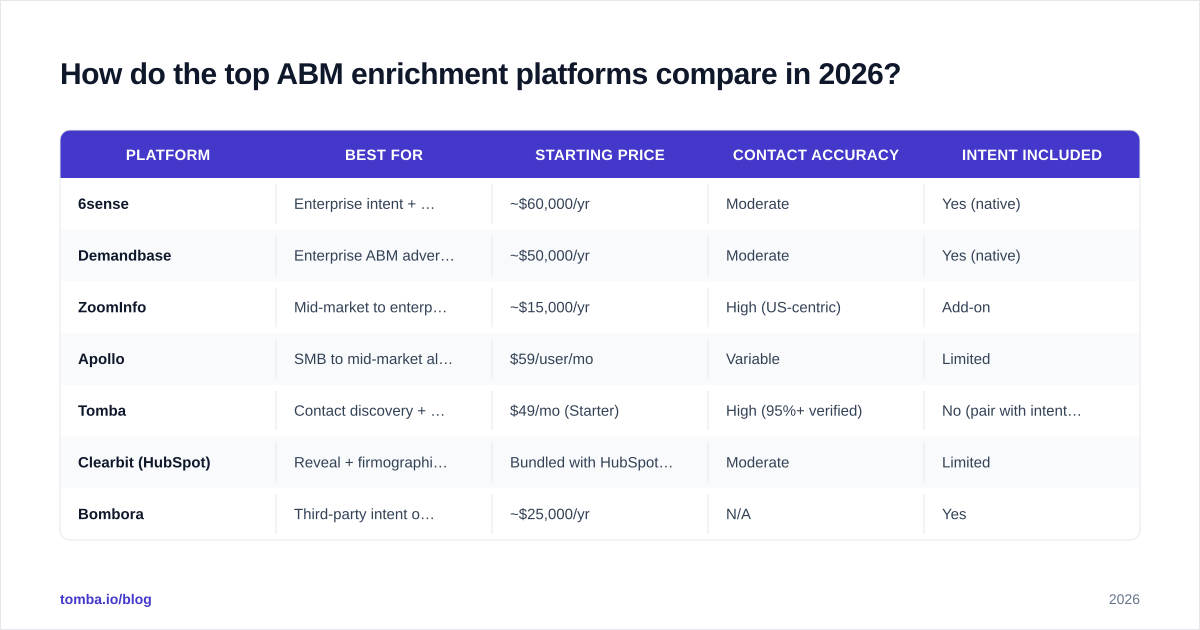
ZoomInfo, Apollo, Tomba), and intent-only platforms (Bombora, G2 Buyer Intent). Most mature teams run a hybrid.
| Platform | Best for | Starting price | Contact accuracy | Intent included |
|---|---|---|---|---|
| 6sense | Enterprise intent + ABM orchestration | ~$60,000/yr | Moderate | Yes (native) |
| Demandbase | Enterprise ABM advertising + intent | ~$50,000/yr | Moderate | Yes (native) |
| ZoomInfo | Mid-market to enterprise contact data | ~$15,000/yr | High (US-centric) | Add-on |
| Apollo | SMB to mid-market all-in-one | $59/user/mo | Variable | Limited |
| Tomba | Contact discovery + verification | $49/mo (Starter) | High (95%+ verified) | No (pair with intent vendor) |
| Clearbit (HubSpot) | Reveal + firmographics | Bundled with HubSpot tiers | Moderate | Limited |
| Bombora | Third-party intent only | ~$25,000/yr | N/A | Yes |
A common 2026 mid-market stack: Tomba for contact enrichment and bulk verification, Bombora or G2 for third-party intent, HubSpot or Salesforce as the system of record. That stack runs $1,500–$3,000/month all-in for most teams.

How accurate is ABM enrichment data in practice?#
This is the question vendors hate. Marketing pages quote "95% accuracy" universally. Independent testing tells a different story.
Real accuracy varies by:
- Geography — US data is consistently 10–20 points more accurate than EMEA, which is 10–20 points ahead of APAC.
- Seniority — C-suite and VP data is more stable than IC-level data because executives appear in press releases, filings, and bios. Director-and-below contacts churn faster.
- Recency — contact data decays at roughly 2–3% per month. A "verified" record from 18 months ago is functionally unverified.
- Verification method — SMTP verification beats pattern-matching. Catch-all domains require special handling via a catch-all verifier.
A practical accuracy benchmark: if your enrichment workflow produces fewer than 5% hard bounces and fewer than 15% no-reply rates on warmed-up sending infrastructure, the data layer is doing its job. Anything worse is a data problem, not a copy problem.
What does an ABM enrichment workflow actually look like?#
Here's the workflow a mid-market team should run in 2026. Each step is automatable.
- Define the ICP as a structured filter: industry, employee count band, revenue band, tech stack signals, geography.
- Seed the account list — pull from your CRM, your closed-won analysis, and a third-party database. Dedupe by domain, not by name.
- Firmographic enrichment — append company size, revenue, industry, HQ, subsidiaries. Score against ICP.
- Buying-committee mapping — for accounts above the fit threshold, find 5–12 contacts per account by role using a domain search or bulk email finder.
- Verify every email before it touches a sequence — bounce rate is the single biggest input to sender reputation.
- Technographic enrichment — append current stack signals so reps can personalize.
- Intent layer — overlay third-party intent (Bombora, G2) and first-party signals (web visits, form starts).
- Score and route — combine fit + intent + recency into a single account score. Route hot accounts to AEs, warm to SDRs, cold to nurture.
- Refresh quarterly — re-verify contacts, re-pull tech stack, re-score.
For teams without a Salesforce integration or HubSpot integration already in place, the workflow runs through a warehouse or through Zapier.
What's the right budget for ABM enrichment?#
Budgets that don't match team size waste money. Here's a rough sizing guide for 2026.
| Team profile | Monthly ABM data budget | Stack |
|---|---|---|
| 1–3 SDRs, <100 target accounts | $50–$300 | Tomba Starter + free HubSpot CRM |
| 5–15 SDRs/AEs, 500 accounts | $1,500–$3,000 | Tomba Pro + Bombora-lite + HubSpot Pro |
| 15–50 GTM, 2,000 accounts | $3,000–$8,000 | Tomba +ZoomInfo Mid + Bombora + Salesforce |
| 50+ GTM, 5,000+ accounts | $15,000+ | 6sense/Demandbase + ZoomInfo + Salesforce |
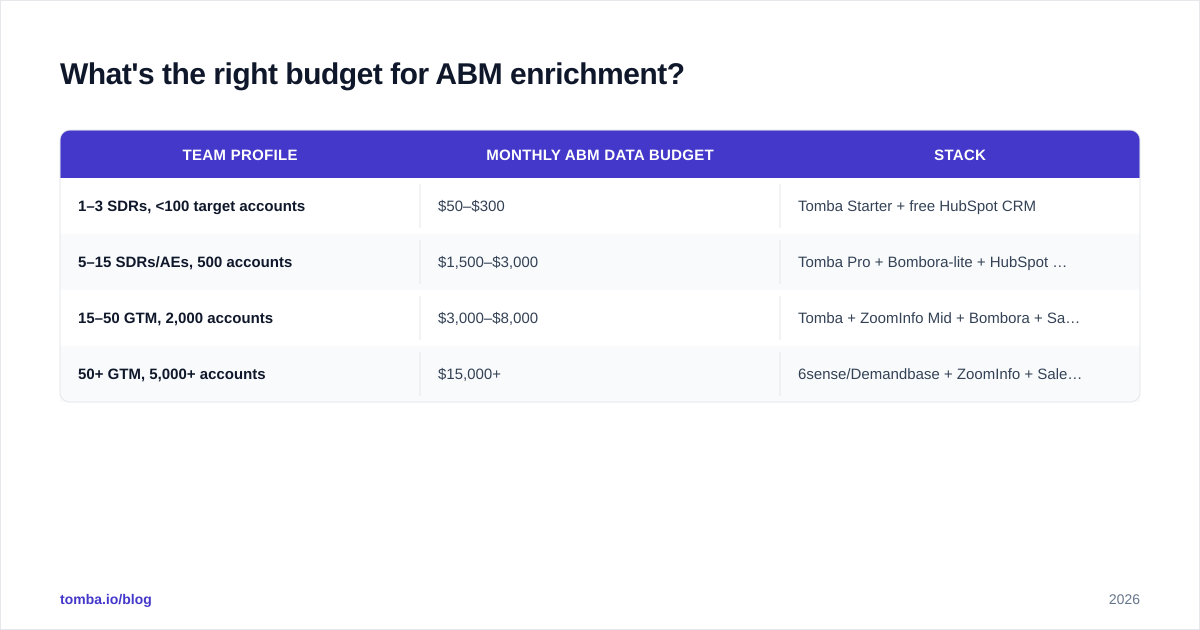
The biggest budget mistake teams make is buying enterprise intent before they have a clean contact layer. Intent fires on Acme; rep has no email for the buyer; signal dies. Fix the contact layer first.
How do you measure ABM enrichment ROI?#
Six metrics tell you whether your enrichment investment is paying off.
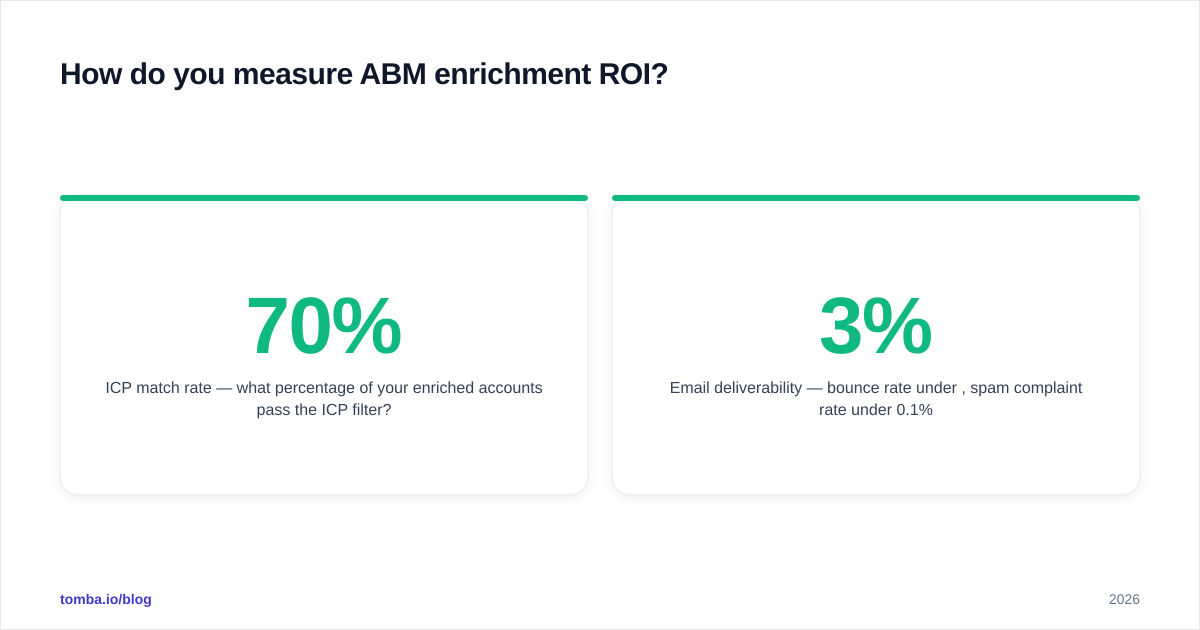
- ICP match rate — what percentage of your enriched accounts pass the ICP filter? Below 70% means your seed list is wrong.
- Buying-committee coverage — average contacts per target account. Target: 5+ for mid-market deals, 8+ for enterprise.
- Email deliverability — bounce rate under 3%, spam complaint rate under 0.1%.
- Reply rate by enrichment depth — segment your sequences by enrichment quality (full vs partial) and watch reply rate divergence. Fully enriched accounts should outperform partial by 2–3x.
- Pipeline-influenced rate — what share of new opportunities touched an enriched account?
- Cost per qualified opportunity — total enrichment spend divided by qualified opps. Use this to compare vendors honestly.
Forrester's research on B2B data quality consistently points to the same conclusion: data freshness and completeness are stronger predictors of ABM ROI than volume.
How does Tomba fit into an ABM enrichment stack?#
Tomba covers the contact-discovery and verification half of the stack. It does not replace an intent platform; it does replace the contact-data half of
ZoomInfo, Apollo, or Clearbit for most mid-market teams.
Where Tomba sits in the workflow:
- Buying-committee mapping — domain search returns all discoverable contacts at a target account, filterable by department and seniority.
- Contact verification — every email runs through SMTP-level verification plus catch-all detection.
- Bulk operations — bulk lead generation handles thousands of accounts per run for list-building.
- Enrichment — data enrichment appends contact data to existing CRM rows by email or domain.
- Integration — native HubSpot, Salesforce, and Pipedrive connectors, plus a developer API.
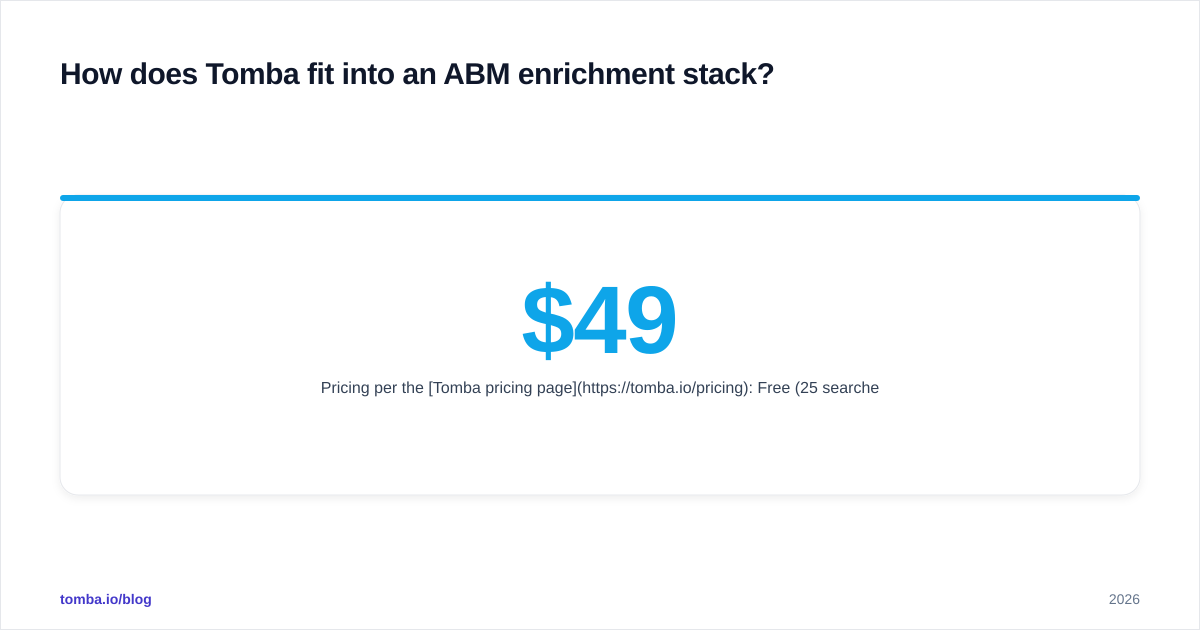
Pricing per the Tomba pricing page: Free (25 searches/mo), Starter $49/mo, Growth $99/mo, Pro $249/mo, Enterprise custom. Most ABM teams running 500–2,000 accounts land on Pro.
What are the common mistakes to avoid?#
A short list of patterns that burn budget without producing pipeline.
- Buying intent before contacts. Intent without reach is a dashboard, not a pipeline driver.
- Single-source enrichment. Every vendor has coverage gaps. Stack two contact sources before you trust the data.
- Skipping verification. Pattern-matched emails without SMTP verification bounce. Bounces destroy email deliverability.
- Static account lists. Companies change. Re-enrich quarterly at minimum.
- Over-fitting the ICP. Filters so narrow that your TAM shrinks below your quota math.
- Ignoring catch-all domains. 20–30% of mid-market domains are catch-all. Treat them differently.
Is ABM data enrichment worth it in 2026?#
Yes, but only if you sequence it correctly. The path that consistently works:
- Clean ICP definition first.
- Contact accuracy second.
- Technographics third.
- Intent fourth.
- Orchestration platform last (and only at enterprise scale).
Teams that try to start with an orchestration platform (6sense, Demandbase) before fixing the underlying data layer end up with a $60k/yr dashboard nobody trusts. Teams that start with contact accuracy and add intent on top see compounding returns within two quarters.
Ready to fix the contact layer?#
If your ABM program is stalling because reps can't reach the buyers your intent signals are pointing to, fix the contact layer first. Tomba's Email Finder gives you buying-committee mapping, SMTP-verified emails, and native CRM enrichment from $49/month — free to start with 25 searches and no credit card. Pair it with your intent vendor of choice and your ABM funnel finally connects end to end.
// get started
Find, verify and enrich your first contacts today
Start on the free plan with 25 searches a month, then scale when your team is ready.
Free plan · No credit card required · GDPR & CCPA
// about the author