Abstract API vs Apollo.io 2026: Honest Side-by-Side Comparison
Abstract API ships utility endpoints. Apollo.io ships a full sales platform. Here's where each one wins, where they fall short, and which fits your 2026 workflow.
TL;DR#
- Abstract API is a buffet of small, single-purpose REST endpoints (email validation, phone validation, IP geolocation, VAT lookup). It is built for developers, not sellers.
- Apollo.io is a full sales platform: a 275M+ contact database, email finder, sequences, dialer, and CRM sync. It is built for revenue teams, not engineers.
- Pricing models are nothing alike. Abstract charges per API call per product, starting free. Apollo charges per seat with credit caps, starting at $49/user/month.
- Pick Abstract if you need a verification endpoint inside your own app. Pick Apollo if you need a prospecting workspace your AEs will actually log into.
- If you want Apollo-grade B2B data with Abstract-style API simplicity and pay-as-you-go pricing, look at Tomba.
What is Abstract API?#
Abstract API is a developer-first platform that publishes a catalog of standalone REST APIs. Each product solves a single, narrow problem: validate an email, look up an IP, normalize a phone number, fetch a company logo, convert currency. There is no UI workflow, no CRM, no sequences. You sign up, grab an API key per product, and hit the endpoint from your code.
That focus is the appeal. Engineering teams use Abstract when they need to drop a verification step into a signup form, enrich a row in their internal admin panel, or filter a webhook payload. It behaves like a Swiss Army knife of small utilities.
The catch: each product is metered separately. The free tier on the email verification API is generous for testing, but production volume across two or three of their APIs adds up fast, and the data is shallow compared to what a true B2B database returns.
What is Apollo.io?#
Apollo.io sells a full go-to-market platform. The core is a contact and company database (Apollo claims 275M+ contacts and 73M+ companies as of 2026), wrapped in a workspace that includes an email finder, multi-channel sequences, a dialer, meeting scheduler, deal management, and bidirectional CRM sync with Salesforce and HubSpot.
Apollo is what a sales rep opens in the morning. They build a list of "VP of Marketing at 50-200 person SaaS companies in North America," pull the verified emails and phone numbers, drop the result into a 7-step sequence, and Apollo handles sending, tracking, and replying. Engineering teams use Apollo's API too, but the API is a side door — most usage happens in the UI.
That breadth comes at a cost. You buy seats, not requests. Credits are bundled per plan and most teams blow through them. The data is broader than Abstract's email-only universe but inherits the classic crowd-sourced data problem: stale titles, missing direct dials, duplicate records.
How do Abstract API and Apollo.io actually differ?#
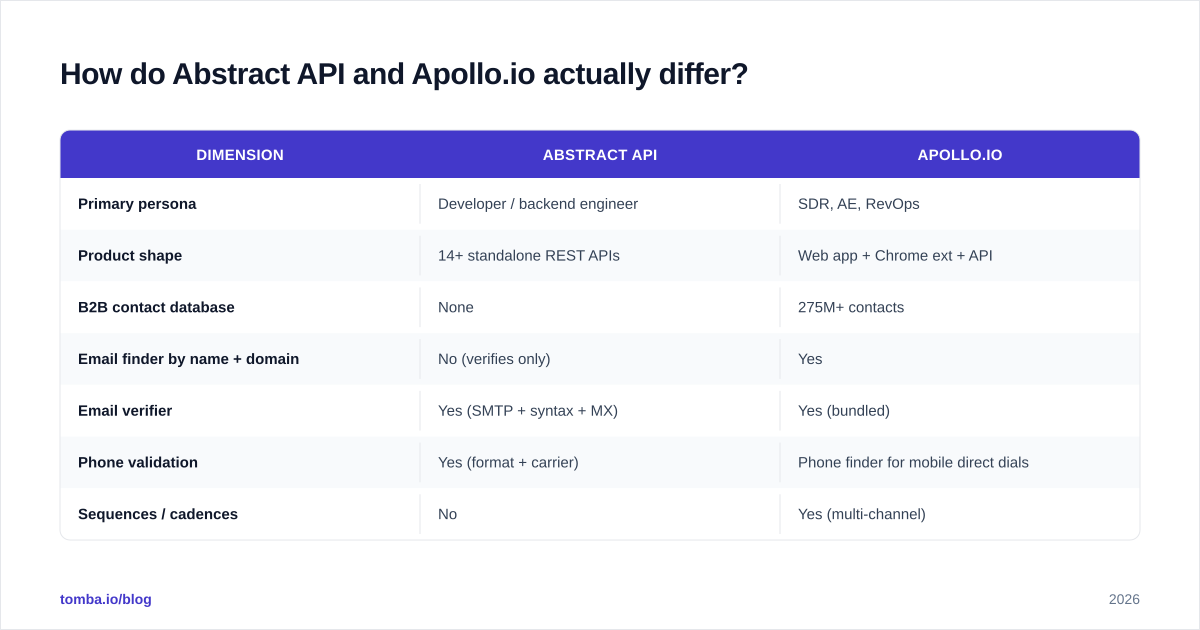
The two products barely overlap. Abstract API gives you a verification primitive. Apollo gives you a sales workflow that uses verification as one step inside a much larger funnel. The clearest way to see it is to put them next to each other.
| Dimension | Abstract API | Apollo.io |
|---|---|---|
| Primary persona | Developer / backend engineer | SDR, AE, RevOps |
| Product shape | 14+ standalone REST APIs | Web app + Chrome ext + API |
| B2B contact database | None | 275M+ contacts |
| Email finder by name + domain | No (verifies only) | Yes |
| Email verifier | Yes (SMTP + syntax + MX) | Yes (bundled) |
| Phone validation | Yes (format + carrier) | Phone finder for mobile direct dials |
| Sequences / cadences | No | Yes (multi-channel) |
| Dialer | No | Yes (Pro+) |
| CRM sync | No native | HubSpot, Salesforce native |
| Free tier | Yes, per product | Yes, 50 email credits/mo |
| Starting paid price | $9/mo (email API) | $49/user/mo (Basic) |
| Pricing model | Per API call, per product | Per seat + credit cap |
| API uptime SLA | 99.9% on paid plans | 99.9% on Enterprise only |
| Best for | Embedding validation in your app | Running an outbound team |

Is Abstract API better than Apollo.io for email verification?#
For pure verification, Abstract API is faster to set up. You get an endpoint, a key, and a JSON response with deliverability, is_valid_format, is_mx_found, is_smtp_valid, is_catchall_email, and quality_score. The free tier covers 100 requests per month, paid plans start around $9/mo for 5,000 requests, and the API is well-documented.
Apollo's verifier is bundled into the platform. You cannot really buy "just verification" from Apollo — you pay for a seat and verification rides along. If your only need is "tell me if this address bounces before I send," Abstract is the correct tool and Apollo is the wrong one.
But verification is rarely the whole job. Most teams that ask "is this email valid" actually need to find the email first, enrich the person, and then send to them. Apollo does all three. Abstract does one. That is why the comparison usually collapses into a different question: are you building software, or are you running outbound?
For deeper context on what makes a verifier reliable, read our breakdown on email deliverability and how SMTP checks differ from catch-all logic in our catch-all verifier guide.
How does pricing actually compare?#
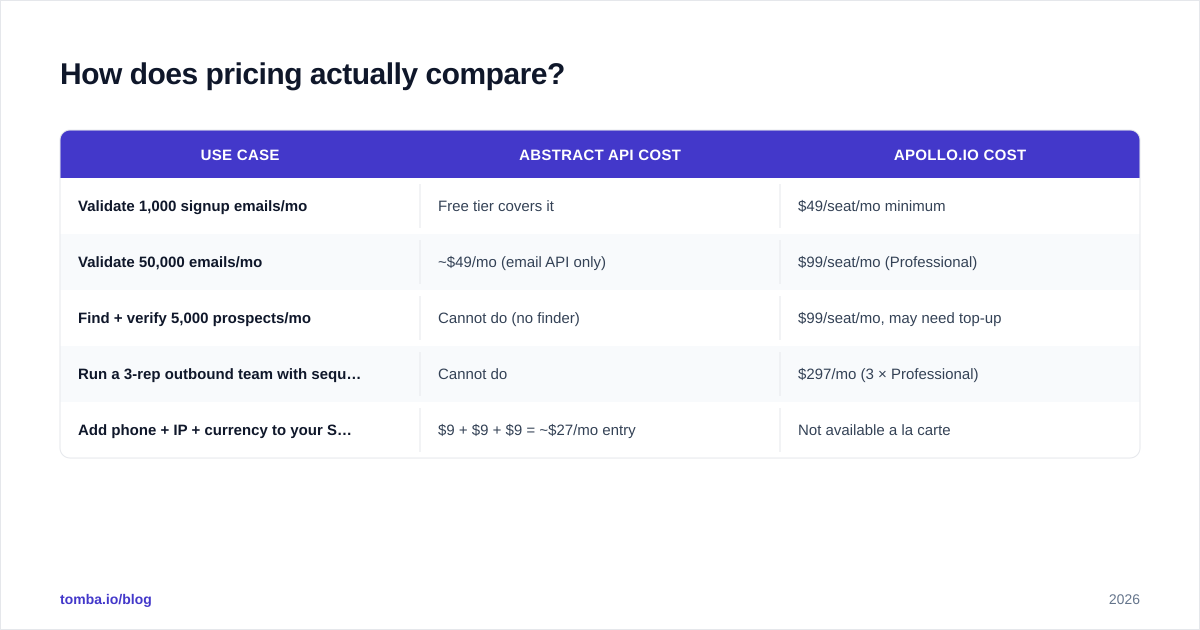
This is where most evaluations get confused. The two vendors charge for fundamentally different things, so a per-month sticker comparison is misleading until you map it to your usage.
| Use case | Abstract API cost | Apollo.io cost |
|---|---|---|
| Validate 1,000 signup emails/mo | Free tier covers it | $49/seat/mo minimum |
| Validate 50,000 emails/mo | ~$49/mo (email API only) | $99/seat/mo (Professional) |
| Find + verify 5,000 prospects/mo | Cannot do (no finder) | $99/seat/mo, may need top-up |
| Run a 3-rep outbound team with sequences | Cannot do | $297/mo (3 × Professional) |
| Add phone + IP + currency to your SaaS | $9 + $9 + $9 = ~$27/mo entry | Not available a la carte |
Abstract's model rewards narrow, embedded use. Apollo's model rewards a team that lives in the tool 8 hours a day. Mixing the two — paying Apollo seat fees but using it like an API — is the most common way teams overspend.
If you want predictable per-credit pricing without per-product fragmentation, the Tomba pricing page lays out a hybrid model: API and dashboard access included, with credits that work across email finding, verification, enrichment, and phone lookup.
What about data accuracy?#
Abstract does not publish a contact database, so accuracy means "how often does our SMTP probe correctly classify a deliverable address." Independent tests put their email verification accuracy in the high 80s to low 90s, which is competitive with mid-tier verifiers.
Apollo's data accuracy is a different conversation. Apollo's database is large and crowd-sourced, with strong coverage in North American mid-market SaaS and lighter coverage in EMEA, APAC, and SMB. Public reviews on G2 consistently flag stale titles after layoffs and missing mobile numbers as the biggest data complaints.

If accuracy is the deciding factor and you need a finder plus a verifier in the same pipeline, neither product is a clear winner on its own. Abstract has no finder. Apollo has a finder but its accuracy varies by region and segment. Running a small benchmark on 100 known-good contacts in your ICP is the only honest way to compare them for your use case.
Which tool fits which team?#
A simple decision rule, drawn from how teams actually use these products in production:
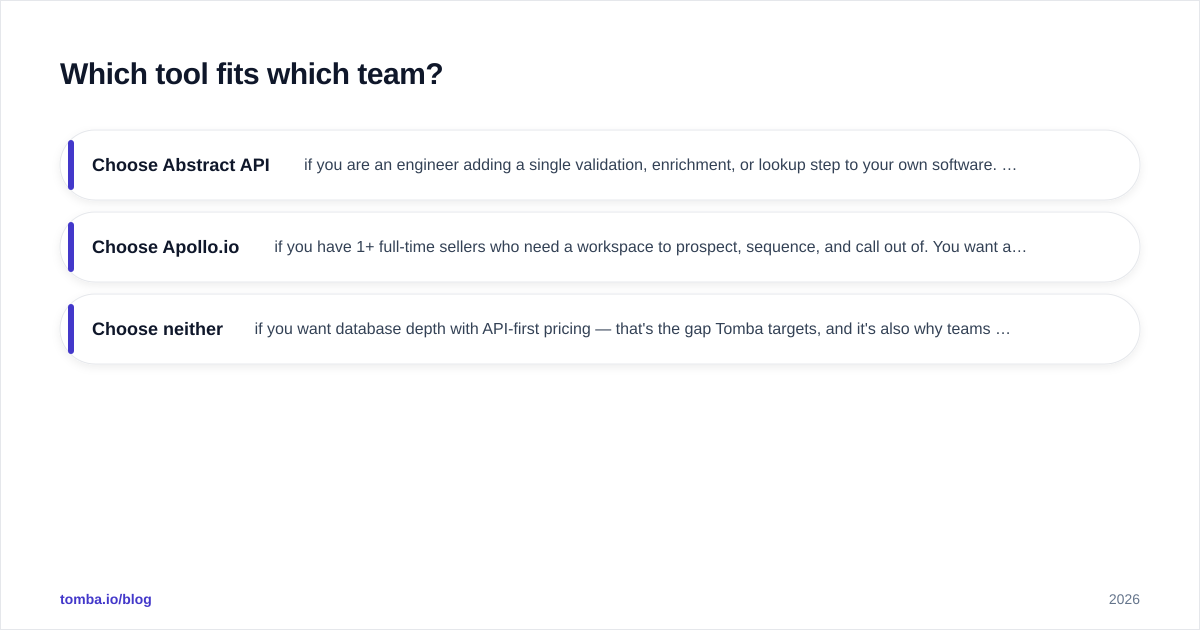
- Choose Abstract API if you are an engineer adding a single validation, enrichment, or lookup step to your own software. You want a
curl-able endpoint, predictable per-call pricing, and no UI you'll never log into. - Choose Apollo.io if you have 1+ full-time sellers who need a workspace to prospect, sequence, and call out of. You want a database, not an endpoint. Budget at least $99 per seat per month and accept that data quality varies by segment.
- Choose neither if you want database depth with API-first pricing — that's the gap Tomba targets, and it's also why teams compare Tomba against both vendors as an Apollo alternative.
Where does Tomba fit in the abstract api vs apolloio debate?#
Tomba sits between the two. The product is built API-first like Abstract — you can call the email finder API, the email verifier, the domain search, and the phone finder directly from your stack. But Tomba also ships a full UI, a Chrome extension, Excel and Google Sheets add-ins, and a B2B database so non-technical users can prospect without writing code.
Three concrete differences that matter when you're choosing:
- One credit pool across products. With Abstract, every API is a separate subscription. With Apollo, credits are bundled but capped per seat. With Tomba, credits work across finder, verifier, enrichment, and phone — you pick the operation, you pay for the result.
- Real source citations. When Tomba returns an email, the response includes the public sources it was found in. Apollo does not show provenance. Abstract has no finder to cite.
- No seat minimums. Tomba's Starter plan is $49/mo for a single account; Apollo's equivalent is $49/seat/mo with credit limits that force upgrades.
| Feature | Abstract API | Apollo.io | Tomba |
|---|---|---|---|
| Email finder | No | Yes | Yes |
| Email verifier | Yes | Yes | Yes |
| Source citations on results | N/A | No | Yes |
| Full B2B database | No | 275M contacts | Yes |
| Phone finder | Validation only | Mobile direct dials | Yes |
| Free tier | Per-product | 50 credits | 25 searches |
| Entry price | $9/mo (one API) | $49/seat/mo | $49/mo (Starter) |
| API-first | Yes | Partial | Yes |
| CRM integrations | None native | HubSpot, Salesforce | HubSpot, Salesforce, Pipedrive, |
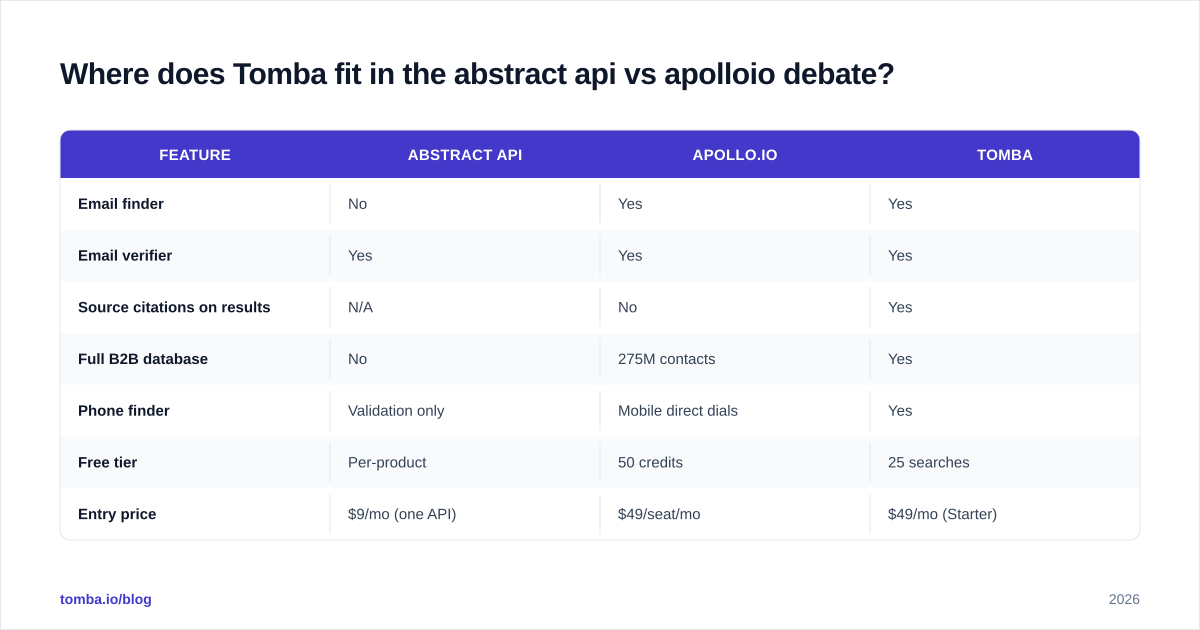
Zapier |

What are the most common gotchas with each tool?#
A short list of pitfalls teams hit in their first 30 days. Knowing them beforehand saves a billing call.
Abstract API gotchas
- Each API is metered separately. Buying three products at the Starter tier is not the same as one $27 plan — they bill as three subscriptions.
- The free tier rate limit (1 req/sec on most products) is too tight for any production bulk job.
- No SLA on the free tier. Production traffic needs a paid plan to get the 99.9% uptime guarantee.
- The phone validation API normalizes format and detects line type, but does not return a name or company — it is not a phone finder.
Apollo.io gotchas
- "Unlimited email credits" on higher plans is throttled by daily and weekly caps documented inside the product, not on the pricing page.
- Exporting a list to CSV consumes export credits that are separate from email credits.
- The Chrome extension's LinkedIn scraping is a frequent source of LinkedIn account flags. Use it carefully.
- Bidirectional CRM sync is included on Professional+ but the initial mapping is fiddly and easy to misconfigure.
When should you pick a third option?#
If your evaluation between abstract api vs apolloio keeps stalling, that is usually a signal that neither product is shaped right for your job. Three patterns we see:
- You need a finder, not just a verifier, but Apollo's seat-based pricing kills the ROI. A pay-per-result API like Tomba's solves this without forcing seats on engineers.
- You need verification at scale (millions of emails) for a marketing list cleanup. Both Abstract and Apollo will get expensive. A dedicated bulk verifier with bulk verify makes more sense.
- You're enriching CRM records, not prospecting. A pure data enrichment API beats both, because you already have the email — you need the rest of the profile.
Final verdict on abstract api vs apolloio#
Abstract API and Apollo.io are not really competitors. They sit in different categories that share a few overlapping words. Abstract is a developer utility belt with an excellent email verification endpoint. Apollo is a sales platform with a database that lives or dies by your ICP fit. Buying the wrong one because they sound similar is the most expensive mistake in this comparison.
If you came here to pick one and walk away: pick Abstract for embedded validation in your software, pick Apollo if you have humans doing outbound full-time, and try Tomba if you want API-first access to real B2B data without per-seat lock-in.
Ready to test the third option? Tomba's Email Finder gives you 25 free searches per month, source citations on every result, and one credit pool that works across finder, verifier, domain search, and phone finder. No seat minimums, no per-product subscriptions — just an honest API with a usable UI on top. Start with the free tier, scale to Starter at $49/mo when you're ready, and keep your stack simple.
// get started
Find, verify and enrich your first contacts today
Start on the free plan with 25 searches a month, then scale when your team is ready.
Free plan · No credit card required · GDPR & CCPA
// about the author