Abstract API vs DiscoverOrg (ZoomInfo): 2026 Comparison
Abstract API gives you developer-first email validation endpoints. DiscoverOrg (now ZoomInfo SalesOS) sells enterprise contact intelligence. Here's how to pick — and where Tomba fits.
TL;DR
- Abstract API is a pay-as-you-go developer toolkit — email validation, phone validation, IP geolocation — billed per call. Great for engineers who need a single endpoint inside an app.
- DiscoverOrg no longer exists as a standalone brand. It merged into ZoomInfo in 2019 and is now sold as ZoomInfo SalesOS — an enterprise GTM platform with contracts that typically start around $15K/year and climb fast.
- These two products are not really competitors. One is a $9–$249/month API; the other is a $15K–$100K/year sales intelligence suite. You pick based on whether you need data plumbing or a sales database.
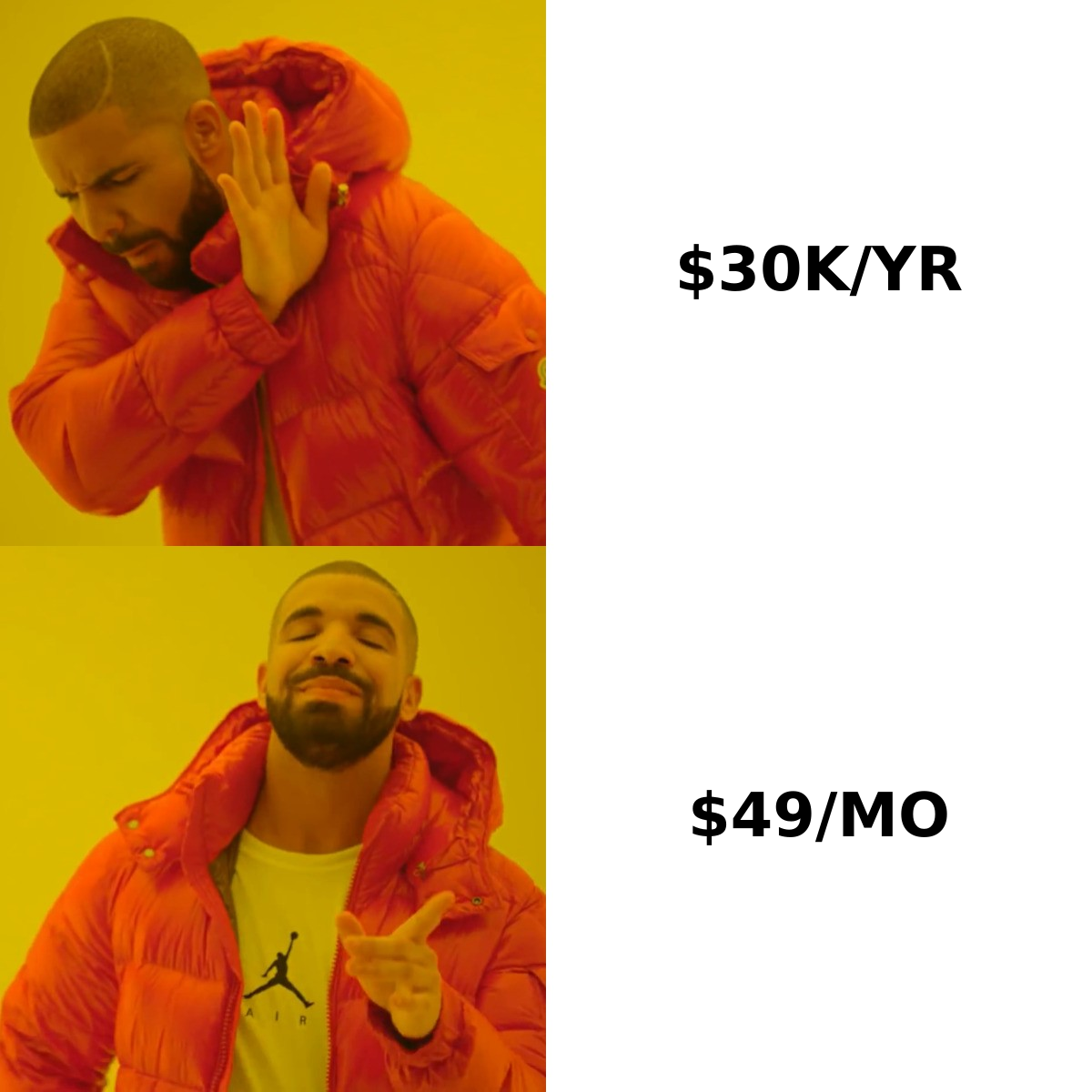
- If you want email-finder accuracy without the ZoomInfo contract — and richer enrichment than Abstract's validator-only stack — Tomba sits between the two at $49/month entry.
- Use this guide to decide which side of the spectrum your GTM team actually belongs on.
What is Abstract API?#
Abstract API is a collection of small, focused REST endpoints aimed at developers. Each product — Email Validation, Phone Validation, IP Geolocation, Company Enrichment, VAT Validation, and a dozen others — is sold as its own SKU with its own pricing table. You sign up, grab a key, and call the endpoint from your application.
The pitch is simplicity. Documentation is short. Responses are plain JSON. You don't need to know anything about GTM data infrastructure to ship the first call within an afternoon. That's the whole product personality.
What Abstract is not: a prospecting database, a CRM-grade enrichment layer, or a sales intelligence tool. There is no UI to search 100M contacts. There is no intent data. There is no buying-committee mapping. The email validation API tells you if john@acme.com is reachable — it will not tell you who John is, what he buys, or whether his company just raised a Series B.
What is DiscoverOrg — and does it still exist in 2026?#
This is the part that confuses most buyers. DiscoverOrg as a standalone product was retired. In 2019, DiscoverOrg acquired ZoomInfo, kept the ZoomInfo name, and folded the DiscoverOrg dataset (heavy on tech-vertical org charts and IT decision-makers) into what is now ZoomInfo SalesOS.
If a vendor tells you in 2026 that they're "DiscoverOrg" — they're either using the historical name as shorthand for ZoomInfo, or you're being shown legacy materials. The product you can actually buy is ZoomInfo, which inherited DiscoverOrg's research methodology: human-verified org charts, scoops on hiring and projects, and intent signals layered on top.
ZoomInfo SalesOS today bundles:
- Contact and company database (~100M+ professional profiles claimed)
- Intent data (via Bombora partnership)
- Workflow automation, sequences, and a native dialer
- Org charts, technographics, and scoops
- Integrations with Salesforce, HubSpot, Outreach, Salesloft
Pricing is not public. Public Gartner Peer Insights and G2 reviews put typical entry contracts at $15K–$30K/year, with multi-seat enterprise deals routinely landing six figures.
Abstract API vs DiscoverOrg: how do they compare?#
Apples and oranges, but here's the honest matrix.
| Attribute | Abstract API | DiscoverOrg /ZoomInfo SalesOS |
|---|---|---|
| Product type | Developer API, per-endpoint | Full sales intelligence platform |
| Primary buyer | Engineer | VP Sales, RevOps, Marketing Ops |
| Pricing model | Pay-as-you-go, monthly | Annual contract, seat-based |
| Entry price (2026) | Free tier; paid from ~$9/mo | ~$15,000/year typical floor |
| Contact database | None — validates inputs you supply | ~100M+ profiles, searchable |
| Email validation | Yes (core product) | Yes (bundled) |
| Phone numbers | Validates inputs only | Direct dials in DB |
| Intent data | No | Yes (Bombora) |
| Org charts | No | Yes |
| UI for sales reps | No (API only) | Yes, full SaaS app |
| Time to value | Hours | Weeks (onboarding + training) |
| Contract lock-in | None (monthly) | Typically 12-month minimum |
| Best for | Form validation, signup hygiene | Outbound at enterprise scale |
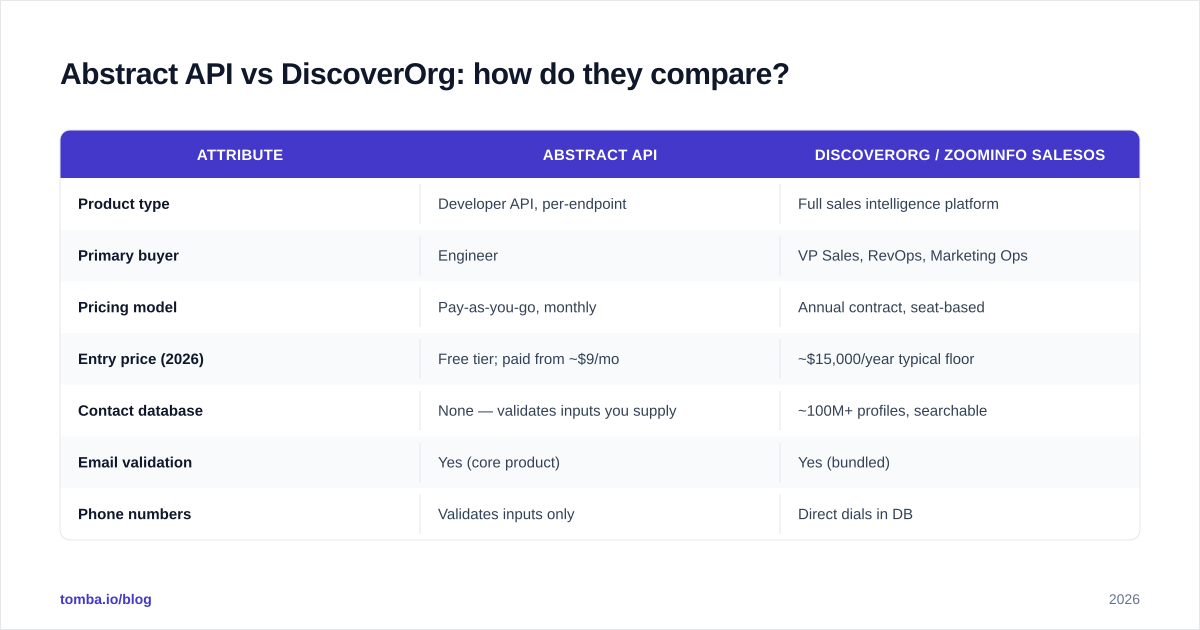
Read that table once and the question answers itself: these tools belong in different budget lines. Abstract is a developer tool. ZoomInfo (née DiscoverOrg) is a sales platform.
Is Abstract API enough on its own?#
For most teams reading a comparison post like this — no. Abstract validates data; it does not generate it.
If you want to send a cold email to a VP of Engineering at a fintech with 200–500 employees, Abstract has nothing for you. There's no search interface, no filters, no list of fintechs and their VPEs. You'd need to:
- Get a list of target companies from somewhere else
- Get names from LinkedIn (manually or via a separate tool)
- Guess email patterns
- Hit Abstract's email validator to filter the dead ones
That's a workflow, not a product. You're using Abstract as the last-mile filter, with the heavy lifting handled elsewhere. Compare that to a dedicated email finder that goes name + domain → verified address in one call, and it's obvious where Abstract's gap is.

Is DiscoverOrg/ZoomInfo worth $15K+ a year?#
Depends on three things: deal size, team size, and ICP density.
It earns its keep when:
- Your average contract value (ACV) is north of $25K and one extra closed deal pays for the year
- You have 5+ reps who use it daily — not 30 seats sitting idle in Salesforce
- Your ICP is concentrated in segments ZoomInfo covers deeply (mid-market and enterprise tech, financial services, healthcare in North America)
- You actually use the intent data and scoops, not just the contact list
It's a money pit when:
- You're a 1–3 person founder-led GTM team
- Your ICP is SMB, international, or very niche (long tail — ZoomInfo's coverage drops off fast outside its core segments)
- You only need email + phone, not the full workflow suite
- You'd never use intent data, sequences, or the dialer
Don't let a procurement-led RFP push you into ZoomInfo when a $99/month tool would do the same job. This is the most common mistake I see RevOps teams make in years 1–3.
How does Tomba fit in this picture?#
Tomba is in the middle: a real prospecting database (not just a validator) priced like an API tool (not like an enterprise platform).
Concretely:
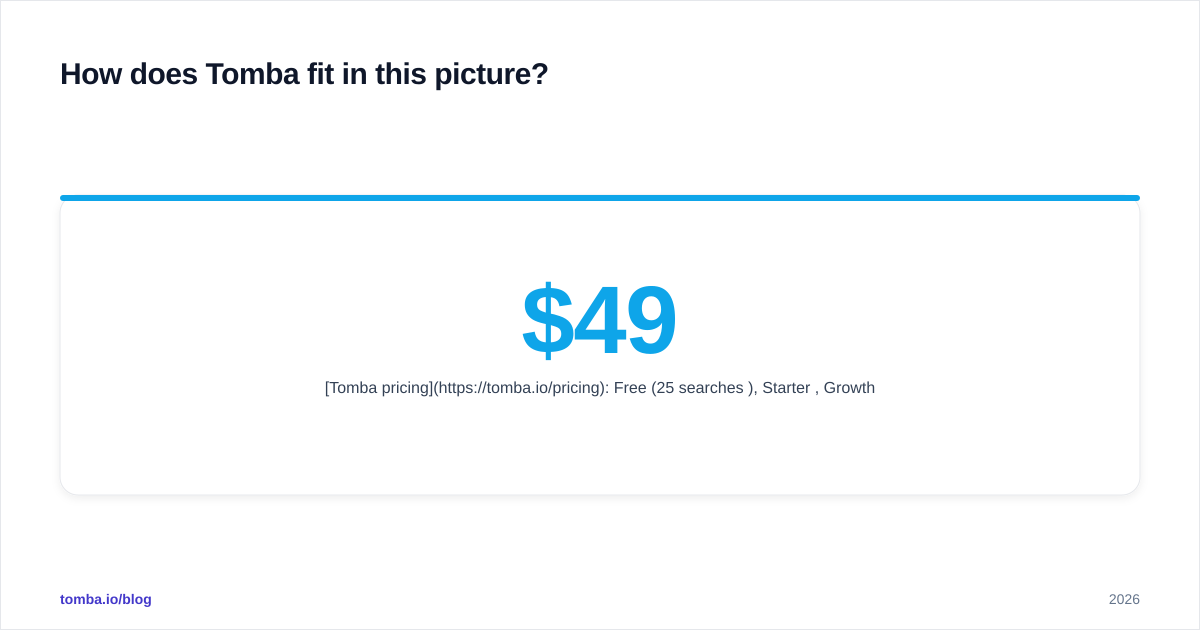
- Tomba pricing: Free (25 searches/mo), Starter $49/mo, Growth $99/mo, Pro $249/mo, Enterprise custom
- The email finder returns name + verified email from a domain
- The domain search lists every public email on a company domain
- The email verifier does the same SMTP-grade validation Abstract sells as its main product
- Bulk email finder handles list jobs without burning credits one by one
- Data enrichment adds firmographic and contact context — closer to
ZoomInfo's territory, at API pricing
- The Tomba API covers the developer-API use case Abstract is built for

Across independent benchmarks, dedicated email-finder tools — Tomba included — outperform generic validators on professional-domain accuracy, because they verify against a continuously rebuilt corpus rather than just running SMTP probes.

When do you pick which?#
A decision matrix that respects your actual stage:
| Situation | Best pick | Why |
|---|---|---|
| You're a developer adding signup email validation to a form | Abstract API | Pay per call, ship today |
| You need to enrich CRM records with verified emails | Tomba | Better email coverage at API price |
| You run a 20+ rep outbound team with $50K+ ACV | ZoomInfo SalesOS | Database + workflow + intent justifies the spend |
| Solo founder running cold outbound | Tomba Starter ($49/mo) | Find + verify in one tool |
| You need IP geolocation, VAT, currency lookups too | Abstract API | Multi-product developer suite |
| You need org charts and buying-committee mapping | ZoomInfo SalesOS | Nothing else in the same league |
| You want LinkedIn email extraction | Tomba's LinkedIn finder | Direct workflow integration |
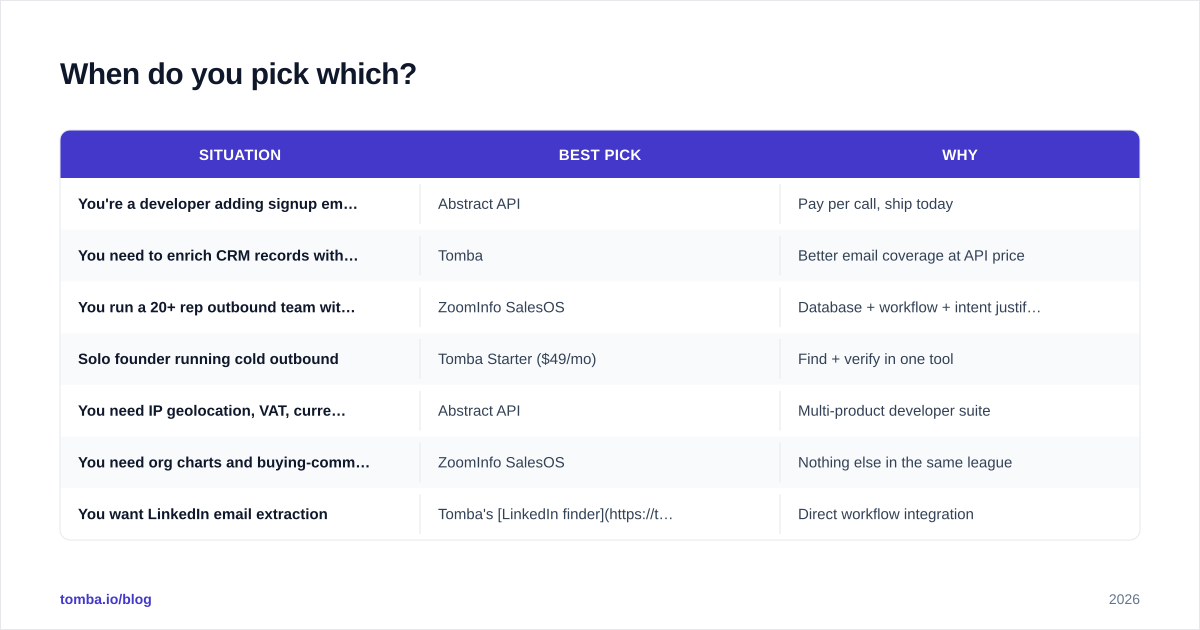
The clarifying question I'd ask any buyer: "Do you want a tool, or a database?" Abstract sells tools. ZoomInfo sells a database wrapped in a platform. Tomba sells both, at developer-tool prices.
What about accuracy and data sources?#
This is where buyers usually get oversold.
Abstract's email validation accuracy is competitive with most pure validators — they're all running broadly similar techniques (syntax, MX, SMTP ping, role-account detection, disposable-domain lists). Where things differ is what they do with catch-all domains. Abstract's free tier marks most catch-alls as "unknown." That's honest but it's not always actionable. Tomba's catch-all verifier goes further, using engagement history and pattern triangulation to give you a confidence score.
ZoomInfo's accuracy depends on segment. In its core ICP — North American mid-market and enterprise tech — its contact coverage is genuinely strong, partly because of the DiscoverOrg legacy of human research. Outside that core (SMB, EMEA, APAC, government), independent reviews show coverage that's no better than open-web scraping with verification on top.
If accuracy in your specific segment matters, run a pilot on 100 real leads against three vendors before signing anything. Don't trust marketing pages. The breakdown on where Tomba gets its data is more transparent than most peers, and worth reading as a baseline for what to demand from any vendor.
How do contracts and procurement compare?#
Friction is part of the cost.
Abstract: credit card, signup, done. You can be in production in an hour. Cancel any time.
ZoomInfo: SDR call, demo, scoping call, custom proposal, legal review, MSA, DPA, security questionnaire, and then 12-month annual contract paid up front (or quarterly if you negotiate). Plan 4–8 weeks from first touch to live access. Renewals are notoriously aggressive — expect 15–30% increase asks and auto-renew clauses unless you push back.
Tomba: self-serve, monthly or annual, transparent pricing on the website. Closer to Abstract's friction model.
If your team needs to move fast — testing a campaign, building an integration this week, validating a new ICP — procurement-heavy vendors silently cost you more than their sticker price. The opportunity cost of a 6-week procurement cycle on a 3-month outbound experiment is the experiment.
What does the integration story look like?#
Abstract is API-first, no native CRM apps. You build everything yourself, or wire it through Zapier/Make.
ZoomInfo ships dozens of native integrations — Salesforce, HubSpot, Outreach, Salesloft, Marketo, Eloqua, Slack, Chrome extension, dialer. Workflow automation is part of why you pay the premium.
Tomba sits closer to ZoomInfo on integrations than to Abstract: native HubSpot integration, Salesforce integration, Pipedrive, Zapier, Make.com, Google Sheets, Excel, Airtable, plus a Chrome extension and a full Tomba API for developers. You get both the API and the workflow integrations, without the contract.
What's the verdict?#
Three buyer profiles, three different answers:
Developer who needs to validate user-supplied data — Abstract API. Cheap, fast, focused. No need to overbuy.
Enterprise GTM team with $50K+ ACV and 10+ reps — ZoomInfo SalesOS (the modern DiscoverOrg). The database and workflow earn the contract.
Everyone in between — founders, SMB sales teams, mid-market RevOps, growth marketers, agencies — Tomba. You get a real prospecting database, native CRM integrations, an API for your engineers, and pricing that doesn't require a procurement department.
The mistake to avoid: assuming the most expensive option is the safest. It isn't. ZoomInfo seats sitting unused are one of the most common waste lines on a RevOps budget. Buy what your team will actually log into.
Get started#
Want to test the middle path before committing to anything? Start with Tomba's free tier — 25 searches a month, no credit card. Try the email finder on 25 real prospects in your ICP, run the same names through Abstract's email validator, and (if you can wangle a trial) put the same set in front of ZoomInfo. You'll have a concrete read on coverage and accuracy in under an hour, and you'll never again have to take a marketing page's word for it.
When you're ready to scale, Tomba pricing starts at $49/month — roughly what ZoomInfo charges for a single seat, per day.
// get started
Find, verify and enrich your first contacts today
Start on the free plan with 25 searches a month, then scale when your team is ready.
Free plan · No credit card required · GDPR & CCPA
// about the author