Abstract API vs Generect 2026: Which Lead Data Tool Wins?
Abstract API vs Generect compared on accuracy, pricing, coverage, and use cases. See which lead data tool fits your stack in 2026 — plus a third option worth testing.
TL;DR#
- Abstract API is a buffet of small utility APIs — email validation, IP geolocation, phone validation, VAT lookup — priced per endpoint and aimed at developers bolting validation onto a product.
- Generect is a B2B prospecting platform built around LinkedIn-style lead discovery, email enrichment, and intent signals — aimed at SDRs and revenue teams.
- They are not direct competitors. If you need infrastructure-level validation, Abstract API wins. If you need actual prospect contacts to sell into, Generect wins.
- Generect's email accuracy tends to land in the high 80s to low 90s on verified-business domains; Abstract API's verification is solid but does not source new emails — you bring the list.
- For most outbound teams in 2026, a dedicated email finder like Tomba Email Finder plus an enrichment layer beats either one head-to-head on cost-per-verified-contact.
What problem are you actually solving?#
Before you compare Abstract API vs Generect on a feature grid, name the job-to-be-done. The two products look adjacent because both touch "email data," but they sit at opposite ends of the outbound stack.
Abstract API is a developer toolkit. You sign up, get a key, and call a REST endpoint to check whether jane@acme.com is syntactically valid, has a working MX record, and isn't a known disposable address. The same account gets you IP geolocation, currency conversion, holiday calendars, and a dozen other micro-APIs. It is plumbing.
Generect is sales tooling. You log in, build a search ("Heads of Marketing at Series B SaaS in DACH, 50-200 employees"), and the platform returns matching people with work emails, LinkedIn URLs, and sometimes phone numbers. It is a faucet.
Picking between them like they are interchangeable is the most common mistake. Decide which side of the stack you need first.
What is Abstract API and who is it for?#
Abstract API launched as a fast, focused alternative to bloated validation suites. The pitch: each endpoint does one thing, has its own pricing, and is small enough to integrate in an afternoon.
The flagship endpoints relevant to a sales or growth team:
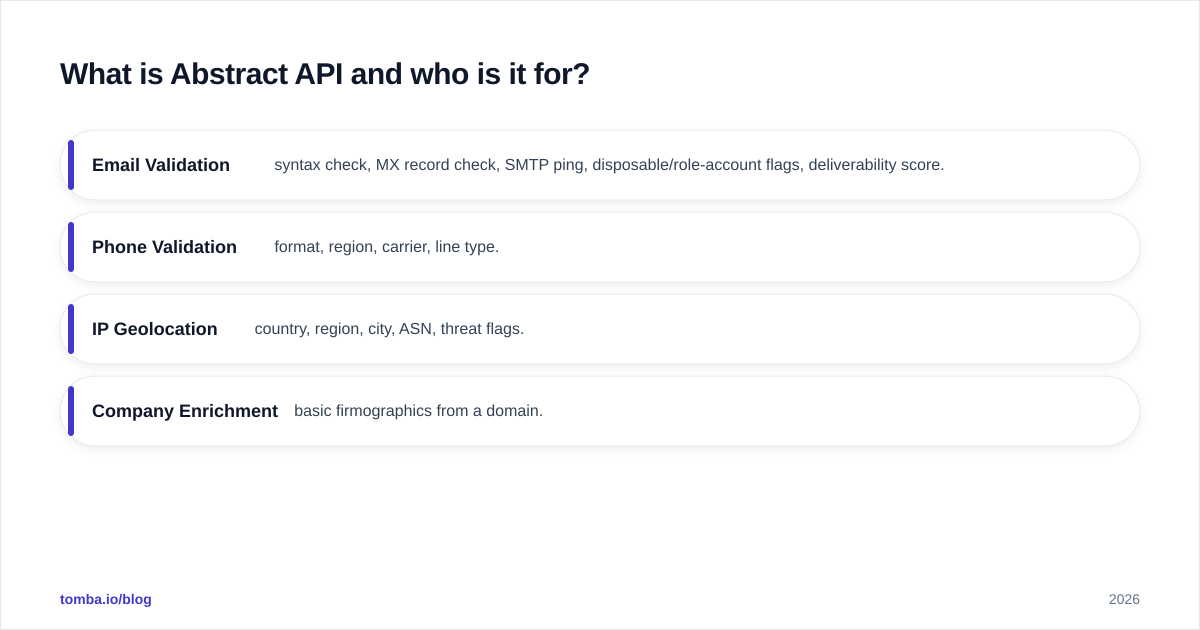
- Email Validation — syntax check, MX record check, SMTP ping, disposable/role-account flags, deliverability score.
- Phone Validation — format, region, carrier, line type.
- IP Geolocation — country, region, city, ASN, threat flags.
- Company Enrichment — basic firmographics from a domain.
Developers like Abstract because the response shapes are predictable, the docs are clean, and the free tier is generous enough for hobby use. It is the kind of tool you embed in a signup flow to reject test@mailinator.com before it pollutes your database.
What Abstract does not do: find someone's email when you only know their name and company. There is no "given Sarah Chen at Acme.com, return her work email" endpoint. You must bring the address. That single gap is the whole story of how it stacks up against Generect.
What is Generect and who is it for?#
Generect is a B2B lead generation platform. You feed it ICP filters — title, seniority, industry, headcount, geography, tech stack — and it returns a list of people with contact data. Under the hood it blends LinkedIn-scraped profile data, a proprietary email-pattern engine, and SMTP-level verification.
Generect's bread and butter:
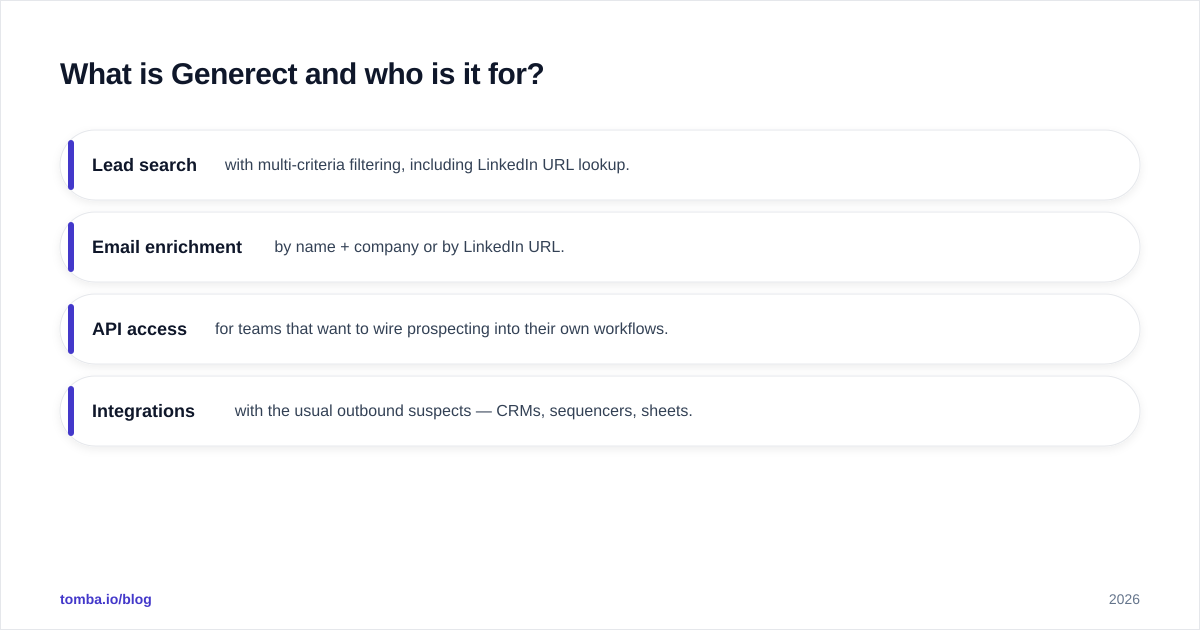
- Lead search with multi-criteria filtering, including LinkedIn URL lookup.
- Email enrichment by name + company or by LinkedIn URL.
- API access for teams that want to wire prospecting into their own workflows.
- Integrations with the usual outbound suspects — CRMs, sequencers, sheets.
The buyer is an SDR manager or a growth lead who needs to fill a sequence with 500 fresh contacts on Monday morning. Generect's accuracy on common patterns (firstname.lastname@, f.lastname@, first@) is competitive, and it covers a respectable swath of LinkedIn for a younger entrant.

Abstract API vs Generect: side-by-side comparison#
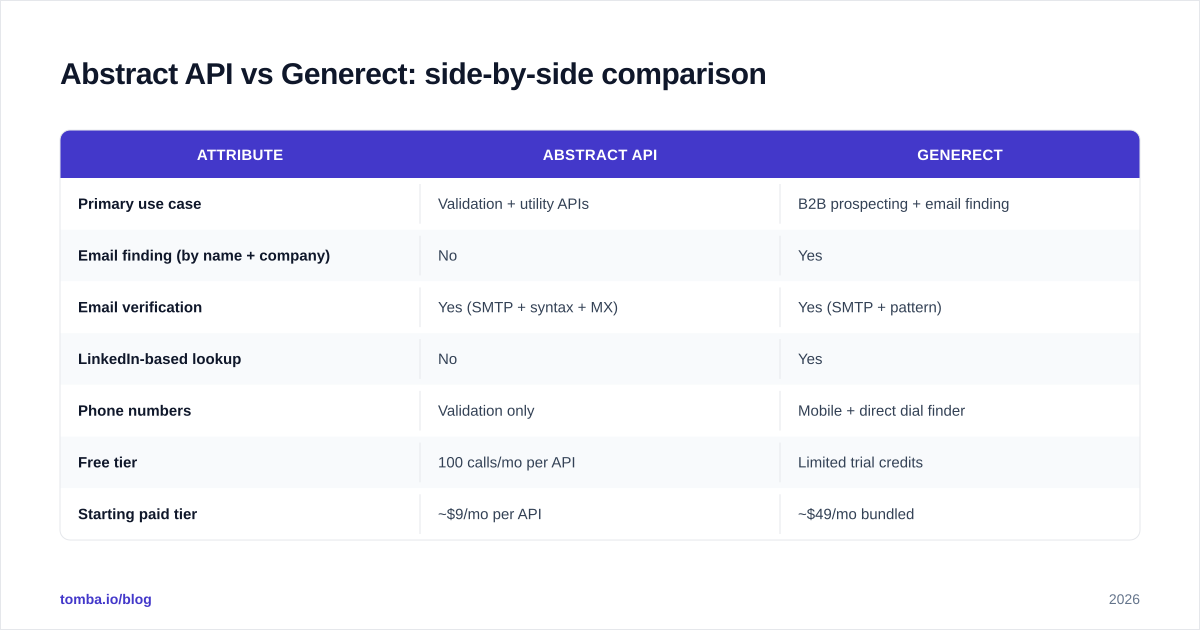
The two tools overlap on exactly one feature — checking whether an email is real — and diverge everywhere else.
| Attribute | Abstract API | Generect |
|---|---|---|
| Primary use case | Validation + utility APIs | B2B prospecting + email finding |
| Email finding (by name + company) | No | Yes |
| Email verification | Yes (SMTP + syntax + MX) | Yes (SMTP + pattern) |
| LinkedIn-based lookup | No | Yes |
| Phone numbers | Validation only | Mobile + direct dial finder |
| Free tier | 100 calls/mo per API | Limited trial credits |
| Starting paid tier | ~$9/mo per API | ~$49/mo bundled |
| API quality | Excellent docs, REST/JSON | Solid REST API, fewer endpoints |
| Bulk processing | Pay-per-call | Built-in bulk export |
| CRM integrations | DIY via webhooks | Native HubSpot, Pipedrive, Salesforce |
| Best for | Devs hardening product forms | SDRs filling outbound sequences |
If you map this against your own workflow, the answer often picks itself. A signup form that rejects junk emails is an Abstract job. A 2,000-lead outbound campaign for next quarter is a Generect job — or, more honestly, an email-finder job that Generect is one option for.
How accurate is each tool in practice?#
Vendor-published accuracy numbers are unreliable. Both companies will tell you they hit 95%+ on something — Abstract on validation correctness, Generect on email match rate. Real-world performance depends on your target market.
For European mid-market with strict catch-all behavior, expect:
- Abstract API verification — high precision on hard bounces (rarely says "valid" when it should say "invalid"), but conservative on catch-all domains where it tends to return "unknown."
- Generect email finding — strong on US tech companies and English-speaking markets, weaker on Asian and Eastern European domains where naming conventions vary.
The honest benchmark: blind-test 200 prospects from your actual ICP against three tools, then compare bounce rates after sending. Public studies overweight US SaaS and undercount everything else. If you need a deeper read on benchmarking methodology, the email deliverability glossary entry walks through what "verified" actually means at the SMTP layer.
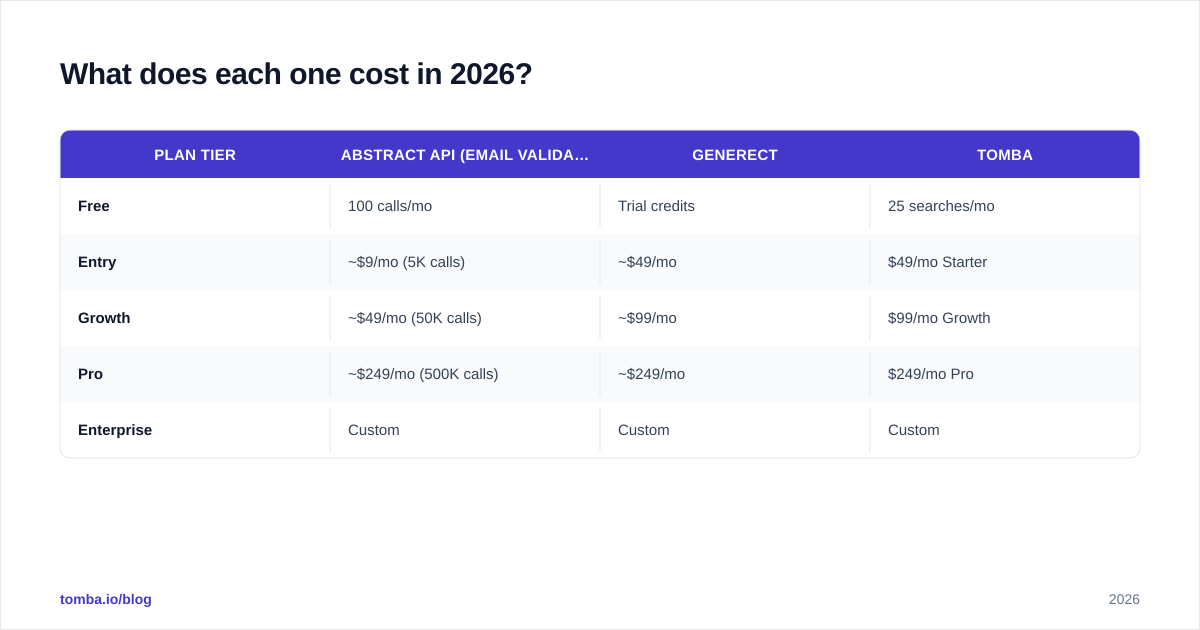
What does each one cost in 2026?#
Pricing pages move, so treat these as directional. Pull live numbers before signing anything.
| Plan tier | Abstract API (Email Validation only) | Generect | Tomba |
|---|---|---|---|
| Free | 100 calls/mo | Trial credits | 25 searches/mo |
| Entry | ~$9/mo (5K calls) | ~$49/mo | $49/mo Starter |
| Growth | ~$49/mo (50K calls) | ~$99/mo | $99/mo Growth |
| Pro | ~$249/mo (500K calls) | ~$249/mo | $249/mo Pro |
| Enterprise | Custom | Custom | Custom |
Two things to notice. First, Abstract's pricing is per-endpoint — if you also need phone validation, IP geolocation, and company enrichment, you pay for each separately. A team that wants three Abstract APIs can spend more than they would on a single bundled platform. Second, Generect's $49 entry price gets you finding + verification together, but the credit allotment is tighter than the equivalent dollar at a dedicated finder. Compare against Tomba pricing and the per-verified-contact economics shift again.
Is Abstract API better than Generect for developers?#
For pure developer ergonomics, yes. Abstract is the cleaner API. The endpoints are RESTful in a way that does not require reading three doc pages to make a first call. Response shapes are stable. Rate limits are explicit. Errors are descriptive.
Generect has an API, but the product is built around the web app first. The API exists to support customers who want to skip the UI, not to be the primary surface. If you are integrating into a product and weight matters, Abstract is the saner pick.
That said, "better API" is not the same as "better tool." A perfectly documented validation endpoint cannot find Sarah Chen's email for you. If finding is the job, no amount of clean JSON helps.
Is Generect better than Abstract API for SDR teams?#
For an outbound team, Generect is the more useful product. You can sit an SDR down in front of it and they will produce a list of prospects on day one. You cannot do that with Abstract — there is no list to produce, only emails to vet.
Where Generect competes well:
- Filter-rich search that maps to common ICP definitions.
- Native LinkedIn-URL-to-email enrichment, useful for Sales Nav exports.
- Built-in deduplication and CSV export.
- A UI that does not require API knowledge.
Where Generect lags:
- Coverage outside North America and Western Europe is thinner.
- Mobile/direct phone data is decent but not the deepest in the category.
- The integration catalog is narrower than the leaders.
For a deeper pool of competing tools, the Apollo alternatives and RocketReach alternative breakdowns map most of the field. Generect sits in the middle of that pack — capable, not category-defining.

When should you skip both and use a dedicated email finder?#
If your job is "find verified work emails for a known list of people or companies," neither Abstract API nor Generect is the most efficient pick. Abstract cannot find. Generect can, but bundles it inside a prospecting app you may not need.
A dedicated email finder gives you:
- Per-credit pricing that matches your actual usage.
- A domain search flow when you have a company but no specific contact.
- A bulk email finder for batch jobs.
- Built-in email verifier so you do not pay Abstract twice for the same record.
This is the path most lean outbound teams end up on after a year of stacking point tools. One finder + one sequencer + a CRM, instead of four overlapping subscriptions.
What does the decision tree look like?#
Walk through three questions in order:
- Do you need to discover new contacts, or only validate ones you have? Validate only → Abstract API or a dedicated verifier. Discover → keep going.
- Do you need a full prospecting UI, or just an API? Full UI → Generect or a broader platform. API-first → a dedicated finder with strong API docs.
- Are your verified-contact volumes predictable enough to pre-commit to a tier? Yes → bundled plan (Generect, Tomba Growth/Pro). No → pay-as-you-go credits.
Most teams who think they need Abstract API actually need a verifier as a feature of a finder, not a standalone product. Most teams who think they need Generect actually need a finder + a sequencer, and Generect's prospecting layer is a nice-to-have they could replicate with filters in their CRM.
What integrations and workflows matter in 2026?#
The outbound stack in 2026 is messier than it was three years ago. AI sequencers compose copy, intent platforms feed signals, and CRMs are the canonical source of truth. Wherever you land, your data tool must plug in cleanly.
Abstract API plugs in via raw HTTP — you write the integration. That is fine if you have engineering bandwidth, painful if you do not.
Generect publishes native connectors for HubSpot, Pipedrive, and Salesforce, plus the usual Zapier/Make hooks. For most non-technical teams that is enough.
For comparison, Tomba ships native HubSpot integration, Salesforce integration, Pipedrive integration, plus a Chrome extension, Google Sheets add-on, and Tomba API — covering both ends of the technical-comfort spectrum from the same account.
How do they handle compliance and data quality?#
Both vendors claim GDPR alignment. Abstract is straightforward because it does not source contact data — it only validates what you give it. Generect, like every B2B contact provider, sits in the trickier zone of compiling profile data from public sources. If you operate in the EU, run any prospecting tool past your DPO before scaling.
For background on the legal landscape, the Gartner B2B data market guides and G2's prospecting category both publish honest summaries of where the line sits in 2026.
Final verdict: which one wins?#
There is no single winner because they are not the same product.
- Pick Abstract API if you are a developer hardening a signup form, a checkout, or any product surface that takes user-provided data. It is well-built infrastructure at a fair price.
- Pick Generect if you are an SDR team that wants a single-pane-of-glass prospecting tool with passable email accuracy and reasonable integrations.
- Pick a dedicated email finder if you already have a CRM, a sequencer, and a clear ICP, and what you actually need is the contact data layer between them.
Run a 200-lead bake-off against your real ICP before you commit. Vendor demos are scripted; your industry is not.
Ready to test a focused alternative?#
If your bottleneck is finding verified work emails for the right people, skip the bundled tools and try the layer built for exactly that job. Tomba Email Finder gives you 25 free searches per month, transparent per-credit pricing from $49/mo, and the same SMTP-level verification baked in — no second tool, no second invoice. Run it against your next 200 prospects and compare bounce rates before you renew anything else.
// get started
Find, verify and enrich your first contacts today
Start on the free plan with 25 searches a month, then scale when your team is ready.
Free plan · No credit card required · GDPR & CCPA
// about the author