Abstract API vs Seamless.AI: Which Wins in 2026?
Abstract API and Seamless.AI solve different problems but get confused constantly. Here's the honest breakdown of pricing, accuracy, use cases, and where each one breaks in 2026.
TL;DR#
- Abstract API is a developer toolkit — email validation, phone validation, IP geolocation, and other REST endpoints priced per call. It is not a lead database.
- Seamless.AI is a B2B contact database with claimed AI-driven discovery, sold on credit packs to sales teams. It is not a validation API.
- Comparing them head-to-head only makes sense when you are deciding what layer of the stack you actually need — verification infrastructure or prospecting data.
- On verification accuracy, Abstract API holds its own against ZeroBounce and NeverBounce. On prospecting accuracy, Seamless.AI is widely reported to over-credit and over-promise — review the G2 transcript before signing.
- If you want both verification and a real B2B database in one bill, a unified vendor like Tomba is usually cheaper than running these two tools in parallel.
Why are people comparing Abstract API vs Seamless.AI?#
Because Google groups them. Search "B2B data tools" or "lead enrichment API" and both surface, even though they barely overlap.
Abstract API is a collection of utility REST endpoints: email validation, phone validation, IP geolocation, company enrichment, VAT lookup, holidays, exchange rates. Developers wire it into signup flows, fraud checks, and form validation. The pricing is per-call, the docs are clean, the SLA is uptime-focused.
Seamless.AI is a sales-led contact database. Reps log in, build a search ("VP of Marketing at SaaS companies, 50–200 headcount"), and spend credits to "find" emails and phone numbers. Marketing leans hard on the "real-time AI search engine" pitch.
So the honest framing for this post is: if you arrived here trying to pick between the two, you are probably mixing up two different problems. Below we'll separate them, then give you a clean call on which tool actually wins for each use case in 2026.
What does Abstract API actually do?#
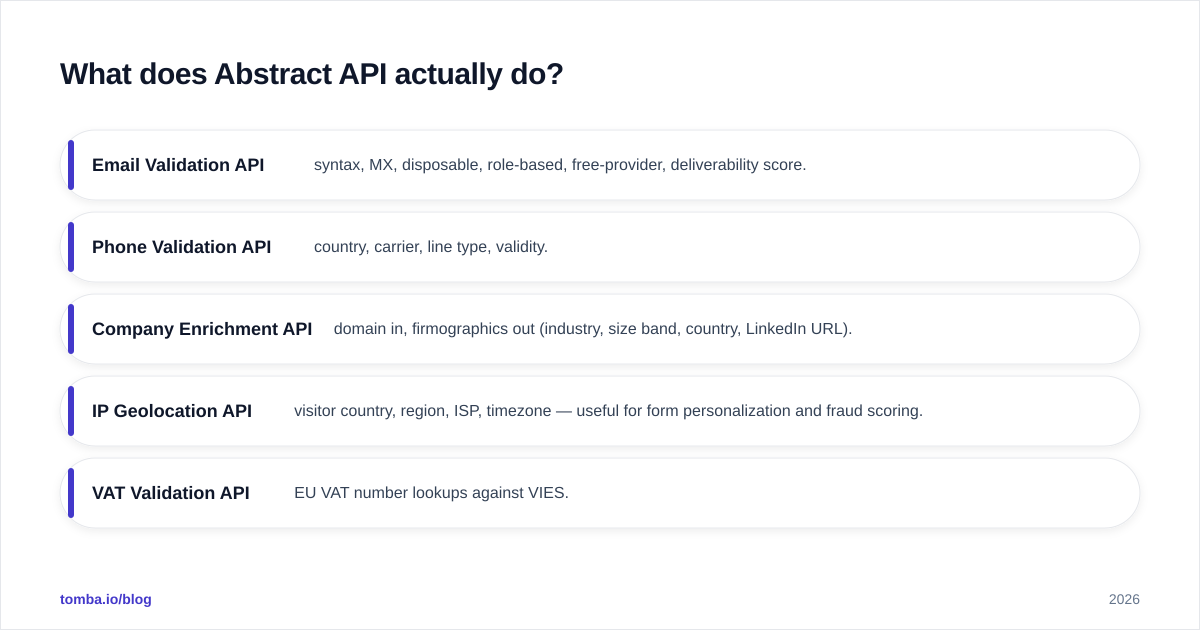
Abstract API ships about a dozen single-purpose APIs. The ones that matter for sales and growth teams:
- Email Validation API — syntax, MX, disposable, role-based, free-provider, deliverability score.
- Phone Validation API — country, carrier, line type, validity.
- Company Enrichment API — domain in, firmographics out (industry, size band, country, LinkedIn URL).
- IP Geolocation API — visitor country, region, ISP, timezone — useful for form personalization and fraud scoring.
- VAT Validation API — EU VAT number lookups against VIES.
Pricing is metered. The Email Validation API, for example, runs roughly $9/mo for 5,000 credits at the entry tier, and climbs by usage. You can mix and match endpoints under one account.
Where it shines: production traffic. Form-level validation, signup hygiene, anti-fraud checks, and any place you need a sub-second REST call with a 99.9% uptime expectation. The docs are direct, the SDKs cover Node, Python, PHP, Ruby, and Go, and you get back JSON you can hand to your frontend immediately.
Where it does not shine: building a prospect list. Abstract API does not let you say "give me all VPs of Sales at fintech companies in Texas." That is not what it is for. If you bought it expecting that, you bought the wrong tool.
What does Seamless.AI actually do?#
Seamless.AI is positioned as a "real-time" B2B search engine. You log into a web app, build a search by job title, company, industry, geography, and headcount, and the platform returns contact records you can unlock with credits. Unlocked records flow into a CRM (Salesforce, HubSpot, Pipedrive) via native integrations or Zapier.
The pitch is volume and "AI-verified" data. The reality, per public G2 reviews and Reddit threads, is more mixed:
- Some teams genuinely build pipeline with it, especially in mid-market US sales.
- Many users complain about wasted credits on bounced emails, outdated phone numbers, and aggressive renewal practices.
- The data feels strongest in US tech and weakest in EU and APAC.
Pricing is opaque on the public site and negotiated per seat plus a credit allocation. Annual contracts are standard. There is a free tier of 50 credits, but most actual users sit on paid plans starting in the $1,200–$2,000/year/seat range, depending on credit volume.
So Seamless.AI is a prospecting tool, not infrastructure. You do not embed it in a form. You do not call it from a signup webhook. It lives in the sales rep's browser tab.
How do they compare on pricing in 2026?#
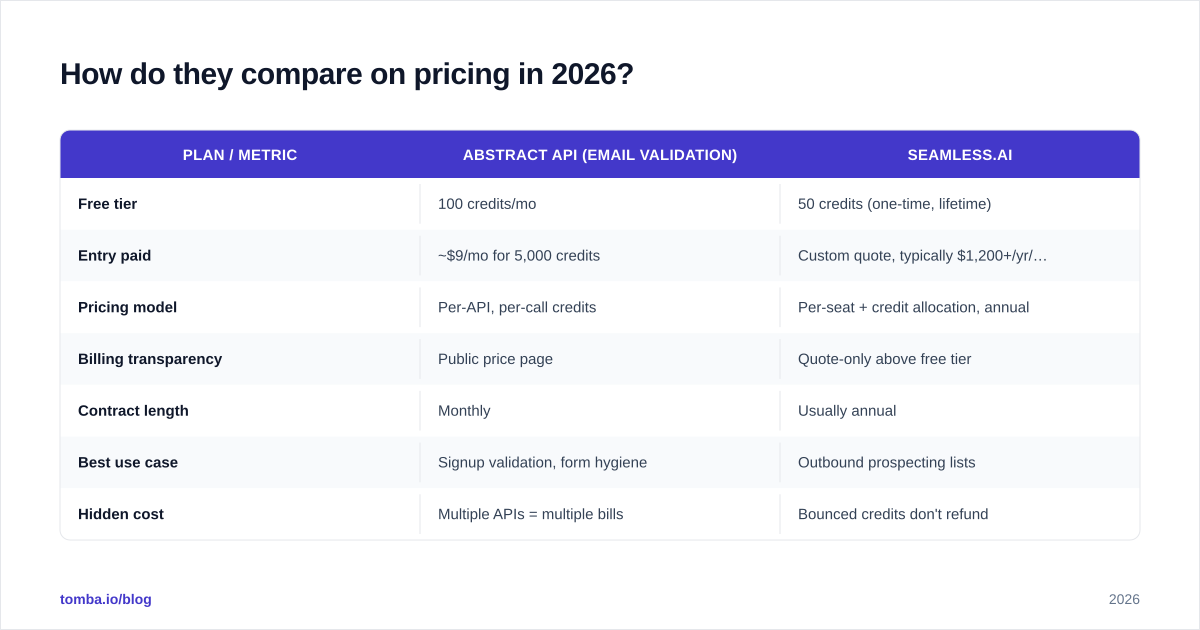
| Plan / metric | Abstract API (Email Validation) | Seamless.AI |
|---|---|---|
| Free tier | 100 credits/mo | 50 credits (one-time, lifetime) |
| Entry paid | ~$9/mo for 5,000 credits | Custom quote, typically $1,200+/yr/seat |
| Pricing model | Per-API, per-call credits | Per-seat + credit allocation, annual |
| Billing transparency | Public price page | Quote-only above free tier |
| Contract length | Monthly | Usually annual |
| Best use case | Signup validation, form hygiene | Outbound prospecting lists |
| Hidden cost | Multiple APIs = multiple bills | Bounced credits don't refund |
The pricing comparison is awkward because the units don't match. Abstract API charges for machine actions. Seamless.AI charges for human seats plus the right to unlock records. The honest read: if you only need email validation, Abstract API is dramatically cheaper. If you need a prospecting database, Abstract API does not solve the problem at all.
For a tool that bundles both at predictable monthly pricing, look at Tomba pricing — Starter is $49/mo, Growth $99/mo, Pro $249/mo, and every plan covers email finding, verification, and enrichment in one bill.

Which one is more accurate?#
Two different accuracy questions.
Verification accuracy (Abstract API's job). Independent tests place Abstract API's email validation in the same competitive band as ZeroBounce, NeverBounce, and Kickbox — typically 95–98% agreement on a known-good corpus. Catch-all domains are the universal weak point; nobody nails them at 100%. If verification is your only job, Abstract API is a defensible choice. So is a dedicated email verifier with a catch-all verifier module bolted on.
Prospecting accuracy (Seamless.AI's job). This is where the story changes. The most common Seamless.AI complaint is that credits get spent on records that bounce, go to ex-employees, or hit catch-all domains the platform marks as "verified." Public benchmarks of B2B databases over the last two years consistently rank Seamless.AI in the lower half on email accuracy, behind Apollo, Cognism, and unified finders like Tomba.
If you are evaluating prospecting tools specifically on accuracy, the benchmark image below is a useful starting reference — but always sanity-check vendor numbers against your own test list.

When should you pick Abstract API?#
Pick Abstract API when:
- You are a developer or engineering team and you need a REST endpoint, not a UI.
- You want to validate emails or phone numbers at the point of capture — signup forms, lead-gen forms, checkout.
- You need IP geolocation for fraud scoring, language routing, or pricing localization.
- You already have your prospecting data and you just need infrastructure to clean and enrich it.
- Your usage is bursty and you want monthly metered billing rather than an annual seat commitment.
Where it falls down: any "give me a list of decision-makers" workflow. Abstract has a company enrichment endpoint, but it returns firmographics from a domain, not contacts from a search query.
When should you pick Seamless.AI?#
Pick Seamless.AI when:
- You are running a US-focused, mid-market or SMB sales motion.
- Your reps live in a web UI and want a Chrome extension to grab contacts from LinkedIn.
- You have budget for annual seat-based contracts and are comfortable negotiating credit packs.
- You have the discipline to verify every unlocked email before loading it into your sequencer — because credits are non-refundable and bounce rates can hurt deliverability fast.
Where it falls down: API-first teams, EU/APAC coverage, anyone allergic to annual contracts, and any workflow that depends on the data being right on first try without a verification layer behind it.
What about the alternatives?#
This is the part most comparison posts skip. The honest answer is that very few teams only need one of these two. Most teams need a finder + verifier + enrichment in one place, sold with transparent monthly pricing.
A few alternatives worth considering:
- Tomba — email finder, verifier, domain search, catch-all verifier, phone finder, and enrichment under one account. Predictable monthly pricing from $49.
- Apollo.io — large B2B database with sequencing built in; heavier UI, broader scope. Worth reading our Apollo alternative breakdown.
- Cognism — strong EU/UK coverage, GDPR-aware, enterprise pricing.
- **
ZoomInfo** — the legacy heavyweight; deepest dataset, hardest contract.
- Seamless.AI alternative — for a direct swap with monthly billing.
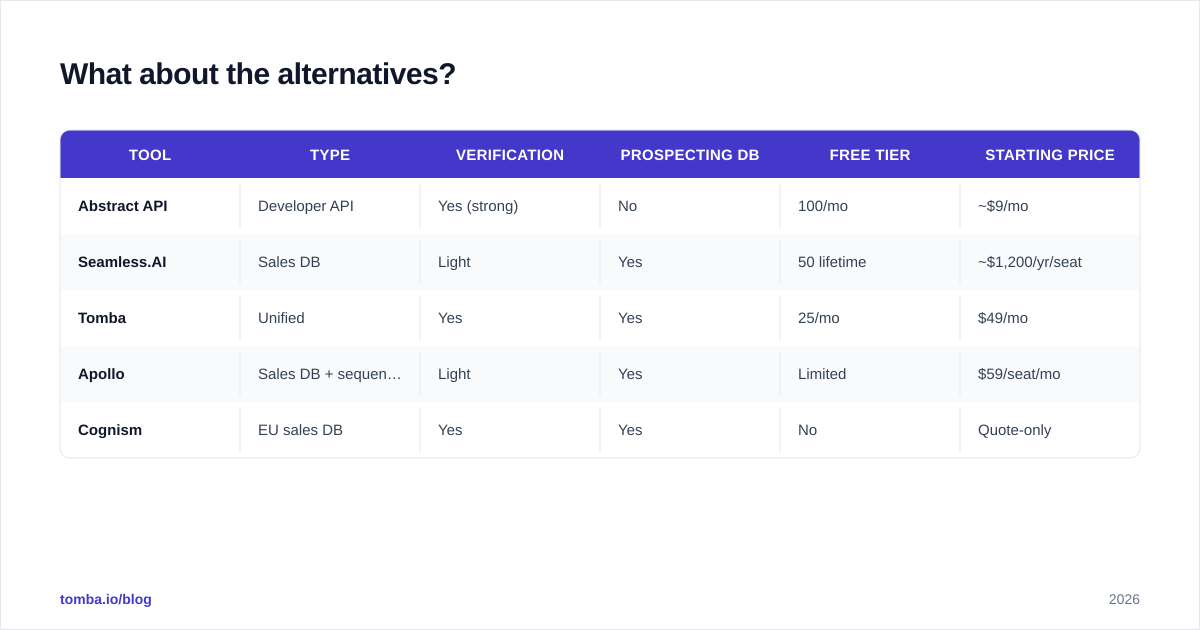
| Tool | Type | Verification | Prospecting DB | Free tier | Starting price |
|---|---|---|---|---|---|
| Abstract API | Developer API | Yes (strong) | No | 100/mo | ~$9/mo |
| Seamless.AI | Sales DB | Light | Yes | 50 lifetime | ~$1,200/yr/seat |
| Tomba | Unified | Yes | Yes | 25/mo | $49/mo |
| Apollo | Sales DB + sequencing | Light | Yes | Limited | $59/seat/mo |
| Cognism | EU sales DB | Yes | Yes | No | Quote-only |
Can you use them together?#
You can, and some teams do. A common pattern:
- Use Seamless.AI (or any database) to source new prospects.
- Run every email through Abstract API's validation endpoint before loading it into your sequencer.
- Use Abstract API's IP geolocation on form fills to route inbound by region.
This works, but you are now paying two vendors for a workflow a single tool can do. Many teams collapse the stack by using a unified solution that does domain search, email finding, and email verification under one API key — and saving the Abstract API budget for things only Abstract solves (VAT lookups, fraud scoring, holiday calendars).
What are the deal-breakers for each?#
Abstract API deal-breakers:
- You need a contact database with names, titles, and companies — Abstract does not have one.
- You need bulk list upload + verify from a CSV without writing code — possible via API but not a primary UX.
- You expect "AI-powered" prospect discovery — not the product.
Seamless.AI deal-breakers:
- You want monthly billing — most plans are annual.
- You operate primarily outside North America — coverage thins out fast.
- You cannot tolerate credit waste on bad data — the published complaint pattern is real.
- You need a REST API for production workflows — possible, but not the primary integration model.
How do you decide in one minute?#
Ask yourself two questions:
Am I building a product feature or a sales workflow?
- Product feature → Abstract API (or another developer-first API).
- Sales workflow → Seamless.AI, Apollo, or Tomba.
Do I need contact discovery or just data quality?
- Discovery → contact database (Seamless.AI, Apollo, Tomba).
- Quality → validation API (Abstract API, Tomba's verifier, ZeroBounce).
If you answered "both" to question 2, stop running two tools. Pick a unified vendor. The integration tax of two billing accounts, two API keys, two error-handling paths, and two renewals is rarely worth the marginal feature win.
The verdict#
There is no winner of "Abstract API vs Seamless.AI" because they are not in the same race. Abstract API is a clean, fairly-priced developer toolkit that does its job. Seamless.AI is a sales database with real coverage in the US mid-market but a credibility problem on data accuracy and an annual-contract sales motion that frustrates buyers.
If you are a developer who needs to validate emails, IPs, or VAT numbers, Abstract API is a reasonable buy. If you are a sales team that needs prospecting data, look past Seamless.AI to Apollo, Cognism, or a unified finder before signing an annual seat.
And if you want both jobs done under one bill, with monthly pricing and a free tier you can actually use to evaluate the product, try the Tomba Email Finder — find and verify contacts with one API key, one dashboard, and one renewal date. Start free with 25 searches a month, or jump to Starter at $49/mo when you're ready to scale.
// get started
Find, verify and enrich your first contacts today
Start on the free plan with 25 searches a month, then scale when your team is ready.
Free plan · No credit card required · GDPR & CCPA
// about the author