Abstract API vs ZoomInfo 2026: Which Data Stack Wins?
Abstract API and ZoomInfo target different buyers — one ships developer endpoints by the call, the other sells a six-figure B2B database. Here's which fits your stack in 2026.
Abstract API and ZoomInfo show up in the same Google searches, but they are not actually competing for the same buyer. One is a pay-as-you-go developer toolkit. The other is a six-figure enterprise B2B intelligence platform. Picking the wrong one means either over-spending by 50x or shipping a product that cannot scale past prototype.
This breakdown walks through what each platform actually does in 2026, where their data comes from, what they cost, and which type of team should write a check to which vendor.
TL;DR#
- Abstract API is a suite of 20+ standalone REST endpoints — email validation, IP geolocation, phone validation, company enrichment — priced per call, starting free.
- ZoomInfo is a full B2B intelligence platform with 100M+ contacts, intent data, org charts, and workflows — sold as annual contracts that typically start near $15K and climb past $100K.
- Use Abstract API when you need data inside your own product or a script — verification, enrichment, fraud checks.
- Use ZoomInfo when you have a sales team that needs prospecting lists, intent signals, and CRM workflows.
- For teams that want ZoomInfo-grade contact data without the enterprise contract, dedicated email-finders like Tomba sit in the middle: pay-as-you-go, API-first, contact-focused.
What is Abstract API?#
Abstract API is a developer-first platform that exposes individual data and validation endpoints as standalone REST APIs. Each product is sold as its own SKU — you do not buy "Abstract" as a single subscription. You pick the endpoints you need.
The catalog includes:
- Email Validation API
- Phone Validation API
- IP Geolocation API
- Company Enrichment API
- VAT Validation API
- Image Processing API
- Exchange Rates API
- Holidays API
The pitch is simple: you sign up, get a key, and start hitting endpoints in minutes. Most products have a free tier of a few hundred to a few thousand calls per month, and paid tiers scale linearly with volume. There is no minimum, no sales call, no annual lock-in.
Abstract API does not ship a prospecting UI, a CRM connector, or a list-builder. There is no "search for VPs of Engineering in fintech companies with 200-500 employees" experience. If you want that, you are looking at the wrong product.
You can find their full catalog at abstractapi.com.
What is ZoomInfo?#
ZoomInfo (now sold under the ZoomInfo Sales, Marketing, and Operations bundles) is an enterprise B2B intelligence platform. It is the closest thing the industry has to a default for outbound sales teams at companies above 200 employees.
The platform combines:
- A contact database of roughly 100M+ business professionals
- Company firmographics for 100M+ organizations
- Intent data (powered by Bombora signals + their own)
- Technographics (what software a company runs)
- Org charts and reporting relationships
- Workflows, sequencing, and conversation intelligence (via the Chorus acquisition)
- WebSights — anonymous visitor identification on your own site
ZoomInfo is sold through a sales process. There is no self-serve checkout. Contracts are annual, seat-based, and priced by data scope. Public reporting on G2 and industry posts consistently shows entry deals around $15K–$30K per year, with mid-market deployments landing in the $40K–$80K range.
Is Abstract API actually a ZoomInfo alternative?#
For most use cases — no, and the people Googling this comparison usually misunderstand one of the two products.
If your job is to:
- Build a list of 2,000 marketing VPs at SaaS companies in EMEA
- Trigger sequences based on funding rounds
- Score accounts by intent topic
- Enrich your CRM nightly with org chart changes
…then Abstract API cannot do that. It has no prospecting UI and its Company Enrichment endpoint is firmographic-only — you give it a domain, you get back industry, employee count, revenue band, location. There is no contact-level dataset to search.
If your job is to:
- Validate a signup form's email in real time
- Block a fraudulent IP at checkout
- Enrich a freshly captured lead with company size before routing it
- Add country detection to your billing flow
…then ZoomInfo is wildly over-engineered. You will be paying $30K+ for endpoints that Abstract sells for cents per call.
The Venn diagram looks like this:

How do Abstract API and ZoomInfo compare on pricing?#
This is where the gulf is widest. Abstract publishes prices.
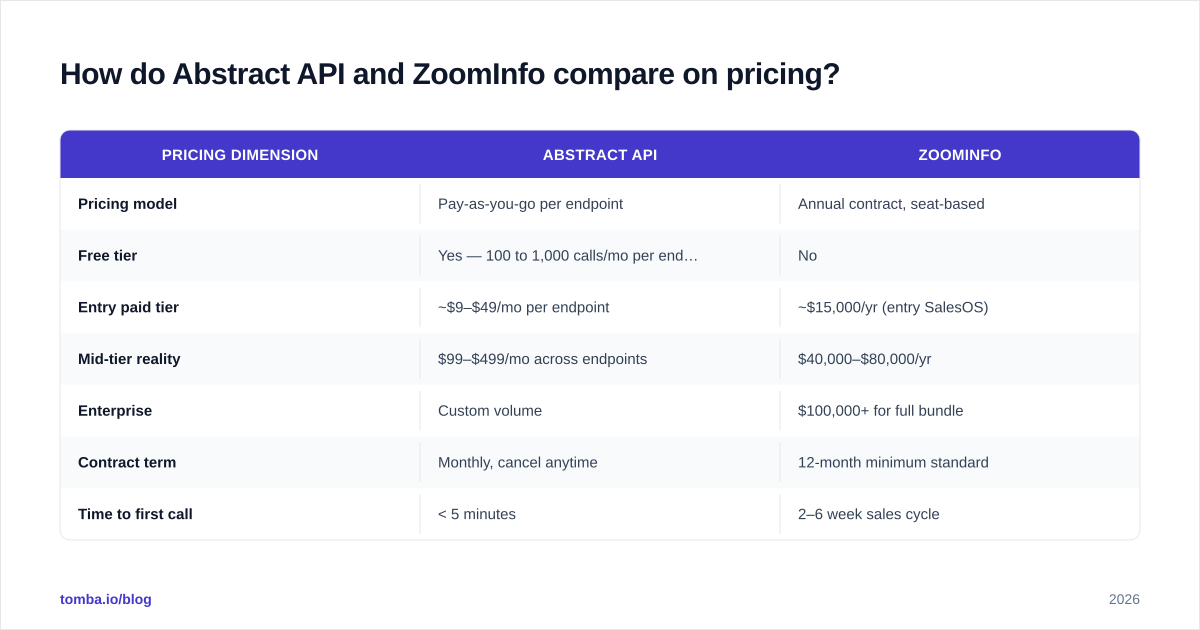
ZoomInfo does not.
| Pricing dimension | Abstract API | ZoomInfo |
|---|---|---|
| Pricing model | Pay-as-you-go per endpoint | Annual contract, seat-based |
| Free tier | Yes — 100 to 1,000 calls/mo per endpoint | No |
| Entry paid tier | ~$9–$49/mo per endpoint | ~$15,000/yr (entry SalesOS) |
| Mid-tier reality | $99–$499/mo across endpoints | $40,000–$80,000/yr |
| Enterprise | Custom volume | $100,000+ for full bundle |
| Contract term | Monthly, cancel anytime | 12-month minimum standard |
| Time to first call | < 5 minutes | 2–6 week sales cycle |
| Public price list | Yes | No |
The honest read: if you are a developer at a startup who needs email validation on a signup form, ZoomInfo is not a real option. If you are a 50-rep sales team that needs sequenced outbound on enriched accounts, Abstract API is not a real option.
How does data accuracy compare?#
These two products do not even validate against the same data. So accuracy has to be measured per use case.
Email validation accuracy
Abstract API's Email Validation product performs syntax, DNS, MX, and SMTP-level checks. Public benchmark posts have placed it in the 90–95% accuracy band on disposable detection and around 92% on deliverability prediction. Independent reviews on G2's email verification category put it in the upper-mid pack — better than free tools, behind specialists like
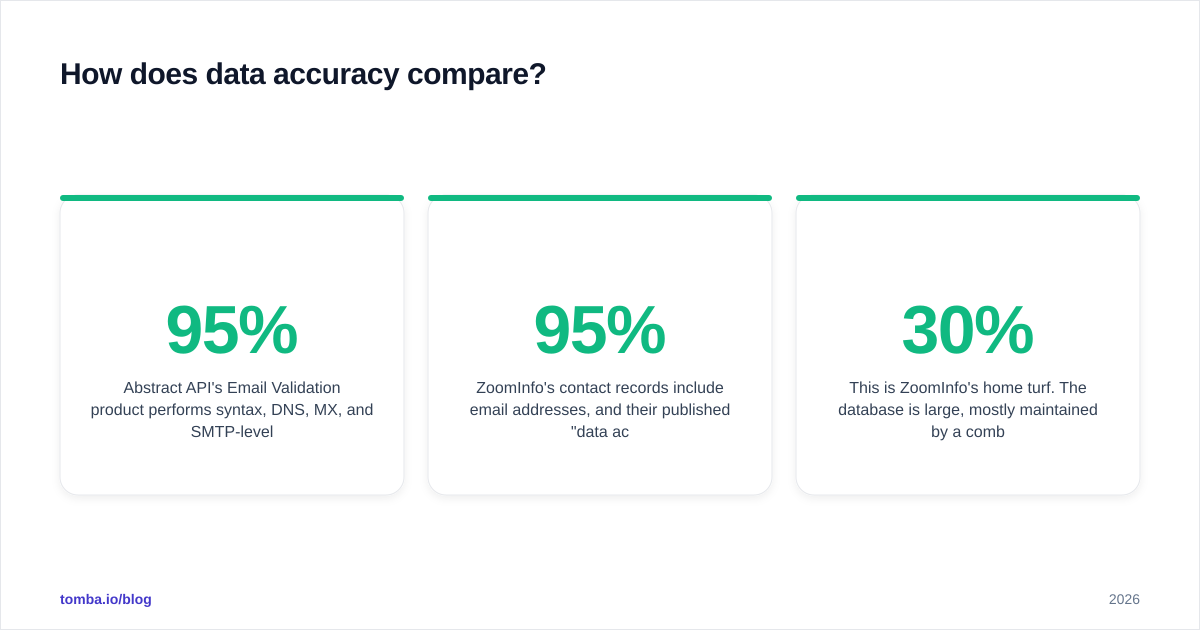
ZeroBounce, NeverBounce, and dedicated email verifier products.
ZoomInfo's contact records include email addresses, and their published "data accuracy" stat is famously around 95% — but that number refers to whether the contact still works at the company, not whether the email will deliver. ZoomInfo does not market itself as an email verifier and most teams pipe the addresses through a dedicated verifier before sending.
Contact data
This is ZoomInfo's home turf. The database is large, mostly maintained by a combination of contributory data, scraping, and a research team. Decay is the real problem — B2B contact data decays at roughly 30% per year, and ZoomInfo's update cadence on lower-profile contacts is the most common complaint in Capterra reviews.
Abstract API does not have a contact-level dataset, so this comparison is N/A on their side.
Firmographics and enrichment
Both platforms cover this. ZoomInfo has a far deeper schema — funding history, locations, parent/subsidiary structure, technographics, intent topics. Abstract API's Company Enrichment endpoint is intentionally lighter: domain in, basic firmographics out. Good for routing and form enrichment. Not good for account research.

What does the developer experience look like?#
The DX gap is as large as the price gap, but it cuts in the opposite direction.
Abstract API is built API-first. Every endpoint has consistent JSON schemas, REST conventions, official SDKs in JavaScript, Python, Ruby, PHP, Java, and Go, and documentation that you can copy-paste from. There is no UI to fight. You ship code, you ship features.
ZoomInfo has an API, but it is plainly the secondary surface. The primary product is the web app and the CRM integration. The API requires negotiation in most contracts, is rate-limited aggressively, and is not the experience the vendor optimizes for. Developers who try to use ZoomInfo as a data API often end up frustrated.
If your build looks like "I need to programmatically fetch this data inside my own product," Abstract API is the cleaner fit. If your build looks like "I need a sales rep to use this in their browser," ZoomInfo wins.
Where does Tomba fit between the two?#
Most teams Googling "Abstract API vs
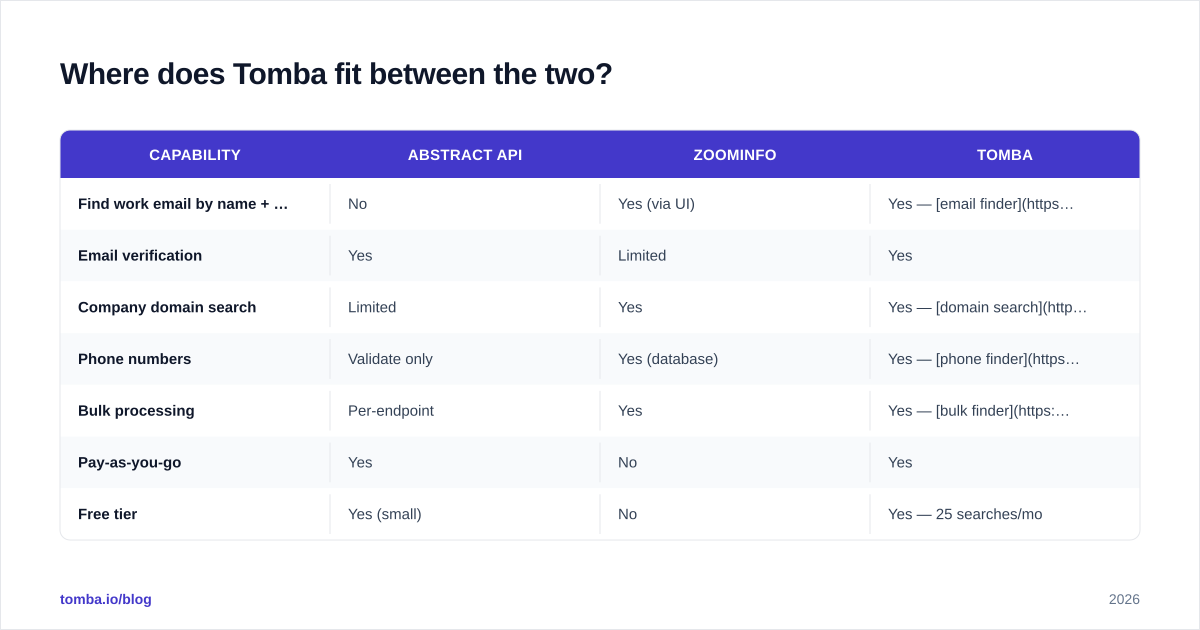
ZoomInfo" actually want a third option: contact-level data, API-first, no enterprise contract. That is the lane Tomba sits in.
| Capability | Abstract API | ZoomInfo | Tomba |
|---|---|---|---|
| Find work email by name + domain | No | Yes (via UI) | Yes — email finder |
| Email verification | Yes | Limited | Yes |
| Company domain search | Limited | Yes | Yes — domain search |
| Phone numbers | Validate only | Yes (database) | Yes — phone finder |
| Bulk processing | Per-endpoint | Yes | Yes — bulk finder |
| Pay-as-you-go | Yes | No | Yes |
| Free tier | Yes (small) | No | Yes — 25 searches/mo |
| Entry paid | ~$9–$49/mo | ~$15,000/yr | $49/mo Starter |
| Native API | Yes | Limited | Yes — Tomba API |
| Time to first call | Minutes | Weeks | Minutes |
Tomba is the in-between: it has the developer experience and pay-as-you-go pricing of Abstract API, but its dataset is purpose-built around B2B contacts — which is the part of ZoomInfo most teams actually need.
You can see the full Tomba pricing breakdown — Starter is $49/mo, Growth is $99/mo, Pro is $249/mo, with Enterprise quoted custom.


When should you pick Abstract API?#
Pick Abstract API when all three are true:
- You are a developer or product team, not a sales team.
- You need narrow, well-defined endpoints — validate this email, geolocate this IP, look up this VAT number.
- Your volume is predictable and you want metered pricing.
Specific use cases where Abstract is the right call:
- Signup form email validation to reduce typo bounces
- IP geolocation for content personalization or pricing localization
- Phone number validation in a checkout flow
- Light firmographic enrichment on inbound demo requests
- Currency conversion in a billing UI
- VAT validation for EU invoicing
If you find yourself reaching for more than five Abstract endpoints, run the math. The per-endpoint pricing is fair on each line, but stacking them can quietly hit four figures a month and a consolidated platform may be cheaper.
When should you pick ZoomInfo?#
Pick ZoomInfo when all three are true:
- You have a funded sales team (typically 10+ reps) running outbound.
- You need prospect search, sequencing, and intent — not just data.
- You can sign a multi-year contract and absorb $30K–$100K in ACV.
Specific use cases where ZoomInfo earns its price tag:
- Building large, segmented prospect lists with org-chart context
- Triggering plays on hiring and funding signals
- Account-based marketing with intent topic data
- Routing inbound leads with deep firmographic + technographic context
- Conversation intelligence integrated with the same data layer
Mid-market and SMB teams almost always over-buy ZoomInfo. The number one regret in Gartner Peer Insights ZoomInfo reviews is contract size relative to usage. If reps are only pulling 50 contacts a week, you are paying enterprise prices for a list-builder.
Are there better alternatives to both?#
For most teams in 2026, the honest answer is yes — at least for the parts of the workflow that matter most.
- For contact data (the part of
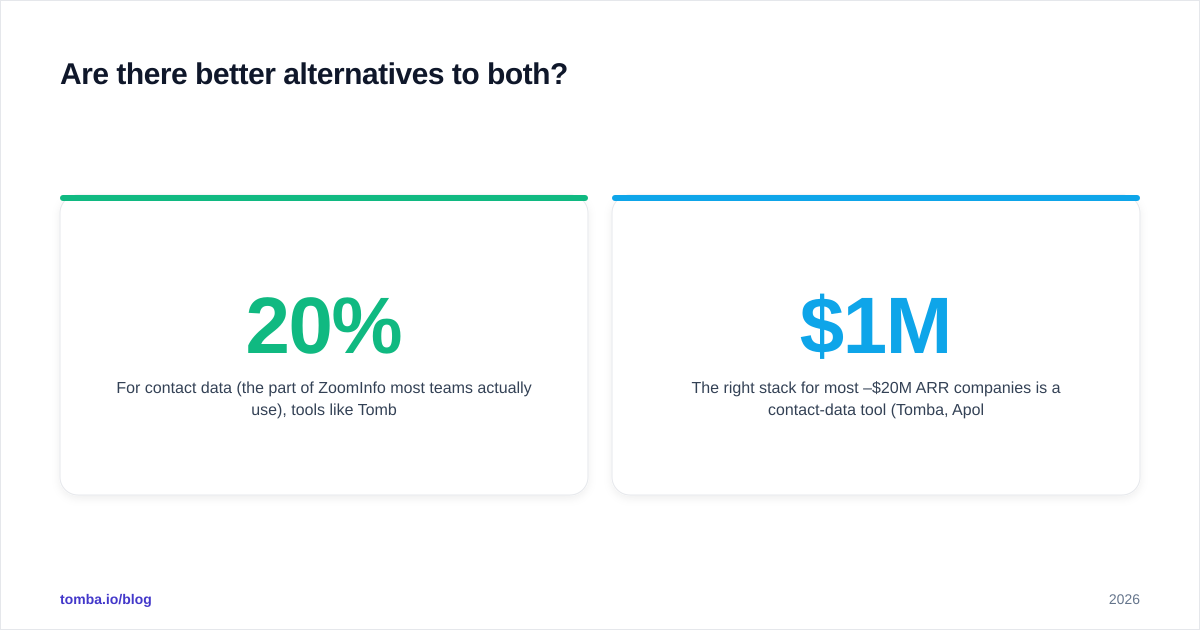
ZoomInfo most teams actually use), tools like Tomba, Apollo, and Cognism deliver similar coverage at 5–20% of the cost. See our breakdowns of Apollo alternatives and RocketReach alternative for the landscape.
- For email verification (a piece of Abstract API's catalog), specialists like ZeroBounce alternative and dedicated catch-all verifier tools score higher on accuracy benchmarks.
- For enrichment, data enrichment products purpose-built for B2B sales (vs Abstract's generic firmographics) plug into HubSpot and Salesforce with no glue code.
- For intent data (ZoomInfo's strongest moat), 6sense and Demandbase compete head-on. See 6sense alternative and Demandbase alternative.
The right stack for most $1M–$20M ARR companies is a contact-data tool (Tomba, Apollo) + an enrichment layer + a verifier — not one giant ZoomInfo contract and not Abstract API for everything.
FAQ#
Is ZoomInfo worth it for a 5-person sales team? Usually not. The unit economics only work above ~10 reps actively prospecting. Below that, a $49–$249/mo email finder plus a CRM does the same job for 1% of the price.
Does Abstract API have a contact-finder? No. Abstract has Company Enrichment (firmographics from a domain) but no people search. For finding work emails by name, look at dedicated email finder tools.
Can I use Abstract API for cold email lists? Not really. Abstract validates emails you already have. It does not source them. You would pair it with a separate prospecting tool — at which point a single tool that does both is usually cheaper.
How accurate is ZoomInfo data in 2026? ZoomInfo publishes ~95% accuracy on contact employment status, but third-party tests on email deliverability typically land 70–85%. Always run ZoomInfo exports through a verifier before sending.
What's the cheapest way to get ZoomInfo-style data? Pay-as-you-go email finders combined with a verifier. Tomba's pricing starts at $49/mo, with a free tier of 25 searches. No annual contract.
The bottom line#
Abstract API and ZoomInfo are not really competitors — they sit at opposite ends of the B2B data spectrum. Abstract is a developer toolbox sold by the call. ZoomInfo is an enterprise sales platform sold by the year. Most teams that compare them end up needing a third thing: contact-grade data with the developer experience and pricing model of a modern API.
That third thing is what Tomba Email Finder was built for. You get verified work emails by name and domain, an API that ships in minutes, a free tier to test, and pricing that scales from $49/mo without a sales call. If you came here trying to choose between Abstract API and ZoomInfo and the answer felt wrong both ways — start there.
Ready to find emails that actually work?
Join 150,000+ professionals who stopped guessing and started sending. Free credits on signup — no credit card required.
Get the Tomba newsletter
Practical outbound tactics and product updates — once every two weeks.
About the author