Account Based Selling Platform: The 2026 Buyer's Guide
What an account based selling platform actually does, how the major tools compare, and how to build a stack that wins enterprise deals in 2026.
TL;DR
- An account based selling platform coordinates targeting, data, multi-threading, and orchestration so a whole revenue team can run one play against one named account — instead of reps spraying individual contacts.
- The category splits into three jobs: account intelligence (who to chase), engagement orchestration (how to reach the buying group), and data/contact sourcing (the emails and phone numbers that make outreach possible).
- No single tool does all three well. The winning 2026 stack is usually an orchestration layer (6sense, Demandbase, or your CRM) plus a precise contact-data source.
- Data accuracy is the hidden failure point: a beautiful ABS workflow still dies if 30% of the emails bounce. Budget for verification, not just discovery.
- Below: a feature-and-pricing comparison table, a buyer's framework, and a stack recommendation by company size.
What is an account based selling platform?#
An account based selling platform is software that helps a revenue team treat a company as the unit of sale, not an individual lead. Instead of a rep chasing one contact who downloaded an ebook, the platform helps the team identify a target account, map every relevant stakeholder in the buying group, and coordinate touches across sales, marketing, and SDRs so the account hears a consistent message.
Think of it like the difference between fishing with a single line and running a coordinated trawler. Lead-based selling casts one hook per person and hopes. Account based selling (ABS) surrounds the whole school — the CFO, the VP of Engineering, the procurement lead, the champion — and works them in parallel because enterprise deals are almost never decided by one person. Gartner research consistently puts the typical B2B buying group at six to ten people, which is exactly why single-threaded outreach stalls.
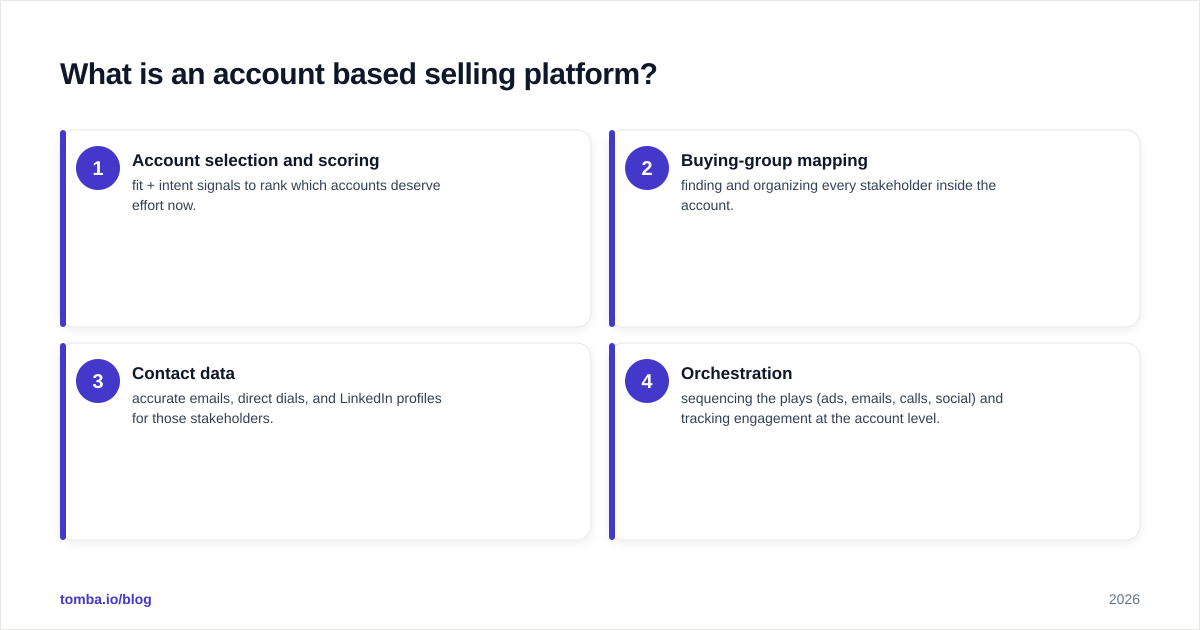
A real platform ties together four capabilities:
- Account selection and scoring — fit + intent signals to rank which accounts deserve effort now.
- Buying-group mapping — finding and organizing every stakeholder inside the account.
- Contact data — accurate emails, direct dials, and LinkedIn profiles for those stakeholders.
- Orchestration — sequencing the plays (ads, emails, calls, social) and tracking engagement at the account level.
How is account based selling different from lead generation?#
The short answer: ABS optimizes for depth per account, lead gen optimizes for volume of contacts. They are complementary, but they require different tooling and different metrics.
In lead gen, success looks like more MQLs in the funnel. In ABS, success looks like more engaged accounts moving through stages — even if the raw contact count is smaller. If you measure an ABS motion with lead-gen metrics, you will starve it before it pays off, because ABS trades early volume for late-stage win rate.
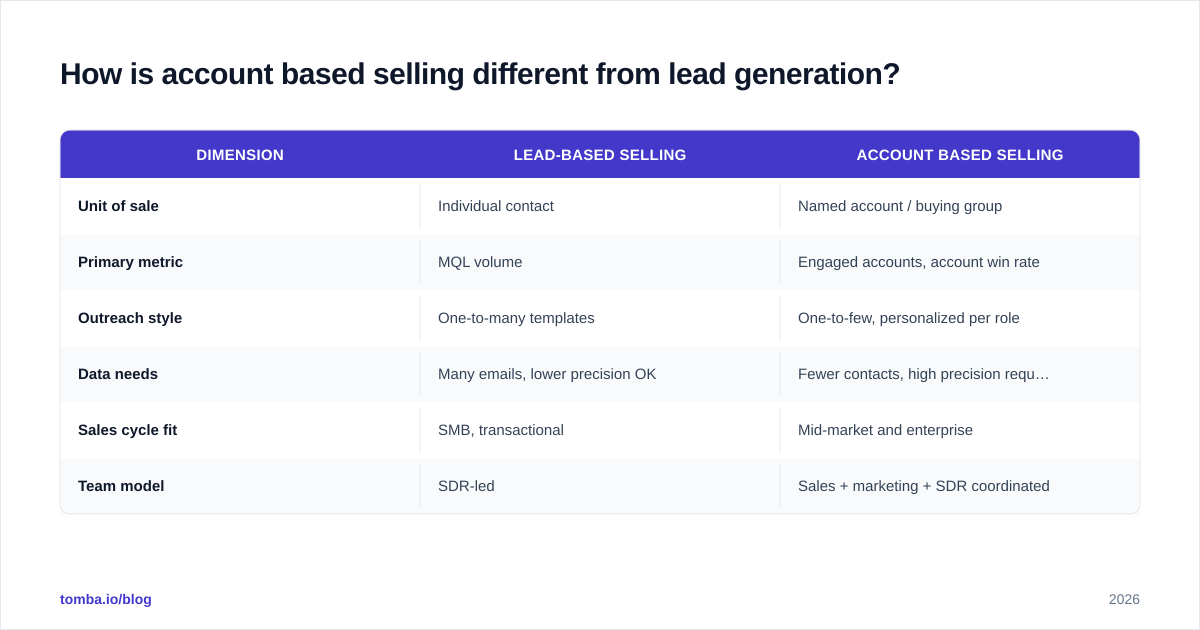
| Dimension | Lead-based selling | Account based selling |
|---|---|---|
| Unit of sale | Individual contact | Named account / buying group |
| Primary metric | MQL volume | Engaged accounts, account win rate |
| Outreach style | One-to-many templates | One-to-few, personalized per role |
| Data needs | Many emails, lower precision OK | Fewer contacts, high precision required |
| Sales cycle fit | SMB, transactional | Mid-market and enterprise |
| Team model | SDR-led | Sales + marketing + SDR coordinated |
If your average contract value is low and your cycle is short, pure ABS is overkill. If you sell five- and six-figure deals to defined target accounts, an account based selling platform is how you keep the buying group from going dark.
What are the core features to look for in 2026?#
Not every "ABS platform" covers the same ground. Vendors cluster around one of the three jobs and bolt on the rest. When you evaluate, score each tool against the capabilities below rather than its marketing category.
Account intelligence and intent. Can it tell you which accounts are in-market right now? This is where intent-data vendors live. Look for third-party intent, first-party website de-anonymization, and a transparent scoring model you can actually tune — not a black box.
Buying-group and org mapping. Surfacing the CFO is easy; surfacing the three engineers who will veto the deal is hard. Strong platforms build the org chart and flag the roles you are missing on a given account.
Contact data quality. This is the quiet make-or-break. The slickest orchestration is worthless if the underlying emails bounce and the phone numbers ring dead lines. Demand published accuracy rates and a built-in email verifier step. A platform that finds contacts but never validates them is shipping you a liability.
Orchestration and plays. Can marketing run display ads to the same accounts your SDRs are calling, on the same timeline? Account-level engagement tracking and pre-built plays separate a true platform from a glorified list builder.
Integrations. ABS lives or dies inside your CRM. Native, two-way sync with Salesforce or HubSpot is non-negotiable, plus the broader integrations ecosystem (Slack alerts, enrichment-on-create, Zapier).
How do the leading account based selling platforms compare?#
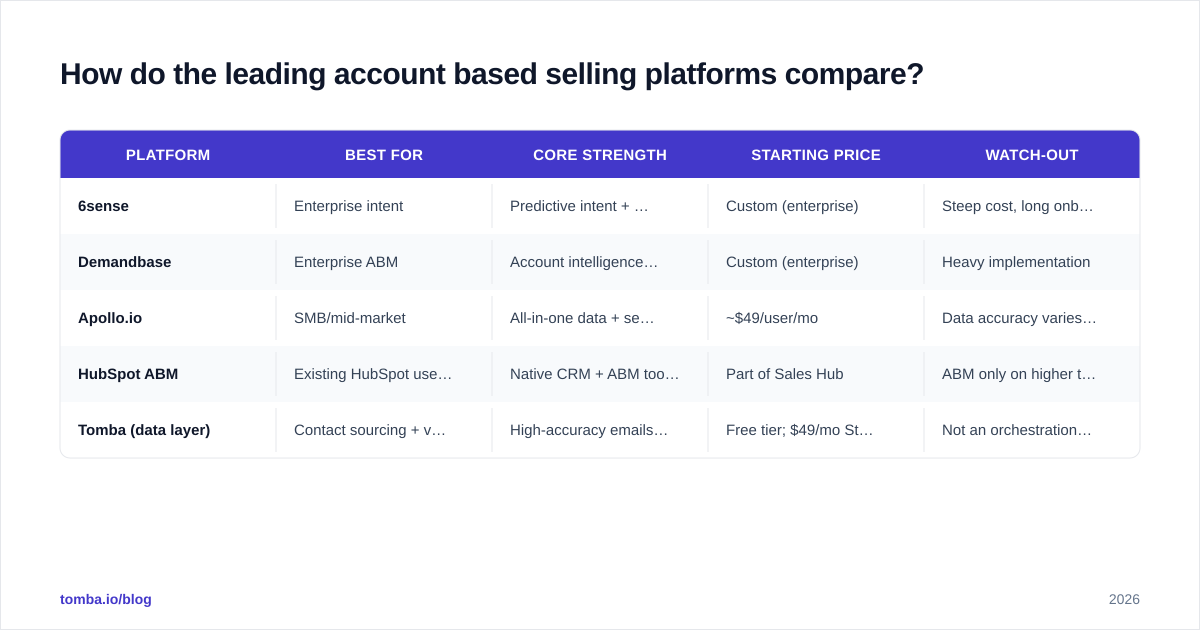
Here is the honest landscape. The "big two" orchestration suites (6sense and Demandbase) are powerful and priced for enterprise. Apollo and similar all-in-one tools are more accessible but lean toward volume prospecting with an ABS layer on top. And underneath all of them sits the data layer — where a focused, accurate provider like Tomba does the unglamorous work of making sure the contacts are real.
| Platform | Best for | Core strength | Starting price | Watch-out |
|---|---|---|---|---|
| 6sense | Enterprise intent | Predictive intent + orchestration | Custom (enterprise) | Steep cost, long onboarding |
| Demandbase | Enterprise ABM | Account intelligence + advertising | Custom (enterprise) | Heavy implementation |
| Apollo.io | SMB/mid-market | All-in-one data + sequences | ~$49/user/mo | Data accuracy varies by region |
| HubSpot ABM | Existing HubSpot users | Native CRM + ABM tools | Part of Sales Hub | ABM only on higher tiers |
| Tomba (data layer) | Contact sourcing + verification | High-accuracy emails, verification, enrichment | Free tier; $49/mo Starter | Not an orchestration suite |
A few caveats so this stays honest. 6sense and Demandbase are leaders in the G2 ABM grids for a reason — if you have the budget and a dedicated ops team, their intent models are excellent. Apollo is the popular starting point for teams that want data and sequencing in one seat. And Tomba is deliberately not trying to be your orchestration suite; it is the layer that feeds accurate contacts into whatever orchestration you choose. Comparing them head-to-head is a category error — most strong stacks use both an orchestrator and a dedicated data source.
If you are evaluating Apollo specifically, it is worth reading a direct Apollo alternative breakdown rather than trusting any single vendor's self-scoring.
Why does contact data quality make or break ABS?#
Because every ABS play ends in a touch, and every touch needs a real, deliverable contact. This is the step buyers under-budget.
Run the math. Say your platform maps a clean 8-person buying group across 200 target accounts — 1,600 contacts. If your data source runs at 75% deliverability, 400 of those touches bounce or hit dead numbers. Worse, high bounce rates wreck your sender reputation, which then suppresses delivery to the good addresses too. One bad data layer poisons the whole motion.
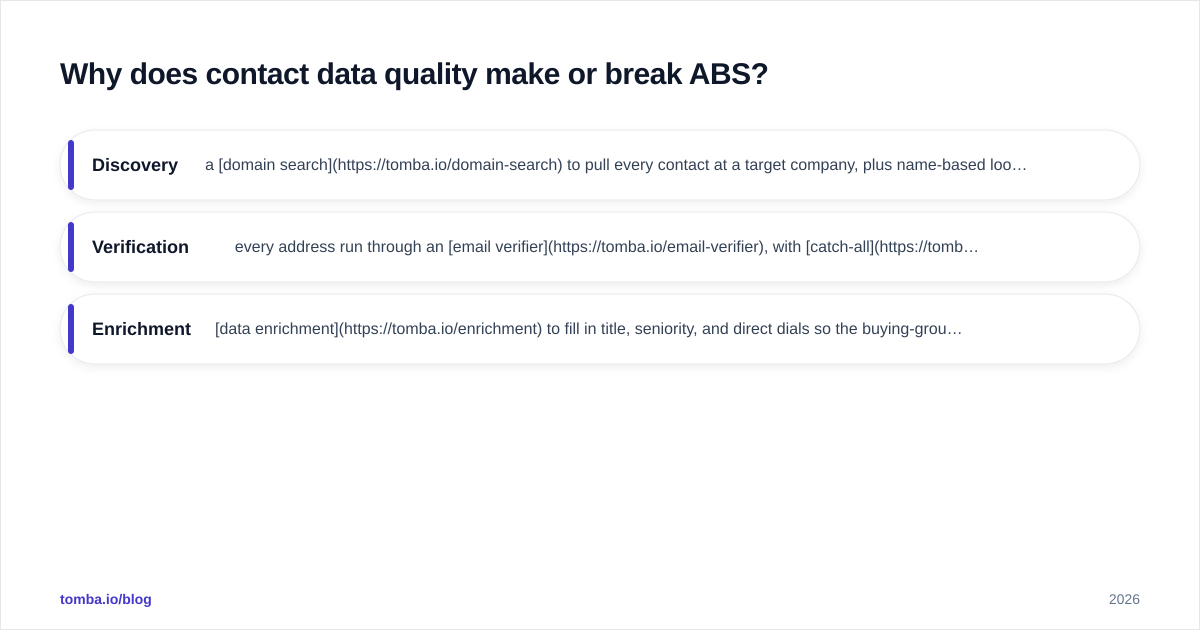
This is why the data step needs three things working together:
- Discovery — a domain search to pull every contact at a target company, plus name-based lookups for specific stakeholders you already know you need.
- Verification — every address run through an email verifier, with catch-all domains flagged so you know which "valid" results are actually unconfirmed.
- Enrichment — data enrichment to fill in title, seniority, and direct dials so the buying-group map is complete enough to multi-thread.
Tomba's data sources and verification pipeline exist for exactly this layer. You can score the most perfect set of accounts in the world, but if the contacts behind them bounce, the play never lands.
How do you build an ABS stack by company size?#
You do not need every tool. You need the three jobs covered — intelligence, orchestration, data — at a level that matches your deal size and team. Here is a practical starting point.
Early-stage / SMB (1–10 reps). Skip the enterprise intent suites. Use your CRM (HubSpot or Pipedrive) as the orchestration layer, define 50–100 target accounts manually, and invest in a strong data layer for accurate contacts. A bulk email finder plus verification gets your buying-group lists clean without a six-figure platform contract. This is the highest-ROI starting point because it is cheap and the data quality is in your control.
Mid-market (10–50 reps). Add a layer of intent. Apollo or a similar all-in-one covers sequencing and basic intent, while you keep a dedicated data/verification source to backstop accuracy. Wire enrichment to fire automatically on new CRM records via Zapier or Make so reps never work a stale record.
Enterprise (50+ reps). This is where 6sense or Demandbase earns its price — predictive intent, account-level advertising, and orchestration across a large team justify the cost and the ops headcount to run them. Even here, feed the suite with a reliable contact source and a verification gate, because enterprise data still decays and catch-all domains still hide bad addresses.
A note on metrics, because tooling without the right scoreboard fails: track engaged accounts, buying-group coverage (how many roles you've reached per account), and account-stage progression. Borrow the discipline of revenue operations to align sales and marketing on those shared numbers. If marketing reports MQLs while sales reports account progression, your ABS motion will tear itself apart at the seams.
What are the common ABS platform mistakes to avoid?#
- Buying orchestration before you have data hygiene. A $100k platform on top of 70%-deliverable data is a fast way to burn your domain reputation. Fix the data layer first.
- Targeting too many accounts. ABS depth beats breadth. A focused list of 100 well-mapped accounts outperforms 1,000 thinly-touched ones every time.
- Ignoring catch-all domains. Many enterprise domains accept all mail, so a naive verifier marks every address "valid." Use a real catch-all verifier so you know what's actually confirmed.
- Single-threading. If you only have one contact at an account, you have a single point of failure. Map the full buying group with a domain search before you start the play.
- No feedback loop. Bounces, replies, and meetings should flow back to refine account scoring. ABS is iterative, not set-and-forget.
Build your ABS data layer with Tomba#
Whatever orchestration suite you land on, the plays only convert if the contacts are real. That is where Tomba fits: the Tomba Email Finder sources accurate professional emails by name, company, or domain, then verifies them and enriches the record — so every account in your buying-group map is a contact you can actually reach.
Start on the free tier (25 searches/month) to test accuracy against your own target accounts, then scale on the $49/mo Starter or $99/mo Growth plan as your list grows; full Tomba pricing is transparent and per-search, not per-seat. Build the data layer right, plug it into the orchestrator that fits your size, and your account based selling platform stack will land touches instead of bounces.
Sources and further reading: Gartner Sales research, G2 Account-Based Marketing software grid, HubSpot ABM resources.
// get started
Find, verify and enrich your first contacts today
Start on the free plan with 25 searches a month, then scale when your team is ready.
Free plan · No credit card required · GDPR & CCPA
// about the author