Accutrend vs Sparklane 2026: B2B Data Platform Comparison
Accutrend sells static B2B data lists; Sparklane predicts which accounts to chase next. Here's how the two stack up on accuracy, scoring, pricing, and real-world sales fit in 2026.
Choosing between Accutrend and Sparklane usually comes down to one question: do you need raw B2B data delivered as a list, or do you need software that tells you which accounts to act on first? They sound similar on a feature grid, but they solve different problems for different teams.
This guide breaks down both platforms on data accuracy, predictive scoring, integrations, pricing, and the kind of sales motion each one actually fits — so you can pick without a three-week trial cycle.
TL;DR#
- Accutrend is a B2B data and list provider. You buy targeted contact and company records, often as bulk exports, to feed outreach and direct marketing campaigns.
- Sparklane is a predictive lead-generation and sales-intelligence platform. It scores accounts, tracks buying signals, and surfaces "act now" prospects inside a workflow.
- Pick Accutrend if you want affordable, on-demand data volume and run your own scoring. Pick Sparklane if you want the tool to prioritize accounts and detect intent for you.
- Both are weaker on real-time, verified email accuracy than a dedicated finder — most teams pair either one with a tool like the Tomba Email Finder for deliverable contacts.
- Budget matters: list-based pricing (Accutrend) scales with volume; SaaS seat-and-signal pricing (Sparklane) scales with team size.

What is Accutrend?#
Accutrend is a B2B data vendor. Its core offering is curated business contact and company data — firmographics, titles, phone numbers, postal addresses, and emails — that you filter by industry, geography, company size, and role, then export for campaigns.
The model is straightforward: you describe your ideal customer profile, Accutrend returns matching records, and you pay for the list. That makes it attractive for teams running high-volume cold outreach, direct mail, or appending missing fields to an existing CRM. It behaves less like software you log into daily and more like a data faucet you open when you need fresh names.
The trade-off is that static lists age fast. B2B data decays roughly 2–3% per month as people change jobs, so a list bought in January looks noticeably worse by summer. You own the scoring, the sequencing, and — critically — the verification of whatever you receive.
What is Sparklane?#
Sparklane is a predictive lead-generation platform built around account prioritization. Instead of handing you a flat file, it ranks companies by how likely they are to buy, layers on buying signals (hiring spikes, funding rounds, leadership changes, tech adoption), and pushes the highest-potential accounts into your reps' daily view.
It leans on machine learning to model your best existing customers and find lookalikes, which is genuinely useful when you don't yet know which segments convert. Sparklane is popular with European mid-market and enterprise sales teams that want intent and timing baked into the workflow rather than bolted on afterward.
The catch: you're buying a system, not just data. That means onboarding, a learning curve, and SaaS-tier pricing. If your team won't actually use the scoring and signals, you're paying for engine power you never put on the road.
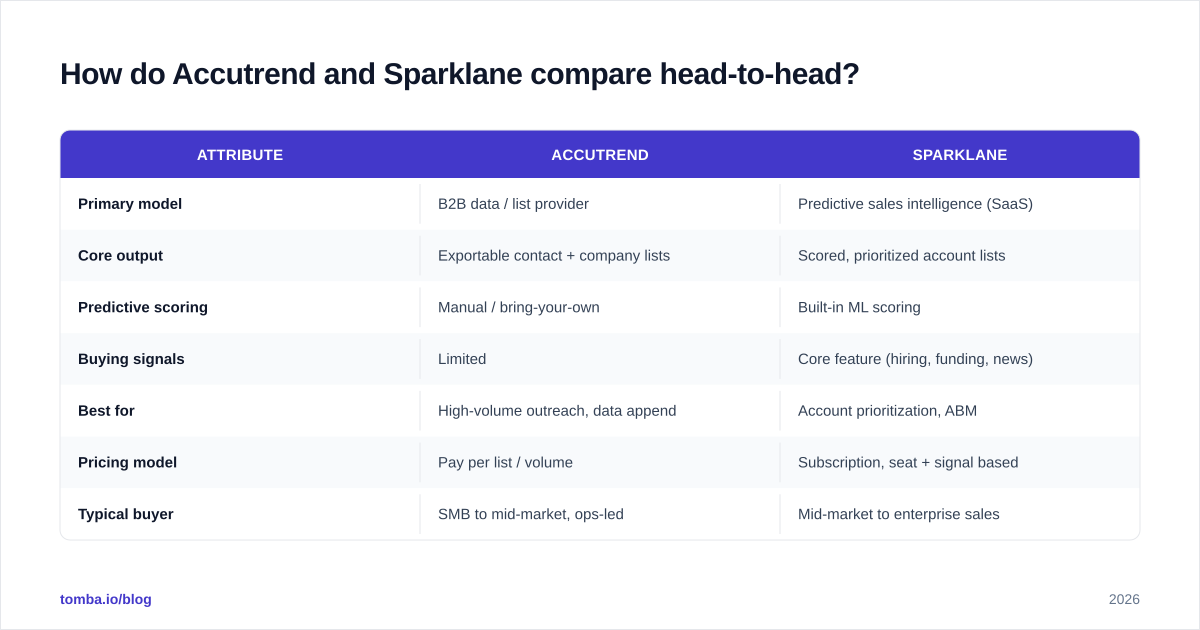
How do Accutrend and Sparklane compare head-to-head?#
Here is the side-by-side on the attributes that actually change a buying decision.
| Attribute | Accutrend | Sparklane |
|---|---|---|
| Primary model | B2B data / list provider | Predictive sales intelligence (SaaS) |
| Core output | Exportable contact + company lists | Scored, prioritized account lists |
| Predictive scoring | Manual / bring-your-own | Built-in ML scoring |
| Buying signals | Limited | Core feature (hiring, funding, news) |
| Best for | High-volume outreach, data append | Account prioritization, ABM |
| Pricing model | Pay per list / volume | Subscription, seat + signal based |
| Typical buyer | SMB to mid-market, ops-led | Mid-market to enterprise sales |
| Learning curve | Low | Moderate |
| Email verification depth | Basic | Basic to moderate |
The pattern is clear: Accutrend optimizes for affordable reach, Sparklane optimizes for focused timing. Neither is "better" in the abstract — they're tuned for different go-to-market motions.
Which one has better data accuracy?#
Neither tool fully solves the freshness problem, and that's the honest answer most comparison posts skip.
Accutrend's accuracy depends on how recently a given segment was refreshed; broad consumer-style B2B lists are cheaper but stale faster, while tightly filtered niche pulls tend to be cleaner. Sparklane's company-level intelligence is strong because firmographic and signal data changes more slowly than individual contact records — a company's funding round is still true next month, but the VP you found may have left.
For contact-level accuracy — the email actually landing in an inbox — both platforms benefit from a verification layer on top. Running exports through a dedicated email verifier before you send catches dead addresses, role accounts, and risky domains that erode your sender reputation. If you're working with catch-all domains (common in enterprise), a catch-all verifier is the difference between a 2% bounce rate and a 20% one.
Rule of thumb: trust Sparklane's account signals and Accutrend's volume, but verify every email yourself regardless of source.
How do they handle integrations and workflow?#
This is where the SaaS-vs-data-vendor split shows up most.
Sparklane is designed to live inside your sales stack. It connects to major CRMs so scored accounts and signals flow to reps without manual exports, and it's meant to be checked daily — the prioritized list is the product. That tight loop is its biggest advantage and its biggest commitment.
Accutrend's workflow is more transactional. You pull a list, export it (usually CSV), and load it wherever you work — your CRM, a sequencer, a bulk email finder to fill contact gaps, or a spreadsheet. There's less lock-in and more manual handling. For ops-led teams that already have a pipeline, that flexibility is a feature, not a bug.
If your stack is the deciding factor, map both tools against your CRM first. A platform that doesn't sync cleanly with how your reps already work will quietly get abandoned no matter how good its data is. Tools that plug into HubSpot, Salesforce, or Pipedrive tend to survive past the trial; the ones requiring constant copy-paste do not.
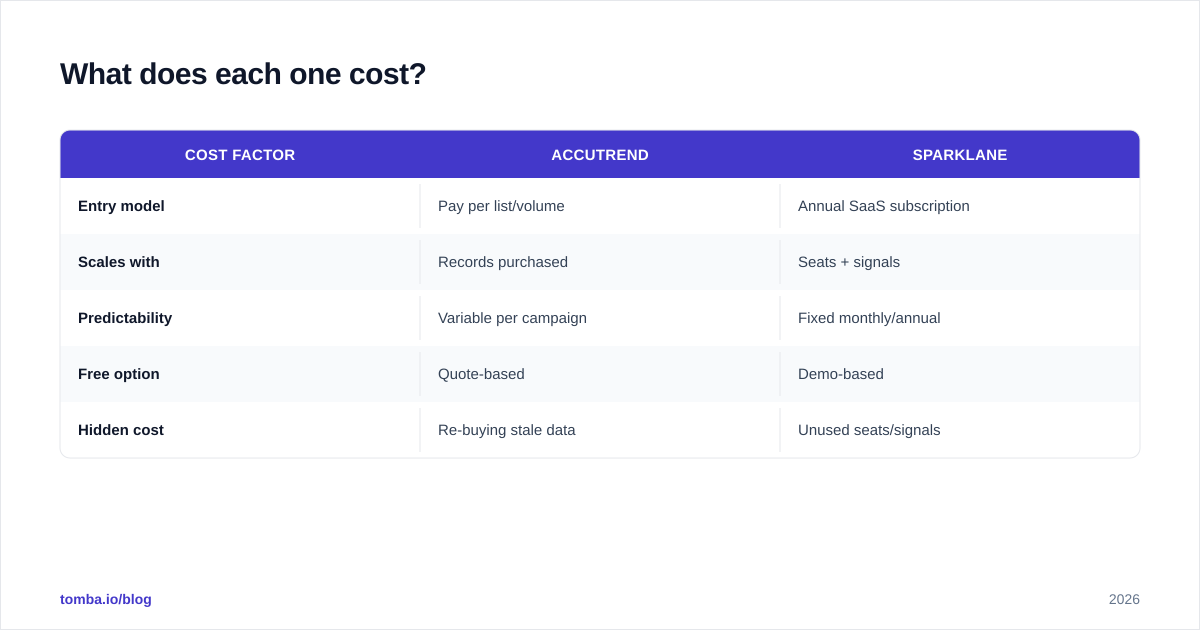
What does each one cost?#
Pricing is the cleanest way to tell these two apart, because the models are fundamentally different.
Accutrend uses a data/volume model — you pay for records, so cost scales with how much you pull. That's predictable for one-off campaigns and budget-friendly at low volume, but it can balloon if you refresh large lists often.
Sparklane uses a subscription model — typically seats plus signal/credit allowances. You're paying for continuous access to scoring and intelligence, which is efficient if your team uses it daily and expensive if it sits idle.
| Cost factor | Accutrend | Sparklane |
|---|---|---|
| Entry model | Pay per list/volume | Annual SaaS subscription |
| Scales with | Records purchased | Seats + signals |
| Predictability | Variable per campaign | Fixed monthly/annual |
| Free option | Quote-based | Demo-based |
| Hidden cost | Re-buying stale data | Unused seats/signals |
Always confirm current numbers directly with each vendor and on review sites like G2 and Capterra — published B2B pricing shifts quarterly, and list/SaaS quotes are usually customized to your volume.
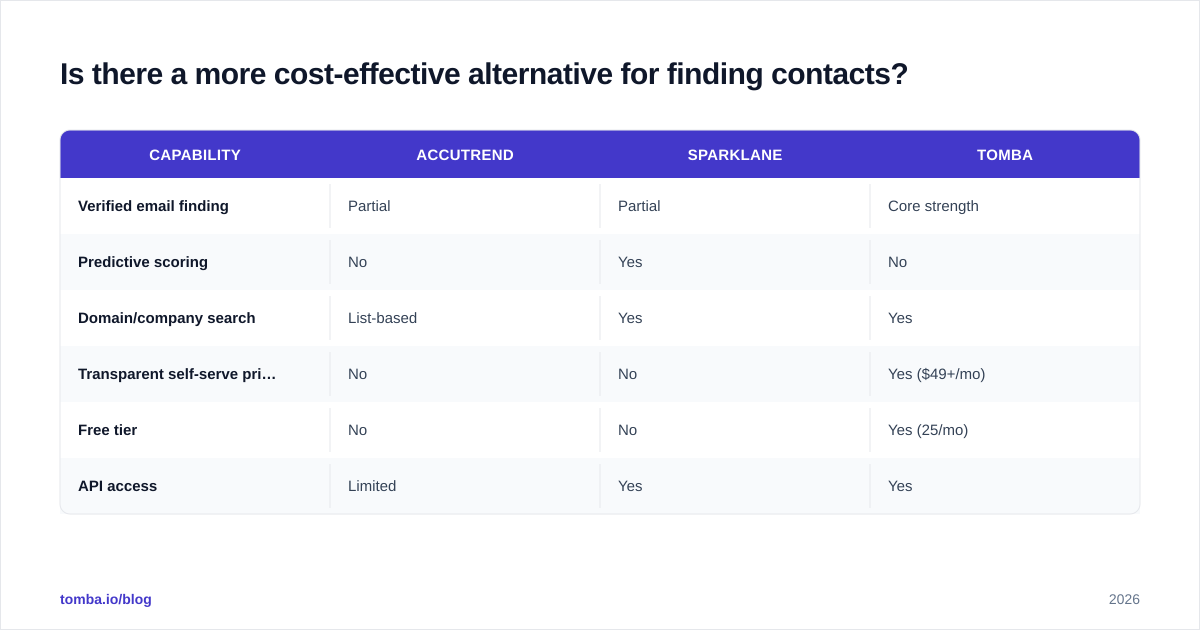
Is there a more cost-effective alternative for finding contacts?#
If your real bottleneck is getting verified, deliverable contact data — not predictive account scoring — a dedicated email-finding platform is often cheaper and more accurate than either option.
Tomba sits in this lane. Instead of buying aging lists or paying enterprise SaaS rates, you find emails on demand by name, company, or domain, then verify them in the same flow. Tomba pricing is transparent: a Free tier with 25 searches/month, Starter at $49/mo, Growth at $99/mo, Pro at $249/mo, and custom Enterprise — no per-list quotes, no annual lock-in to access the core finder.
| Capability | Accutrend | Sparklane | Tomba |
|---|---|---|---|
| Verified email finding | Partial | Partial | Core strength |
| Predictive scoring | No | Yes | No |
| Domain/company search | List-based | Yes | Yes |
| Transparent self-serve pricing | No | No | Yes ($49+/mo) |
| Free tier | No | No | Yes (25/mo) |
| API access | Limited | Yes | Yes |
The practical setup many teams land on: use Sparklane (or Accutrend) to decide who to target, then use a domain search and the email finder to get how to reach them with addresses that won't bounce. You can also enrich existing records with data enrichment to fill the gaps a list provider leaves behind.
Accutrend vs Sparklane: which should you choose?#
Decide based on your actual constraint, not the longer feature list.
Choose Accutrend if:
- You need affordable data volume on demand.
- You run high-volume cold outreach or direct mail.
- Your ops team already owns scoring and sequencing.
- You want flexibility without SaaS lock-in.
Choose Sparklane if:
- You want the tool to prioritize accounts for you.
- Timing and buying signals drive your motion (ABM, mid-market/enterprise).
- Your reps will actually log in and act on a daily list.
- You're standardizing intelligence across a larger team.
Choose a dedicated finder (like Tomba) if:
- Your gap is verified, deliverable contact data — not scoring.
- You want transparent, self-serve pricing and a free tier to test.
- You'd rather pair on-demand email finding with whatever data source you already trust.
For more background on how predictive scoring and intent fit into modern pipelines, Gartner and the relevant Wikipedia overview of lead generation are good neutral starting points before you commit budget.
Final recommendation#
Accutrend and Sparklane aren't really rivals — they're different tools that happen to overlap on the word "data." Accutrend gives you reach at a volume price; Sparklane gives you focus at a SaaS price. Match the tool to whether your problem is coverage or prioritization, and you'll rarely regret it.
Whichever side you land on, the contact data underneath has to be deliverable or none of it matters. Start free with the Tomba Email Finder — 25 searches a month, no card — and bolt verified, real-time emails onto your scoring or your lists so your reps spend time on replies, not bounces.
// get started
Find, verify and enrich your first contacts today
Start on the free plan with 25 searches a month, then scale when your team is ready.
Free plan · No credit card required · GDPR & CCPA
// about the author