Adaptio vs Cufinder 2026: Which B2B Sales Tool Wins?
Adaptio leans into AI ad optimization while Cufinder focuses on B2B data and lead enrichment. Here's how the two stack up on features, pricing, and accuracy in 2026.
Adaptio vs Cufinder is a confusing matchup because the two tools barely play the same sport. One optimizes paid B2B advertising with AI; the other builds and enriches contact data for outbound. Picking between them is less "which is better" and more "which problem are you actually solving." This guide settles it.
TL;DR#
- Adaptio is an AI-driven B2B advertising and account-based marketing (ABM) optimizer. Its job is to spend ad budget smarter across LinkedIn and programmatic channels.
- Cufinder is a B2B data, email-finding, and lead-enrichment platform. Its job is to find, verify, and enrich contact records for your sales team.
- They overlap only at the edges — both want to help you reach the right accounts — but they sit at opposite ends of the funnel.
- Choose Adaptio if your bottleneck is ad performance and demand gen. Choose Cufinder if your bottleneck is contact data and outbound volume.
- If accuracy and cost-per-verified-contact matter most, a dedicated email finder like Tomba often beats Cufinder's bundled data — more on that below.
What is Adaptio?#
Adaptio is an AI advertising platform built for B2B marketers who run account-based campaigns. Instead of manually tweaking bids, audiences, and creative, you hand Adaptio your targeting goals and budget, and its models adjust spend in near real time. Think of it like cruise control for a paid-media car: you still set the destination, but the system handles the throttle so you stop overspending on accounts that will never convert.
Its core value lands in three places:
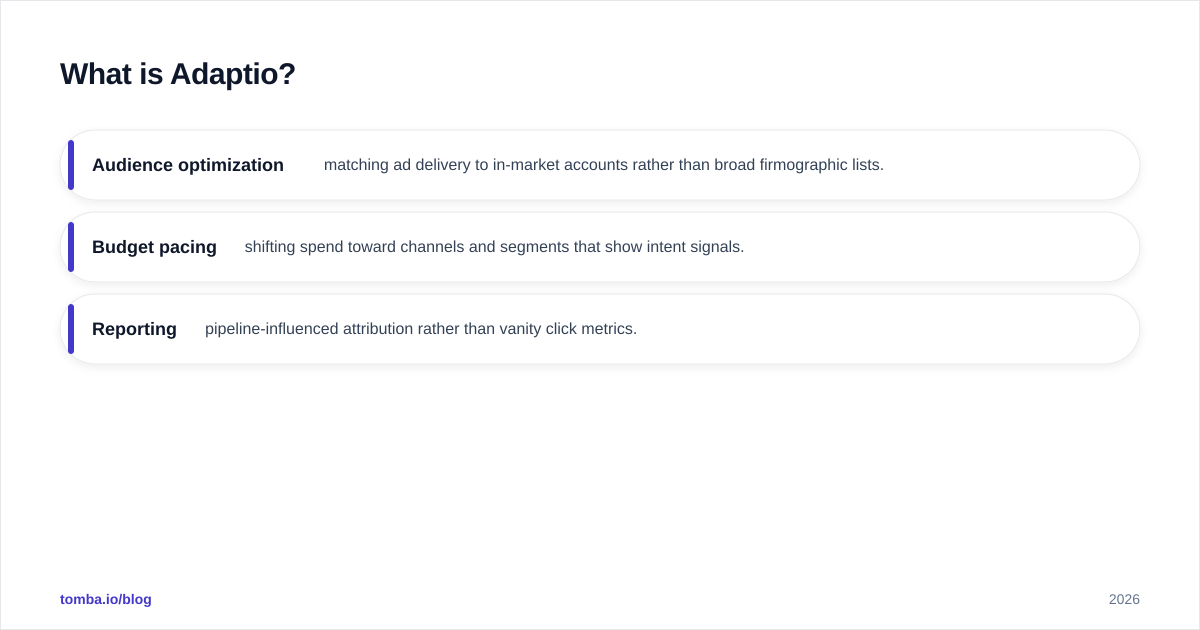
- Audience optimization — matching ad delivery to in-market accounts rather than broad firmographic lists.
- Budget pacing — shifting spend toward channels and segments that show intent signals.
- Reporting — pipeline-influenced attribution rather than vanity click metrics.
Adaptio is a marketing tool first. It does not build your contact database, and it does not find email addresses. It assumes you already know who you want to reach and helps you reach them efficiently through paid channels.
What is Cufinder?#
Cufinder is a B2B data engine and lead-generation suite. You search by company, domain, or person and it returns enriched records: emails, phone numbers, company size, tech stack, and more. It also offers bulk enrichment and an API, which puts it in the same broad category as tools like Apollo, RocketReach, and ZoomInfo.
Cufinder is a sales-and-data tool first. Its output feeds your CRM, your sequencer, and your SDRs. Where Adaptio helps you advertise to accounts, Cufinder helps you contact the people inside them. If you want a primer on how that contact-finding layer works, the mechanics are the same ones behind any modern email finder.

Adaptio vs Cufinder: how do they actually compare?#
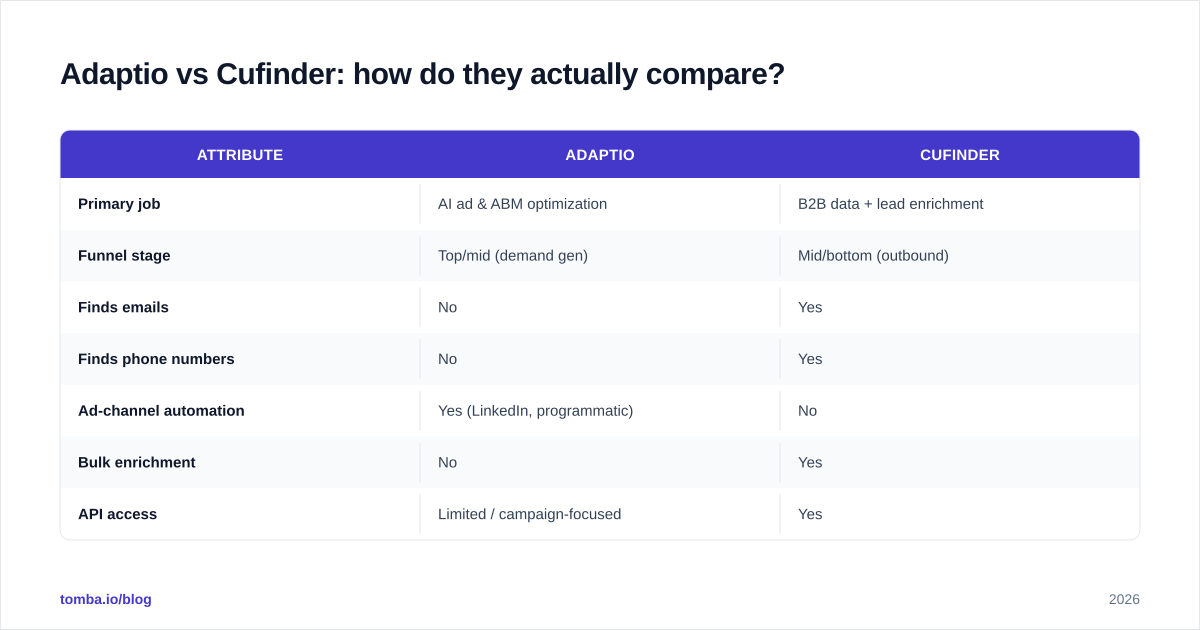
Because they solve different problems, a feature-by-feature table only makes sense if you read it as "what each tool is for," not "which checks more boxes." Here is the honest breakdown.
| Attribute | Adaptio | Cufinder |
|---|---|---|
| Primary job | AI ad & ABM optimization | B2B data + lead enrichment |
| Funnel stage | Top/mid (demand gen) | Mid/bottom (outbound) |
| Finds emails | No | Yes |
| Finds phone numbers | No | Yes |
| Ad-channel automation | Yes (LinkedIn, programmatic) | No |
| Bulk enrichment | No | Yes |
| API access | Limited / campaign-focused | Yes |
| Best for | Paid-media marketers | SDRs, growth, RevOps |
| Typical buyer | Demand-gen lead | Sales / data lead |
| Free tier | Demo-led | Limited free credits |
The takeaway: if someone tells you to "compare Adaptio and Cufinder," your first question should be which team is asking. A demand-gen marketer evaluating ad spend will never be satisfied by Cufinder, and an SDR who needs 500 verified emails this week will get nothing usable out of Adaptio.
Which one fits your team?#
Use this quick framework. Map your single biggest bottleneck to a column.
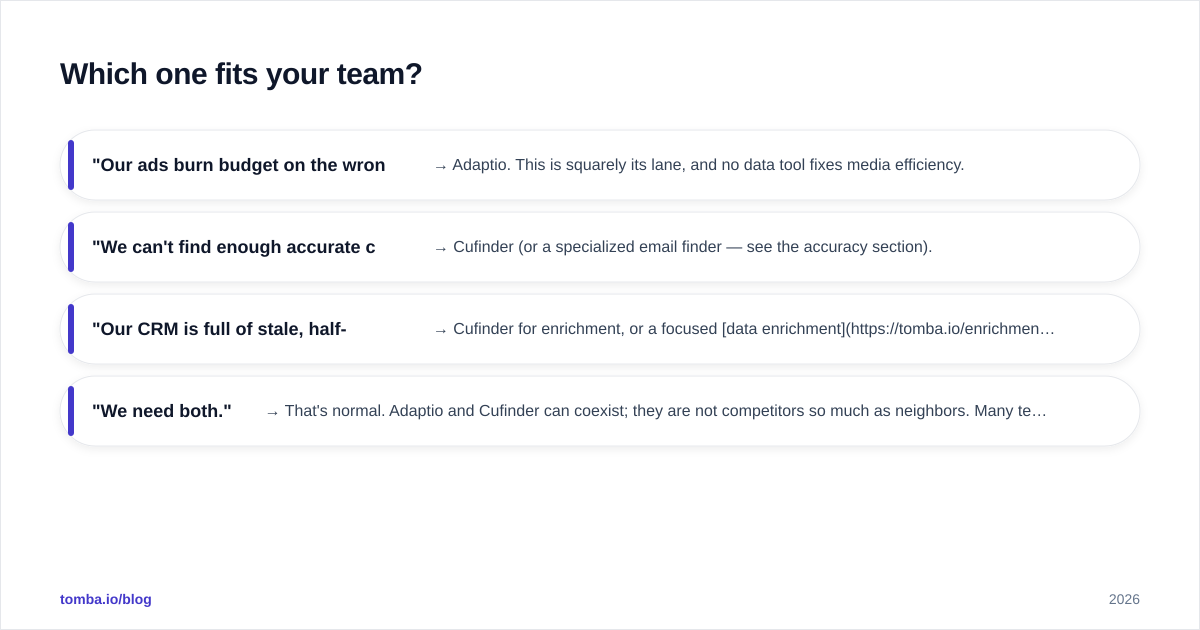
- "Our ads burn budget on the wrong accounts." → Adaptio. This is squarely its lane, and no data tool fixes media efficiency.
- "We can't find enough accurate contacts to email or call." → Cufinder (or a specialized email finder — see the accuracy section).
- "Our CRM is full of stale, half-empty records." → Cufinder for enrichment, or a focused data enrichment workflow.
- "We need both." → That's normal. Adaptio and Cufinder can coexist; they are not competitors so much as neighbors. Many teams run Adaptio for paid and a data tool for outbound simultaneously.
How accurate is Cufinder's data?#
This is where Cufinder gets evaluated honestly against the broader market — and where most buyers actually make their decision, because data accuracy is the line item that wastes the most money when it's wrong.
Bundled-data platforms (Cufinder, Apollo, Seamless.AI) trade breadth for precision. You get a lot of records fast, but verification depth varies, and catch-all domains, role accounts, and stale entries slip through. When you send to a list that's only 80% deliverable, you don't just waste credits — you damage sender reputation and your whole domain pays for it.
Specialized email finders take the opposite stance: fewer sources, more verification passes, higher confidence per contact. Independent reviews on G2 consistently show that accuracy — not database size — is the variable that correlates with reply rates. If your outbound depends on hitting real inboxes, run any provider's output through a dedicated email verifier before you trust it, and treat catch-all results with a proper catch-all verifier rather than guessing.
The practical rule: never assume a bundled platform's "verified" label means inbox-ready. Test a sample of 100 contacts, measure bounce rate, and let the number — not the marketing — decide.
What does Adaptio vs Cufinder pricing look like?#
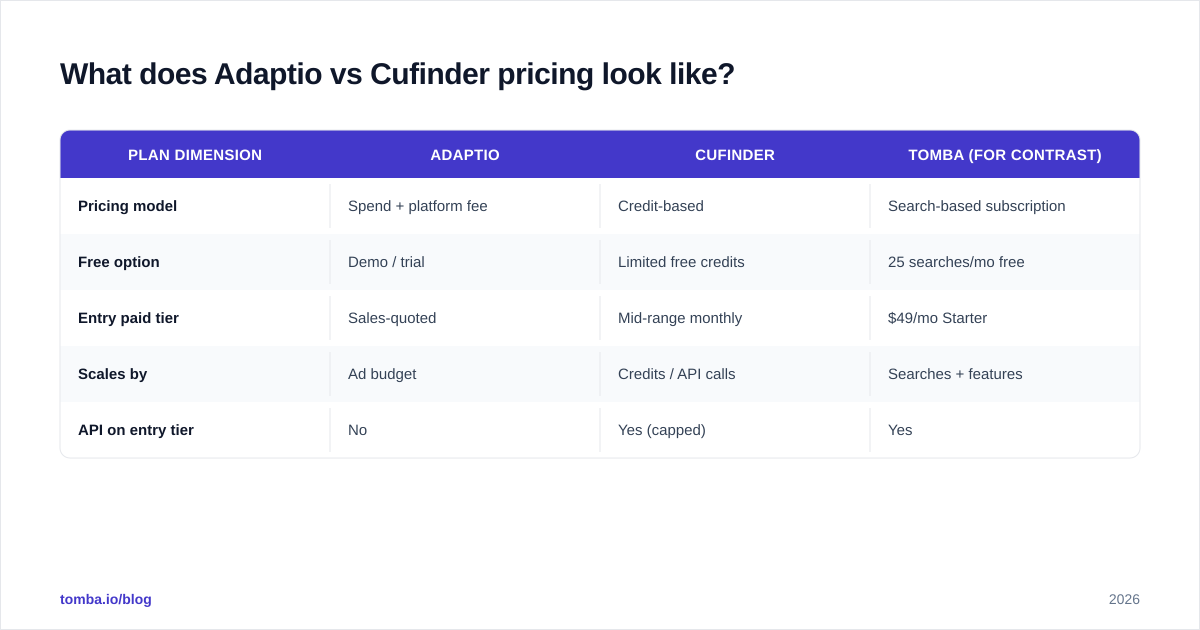
Neither tool publishes fully transparent pricing the way self-serve products do, and they price on different axes — Adaptio on managed ad spend and seats, Cufinder on data credits and API volume. That makes a straight dollar-for-dollar comparison misleading. Here's the shape of it.
| Plan dimension | Adaptio | Cufinder | Tomba (for contrast) |
|---|---|---|---|
| Pricing model | Spend + platform fee | Credit-based | Search-based subscription |
| Free option | Demo / trial | Limited free credits | 25 searches/mo free |
| Entry paid tier | Sales-quoted | Mid-range monthly | $49/mo Starter |
| Scales by | Ad budget | Credits / API calls | Searches + features |
| API on entry tier | No | Yes (capped) | Yes |
Two things matter here. First, Adaptio's cost is a percentage of a budget you're already spending — it has to save more than it charges to make sense. Second, if your real need is contacts rather than ads, you can often get higher accuracy at a lower, more predictable price from a dedicated finder. Tomba's published Tomba pricing starts at $49/mo for the Starter plan with a genuinely usable free tier, which makes it easy to benchmark accuracy before committing — something neither Adaptio nor Cufinder makes simple.
Can you use Adaptio and Cufinder together?#
Yes, and for a mature go-to-market motion it's a reasonable stack. The clean division of labor looks like this:
- Cufinder (or a dedicated finder) builds and enriches your target-account contact list.
- That list feeds your CRM and segments your audiences.
- Adaptio runs paid campaigns against those same accounts to warm them before outbound.
- Your SDRs work the warmed accounts with verified contact data.
The friction point is data hygiene. Adaptio's optimization is only as good as the account list you feed it, and outbound is only as good as the emails behind each name. Both depend on the same thing: clean, current, verified records. That's why most teams that run this stack also keep a verification layer in the loop — wiring it through the Tomba API or a HubSpot integration so enrichment happens automatically instead of in a quarterly cleanup scramble.
What do the alternatives look like?#
Neither tool is the only option in its category, and pretending otherwise would be dishonest.
- Against Adaptio: other ABM and ad-optimization platforms like 6sense and Demandbase play in the same space, usually at higher price points and with deeper intent data.
- Against Cufinder: the email-finder and enrichment market is crowded. If accuracy is your priority, compare it directly against tools positioned on verification quality. Tomba publishes side-by-side breakdowns such as its Apollo alternative and RocketReach alternative pages that are useful even if you don't buy.
For a neutral starting point, vendor-agnostic directories like Capterra let you filter by category, price, and verified review volume before you sit through a single sales demo.
The verdict: Adaptio vs Cufinder#
There's no single winner because there's no single contest. Adaptio wins for paid-media and ABM efficiency. Cufinder wins for contact data and enrichment volume. If you forced a one-line answer: buy the one that fixes your current bottleneck, and don't let a sales rep talk you into the other tool's job.
But notice what both have in common — they're broad platforms that bundle a lot. If your actual pain is "I need accurate, deliverable contacts and I don't want to overpay for features I won't use," neither bundled tool is the most efficient answer. A focused, verification-first email finder usually delivers a better cost-per-real-contact than a data suite, and a better deliverability outcome than feeding unverified records into ads or sequences.
That's the gap Tomba is built for. Start with the Tomba Email Finder to find professional emails by name, domain, or company, run every result through built-in verification, and only then decide whether you need Adaptio's ad layer on top. Try it free with 25 searches a month, measure the bounce rate yourself, and let the data — not the pitch — pick your stack.
Ready to find emails that actually work?
Join 150,000+ professionals who stopped guessing and started sending. Free credits on signup — no credit card required.
Get the Tomba newsletter
Practical outbound tactics and product updates — once every two weeks.
About the author