Adaptio vs Enrow (2026): Email Finder Accuracy Compared
A neutral, hands-on breakdown of Adaptio vs Enrow in 2026 — accuracy, waterfall enrichment, verification, pricing, and which email finder fits your outbound stack.
Choosing between Adaptio and Enrow usually comes down to one question that marketing pages bury: how many of the emails you pay for actually land in an inbox? Both tools promise high accuracy and "waterfall" enrichment, but they make different trade-offs on coverage, verification depth, and price. This breakdown treats them as what they are — two B2B email-finding tools competing for the same prospecting budget — and tells you where each one earns its slot.
TL;DR#
- Adaptio leans toward multi-source waterfall enrichment and workflow automation, aiming to maximize coverage by chaining several data providers in one lookup.
- Enrow positions itself around verified-email accuracy and bounce protection, with built-in validation as a core selling point rather than an add-on.
- Accuracy claims look similar on paper (both market 95%+), but the real differentiator is how each verifies — and how each handles catch-all domains, where most "accurate" tools quietly fail.
- Pricing models differ: waterfall tools often charge per valid result, which can be cheaper or far more expensive depending on your hit rate.
- If you want predictable per-lookup economics plus a free tier to test honestly, a transparent provider like Tomba is worth benchmarking against both before you commit.
What are Adaptio and Enrow?#
Both are email-finding and contact-enrichment platforms built for outbound sales and lead generation teams. You feed them a name and a company domain (or a LinkedIn URL, or a list), and they return a business email address — ideally a verified one.
Adaptio markets itself around waterfall enrichment: instead of relying on a single database, it queries multiple data sources in sequence and returns the first valid hit. The pitch is coverage — fewer "not found" results on hard-to-reach contacts.
Enrow emphasizes verification-first email finding. Its messaging centers on deliverability: the idea that a found email is worthless if it bounces, so validation is baked into the core flow rather than sold as a separate credit.
In practice these philosophies overlap. Most modern finders do some chaining and some verification. The differences are in defaults, depth, and how the bill scales.

How does email finder accuracy actually work?#
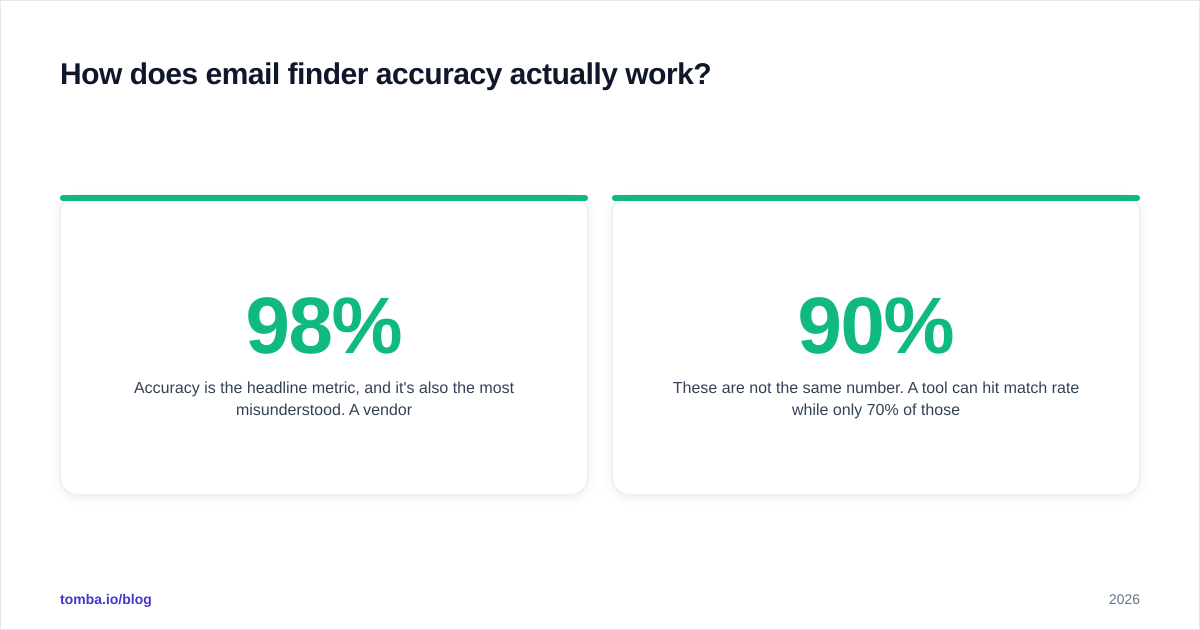
Accuracy is the headline metric, and it's also the most misunderstood. A vendor saying "98% accurate" can mean three different things:
- Match rate — what percentage of your input rows returned any email.
- Verified rate — what percentage of returned emails passed SMTP validation.
- Inbox rate — what percentage actually deliver without bouncing in a real campaign.
These are not the same number. A tool can hit 90% match rate while only 70% of those emails are verifiable, and a smaller share survive a catch-all domain. When you compare adaptio vs enrow, ask which definition each one is quoting.
The mechanics behind a single lookup look like this:
The verification step is where reputations are made or lost. SMTP handshake checks catch obvious dead mailboxes, but catch-all domains — servers that accept mail to any address — defeat naive verification. Both Adaptio and Enrow claim to handle catch-alls; the depth of that handling is the thing to test, not take on faith. (A dedicated catch-all verifier is the honest way to score this.)
For background on why this matters to your sender score, see Tomba's primer on email deliverability and the broader concept of sender reputation.

Adaptio vs Enrow: feature comparison#
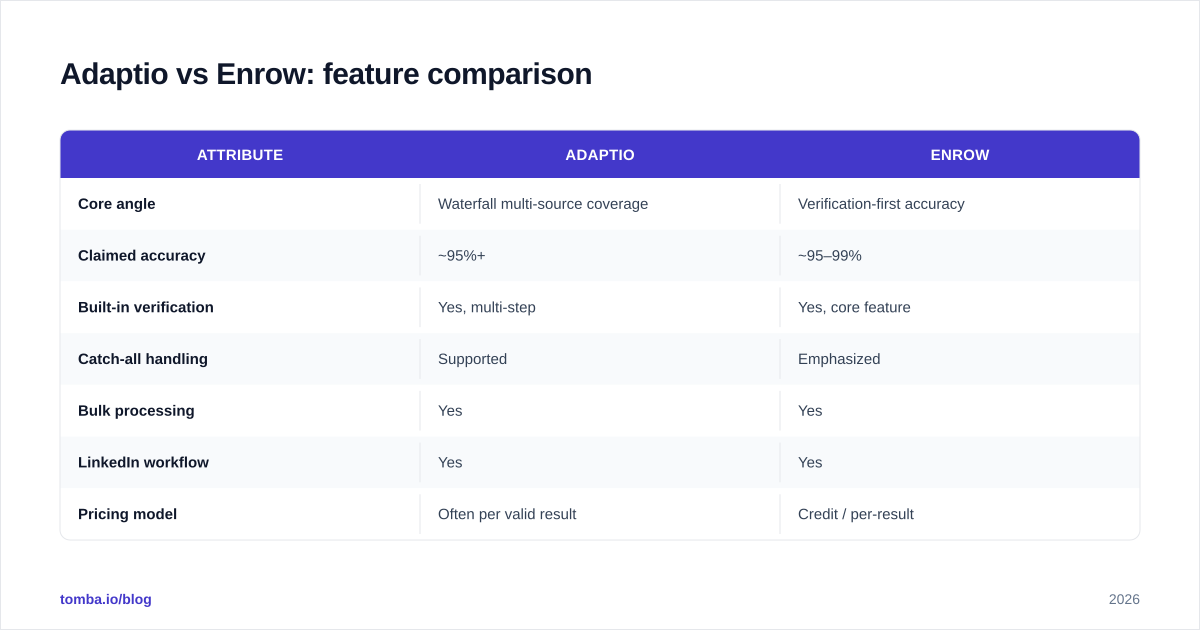
Here's the head-to-head on the attributes that change your results, not just the ones on the pricing page. Treat specific numbers as representative of each tool's positioning — always confirm against current vendor docs before purchasing, since plans shift.
| Attribute | Adaptio | Enrow |
|---|---|---|
| Core angle | Waterfall multi-source coverage | Verification-first accuracy |
| Claimed accuracy | ~95%+ | ~95–99% |
| Built-in verification | Yes, multi-step | Yes, core feature |
| Catch-all handling | Supported | Emphasized |
| Bulk processing | Yes | Yes |
| LinkedIn workflow | Yes | Yes |
| Pricing model | Often per valid result | Credit / per-result |
| Free trial / tier | Limited trial | Limited trial |
| Best for | Maximizing match rate | Minimizing bounce rate |
The pattern: Adaptio optimizes for finding more, Enrow optimizes for trusting what you find. Neither is wrong. Which matters more depends on whether your bottleneck is list size or sender reputation.
Is Adaptio better than Enrow for accuracy?#
It depends on how dirty your input list is. Conclusion first: if your prospect list is broad and messy, Adaptio's waterfall approach typically returns more emails; if your list is tight and your domain reputation is fragile, Enrow's verification-first posture protects you better.
Think of it like fishing. A waterfall tool casts several nets in sequence and keeps whatever it pulls up — great for volume, but you have to inspect the catch. A verification-first tool casts fewer nets but throws back anything questionable before it reaches your boat. If a single bounce can tank a warmed-up domain, the second behavior is worth more than raw count.
The trap with waterfall enrichment is double-charging risk and stale sources. When a tool chains five providers, some of those providers may return the same outdated record, and per-result billing can stack costs on contacts you'd never email. Always check whether you're billed per lookup or per valid, deduplicated result — and whether duplicate hits across sources count once or many times. Tools like Tomba's bulk email finder and remove duplicates utility exist precisely because dedup is where waterfall economics quietly break.
How does pricing compare?#
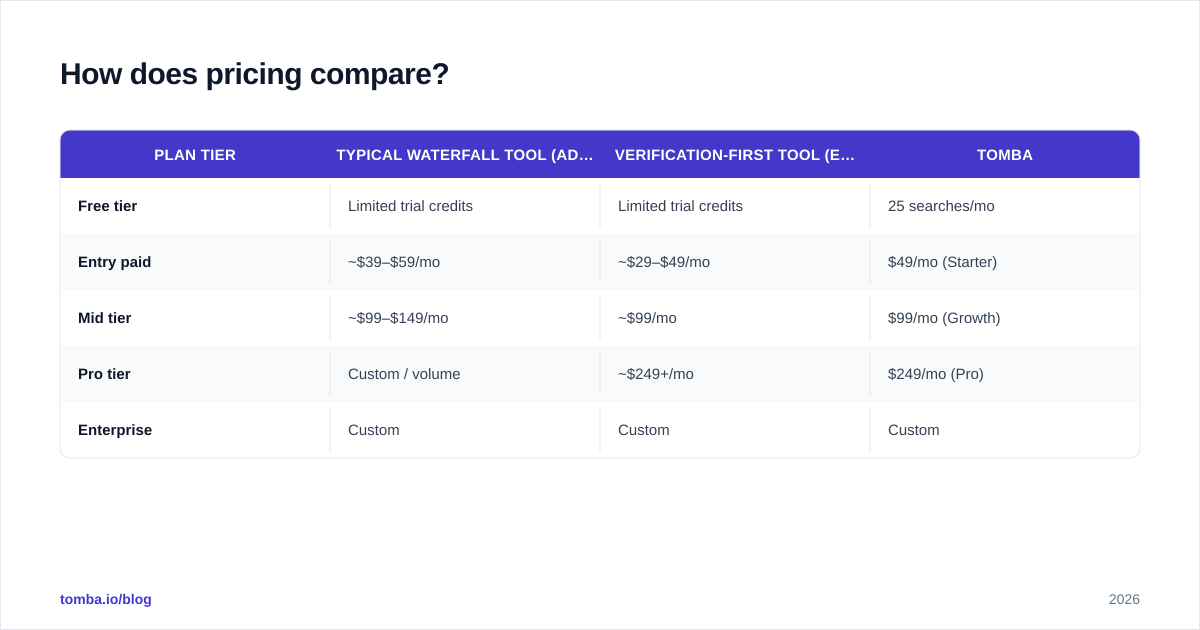
Pricing is the least comparable part of this matchup because the billing units differ. Per-valid-result pricing sounds fair until your match rate drops on a hard vertical, at which point your effective cost per usable email climbs.
| Plan tier | Typical waterfall tool (Adaptio-style) | Verification-first tool (Enrow-style) | Tomba |
|---|---|---|---|
| Free tier | Limited trial credits | Limited trial credits | 25 searches/mo |
| Entry paid | ~$39–$59/mo | ~$29–$49/mo | $49/mo (Starter) |
| Mid tier | ~$99–$149/mo | ~$99/mo | $99/mo (Growth) |
| Pro tier | Custom / volume | ~$249+/mo | $249/mo (Pro) |
| Enterprise | Custom | Custom | Custom |
Two things to model before you sign:
- Effective cost per inboxed email, not per credit. Multiply list size by realistic match rate by realistic verified rate. That number is the only honest comparison.
- Rollover and overage behavior. Per-result tools can spike on a single large, low-quality import.
For a transparent reference point with published, flat per-plan limits, see Tomba pricing. The value of a fixed-credit model is predictability: you know your cost ceiling regardless of how the waterfall behaves on a given list.
Which tool fits which team?#
Match the tool to your constraint, not to the marketing.
- High-volume SDR teams burning through large lists: a waterfall-heavy tool like Adaptio reduces "not found" gaps, which keeps reps in motion. Pair it with strict verification so coverage doesn't cost you deliverability.
- Founder-led or low-volume, high-stakes outbound: Enrow's verification-first stance protects a domain you can't afford to burn. Fewer, cleaner contacts beat a bigger bounce pile.
- Teams that want predictable cost and an API-first workflow: evaluate a flat-credit provider. Tomba's email finder API and email verifier cover both jobs under one transparent plan, and the domain search feature handles company-wide discovery without per-result surprises.
A practical rule: whatever you pick, verify externally at least once. Run a sample of any vendor's "verified" output through an independent email verifier before a real send. If the third-party bounce-risk score disagrees with the vendor's verdict, you've learned which definition of "accurate" you're actually buying.
What do reviewers and the market say?#
Public review platforms are useful for spotting consistent complaints rather than headline scores. Browse independent listings on G2 and Capterra for both tools and read the one- and two-star reviews first — that's where billing surprises, support latency, and real-world bounce rates surface. For a vendor-neutral explainer of the underlying category, Wikipedia's overview of email address harvesting and verification concepts is a reasonable grounding before you trust any single benchmark.
Whatever the aggregate stars say, your own 100-row test on your ICP beats any review. Both Adaptio and Enrow offer trials; use them on the same input list and compare the three metrics from earlier — match, verified, and actual bounce — side by side.

How should you run a fair head-to-head test?#
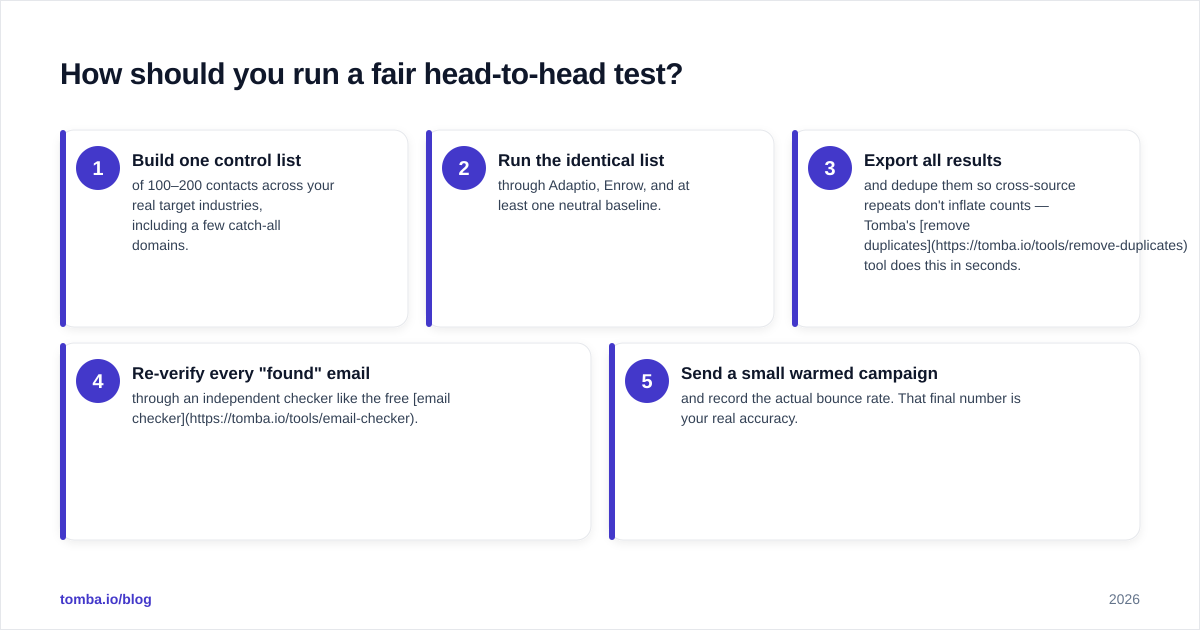
Don't trust either dashboard's self-reported accuracy. Run this protocol:
- Build one control list of 100–200 contacts across your real target industries, including a few catch-all domains.
- Run the identical list through Adaptio, Enrow, and at least one neutral baseline.
- Export all results and dedupe them so cross-source repeats don't inflate counts — Tomba's remove duplicates tool does this in seconds.
- Re-verify every "found" email through an independent checker like the free email checker.
- Send a small warmed campaign and record the actual bounce rate. That final number is your real accuracy.
This is the only way to cut through "98%" claims that mean different things. The winner is whichever tool gives you the lowest cost per inboxed email — not the most impressive number on a landing page.
The bottom line on Adaptio vs Enrow#
Adaptio and Enrow are both credible. Adaptio bets on coverage through waterfall enrichment; Enrow bets on trust through verification-first design. Pick Adaptio when your problem is "not enough emails," and Enrow when your problem is "too many bounces." But test both against a transparent, flat-priced baseline before you lock in — because per-result billing can quietly make a "cheaper" tool the expensive one once your hit rate dips.
If you want a benchmark that's easy to test honestly, start with Tomba's Email Finder. The free tier gives you 25 searches a month — enough to run the head-to-head protocol above — with built-in email verification, domain search, and a published pricing page so there are no per-result surprises. Run all three tools on the same list, measure cost per inboxed email, and let your own data pick the winner.
Ready to find emails that actually work?
Join 150,000+ professionals who stopped guessing and started sending. Free credits on signup — no credit card required.
Get the Tomba newsletter
Practical outbound tactics and product updates — once every two weeks.
About the author