Adaptio vs LakeB2B 2026: Which B2B Data Tool Wins?
Adaptio vs LakeB2B compared on accuracy, coverage, pricing, and integrations — plus where a pay-as-you-grow alternative like Tomba fits your 2026 stack.
TL;DR
- Adaptio (Adapt.io) is a self-serve B2B contact and company database with a Chrome extension, built for SDRs who want to pull verified contacts inside LinkedIn and on the web.
- LakeB2B is a managed data services provider — custom list builds, healthcare and niche databases, and done-for-you campaigns aimed at marketing teams that want curated files, not a self-serve tool.
- Pick Adaptio if you want a hands-on prospecting tool with predictable seats; pick LakeB2B if you want bespoke lists and a vendor to do the data work for you.
- Both sell on volume. Neither is the cheapest way to verify the emails you already have or to find a few hundred targeted contacts on demand.
- A pay-as-you-grow finder/verifier like Tomba Email Finder often slots in alongside either one to keep your list clean and your cost-per-valid-contact down.
What are Adaptio and LakeB2B?#
Think of these two as a hardware store versus a contractor. Adaptio hands you the tools and the aisle — you walk in, search, and pull the contacts you need yourself. LakeB2B is the contractor you hire to deliver a finished list to your door. Both end with B2B contacts in your CRM, but the buying experience, the pricing, and the team that fits each one are different.
Adaptio — branded Adapt.io — is a self-serve sales intelligence platform. It pairs a searchable database of business contacts and companies with a browser extension that surfaces emails and direct dials while you browse LinkedIn or company sites. Its core buyer is the SDR, growth marketer, or founder who wants to build a list this afternoon without filing a request ticket.
LakeB2B sits at the managed-services end of the market. Instead of a dashboard you log into daily, you brief a team on your ideal customer profile and they build, append, or verify a list for you. LakeB2B is known for healthcare, technology, and other vertical databases, plus campaign execution services like email and tele-calling. It is a fit for marketing teams running large, segment-specific campaigns who would rather buy data as a deliverable than operate a tool.
That core difference — self-serve tool versus done-for-you service — drives almost every other decision in this comparison.
How do Adaptio and LakeB2B compare at a glance?#
Here is the side-by-side. Where a vendor is quote-based rather than publicly priced, that is noted honestly — both Adaptio and LakeB2B lean on sales-led pricing, and a chunk of LakeB2B's catalog is fully custom.
| Attribute | Adaptio (Adapt.io) | LakeB2B | Tomba |
|---|---|---|---|
| Model | Self-serve database + extension | Managed data services / custom lists | Self-serve finder + verifier + API |
| Best for | SDRs, growth, founders | Marketing teams buying lists | Teams needing accurate emails on demand |
| Data delivery | In-app search, CSV, CRM push | Curated file / append / campaign | Live search, bulk, API |
| Email verification | Built in | Per-project, varies | Dedicated verifier + catch-all checks |
| Pricing | Seat / credit, quote-led | Custom per project | Free 25/mo, $49, $99, $249, custom |
| Free tier | Limited trial | No | Yes — 25 searches/mo |
| Vertical depth | Broad B2B | Strong healthcare + niche | Broad B2B, domain-level |
| API access | Yes (higher tiers) | Limited | Yes — full REST API |
| Entry friction | Sign up, start | Sales call + brief | Sign up, start |
Two takeaways. First, Adaptio and Tomba both let you start the same day, while LakeB2B is a sales-and-brief process by design. Second, only Tomba publishes a flat, public ladder — Tomba pricing runs Free (25 searches/mo), Starter $49/mo, Growth $99/mo, Pro $249/mo, and Enterprise — which matters if you want to model cost before a single call.

Is Adaptio better than LakeB2B for accuracy?#
Accuracy depends less on the logo and more on how fresh the underlying records are and whether you verify before you send. This is the single biggest lever on your bounce rate, so treat any vendor's headline accuracy number as a starting point, not a guarantee.
Adaptio refreshes its database continuously and verifies emails inside the product, which is what you want for a self-serve workflow: you search, you see a confidence signal, you export. Because you pull records yourself, you can spot-check and re-verify on your own cadence. The risk with any large static database is decay — roughly 2–3% of B2B contacts change jobs every month, so a record that was perfect in January is meaningfully stale by summer.
LakeB2B's accuracy is project-shaped. When you commission a build, verification is part of the scope and you can negotiate guarantees on deliverability. That is genuinely valuable for a one-time campaign into a specific vertical. The trade-off: a list delivered as a file starts decaying the moment it lands, and re-verifying it later is a fresh engagement rather than a button.
This is the gap a dedicated email verifier closes for either tool. Whether your contacts came from Adaptio's extension or a LakeB2B file, running them through verification — including catch-all verification for domains that accept everything — before a send is what actually protects your sender reputation. Accuracy is not a number you buy once; it is a step you repeat.
If you want an independent read on either vendor's data quality, the reviews on G2 are more useful than any vendor-published stat, because they reflect real bounce experiences across many buyers.
How does pricing compare for Adaptio vs LakeB2B?#
Conclusion first: Adaptio is seat-and-credit pricing you negotiate; LakeB2B is per-project pricing you scope; Tomba is the only one of the three with a public, self-serve ladder. None of that makes one "cheapest" in the abstract — it depends entirely on volume and how often you buy.
- Adaptio charges by seats and credits, typically through a sales conversation, with higher tiers unlocking API access and larger export limits. Good when you have a defined team and a steady prospecting motion.
- LakeB2B quotes per engagement based on list size, segment difficulty, and whether you add campaign execution. Niche databases (healthcare, for example) command a premium because the data is harder to source and maintain.
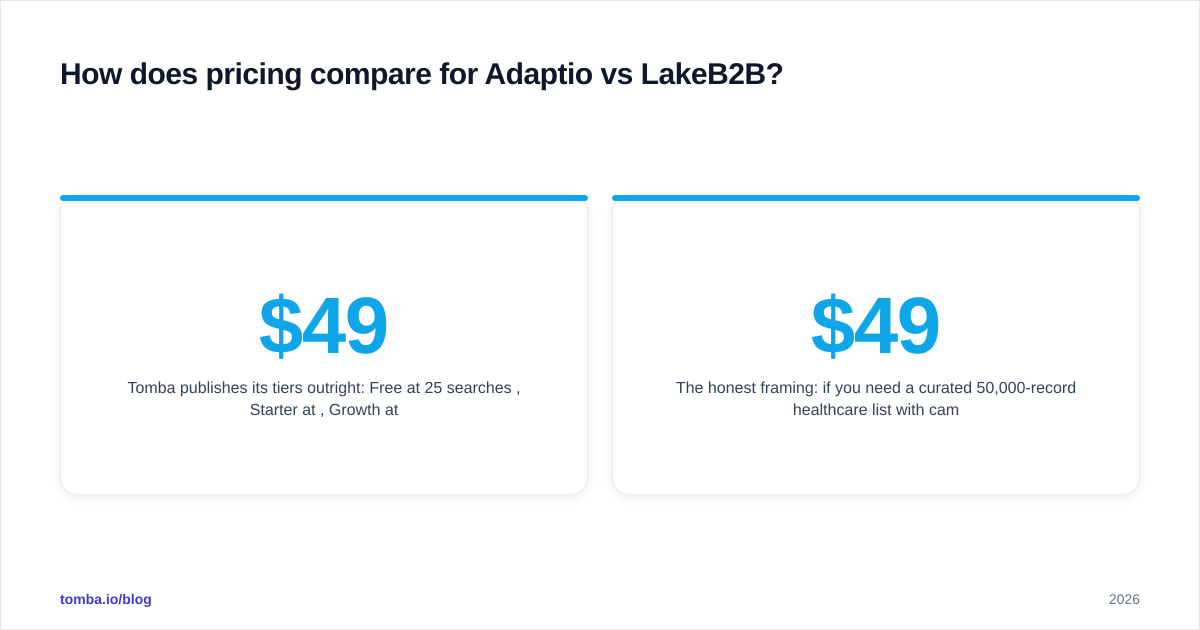
- Tomba publishes its tiers outright: Free at 25 searches/mo, Starter at $49/mo, Growth at $99/mo, Pro at $249/mo, and custom Enterprise — see the full Tomba plans for credit counts.
The honest framing: if you need a curated 50,000-record healthcare list with campaign support, LakeB2B's model is built for that and a $49 self-serve tool is not. If you need a few thousand accurate, verified contacts a month and want to control cost line by line, the public-ladder approach wins. Most teams overpay by buying a heavyweight contract for a job a lighter tool could do — match the model to the volume.
Which tool fits your team — Adaptio, LakeB2B, or a finder?#
Map the tool to how your team actually works rather than to a feature checklist.
Choose Adaptio if you have SDRs living inside LinkedIn who want to self-serve contacts, you value a Chrome extension in the workflow, and you can commit to seats. It rewards daily, hands-on prospecting.
Choose LakeB2B if you are a marketing team running segment-specific campaigns, you need vertical depth (especially healthcare), and you would rather receive a finished, verified file than operate a tool. It rewards big, well-defined builds.
Add a finder/verifier like Tomba if your real need is accurate emails on demand — filling gaps in a CRM, verifying a partner's list, or running targeted outbound without a five-figure commitment. Tools like domain search let you pull every email pattern at a target company in seconds, and the Tomba API wires that into your own systems.
These are not mutually exclusive. A common 2026 stack is one primary data source plus a verifier in front of every send. If you are weighing Adaptio or LakeB2B against the broader market, it is also worth reading how each stacks up against tools like Apollo — our Apollo alternative breakdown covers the same self-serve-versus-managed tension from another angle.
What are the pros and cons of each?#
A blunt scorecard. No tool is all upside.
Adaptio (Adapt.io)
- Pros: Self-serve and fast, browser extension fits the SDR workflow, verification built in, API on higher tiers.
- Cons: Quote-led pricing reduces transparency, broad database means you still verify before bulk sends, value drops if seats sit unused.
LakeB2B
- Pros: Done-for-you lists, strong vertical and healthcare coverage, campaign execution available, negotiable guarantees per project.
- Cons: Sales-and-brief entry, no public pricing, delivered files decay and re-verification is a new engagement, not built for ad-hoc daily pulls.
Tomba (the complementary option)
- Pros: Public pricing, free tier to test, dedicated verifier and catch-all checks, full API/CLI/extension, plug into either vendor's output.
- Cons: Built around emails and B2B contact data, not a managed-services agency — if you want someone to run the campaign for you, that is a different category.
The pattern across all three: the data is only as good as your last verification, and the cheapest path to a clean list is usually buying accurately and verifying continuously rather than buying big once.
How should you actually run the evaluation?#
Run a real bake-off instead of trusting marketing copy. It takes an afternoon and settles the question for your specific ICP.
- Take 200 real target accounts from your ICP — not a vendor's sample.
- Ask each tool (or, for LakeB2B, request a sample build) to return contacts and emails for those accounts.
- Run every result through one neutral email verification pass so you are comparing apples to apples.
- Score on match rate (how many you got), valid rate (how many survived verification), and true cost per valid contact.
- Send a small, identical test campaign and compare bounce and reply rates.
The winner is whichever tool delivers the lowest cost per valid, replied-to contact — not the biggest database or the longest feature list. Vanity metrics like "500M contacts" mean nothing if 15% bounce. For more on building a clean pipeline end to end, our guide to using a reliable email finder walks through the workflow most outbound teams settle on.
The bottom line#
Adaptio and LakeB2B solve adjacent problems: Adaptio is the self-serve tool for hands-on prospectors, and LakeB2B is the managed service for marketing teams buying curated, vertical-heavy lists. Choose based on whether you want to operate a tool or receive a deliverable — and on whether your volume justifies a sales-led contract.
Whichever you pick, the verify step is non-negotiable, and that is where a lighter, transparent tool earns its place in the stack. If your real need is accurate, verified B2B emails on demand — without a five-figure commitment or a sales call to see a price — start free with the Tomba Email Finder. You get 25 searches a month at no cost, a dedicated verifier and catch-all checks behind it, and a full API when you are ready to scale. Build your list, verify before you send, and only pay for what you actually use.
// get started
Find, verify and enrich your first contacts today
Start on the free plan with 25 searches a month, then scale when your team is ready.
Free plan · No credit card required · GDPR & CCPA
// about the author