Adaptio vs Limeleads 2026: B2B Lead Data Compared
Adaptio leans on real-time buying signals; Limeleads sells flat-rate B2B lists. Here's how the two stack up on data, pricing, and fit in 2026 — and where a verifier still matters.
TL;DR
- Adaptio is built around real-time buying signals and intent — it tells you who to contact now, with enrichment layered on top.
- Limeleads is a flat-rate B2B contact database — predictable pricing, large company/contact coverage, and CSV-style list building for who to contact at all.
- They solve different ends of the same problem: Adaptio optimizes for timing and prioritization; Limeleads optimizes for volume and cost-per-record.
- Neither replaces an independent verification step — both feed lists you should clean before you send, or you'll burn sender reputation.
- If your bottleneck is finding and confirming the right address rather than scoring intent, a dedicated email finder plus an email verifier often beats paying database premiums.
Who are Adaptio and Limeleads?#
Short version: Adaptio is a signals-and-enrichment platform; Limeleads is a flat-rate list builder. They get lumped together because both promise "more pipeline," but they attack the funnel from opposite directions.
Think of it like grocery shopping. Limeleads is the bulk warehouse store — you walk out with a full cart at a known price per item, and it's up to you to sort what's fresh. Adaptio is the personal shopper who watches the shelves and texts you the moment the thing you wanted goes on sale. One is about quantity at a fixed cost; the other is about timing and relevance.
Limeleads positions itself as an affordable, transparent B2B lead database. You filter by industry, company size, location, title, and revenue, then export contact records — typically business emails and firmographics — without per-record surprises. The pitch is straightforward: predictable monthly pricing and a deep well of company data for teams that just need lists to work.
Adaptio sits closer to the modern "GTM intelligence" category. Instead of handing you a static export, it watches for behavioral and firmographic signals — hiring changes, technology adoption, funding, web activity — and surfaces accounts that look ready to buy, enriching them with contact data so your reps act on the warmest accounts first.
If you want the broader category context, G2's B2B data and sales-intelligence grids are a reasonable neutral starting point for how buyers rate tools in this space.
How do Adaptio and Limeleads compare at a glance?#
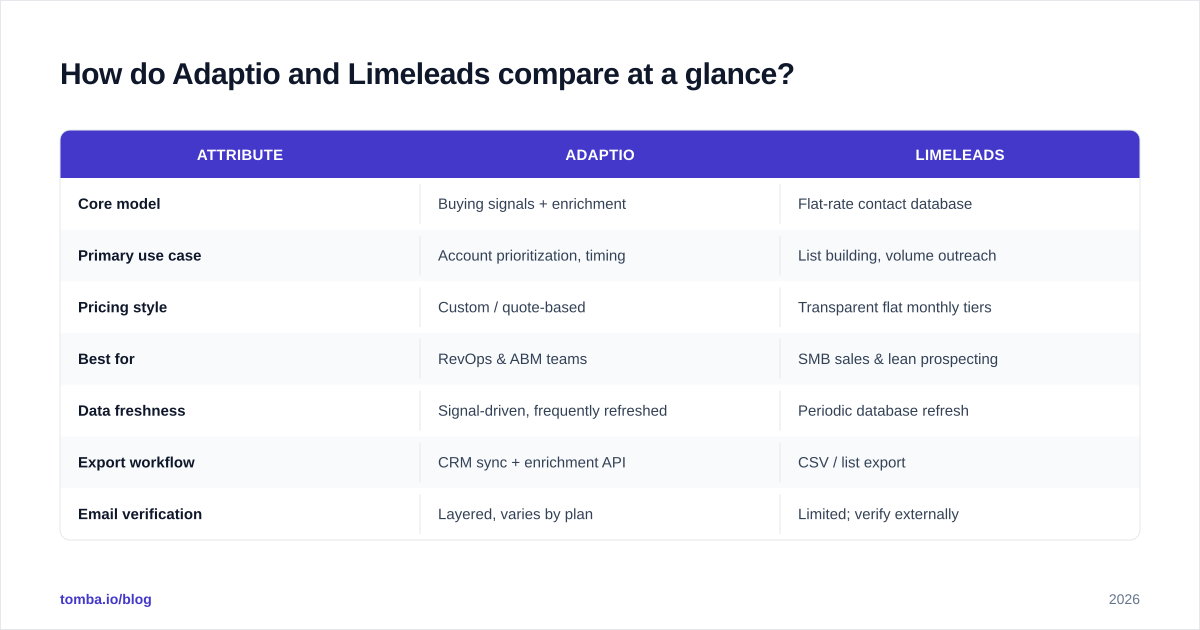
Here's the head-to-head. Where a vendor doesn't publish a number openly, it's marked "Not public" rather than guessed — treat those as "request a quote."
| Attribute | Adaptio | Limeleads |
|---|---|---|
| Core model | Buying signals + enrichment | Flat-rate contact database |
| Primary use case | Account prioritization, timing | List building, volume outreach |
| Pricing style | Custom / quote-based | Transparent flat monthly tiers |
| Best for | RevOps & ABM teams | SMB sales & lean prospecting |
| Data freshness | Signal-driven, frequently refreshed | Periodic database refresh |
| Export workflow | CRM sync + enrichment API | CSV / list export |
| Email verification | Layered, varies by plan | Limited; verify externally |
| Learning curve | Higher (signals, scoring) | Low (filter and export) |
The honest read: Adaptio wins on "when," Limeleads wins on "how cheap and how many." Which one is "better" depends entirely on whether your team's constraint is prioritization or coverage at a price.
Which one has more accurate data?#
Accuracy is a moving target, and neither vendor's marketing number should be taken at face value. B2B contact data decays fast — a widely cited industry estimate is that 20–30% of a database goes stale each year as people change jobs. That's not a knock on either tool; it's physics. The person who was a VP of Marketing in January is a "former employee" by Q3.
Where the two differ is how they fight decay:
- Adaptio leans on signal recency. Because it's watching for changes (new hires, role changes, tech installs), records tied to active signals tend to be fresher by construction. The trade-off is that coverage narrows to accounts showing signals — you see warm accounts clearly, cold ones less so.
- Limeleads leans on database breadth and periodic refresh. You get more records, but a flat export is a snapshot; some rows will be stale the day you download them.
This is why a separate verification layer matters regardless of which platform you pick. Running any exported list through a catch-all verifier and a standard syntax/SMTP check before your first send protects your domain. For a deeper look at how confirmation actually works, our breakdown of email deliverability covers why an unverified list quietly tanks inbox placement.

Is Adaptio better than Limeleads for outbound?#
For timing-driven outbound, yes — Adaptio is built for it. For high-volume, cost-sensitive outbound, Limeleads usually wins on math.
Picture two SDR teams. Team A has five reps and a number to hit this quarter; they don't need 200,000 contacts, they need to know which 300 accounts to call this week. Adaptio's signal scoring is tailor-made for that — it concentrates rep effort where intent is highest, which is exactly what intent-based selling is supposed to do (HubSpot's guide to buyer intent data is a solid primer on the concept).
Team B runs broad, templated campaigns across a large addressable market and lives or dies on cost-per-contact. For them, paying a premium for signal scoring is overkill — they need a big, cheap, well-filtered list and a strong sending stack. Limeleads' flat-rate model fits that shape.
A practical rule of thumb:
- If your reps complain they don't know who to call first → Adaptio's signals help.
- If your reps complain they run out of contacts → Limeleads' volume helps.
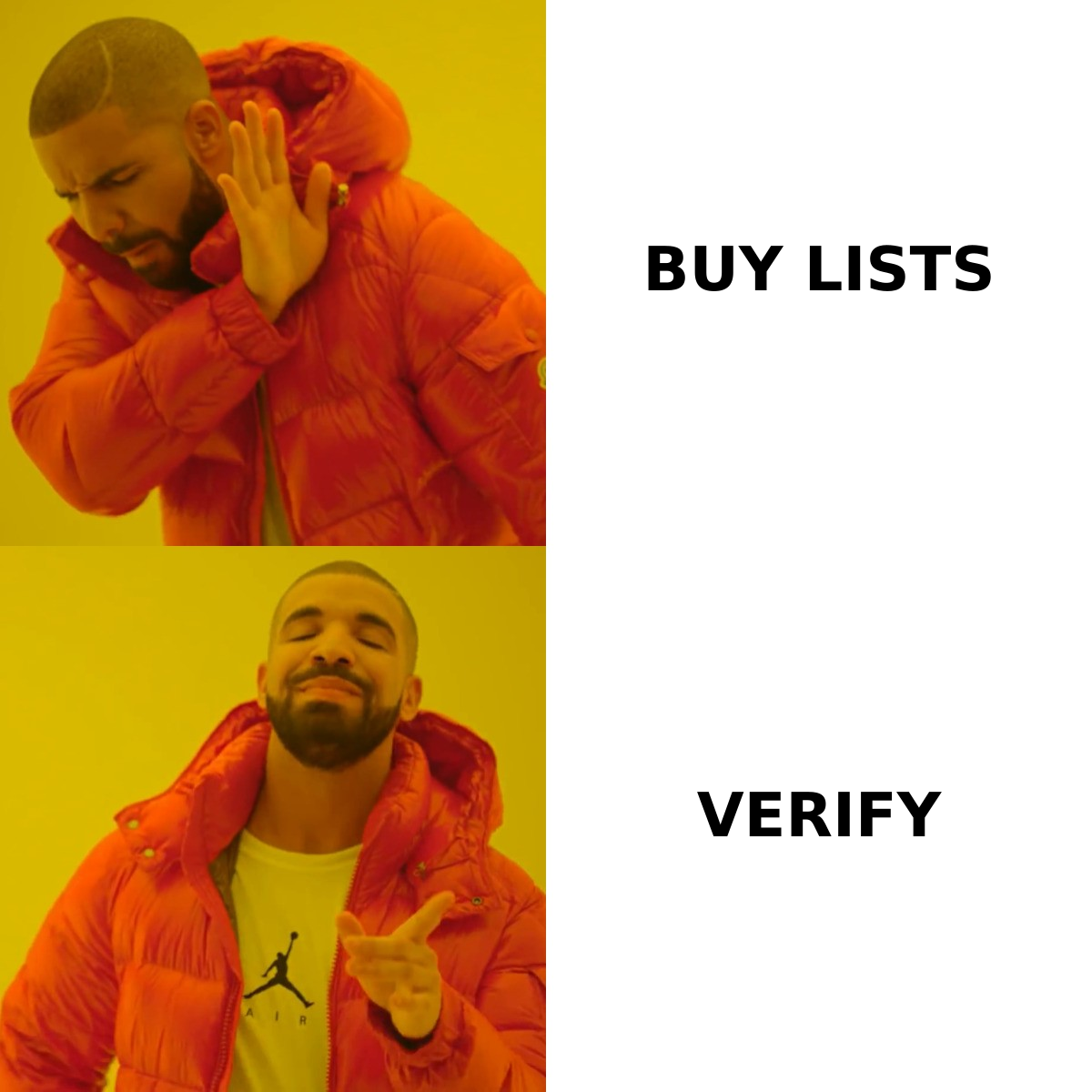
- If your reps complain emails bounce → neither is your real fix; verification is.
That third point is the one teams skip. You can buy the most expensive intent data on the market and still land in spam if the underlying address is dead. Pairing either tool with a verification pass — or replacing the contact-finding step entirely with a dedicated finder — is what actually moves reply rates.
What about pricing and total cost?#
Limeleads is the easier number to defend to finance; Adaptio is the easier outcome to defend to the board.
Limeleads' flat-rate transparency means you know your cost-per-month and roughly your cost-per-record up front. That predictability is genuinely valuable for SMBs and bootstrapped teams — no "talk to sales" friction, no per-export metering anxiety.
Adaptio's quote-based pricing reflects its enterprise/RevOps positioning. You're paying for the intelligence layer, not just the rows, so total cost scales with seats, signal volume, and integrations rather than raw record counts. For a well-funded team where one well-timed deal pays for the year, that's rational. For a two-person shop, it's likely more platform than the problem requires.
When you model total cost, include the hidden line item both vendors share: cleanup. Budget for verification and deduplication on top of either subscription. A tool like Tomba's bulk email finder or data enrichment can fill and confirm gaps so you're not paying database premiums for records you then have to re-check by hand. If you're benchmarking against other providers, our Apollo alternative comparison and Tomba pricing page give you a third reference point on what credit-based access actually costs.
Where does a dedicated email finder fit in?#
Often, the real job-to-be-done isn't "score intent" or "buy a list" — it's "get a correct, confirmed address for this specific person." That's a third lane, and it's frequently cheaper than either platform for that narrow task.
Both Adaptio and Limeleads bundle contact data into a larger product. If you already have your target accounts — from a conference list, a CRM segment, a LinkedIn export, or a webinar signup — you don't need a new database or a signals engine. You need to turn names and domains into verified emails. That's where a focused finder earns its keep:
- You know the company, not the contact? Domain search returns the people and patterns behind a company domain.
- You have a name and a domain? The email finder resolves the specific address and scores its confidence.
- You have a raw list to clean? The email verifier flags invalid, risky, and catch-all addresses before you send.
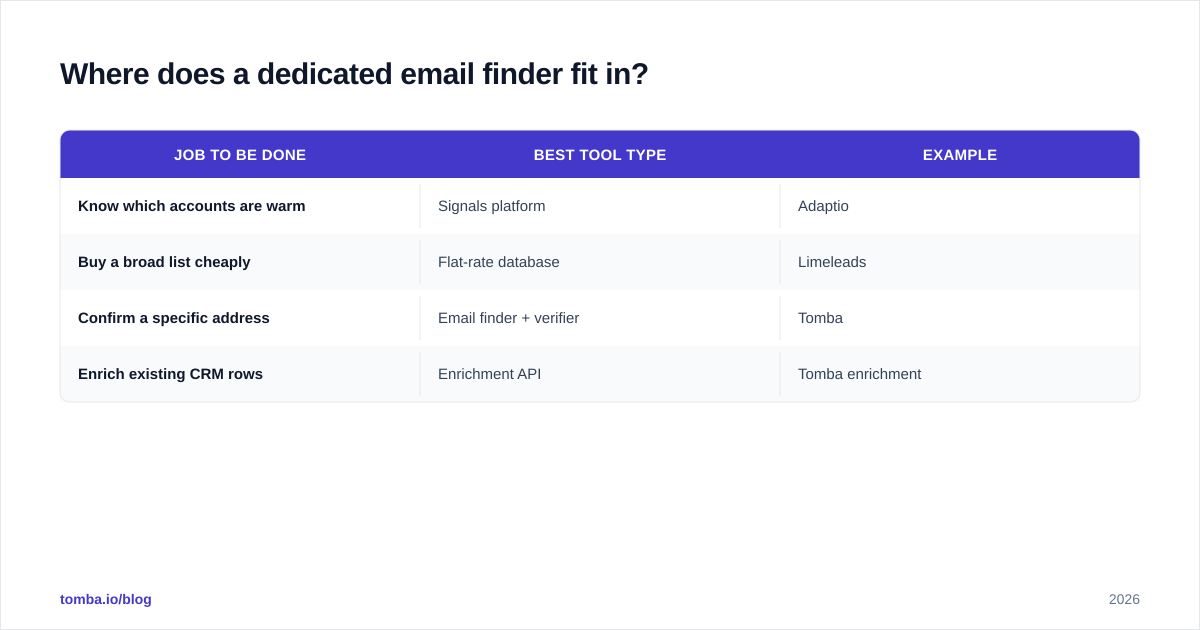
Here's how the three approaches line up on the job each is actually best at:
| Job to be done | Best tool type | Example |
|---|---|---|
| Know which accounts are warm | Signals platform | Adaptio |
| Buy a broad list cheaply | Flat-rate database | Limeleads |
| Confirm a specific address | Email finder + verifier | Tomba |
| Enrich existing CRM rows | Enrichment API | Tomba enrichment |
None of these is universally "best." A mature GTM team often runs a signals layer and a finder/verifier — Adaptio (or similar) tells them whom to prioritize, and a finder confirms the address is real before the email goes out. Stacking them beats over-trusting any single source.
How should you choose between them?#
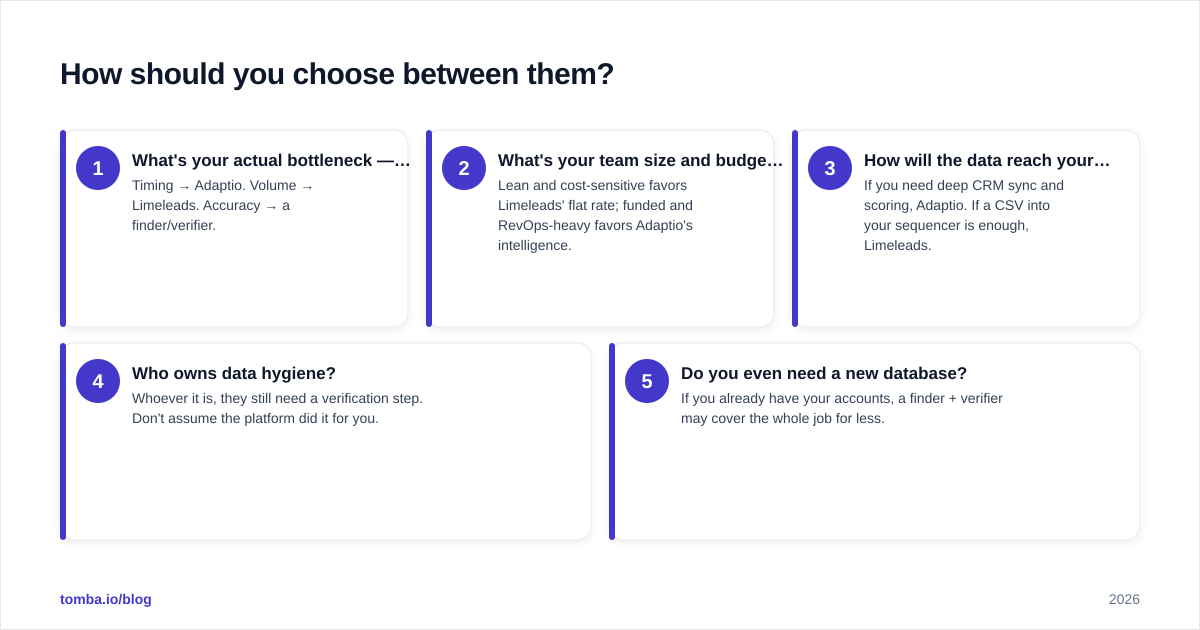
Run your situation through five questions:
- What's your actual bottleneck — timing, volume, or accuracy? Timing → Adaptio. Volume → Limeleads. Accuracy → a finder/verifier.
- What's your team size and budget shape? Lean and cost-sensitive favors Limeleads' flat rate; funded and RevOps-heavy favors Adaptio's intelligence.
- How will the data reach your reps? If you need deep CRM sync and scoring, Adaptio. If a CSV into your sequencer is enough, Limeleads.
- Who owns data hygiene? Whoever it is, they still need a verification step. Don't assume the platform did it for you.
- Do you even need a new database? If you already have your accounts, a finder + verifier may cover the whole job for less.
Be honest about #5 especially. Teams routinely buy a full database to solve what was really a "confirm 500 addresses" problem. Read independent reviews on Capterra for both tools, then map the feature lists back to your one real bottleneck rather than the longest feature grid.
The bottom line#
Adaptio and Limeleads aren't really competitors so much as answers to different questions. Adaptio is for teams whose problem is when and whom to prioritize. Limeleads is for teams whose problem is enough contacts at a predictable price. Pick based on which sentence describes your week.
But whichever you choose, the address still has to be real on send day. That's the step both platforms leave partly to you — and it's the step that decides whether your carefully chosen account ever sees your message.
If your core problem is finding and confirming the right email rather than scoring intent or buying volume, start with the Tomba Email Finder. It turns names and domains into verified, confidence-scored addresses, pairs with a built-in verifier and enrichment, and runs on a free tier (25 searches/month) before paid plans start at $49/month — so you can clean your Adaptio or Limeleads exports, or skip the database premium entirely, without a sales call.
// get started
Find, verify and enrich your first contacts today
Start on the free plan with 25 searches a month, then scale when your team is ready.
Free plan · No credit card required · GDPR & CCPA
// about the author