Adaptio vs Mailshunt 2026: Which Cold Email Tool Wins?
Adaptio leans on AI personalization, Mailshunt on volume sending. Here's a neutral, feature-by-feature breakdown to help you pick the right cold email platform in 2026.
Choosing between Adaptio and Mailshunt usually comes down to one question: do you want a platform that helps you say the right thing, or one that helps you send a lot of things? Both promise more replies, but they pull in different directions. This breakdown walks through what each does well, where each falls short, and which outbound motions they actually fit — without pretending either one is a silver bullet.
TL;DR#
- Adaptio is built around AI-assisted personalization and reply handling. Pick it when message quality and 1:1 relevance matter more than raw send volume.
- Mailshunt is built around high-volume sending, inbox rotation, and warmup. Pick it when you run large lists and need throughput with deliverability guardrails.
- Neither tool finds or verifies contact data for you — that's an upstream job. Garbage lists sink both platforms equally.
- Pricing and seat limits diverge fast at scale; model your real send volume before committing to an annual plan.
- The honest answer for most teams: the sending tool matters less than the quality of the list feeding it. Fix data first.
What Are Adaptio and Mailshunt?#
Both are cold email outreach platforms, but they solve different halves of the problem.
Adaptio positions itself as a personalization-first sending tool. The pitch is that AI drafts and adapts each message to the prospect — pulling in role, company signals, and context so every email reads as if it were written by hand. Sequencing, reply detection, and meeting booking sit on top. The bet is that relevance beats volume, especially in crowded inboxes where generic templates get ignored or flagged.
Mailshunt is throughput-oriented. Its core features cluster around sending at scale: multiple connected mailboxes, automatic inbox rotation to spread load, built-in warmup, and bulk sequence management. The bet here is the opposite — that with enough volume, clean deliverability, and decent (not perfect) copy, the math works in your favor.
That difference in philosophy shows up everywhere, from how you build a campaign to what you pay per seat.
How Do Adaptio and Mailshunt Compare Feature by Feature?#
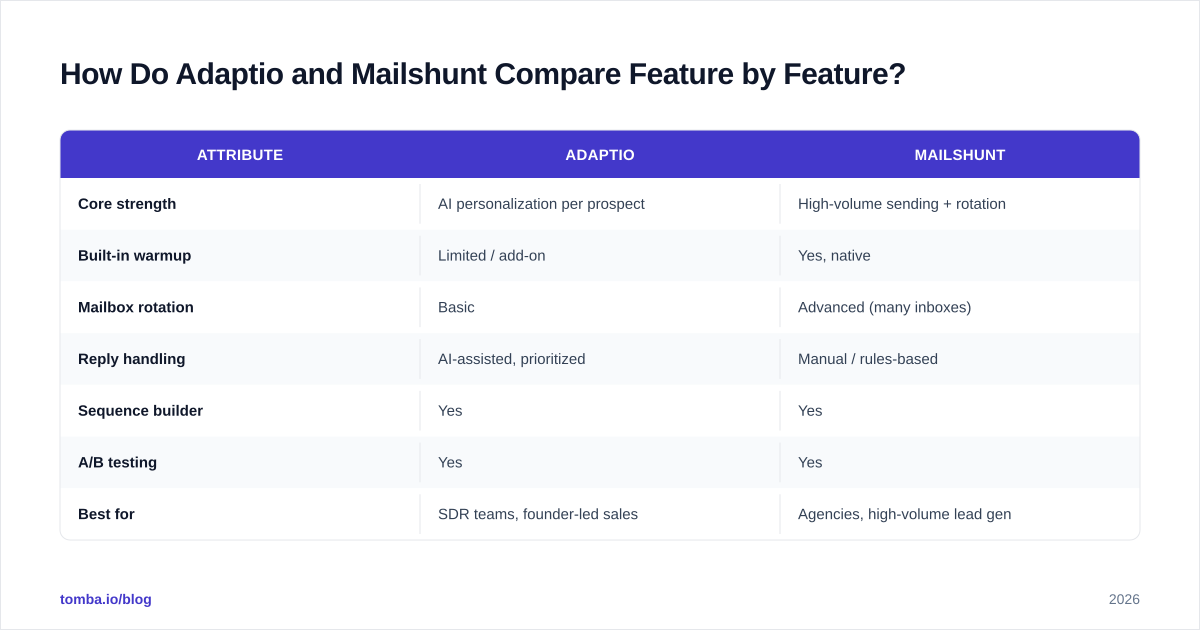
Here's the side-by-side. Treat pricing as indicative — both vendors change tiers and gate features behind annual commitments, so confirm current numbers on their own sites and on a third-party directory like G2 before you buy.
| Attribute | Adaptio | Mailshunt |
|---|---|---|
| Core strength | AI personalization per prospect | High-volume sending + rotation |
| Built-in warmup | Limited / add-on | Yes, native |
| Mailbox rotation | Basic | Advanced (many inboxes) |
| Reply handling | AI-assisted, prioritized | Manual / rules-based |
| Sequence builder | Yes | Yes |
| A/B testing | Yes | Yes |
| Best for | SDR teams, founder-led sales | Agencies, high-volume lead gen |
| Data/email finding | Not included | Not included |
| Entry pricing (indicative) | Higher per seat | Lower per inbox |
| Learning curve | Moderate | Low-moderate |
A few things worth calling out from that table.
First, warmup. Mailshunt treats warmup as a first-class feature because volume senders live or die by domain reputation. Adaptio leans on lower per-prospect volume, so it invests less here — fine if you're sending hundreds of relevant emails, risky if you try to scale to thousands.
Second, reply handling. Adaptio's AI triage is a genuine differentiator for small teams drowning in responses. Mailshunt assumes you have an SDR or a shared inbox process to handle replies downstream.
Third — and this is the one teams forget — neither tool builds your list. Both expect you to arrive with verified contacts.
Which Tool Has Better Deliverability?#
Deliverability is decided more by your inputs than by the platform logo. That said, the two tools give you different levers.
Mailshunt's volume model only works if reputation stays clean, so it bundles warmup, inbox rotation, and send-throttling. Spread across 20 mailboxes, no single domain takes the full blast. That's the right architecture for agencies running thousands of sends a day.
Adaptio's lower-volume, higher-relevance model is inherently gentler on reputation — fewer sends, more replies, better engagement signals. But because it under-invests in warmup tooling, you're more exposed if you push it past its comfort zone.
Either way, three things move the needle more than the tool:
- List hygiene. Sending to invalid or catch-all addresses tanks your bounce rate and your reputation. Run every list through an email verifier before the first send.
- Authentication. SPF, DKIM, and DMARC must be set correctly. Google and Yahoo enforce this for bulk senders — see Google's Postmaster guidance and the broader concept of email deliverability.
- Engagement. Replies and opens build reputation; spam complaints destroy it. This is where Adaptio's personalization quietly helps.
If you want to sanity-check your ramp before committing budget, a free email warmup calculator gives you a realistic send schedule so you don't cook a fresh domain in week one.

Is Adaptio Better Than Mailshunt for Personalization?#
Yes — that's the entire premise of the product, and it's the clearest reason to pick it.
Adaptio's AI drafts messages against each prospect's role, company, and context, then adapts tone and angle automatically. For a founder or a two-person SDR team, that turns a half-day of manual research into minutes. The replies you get tend to be warmer because the email actually references something true about the recipient.
Mailshunt supports personalization too — merge fields, spintax, conditional steps — but it's template-driven. You write the variants; the platform fills the blanks. At 5,000 sends a day, that's the pragmatic trade-off. You can't hand-craft 5,000 emails, so you accept "good enough" relevance in exchange for reach.
The catch nobody mentions: AI personalization is only as good as the data behind it. If your enrichment is thin or wrong, Adaptio will confidently personalize an email to the wrong job title at the wrong company. Personalization amplifies your data quality in both directions. That's why the data layer underneath either tool matters more than the tool itself.
A useful gut check: if you're sending fewer than ~1,000 highly targeted emails a month to senior buyers, Adaptio's relevance edge pays off. If you're running broad campaigns where reply rate per send is low but volume is high, Mailshunt's economics win.
Which Is Better for Agencies vs In-House Teams?#
The split is cleaner than you'd expect.
Agencies and high-volume lead-gen shops usually land on Mailshunt. They manage many client domains, need aggressive inbox rotation, and care about cost per inbox more than cost per seat. Mailshunt's architecture is built for that fan-out, and the lower entry price per mailbox compounds in their favor.
In-house SDR teams and founder-led sales more often fit Adaptio. They send less, target higher, and need every email to land well because they're often emailing accounts they can't afford to burn. The AI reply triage also matters more when you don't have a dedicated inbox manager.
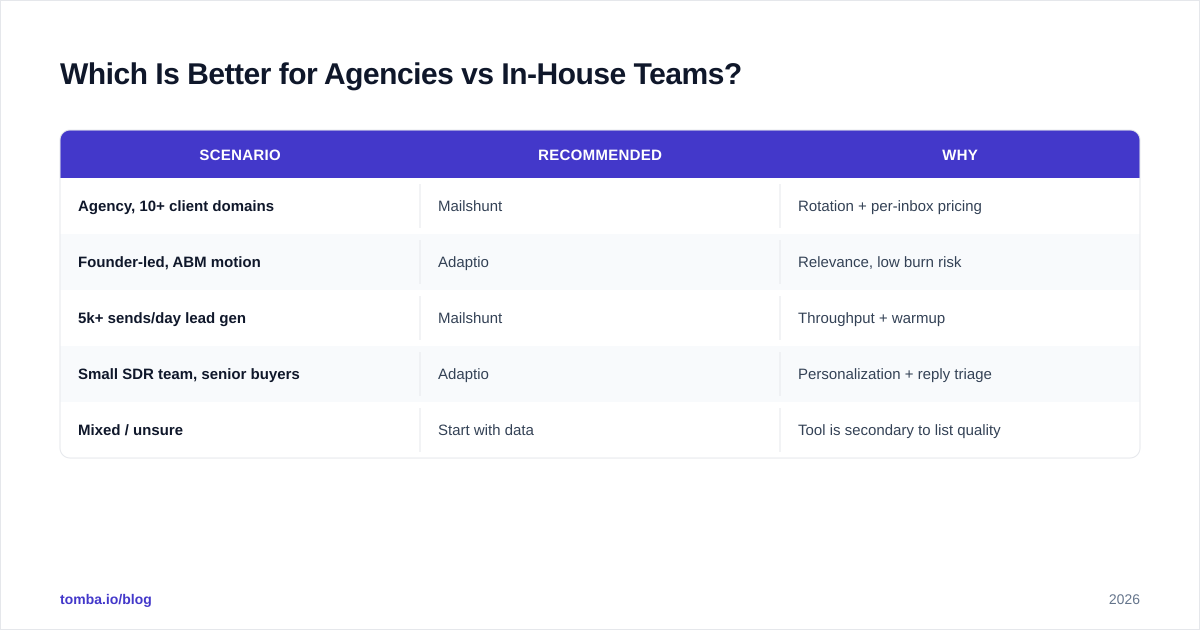
| Scenario | Recommended | Why |
|---|---|---|
| Agency, 10+ client domains | Mailshunt | Rotation + per-inbox pricing |
| Founder-led, ABM motion | Adaptio | Relevance, low burn risk |
| 5k+ sends/day lead gen | Mailshunt | Throughput + warmup |
| Small SDR team, senior buyers | Adaptio | Personalization + reply triage |
| Mixed / unsure | Start with data | Tool is secondary to list quality |
Notice the last row. For a meaningful share of teams, the right first move isn't picking a sender at all — it's fixing what goes into it.

What Both Tools Get Wrong (and How to Fix It)#
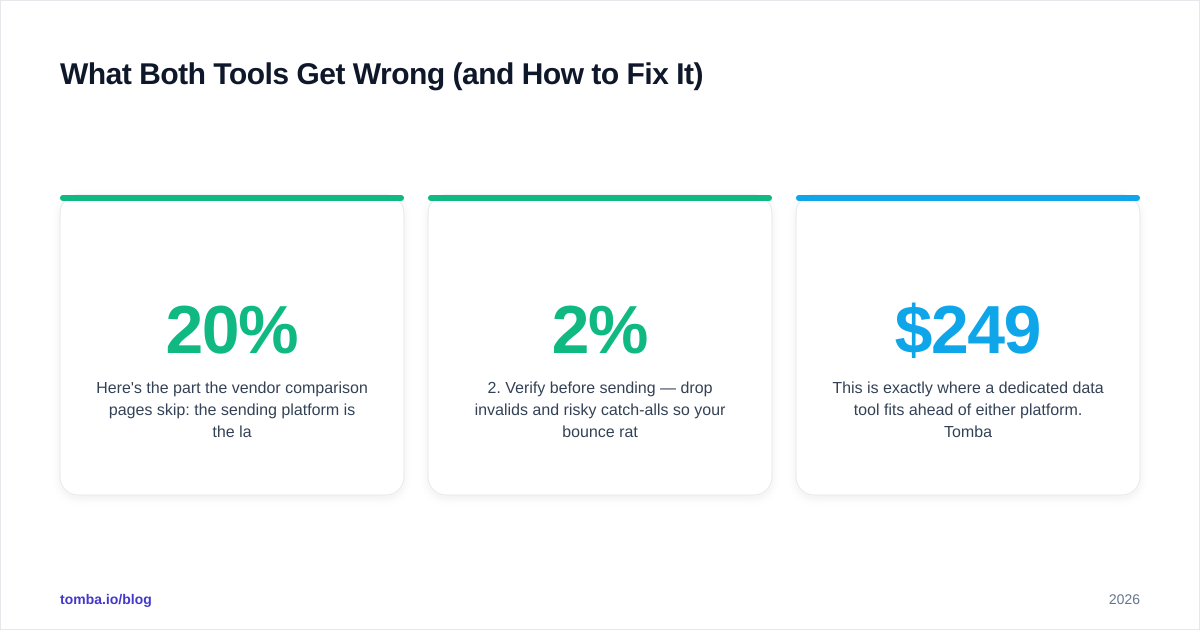
Here's the part the vendor comparison pages skip: the sending platform is the last 20% of an outbound system. The first 80% is targeting and data, and neither Adaptio nor Mailshunt does that for you.
You can run the most elegant Adaptio sequence in the world, but if the email address bounces, none of it matters. You can wire up 30 mailboxes in Mailshunt, but if a third of your list is stale, you'll torch every one of those domains in a month.
A reliable outbound stack looks like this:
- Source accurate contacts — find verified work emails for the people you actually want to reach.
- Verify before sending — drop invalids and risky catch-alls so your bounce rate stays under ~2%.
- Enrich for personalization — give your AI (or your merge fields) real role, company, and signal data to work with.
- Then choose your sender — Adaptio or Mailshunt, based on the volume-vs-relevance trade-off above.
This is exactly where a dedicated data tool fits ahead of either platform. Tomba's email finder and domain search handle steps 1–3, so the list you hand to Adaptio or Mailshunt is clean, complete, and ready to personalize. You can also pull templates from a free cold email templates library so you're not starting copy from a blank page. For pricing comparisons across data tools, the Tomba pricing page lays out tiers from Free (25 searches/mo) up to Pro at $249/mo.
For a deeper benchmark of how outreach platforms stack up on features and integrations, third-party directories like HubSpot's sales tools roundup are a sane neutral reference before you commit.
How Should You Decide Between Adaptio and Mailshunt?#
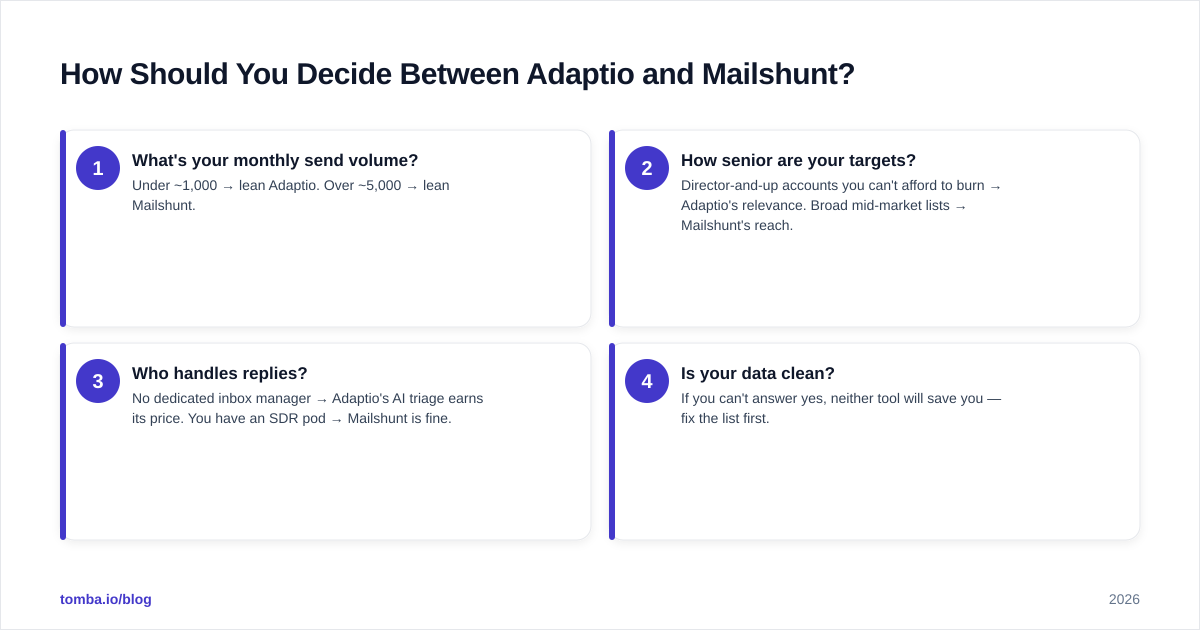
Run through four questions in order:
- What's your monthly send volume? Under ~1,000 → lean Adaptio. Over ~5,000 → lean Mailshunt.
- How senior are your targets? Director-and-up accounts you can't afford to burn → Adaptio's relevance. Broad mid-market lists → Mailshunt's reach.
- Who handles replies? No dedicated inbox manager → Adaptio's AI triage earns its price. You have an SDR pod → Mailshunt is fine.
- Is your data clean? If you can't answer yes, neither tool will save you — fix the list first.
The mistake is treating this as a binary. Plenty of teams use a volume sender for top-of-funnel and a personalization tool for high-value accounts. The platforms aren't religions; they're tools matched to a motion.
The Bottom Line#
Adaptio wins on personalization and reply handling; Mailshunt wins on volume, rotation, and per-inbox economics. Match the tool to your actual outbound motion, not to the louder marketing page.
But before you spend a dollar on either, make sure the list feeding it is real. The single highest-leverage upgrade to any cold email program isn't a better sender — it's verified, enriched contact data going in the top. Start with Tomba's Email Finder to build accurate, deliverable lists by domain, name, or company, verify them in the same workflow, and then let Adaptio or Mailshunt do what it does best. Clean data in, more replies out — that order never changes.
// get started
Find, verify and enrich your first contacts today
Start on the free plan with 25 searches a month, then scale when your team is ready.
Free plan · No credit card required · GDPR & CCPA
// about the author