Adaptio vs No2bounce 2026: Email Verification Tools Compared
Adaptio and No2bounce both promise to kill bounces and protect sender reputation. Here is an honest, side-by-side breakdown of accuracy, catch-all handling, pricing models, and which one fits your stack in 2026.
TL;DR
- Adaptio and No2bounce are both email verification tools built to cut hard bounces and protect your sender reputation before you hit send.
- They diverge most on three things: how they treat catch-all (accept-all) domains, how bulk verification is priced, and how deep the API/integration layer goes.
- No2bounce leans toward simple, list-cleaning workflows; Adaptio leans toward continuous, automation-friendly verification baked into a sending pipeline.
- Neither is a lead-generation tool — they verify addresses you already have. If you also need to find and verify emails in one platform, a finder-plus-verifier like Tomba covers both jobs.
- Pick on your real workflow (one-off list scrubs vs. always-on API checks) and confirm current pricing on each vendor's site before you commit.
What do Adaptio and No2bounce actually do?#
Both tools answer one question: will this email address accept a message, or will it bounce? Think of email verification like checking a guest list at the door before the party — you confirm each name is real, the mailbox exists, and the domain can receive mail, so you do not waste invitations on addresses that were never going to open.
Under the hood, a verifier runs a chain of checks: syntax validation, domain and MX-record lookups, SMTP handshake to see whether the mailbox responds, and risk flags for disposable, role-based (info@, sales@), and catch-all addresses. The output is usually a status — valid, invalid, risky, or unknown — plus a confidence score.
Where they differ is philosophy. No2bounce is positioned around the classic clean-my-list job: upload a CSV, get a scored file back, remove the junk. Adaptio positions itself more as verification that lives inside your sending or enrichment flow, so addresses are checked continuously rather than in big periodic batches. That single distinction drives most of the practical differences below.
If your bounce rate is creeping above 2-3%, mailbox providers start throttling you regardless of which tool you choose. Verification is one input into email deliverability, alongside authentication (SPF/DKIM/DMARC), warmup, and content. No verifier fixes a bad sending setup on its own — it just stops you from torching reputation on dead addresses.
How do Adaptio and No2bounce compare head-to-head?#
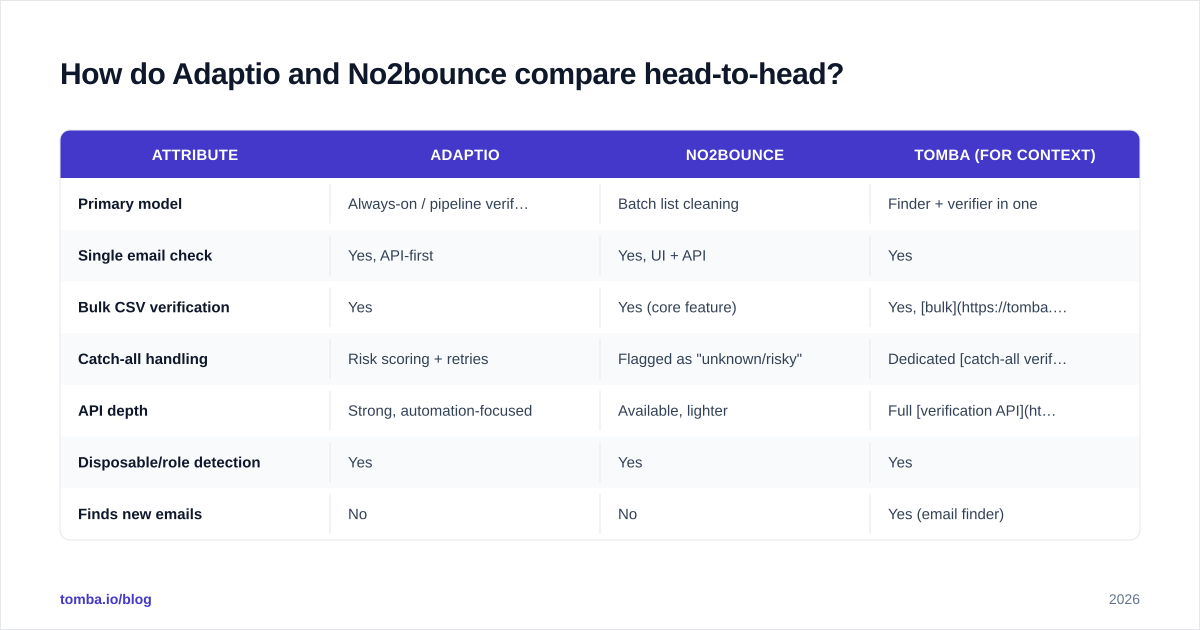
Here is the capability breakdown. Treat pricing as directional — both vendors adjust tiers, and pay-as-you-go credit packs are common in this category, so confirm the live numbers on their websites before buying.
| Attribute | Adaptio | No2bounce | Tomba (for context) |
|---|---|---|---|
| Primary model | Always-on / pipeline verification | Batch list cleaning | Finder + verifier in one |
| Single email check | Yes, API-first | Yes, UI + API | Yes |
| Bulk CSV verification | Yes | Yes (core feature) | Yes, bulk |
| Catch-all handling | Risk scoring + retries | Flagged as "unknown/risky" | Dedicated catch-all verifier |
| API depth | Strong, automation-focused | Available, lighter | Full verification API |
| Disposable/role detection | Yes | Yes | Yes |
| Finds new emails | No | No | Yes (email finder) |
| Pricing shape | Subscription / credits | Credit packs | Free 25/mo, Starter $49/mo |
| Best for | Dev teams, continuous flows | Periodic list hygiene | Teams needing find + verify |
The honest read: if you already have lists and just want them scrubbed on a schedule, No2bounce's batch-first design is the shorter path. If you are wiring verification into a CRM sync, a signup form, or an outbound sequence builder, Adaptio's automation slant fits better. And if your real bottleneck is that you do not yet have the addresses, neither tool solves that — you need a finder.
Which one handles catch-all domains better?#
Catch-all domains are the hardest problem in verification, and they are where these tools earn their keep. A catch-all (accept-all) server says "yes" to every address at the domain during the SMTP handshake — even mailboxes that do not exist. That means a naive verifier marks the whole domain "valid" and you still bounce.
Picture a building with a single mail slot and no name labels: the mail carrier can push anything through, but that does not mean a real person inside will receive it.
No2bounce's typical behavior is conservative — it flags catch-all addresses as risky or unknown and hands the judgment back to you. That is safe but leaves a chunk of your list in limbo. Adaptio leans on scoring and retry logic to push some of those "unknown" verdicts toward a usable answer, which recovers more addresses but introduces a small probability of error you should test on your own data.
This is exactly why specialized tooling exists. Tomba ships a separate catch-all finder and catch-all verifier precisely because a one-size SMTP check is not enough on accept-all infrastructure. Whichever vendor you pick, run a sample batch of known-good and known-bad catch-all addresses and measure how each tool labels them. The marketing copy will not tell you; your own ground-truth test will.

How does pricing and bulk verification compare?#
Verification pricing in 2026 generally follows two shapes, and both Adaptio and No2bounce live somewhere on this spectrum:
- Credit packs (pay-as-you-go): buy N verifications, use them whenever. Great for occasional, large one-off cleans. No2bounce skews this way.
- Subscriptions: monthly volume with API access and overage rules. Better when verification is continuous. Adaptio skews this way.
A few buying rules that hold regardless of vendor:
- Watch the "unknown" billing policy. Some verifiers charge for unknown/catch-all results; some do not. On a dirty list, that difference can double your effective cost.
- Check duplicate handling. A good tool dedupes before charging — run your list through a remove-duplicates step first so you are not paying to verify the same address five times.
- Confirm bulk throughput. A 500k-row list that takes three days to process is a different product than one that returns in an hour.
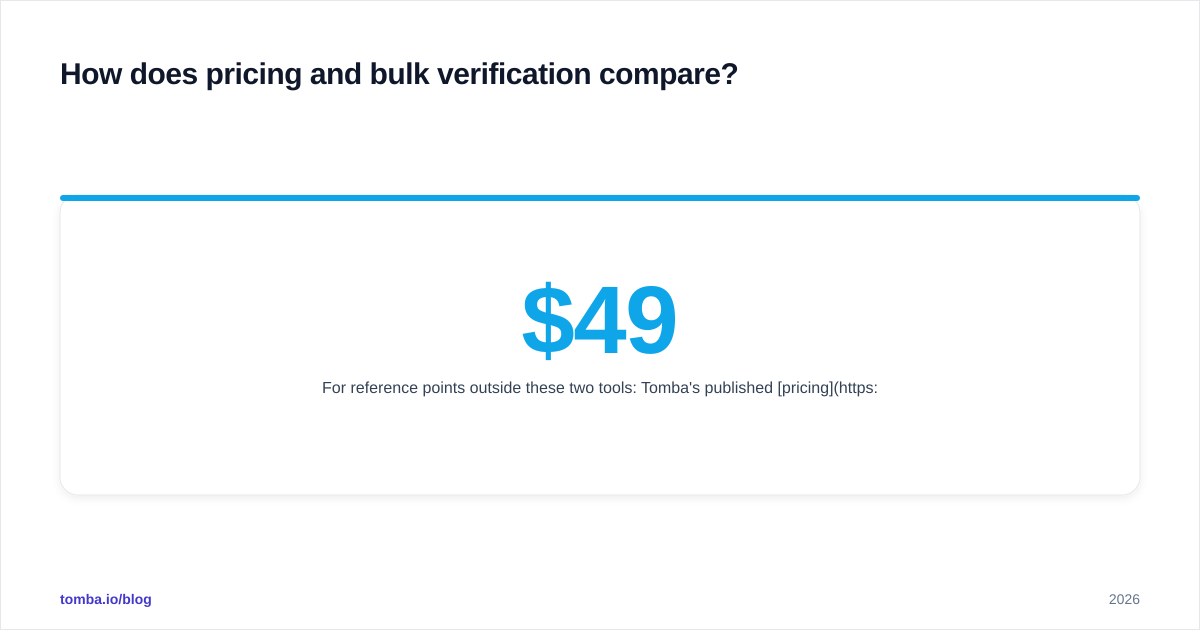
For reference points outside these two tools: Tomba's published pricing runs a Free tier (25 searches/month), Starter at $49/month, Growth at $99/month, and Pro at $249/month — and that price covers both finding and verifying, not verification alone. When you compare against Adaptio or No2bounce, normalize on cost-per-verified-valid-address, not headline price, because catch-all and unknown handling change the math.
You can cross-check user-reported pricing and support quality on a neutral marketplace like G2 before you trust any vendor's own page.
Is Adaptio or No2bounce better for cold email senders?#
For cold outreach specifically, the priorities shift. Your number-one goal is keeping bounce rate under control so mailbox providers do not flag you — a single bad send to a stale list can tank a domain's sender reputation for weeks.
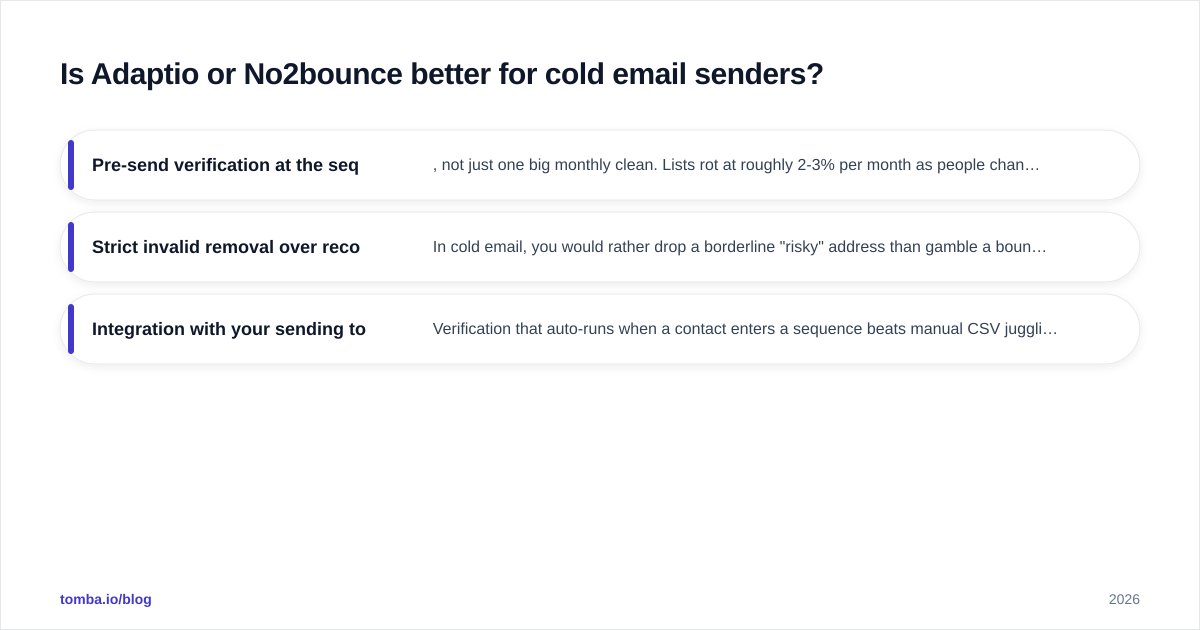
Cold senders should weight these factors:
- Pre-send verification at the sequence level, not just one big monthly clean. Lists rot at roughly 2-3% per month as people change jobs. Adaptio's continuous model fits this rhythm more naturally.
- Strict invalid removal over recovery. In cold email, you would rather drop a borderline "risky" address than gamble a bounce. No2bounce's conservative flagging is arguably safer here.
- Integration with your sending tool. Verification that auto-runs when a contact enters a sequence beats manual CSV juggling.
Verification is necessary but not sufficient. As HubSpot and most deliverability guides note, you still need authenticated sending, gradual warmup, and relevant copy — a verified list with a cold, unwarmed domain still lands in spam. Read up on the mechanics of a bounce message so you can tell a hard bounce (dead address — verification's job) from a soft bounce (full mailbox, temporary — not verification's fault). Vendors like HubSpot publish solid primers on the full deliverability stack if you want the broader context.

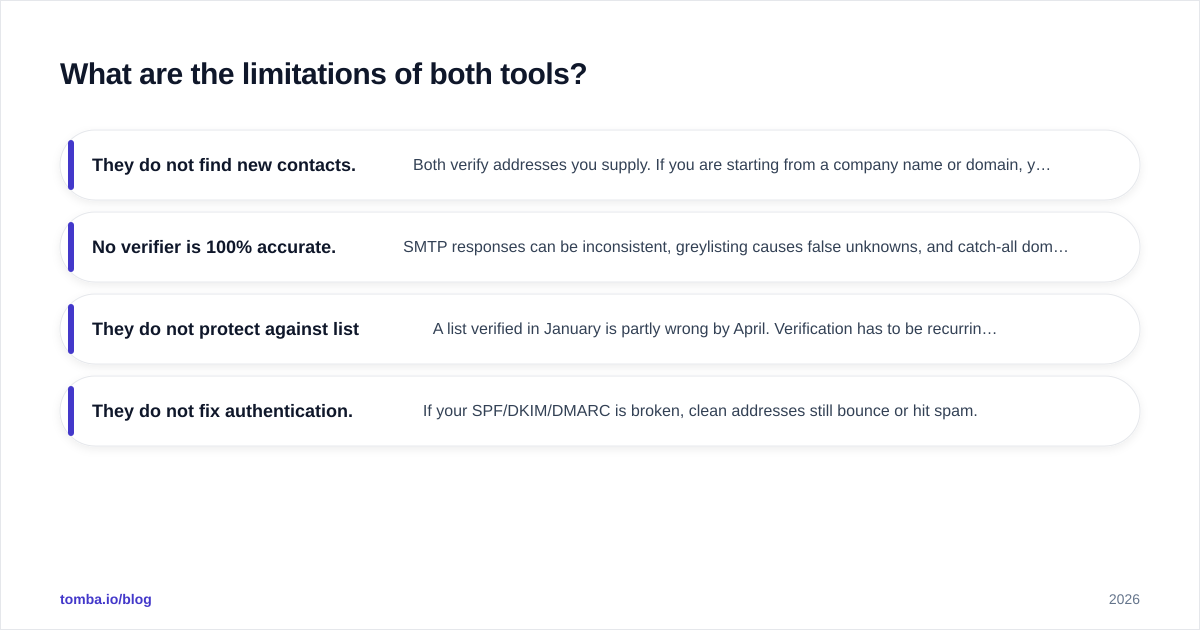
What are the limitations of both tools?#
Be clear-eyed about what neither Adaptio nor No2bounce does:
- They do not find new contacts. Both verify addresses you supply. If you are starting from a company name or domain, you still need a separate prospecting step.
- No verifier is 100% accurate. SMTP responses can be inconsistent, greylisting causes false unknowns, and catch-all domains are inherently ambiguous. Treat any "98% accuracy" claim as a best case on clean data.
- They do not protect against list decay over time. A list verified in January is partly wrong by April. Verification has to be recurring, not one-and-done.
- They do not fix authentication. If your SPF/DKIM/DMARC is broken, clean addresses still bounce or hit spam.
This is where a combined platform changes the calculus. If your real workflow is find the right person at a target account, confirm the address is live, then enrich and sync to CRM, splitting that across a finder plus a standalone verifier adds cost and integration glue. A single tool that does email finding and verification — plus data enrichment — collapses three subscriptions into one.
Which should you choose: Adaptio, No2bounce, or something broader?#
Decide with three questions:
- Do you already have the addresses? If no, a pure verifier (either tool) is the wrong starting point — you need a finder first.
- Is verification continuous or periodic? Continuous and API-driven → Adaptio's model. Periodic batch scrubs → No2bounce's model.
- How much does catch-all matter to your lists? If a large share of your targets sit on accept-all domains, prioritize the tool that scores them best on your data, and budget for a dedicated catch-all step.
| Your situation | Better fit |
|---|---|
| One-off CSV clean before a campaign | No2bounce |
| Always-on verification in a pipeline | Adaptio |
| Heavy catch-all / accept-all lists | Dedicated catch-all verifier |
| Need to find and verify in one place | Tomba |
| Tight budget, low monthly volume | Free-tier-first tool |
There is no universal winner — there is the tool that matches your workflow and your list quality. Run both against the same sample of 1,000 known addresses, measure false invalids and false valids, and let your own numbers decide.
The bottom line#
Adaptio and No2bounce are both legitimate, focused verifiers that solve the same core problem from opposite ends: Adaptio favors continuous, automation-first checking, while No2bounce favors clean, periodic batch list hygiene. Choose on workflow shape, catch-all handling on your data, and true cost-per-valid-address — not headline pricing.
But if the deeper need is finding verified contacts rather than just scrubbing a list you already own, a verifier alone leaves half the job undone. Tomba's Email Finder pairs accurate discovery with built-in email verification and catch-all checks, so you go from a company name to a confirmed, deliverable address in one step. Start free with 25 searches a month, then scale on the $49/month Starter plan when find-and-verify becomes part of your daily motion.
Ready to find emails that actually work?
Join 150,000+ professionals who stopped guessing and started sending. Free credits on signup — no credit card required.
Get the Tomba newsletter
Practical outbound tactics and product updates — once every two weeks.
About the author