Adaptio vs Sellhack: Which Sales Tool Wins in 2026?
Adaptio and Sellhack take very different paths to better outreach—one coaches reps, one finds contacts. Here's how they actually compare in 2026, and where each falls short.
TL;DR
- Adaptio and Sellhack solve different problems. Adaptio is positioned as an AI sales-enablement and rep-coaching layer; Sellhack is a contact-finding and list-building tool. Comparing them head-to-head only makes sense if you're trying to fix the same broken step in your pipeline.
- Sellhack wins on raw prospecting—it's built to surface and "guess" email addresses from a browser extension and bulk lists. Adaptio wins on what happens after you have the contact: messaging, coaching, and rep behavior.
- Neither is a best-in-class email finder. If your real bottleneck is accurate, verified B2B email addresses, a dedicated email finder will beat both on deliverability.
- Pricing transparency differs sharply. Sellhack publishes tiered plans; Adaptio leans toward custom/contact-sales pricing, which matters for small teams.
- Use the framework below to decide which gap you're actually filling before you pay for either.
What are Adaptio and Sellhack?#
Short answer: they sit on opposite ends of the outbound workflow.
Sellhack is a lead-generation and email-discovery tool. Its claim to fame is a Chrome extension that "hacks" email addresses out of LinkedIn profiles and web pages, plus bulk list-building and basic verification. Think of it as a metal detector for contact data—you point it at a profile and it tries to surface a usable email. It has historically appealed to solo founders, recruiters, and small sales teams who want cheap, fast contact discovery without a full data platform.
Adaptio sits later in the funnel. It's marketed as an AI-driven sales enablement and rep-performance layer—the kind of tool that analyzes how your reps sell, surfaces coaching moments, and helps standardize messaging across a team. If Sellhack helps you find someone to email, Adaptio is more concerned with how well your team executes once the contact exists.
Here's the analogy: Sellhack is the person who hands you a stack of phone numbers. Adaptio is the sales coach who listens to your calls and tells you why you're losing deals. Both can be useful. They are not substitutes for each other, and treating them as interchangeable is the most common mistake buyers make.
Adaptio vs Sellhack: how do they compare?#
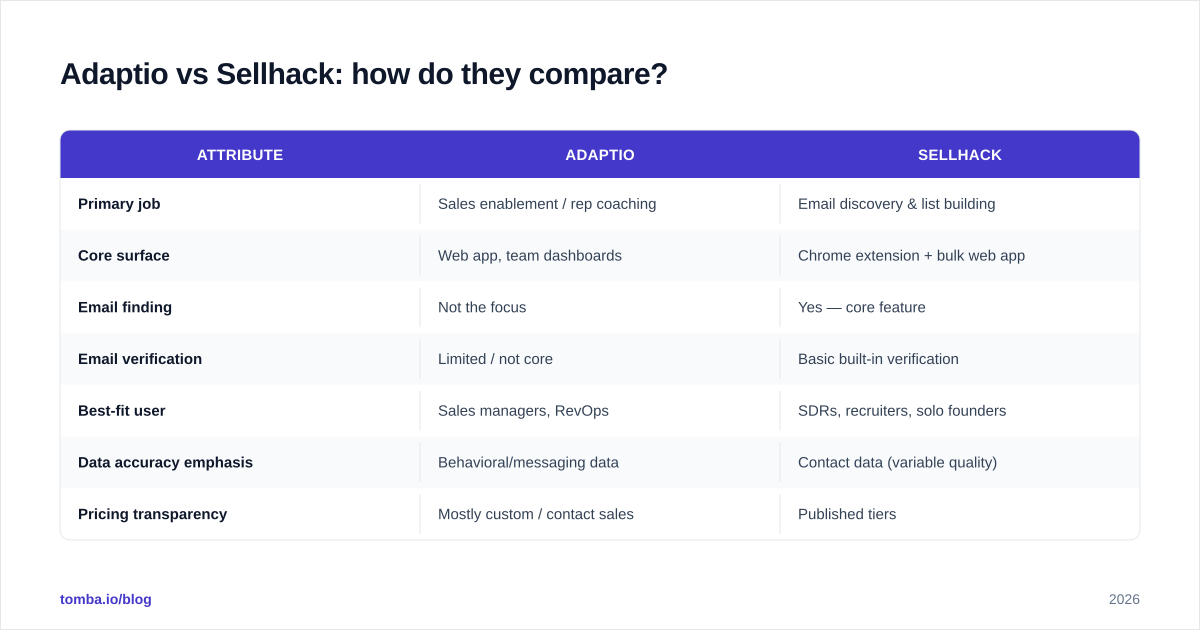
Because the two tools overlap only loosely, the most useful comparison is by job-to-be-done rather than feature-for-feature. The table below maps each tool against the stages of an outbound motion.
| Attribute | Adaptio | Sellhack |
|---|---|---|
| Primary job | Sales enablement / rep coaching | Email discovery & list building |
| Core surface | Web app, team dashboards | Chrome extension + bulk web app |
| Email finding | Not the focus | Yes — core feature |
| Email verification | Limited / not core | Basic built-in verification |
| Best-fit user | Sales managers, RevOps | SDRs, recruiters, solo founders |
| Data accuracy emphasis | Behavioral/messaging data | Contact data (variable quality) |
| Pricing transparency | Mostly custom / contact sales | Published tiers |
| Free option | Demo / custom trial | Limited free credits historically |
| Learning curve | Higher (team rollout) | Low (install and go) |
A few things stand out. First, only one of these tools—Sellhack—is genuinely in the contact-data business. If you compare them purely on "can it find me an email," you've already decided the winner. Second, Adaptio's value is hard to evaluate on a spec sheet because coaching ROI shows up in win rates and ramp time, not in a credit counter. That's also why its pricing is rarely public: enablement tools tend to price by seat and by org maturity.
If you're weighing tools mainly to improve your response rate, be honest about which lever you're pulling—better targeting and data (Sellhack's territory) or better execution (Adaptio's territory).
Is Sellhack good at finding emails?#
Sellhack is decent at surfacing candidate emails, but "candidate" is the operative word.
Tools in Sellhack's category typically work by combining public data with pattern-based guessing—if it sees that jane.doe@acme.com is the format for one employee, it infers the same pattern for others. That's fast and cheap, and for common corporate domains it works often enough to be useful. The problem is the long tail: catch-all domains, role-based inboxes, recent job changes, and companies with non-obvious naming conventions are exactly where guessing breaks down.
Two failure modes matter for your sender reputation:
- Pattern guesses that look verified but aren't. A tool can mark
jane.doe@acme.comas "valid format" without confirming the mailbox actually accepts mail. Send to enough of those and your bounce rate climbs. - Catch-all domains that accept everything. A catch-all server says "yes" to every address, so naïve verification reports a false positive. You need a real catch-all verifier to distinguish a deliverable mailbox from a server that's just being polite.
High bounce rates don't only waste credits—they damage email deliverability and can land your domain on blocklists. This is the single biggest reason teams outgrow lightweight "email hacking" tools: the cheap data quietly costs you inbox placement.

Is Adaptio worth it for sales teams?#
Adaptio is worth evaluating if your problem is rep execution, not pipeline volume.
Coaching-and-enablement platforms earn their keep when you have a team of reps producing inconsistent results: some crush quota, some don't, and you can't see why. The right tool here shortens ramp time for new hires, standardizes messaging, and surfaces the specific behaviors that correlate with closed deals. For a 15-person SDR org, even a small lift in conversion across the team can dwarf the cost of the software.
But there's a catch that buyers underrate: enablement tools only pay off if you already have enough quality activity to coach. Coaching reps on how to handle replies is meaningless if they're emailing bad addresses and getting no replies in the first place. Garbage contact data starves the very motion Adaptio is trying to optimize.
That's why mature teams usually run a stack, not a single tool:
- A data layer that supplies accurate, verified contacts (this is where a dedicated finder/verifier belongs).
- An execution layer for sequencing and sending.
- An enablement layer—Adaptio's slot—that improves how reps perform.
Trying to make Adaptio do the data layer's job, or Sellhack do the enablement layer's job, is where budgets get wasted. Check independent reviews on G2 and Capterra before committing—category labels can blur, and you want to confirm a tool actually does the job you're buying it for.
Which should you choose—Adaptio or Sellhack?#
Pick based on the gap you're filling, not the brand.
Choose Sellhack if:
- You're a solo founder, recruiter, or small SDR team.
- Your bottleneck is finding contacts cheaply and fast.
- You can tolerate variable data quality and you verify before sending.
- You want a low-friction Chrome extension, not a platform rollout.
Choose Adaptio if:
- You manage a team of reps with inconsistent performance.
- You already have a working source of quality contact data.
- Your bottleneck is messaging, coaching, and ramp time—not list size.
- You're prepared for a custom-priced, seat-based commitment.
Choose neither (for the data job) if:
- Deliverability is the thing keeping you up at night.
- You send at volume and bounce rates are eating your sender reputation.
- You need verified emails, not pattern guesses.
In that last case, the honest answer is that you want a purpose-built data tool layered underneath whichever workflow tool you pick. Sellhack's guessing and Adaptio's coaching both get better when the underlying contacts are real.
What's the smarter alternative for contact data?#
If contact accuracy is the real problem, a specialized finder-and-verifier beats a generalist tool on the metric that matters: deliverability.
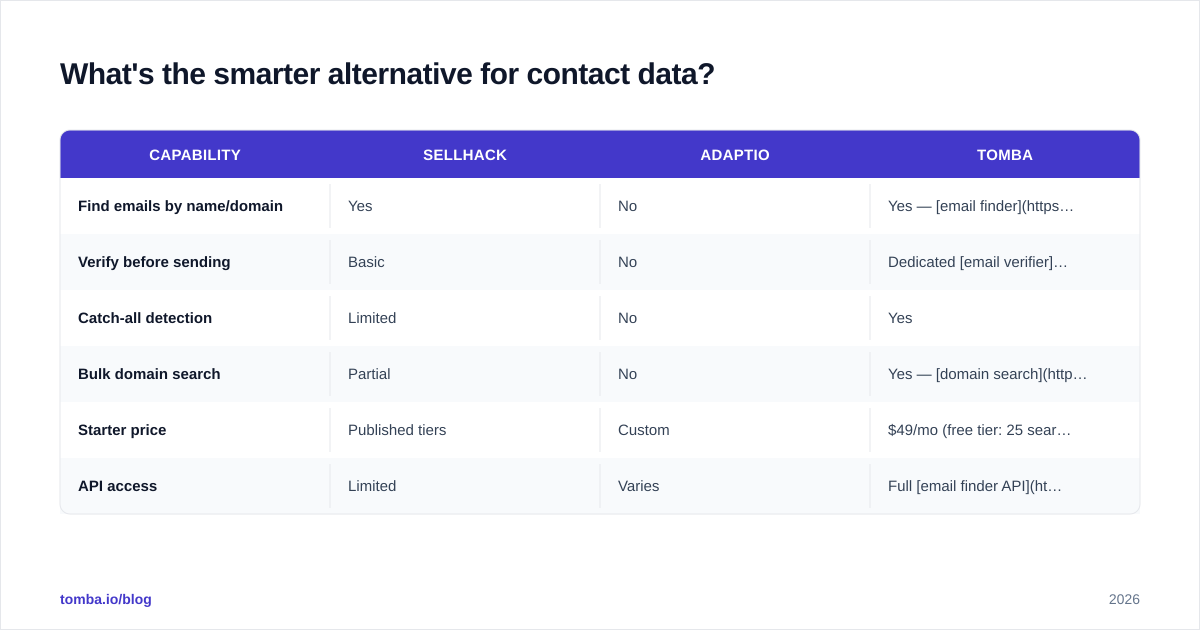
Here's where a dedicated platform like Tomba fits relative to the two tools above. The point isn't that Tomba replaces an enablement coach like Adaptio—it doesn't. It replaces the weakest link in both workflows: the data.
| Capability | Sellhack | Adaptio | Tomba |
|---|---|---|---|
| Find emails by name/domain | Yes | No | Yes — email finder |
| Verify before sending | Basic | No | Dedicated email verifier |
| Catch-all detection | Limited | No | Yes |
| Bulk domain search | Partial | No | Yes — domain search |
| Starter price | Published tiers | Custom | $49/mo (free tier: 25 searches) |
| API access | Limited | Varies | Full email finder API |
Tomba's model is built around verification rather than guessing. You can find professional emails by domain, name, or company, then confirm each one against the mail server before it ever hits a sequence—including the catch-all edge cases that quietly inflate bounce rates elsewhere. For pricing details across the Free, Starter ($49/mo), Growth ($99/mo), and Pro ($249/mo) tiers, see the Tomba pricing page. The free tier lets you test accuracy on your own target list before paying, which is the fairest way to compare any of these tools.
If you're specifically shopping the prospecting/data category, it's also worth reading a focused Apollo alternative breakdown—the same accuracy-vs-volume tradeoffs that separate Sellhack from a verifier apply across that entire tool class.
How do these tools affect deliverability?#
Your tool choice shows up directly in your bounce rate—and your bounce rate shows up in your domain reputation.
The chain works like this: bad data → high bounces → flagged by mailbox providers → lower inbox placement → fewer replies → worse coaching signal. A tool that's "good enough" at finding emails but careless about verification can poison the entire downstream motion, including any enablement platform sitting on top of it. That's the deliverability tax of cheap data, and it's invisible until your open rates quietly collapse.
The fix is structural, not heroic:
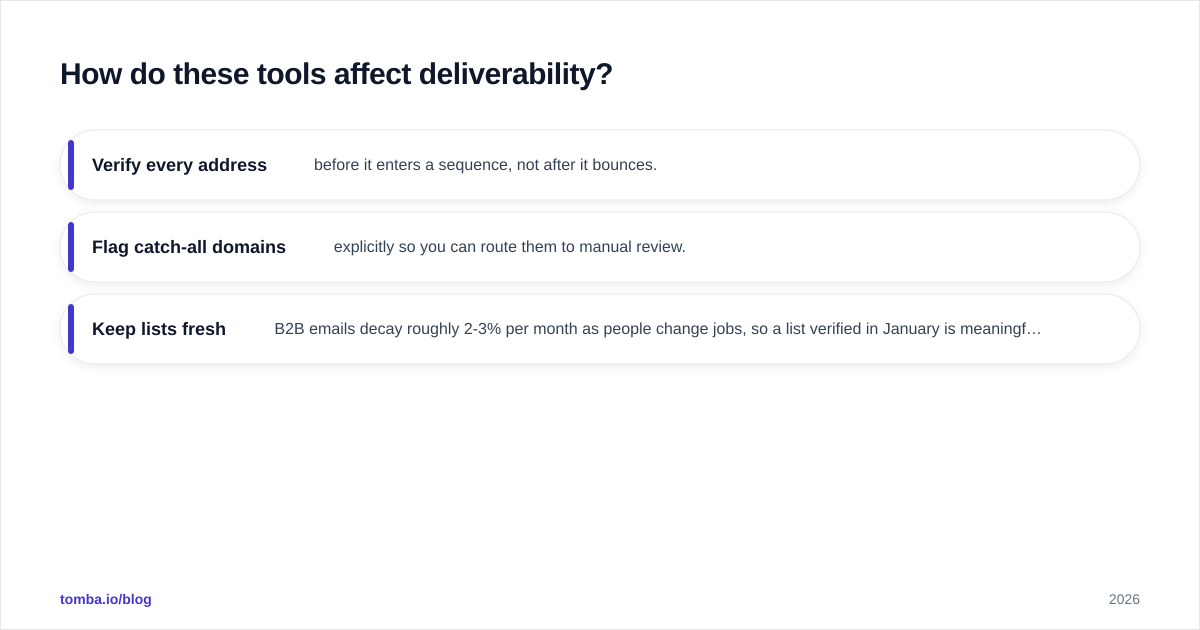
- Verify every address before it enters a sequence, not after it bounces.
- Flag catch-all domains explicitly so you can route them to manual review.
- Keep lists fresh—B2B emails decay roughly 2-3% per month as people change jobs, so a list verified in January is meaningfully stale by spring.
Neither Adaptio nor Sellhack is built to be your deliverability backbone. Sellhack gets you closer because at least it's in the data business, but its verification is a feature, not the product. When deliverability is the priority, a tool whose entire job is accurate, verified contacts will outperform a generalist every time.
Final verdict: Adaptio vs Sellhack in 2026#
There is no universal winner—because they're not really competitors.
Sellhack is the better pick when your problem is finding contacts on a budget, and you have the discipline to verify before you send. Adaptio is the better pick when your problem is rep performance and you already have a reliable source of quality data feeding the team. Buy the one that matches your actual bottleneck, and don't expect either to cover the other's job.
But if you zoom out, the most common real bottleneck for outbound teams in 2026 isn't coaching or list-building speed—it's data accuracy and deliverability. That's the gap that quietly caps everything else, and it's the one neither tool was designed to own.
If accurate, verified B2B emails are what's standing between you and more replies, start with a tool built for exactly that. Try the Tomba Email Finder—find professional emails by domain, name, or company, verify them before you send, and test the whole thing free on your own list (25 searches/month, no card required). Get the data layer right first; the coaching and the sequencing get easier from there.
// get started
Find, verify and enrich your first contacts today
Start on the free plan with 25 searches a month, then scale when your team is ready.
Free plan · No credit card required · GDPR & CCPA
// about the author