Affistash vs Apollo.io (2026): Which Tool Wins for B2B?
Affistash recruits affiliates; Apollo.io powers outbound sales. They get confused constantly. Here's exactly which one fits your B2B motion, and where neither is enough on its own.
TL;DR
- Affistash and Apollo.io solve different problems. Affistash finds and recruits affiliate and partnership prospects; Apollo.io is a sales-intelligence database plus outbound engagement engine for SDRs and AEs.
- If your growth motion is partnerships, affiliates, and referrals, Affistash is the closer fit. If it's direct outbound to net-new accounts, Apollo.io wins on database depth and sequencing.
- Apollo.io has the bigger contact graph (200M+ contacts) and built-in dialer, sequences, and CRM sync. Affistash is narrower, lighter, and cheaper.
- Neither tool guarantees deliverable email addresses. Both benefit from a dedicated verification layer before you hit send.
- Most lean teams end up pairing one of these with a focused email finder and email verifier rather than trusting a single all-in-one for data quality.
What are Affistash and Apollo.io?#
Short version: Affistash hunts partners, Apollo.io hunts buyers.
Affistash is a partnership and affiliate-discovery platform. You describe the kind of affiliate, publisher, or referral partner you want, and it surfaces candidate sites, creators, and programs along with contact paths to reach them. Think of it as a scout for your partner-marketing program, the way a talent agent finds people who will sell on your behalf.
Apollo.io is a B2B sales-intelligence platform. It pairs a large contact-and-company database with outbound tooling, email sequences, a dialer, and CRM enrichment. Its job is to help reps go from "I want to sell to fintech CFOs in the US" to a working list with phone numbers, emails, and a multi-step cadence. It's a hunting rifle for direct sales, not a partner-recruiting tool.
The confusion between them is reasonable. Both promise "more pipeline," both surface contacts, and both charge per seat or per credit. But they sit at different stages of go-to-market: Affistash builds an indirect channel, Apollo.io feeds a direct one.
How do Affistash and Apollo.io compare head-to-head?#
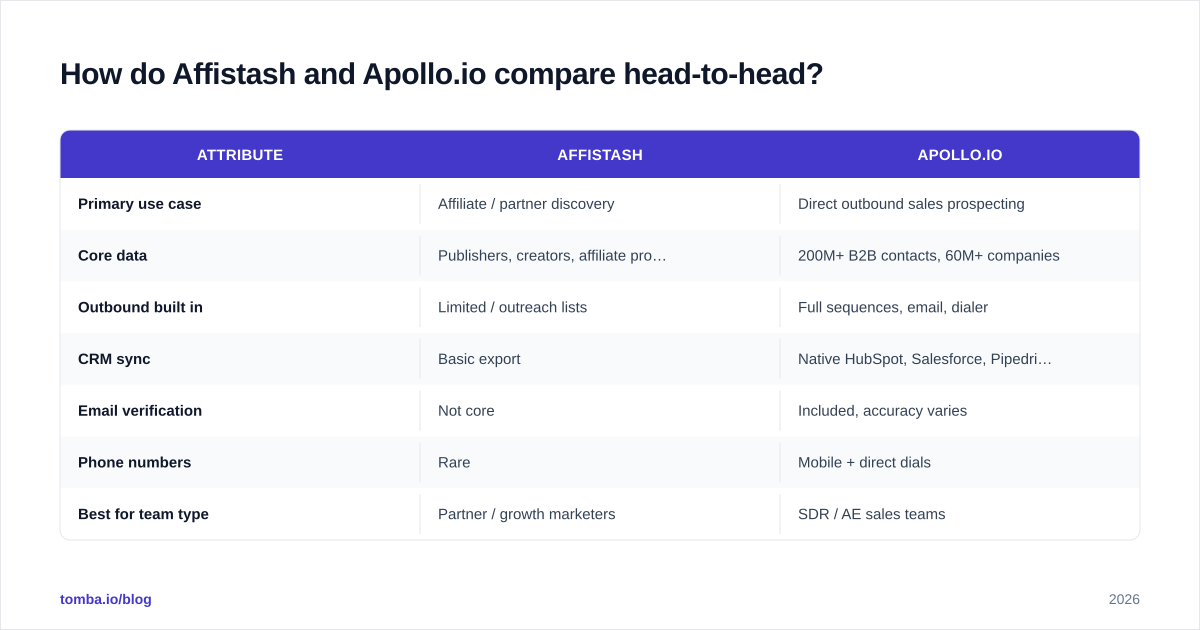
Here's the practical breakdown across the attributes that actually change your buying decision.
| Attribute | Affistash | Apollo.io |
|---|---|---|
| Primary use case | Affiliate / partner discovery | Direct outbound sales prospecting |
| Core data | Publishers, creators, affiliate programs | 200M+ B2B contacts, 60M+ companies |
| Outbound built in | Limited / outreach lists | Full sequences, email, dialer |
| CRM sync | Basic export | Native HubSpot, Salesforce, Pipedrive |
| Email verification | Not core | Included, accuracy varies |
| Phone numbers | Rare | Mobile + direct dials |
| Best for team type | Partner / growth marketers | SDR / AE sales teams |
| Entry pricing | Lower, niche tiers | Free tier; paid from ~$49/seat/mo |
| Learning curve | Light | Moderate (lots of surface area) |
A few things stand out. Apollo.io is the heavier platform with far more surface area: sequencing, scoring, analytics, a Chrome extension, and CRM workflows. Affistash is deliberately narrow, which is a feature if partnerships are your channel and a limitation if you need to run cold outbound at scale.
The other honest note: both vendors market high data accuracy, and both ship a meaningful share of stale or catch-all addresses, as any database at that scale does. That's not a knock unique to either; it's the reality of B2B data. It's also why a separate verification step matters, which we'll get to.
Which one is better for B2B prospecting?#
For classic outbound prospecting, Apollo.io is the stronger standalone tool. It was built for the SDR motion: filter a total addressable market, push contacts into a sequence, dial, log activity to the CRM, and report on it. If your team's daily job is booking meetings with net-new accounts, Apollo.io's database and engagement layer do more out of the box.
Affistash isn't trying to win that fight. Its prospecting is partner-shaped: who could promote you, who already ranks for your category, who runs a relevant newsletter or program. If your pipeline grows through affiliates and co-marketing rather than cold email, Affistash's targeting is more useful than a generic contact database, because it understands the partner graph instead of just job titles.
A simple test: write down where your last 10 closed deals came from. If most were sourced by a rep doing direct outreach, lean Apollo.io. If most came through a partner, publisher, referral, or affiliate link, lean Affistash. Your historical channel mix is a better signal than any feature list.
If you want to go deeper on the broader category, our roundup of Apollo alternatives covers tools that overlap with Apollo's database-plus-sequencing model, several of which compete more directly than Affistash does.
How accurate is the contact data?#
This is where buyers get burned, so be specific about expectations.
Apollo.io's database is large and frequently updated, but "large" and "accurate" are not the same. Across big B2B datasets, a normal outcome is that a slice of emails are outdated, role-changed, or sitting on catch-all domains that accept everything and confirm nothing. Apollo includes verification signals, but they're directional, not a guarantee, and they don't fully solve catch-all ambiguity.
Affistash surfaces contact paths for partners, often a generic inbox, a contact form, or a creator's public address. That's fine for partnership outreach, where you expect a human to read and reply, but it's not optimized for verified, deliverable, individual mailboxes at volume.
The fix is the same regardless of which tool you choose: treat the platform's email as a lead, not a fact, and verify before you send. A standalone email verifier checks syntax, MX records, and SMTP acceptance, and a dedicated catch-all verifier helps you make a call on those ambiguous domains instead of guessing. Skipping this step is the fastest way to torch your sender reputation, which directly drags down email deliverability on every future campaign.
For context on how much variance exists between data vendors, independent review sites like G2 aggregate thousands of user reports on accuracy and support; they're worth a scan before you commit annual budget to either platform.
What does each tool cost in 2026?#
Pricing shifts often, so confirm on each vendor's site before you buy, but the shape of the two models is stable.
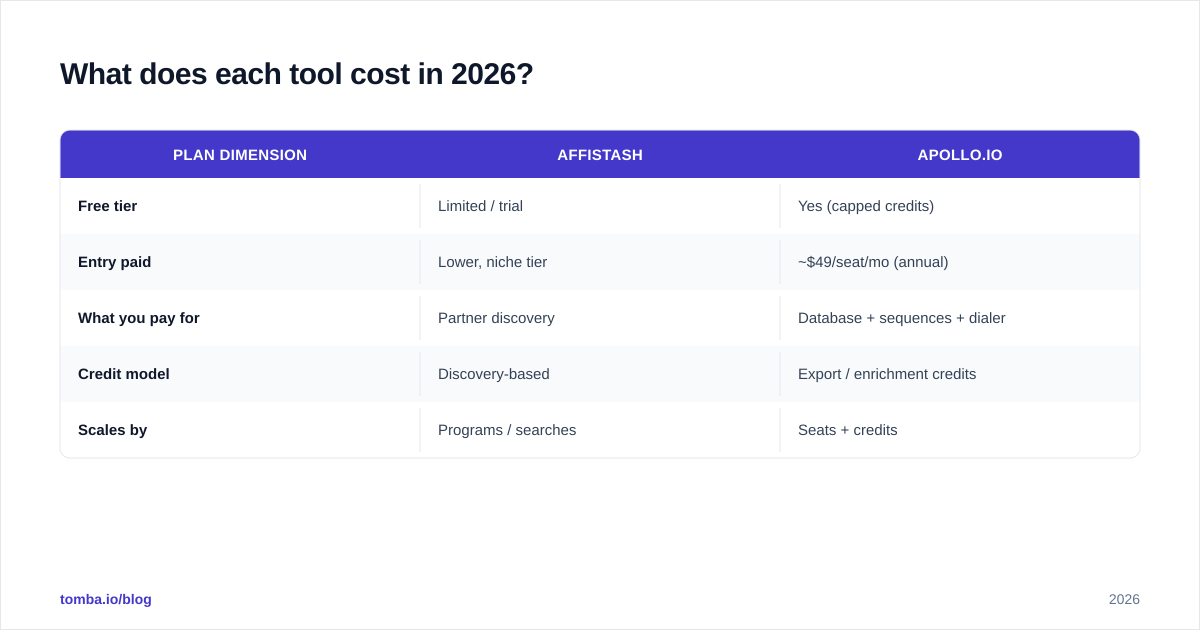
Apollo.io runs a freemium model: a free tier with limited credits, then paid seats that unlock more credits, sequencing volume, and advanced filters. Entry paid plans start in the roughly $49-per-seat-per-month range billed annually, scaling up for larger teams and higher export limits. You're paying for database access plus the engagement platform bundled together.
Affistash sits at a lower entry point with niche, partnership-focused tiers. You're paying for discovery and targeting in a specific channel, not a full outbound suite, so the sticker price is smaller, but so is the scope.
| Plan dimension | Affistash | Apollo.io |
|---|---|---|
| Free tier | Limited / trial | Yes (capped credits) |
| Entry paid | Lower, niche tier | ~$49/seat/mo (annual) |
| What you pay for | Partner discovery | Database + sequences + dialer |
| Credit model | Discovery-based | Export / enrichment credits |
| Scales by | Programs / searches | Seats + credits |
The real cost question isn't the monthly fee, it's cost per booked meeting. A cheaper tool that feeds you the wrong channel is more expensive than a pricier one aligned to how you actually win. Map the spend to your channel mix, not to the headline price.
Where do both tools fall short, and how do you fix it?#
Both platforms share one structural weakness: data quality is a means, not their core obsession. Apollo bundles verification into a much larger product, so it's good-enough rather than best-in-class. Affistash isn't built for verified individual mailboxes at all. In both cases, the email you export is a starting point that still needs validation.
This is exactly where a focused data layer earns its keep. Three gaps come up repeatedly:
- Unverified emails. Run every exported address through verification before it enters a sequence. Bounce rates above 3-4% start hurting your domain reputation fast.
- Catch-all domains. Big chunks of enterprise email sit behind catch-all servers. A dedicated catch-all finder and pattern analysis get you closer to a real inbox than a raw export will.
- Missing or wrong contacts. When a platform has the company but not the right person, a domain search by company plus a name-based email finder fills the gap with sources you can audit.
The pattern most disciplined teams settle on: use Affistash or Apollo.io for what it's genuinely best at (partner discovery or outbound engagement), then run a separate, accuracy-first finder-and-verifier on top so the contacts you actually email are clean. You can compare the full lineup on the Tomba pricing page, including a free tier with 25 searches a month to test against your own list before committing.
Affistash vs Apollo.io: which should you choose?#
Decide by motion, not by marketing.
- Choose Affistash if partnerships, affiliates, publishers, and referrals are how you grow. It speaks the partner-graph language and gets you to relevant programs faster than a generic contact database. Pair it with verification when you move from "found a partner" to "emailing a specific person."
- Choose Apollo.io if direct outbound to net-new accounts is the core motion and you want database, sequences, dialer, and CRM sync in one place. Accept that you'll still want a dedicated verification pass for data quality.
- Choose neither as your data source of truth. Both are workflow tools first and data vendors second. Keep an accuracy-focused finder/verifier underneath whichever one you pick.
If your honest answer is "we need clean, verified B2B emails more than we need another platform," start at the data layer. Tomba's Email Finder pulls professional addresses by name, company, or domain with transparent data sources you can audit, plus a built-in verifier so the contacts you export are ready to send, not ready to bounce. Plans run from a free tier (25 searches/month) to Starter at $49/mo and up, and the same data is available via Tomba API when you're ready to wire it into Affistash, Apollo, or your CRM directly. Start free, verify your first list, and let the bounce rate make the argument for you.
// get started
Find, verify and enrich your first contacts today
Start on the free plan with 25 searches a month, then scale when your team is ready.
Free plan · No credit card required · GDPR & CCPA
// about the author