Agile Education Marketing Alternatives: Top 7 Tools for 2026
Agile Education Marketing (formerly MDR) isn't the only way to reach educators. Here are 7 alternatives—data providers and email-finding tools—compared on coverage, accuracy, and price.
If you sell into schools, districts, colleges, or edtech buyers, you have probably hit the same wall everyone does: Agile Education Marketing (formerly MDR) owns a huge slice of the U.S. education contact market, and its lists are expensive, often rented rather than owned, and frequently stale by the time your campaign launches. This guide breaks down the realistic agile education marketing alternatives for 2026 — what each one does well, where it falls short, and how to stop renting data you can build and verify yourself.
TL;DR#
- Agile Education Marketing is strong on K-12 and higher-ed coverage, but you typically license the data on term contracts rather than owning verified records you control.
- The best alternative depends on your motion: full-service list brokers (SchoolData, MCH/MDR-style providers) vs. self-serve B2B data and email-finding tools you run on demand.
- Self-serve email finders + verification (like Tomba) cost a fraction of a list license and let you build targeted educator lists from district domains in minutes.
- Always verify before you send. Education email lists decay fast — teachers move, retire, and change districts every summer.
- Use the decision framework below to match a tool to your budget, compliance needs, and whether you target individual educators or institutional decision-makers.
What is Agile Education Marketing and why look for alternatives?#
Agile Education Marketing is a data and marketing-services company focused exclusively on the U.S. education vertical. It maintains a large database of K-12 and higher-education contacts — teachers, principals, superintendents, district administrators, and university staff — and sells access through licensed lists, email deployment services, and audience-targeting products. It is widely used by edtech vendors, publishers, and suppliers who need to reach educators at scale.
It is a capable provider. So why do so many teams shop for substitutes?
- Cost structure. Pricing is quote-based and skews enterprise. Annual licenses and per-record fees add up quickly, and you rarely "own" the data outright.
- Rented vs. owned data. Many deployments are run through the provider — you never touch the raw contacts, which limits how you nurture and re-target.
- Data freshness. Education is one of the highest-churn verticals on earth. A list that was accurate in May is partly wrong by September.
- Flexibility. If you only need 500 superintendents in three states, a full enterprise contract is overkill.
If any of those points sting, the alternatives below are worth a serious look. For background on how data vendors define their categories, the B2B glossary is a useful reference while you compare.
)
What are the main types of alternatives?#
Not every alternative is the same kind of product. Grouping them helps you avoid comparing a list broker to a search tool.
- Education-specialist list providers — Direct MDR/Agile competitors that also focus on the education vertical (e.g., SchoolDataLists, MCH Strategic Data, Market Data Retrieval-style brokers). You buy or license curated education lists.
- General B2B data platforms — Broad databases (
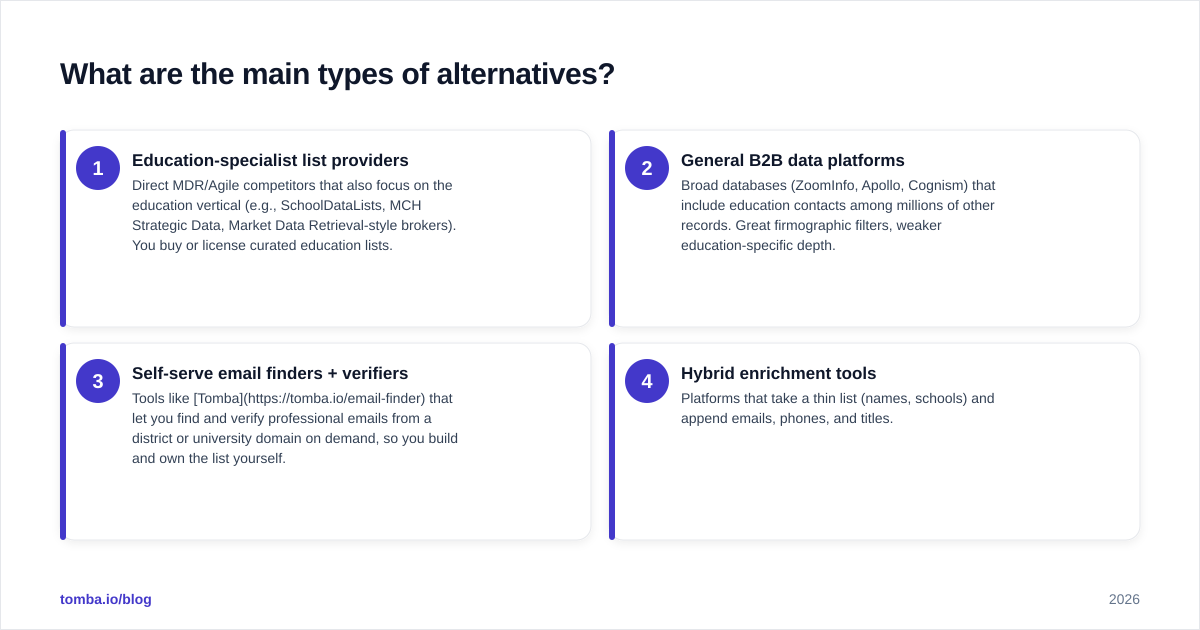
ZoomInfo, Apollo, Cognism) that include education contacts among millions of other records. Great firmographic filters, weaker education-specific depth. 3. Self-serve email finders + verifiers — Tools like Tomba that let you find and verify professional emails from a district or university domain on demand, so you build and own the list yourself. 4. Hybrid enrichment tools — Platforms that take a thin list (names, schools) and append emails, phones, and titles.
Most modern education marketers end up combining type 1 or 2 for net-new discovery with type 3 for verification and ownership.
How do the top Agile Education Marketing alternatives compare?#
Here is a side-by-side look at the seven options most teams evaluate. Pricing reflects publicly listed entry points or typical market positioning as of early 2026; education-list brokers are quote-only by design.
| Tool | Type | Best for | Entry price | Free tier | Education depth | You own the data? |
|---|---|---|---|---|---|---|
| Agile Education Marketing | Education list broker | Enterprise edtech & publishers | Custom quote | No | Very high | Licensed/rented |
| SchoolDataLists | Education list broker | K-12 & higher-ed lists | Custom quote | No | High | Purchased list |
| MCH Strategic Data | Education list broker | Institutional targeting | Custom quote | No | High | Licensed |
| ZoomInfo | General B2B data | Large GTM teams | ~$15k/yr (custom) | No | Medium | Licensed |
| Apollo.io | General B2B data | SMB outbound teams | $49/user/mo | Yes (limited) | Medium | Licensed |
| Cognism | General B2B data | EU/UK compliance | Custom quote | No | Medium | Licensed |
| Tomba | Email finder + verifier | Build & verify owned lists | $49/mo | Yes (25/mo) | Domain-driven | Yes — you export it |
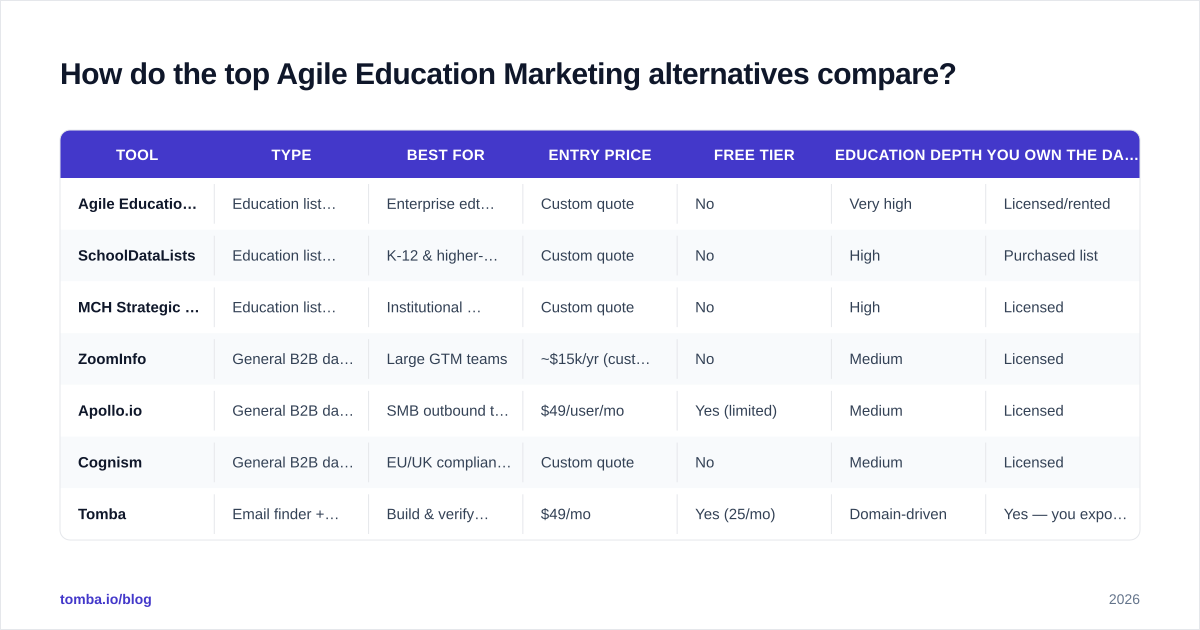
The honest takeaway: if you need a pre-built, deeply segmented list of, say, every Title I curriculum director in the Midwest, a specialist broker still wins on raw coverage. If you want to build a targeted, verified list you actually own — from known district and university domains — a self-serve finder plus a email verifier is dramatically cheaper and more flexible.
Is a list broker or a self-serve tool better for education outreach?#
It depends on three things: how net-new your targeting is, how much you value ownership, and your compliance posture.
Choose a list broker when:
- You need contacts you cannot derive from public institution domains (personal mobile numbers, opt-in consumer-parent data, niche role segments).
- You want done-for-you deployment and someone else to carry CAN-SPAM/list-hygiene responsibility.
- Budget is not the constraint and speed-to-large-volume is.
Choose a self-serve finder + verifier when:
- You already know the institutions you want to reach (districts, universities, edtech companies) and need the right person and a valid email.
- You want to own and re-use the data across campaigns and your CRM.
- You're cost-sensitive and run targeted, account-based outreach rather than blasts.
A practical middle path: pull a firmographic list of institutions from a general platform, then use domain search to surface the actual staff emails at each institution's domain, and finish with verification. You end up with an owned, accurate list at a fraction of license cost.
How accurate is education contact data, and why does verification matter?#
Accuracy is the entire game in education marketing, and it is where rented lists quietly fail you. Educators churn at one of the highest rates of any profession: staff turnover, summer reassignments, retirements, and district consolidations mean a meaningful percentage of any education list goes bad every year. Industry hygiene guidance from sources like HubSpot consistently shows B2B databases decaying 20–30% annually — and education sits at the high end.
That decay has direct consequences:
- Bounces hurt sender reputation. Too many hard bounces and mailbox providers throttle or block you, tanking deliverability for your good contacts too.
- Wasted spend. Paying per record for addresses that no longer exist is pure loss.
- Wasted rep time. SDRs chasing dead inboxes is the most expensive way to discover a list is stale.
This is why verification is not optional. Before any education send, run the list through a verifier to catch invalid, role-based, and risky addresses, and use a catch-all verifier for the many district and university domains configured as catch-all servers (which otherwise return false "valid" results). For a deeper primer on the mechanics, the email deliverability glossary entry is a good starting point, and G2's category reviews at g2.com are useful for vetting any vendor's real-world accuracy claims.
)
What does each alternative do best?#
A quick, opinionated tour so you can shortlist fast.
Education-specialist brokers (SchoolDataLists, MCH, MDR-style)#
These are the closest like-for-like swaps for Agile Education Marketing. They live and breathe the education vertical, segment by enrollment, Title I status, grade band, subject, and role, and will sell or license you a ready list. Expect quote-based pricing, minimum-order thresholds, and term commitments. Best when coverage depth beats everything else.
#
ZoomInfo
The 800-pound gorilla of B2B data. Excellent firmographics, intent signals, and org charts, with education contacts included. The downside is enterprise pricing and that education depth is shallower than a specialist. Strong fit for large GTM teams already standardized on it.
Apollo.io#
A popular SMB-friendly platform combining a contact database with sequencing. The free and low tiers make it accessible, and you can filter to education. Coverage and accuracy in the vertical are middling, so pair it with verification. See how it stacks up as an Apollo alternative if you're price-sensitive.
Cognism#
Known for strong EU/UK coverage and compliance-first data (helpful if you target international education systems). Quote-based and enterprise-leaning.
Tomba#
The cleanest fit when you want to own your data. Point it at a school district or university domain and it returns the staff emails and patterns, verifies them, and lets you export. Pricing is transparent — a free tier with 25 searches, then $49/mo Starter, $99/mo Growth, $249/mo Pro, and custom Enterprise (full Tomba pricing here). For education teams that already know their target institutions, this turns a five-figure license into a low monthly tool cost. You can also pull staff contacts in bulk with the bulk email finder and push verified records straight into your CRM via the Tomba API.
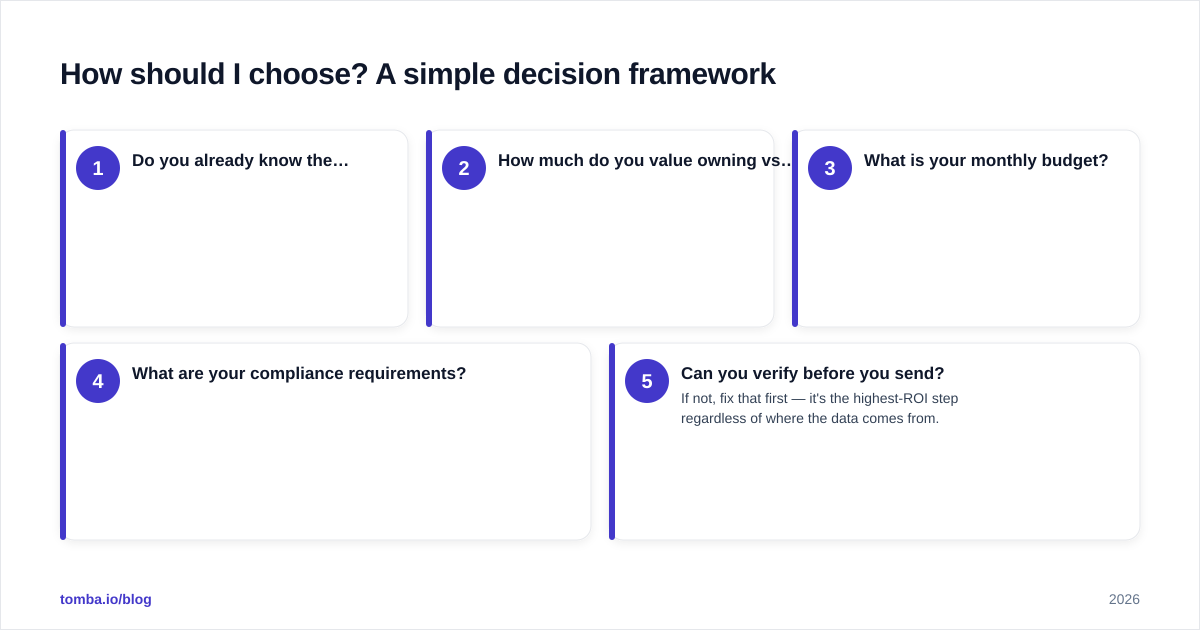
How should I choose? A simple decision framework#
Work through these questions in order:
- Do you already know the institutions you want to reach?
- Yes → lean self-serve (find emails at known domains, verify, own them).
- No, I need net-new discovery → start with a general platform or specialist broker.
- How much do you value owning vs. renting the data?
- Must own and re-use → email finder + verifier.
- Happy to license/deploy through a vendor → broker.
- What is your monthly budget?
- Under $300/mo → self-serve tools are the only realistic option.
- Five figures annually → enterprise platforms and brokers open up.
- What are your compliance requirements?
- International or consumer-adjacent (parents) → prioritize compliance-first vendors and documented consent.
- U.S. institutional B2B → standard CAN-SPAM hygiene plus rigorous verification.
- Can you verify before you send? If not, fix that first — it's the highest-ROI step regardless of where the data comes from.
| Your situation | Recommended approach |
|---|---|
| Known districts/universities, tight budget | Email finder + verifier (own the list) |
| Need net-new, deep education segments | Specialist broker (SchoolData/MCH) |
| Large GTM team, multi-vertical | ZoomInfo or Cognism |
| International education targeting | Cognism + verification |
| Edtech selling to other vendors | General B2B data + Tomba enrichment |
Frequently asked questions#
Is there a free Agile Education Marketing alternative? Yes — Tomba offers a free tier (25 searches/month) so you can build and verify a small education list at no cost, and Apollo has a limited free plan. Specialist brokers do not offer free tiers.
Can I legally email educators I find myself? In the U.S., B2B email to institutional addresses is generally permitted under CAN-SPAM provided you include a valid physical address, honor opt-outs, and don't use deceptive headers. International outreach (e.g., GDPR regions) has stricter consent rules — verify your obligations before sending.
How do I keep an education list from going stale? Re-verify before every major send, refresh quarterly at minimum, and prefer owned data you can re-check over rented lists you can't. A data enrichment pass also fills gaps and updates titles.
Do education domains use catch-all servers? Many do, which makes standard verification unreliable. Use a dedicated catch-all check so you don't treat a "maybe" as a "yes."
The bottom line#
Agile Education Marketing is a solid enterprise option, but it is far from your only choice — and for a growing number of teams, it is the wrong one. If you already know which schools, districts, and institutions you want to reach, you don't need to rent an expensive, decaying list. You can build a targeted, verified, owned list yourself for a fraction of the cost.
Start with Tomba's Email Finder: point it at the education domains you care about, surface the right educators and administrators, verify every address before you send, and export a clean list you actually own. Try it free with 25 searches, and only scale to a paid plan once it's already paying for itself. Your deliverability — and your budget — will thank you.
Ready to find emails that actually work?
Join 150,000+ professionals who stopped guessing and started sending. Free credits on signup — no credit card required.
Get the Tomba newsletter
Practical outbound tactics and product updates — once every two weeks.
About the author