Agile Education Marketing vs Apollo.io: Which Wins in 2026?
Agile Education Marketing sells deep K-12 and higher-ed contact lists; Apollo.io is a broad B2B sales platform. Here's which data source actually fits your outreach in 2026.
If you sell into schools, districts, colleges, or ed-tech buyers, you have probably weighed Agile Education Marketing vs Apolloio and found the choice harder than it looks. One tool is a specialist that lives and breathes education contact data. The other is a broad B2B sales platform with a huge database and a full prospecting toolkit. They are not the same product. Pick the wrong one and you waste both budget and quota.
TL;DR — Which should you pick?#
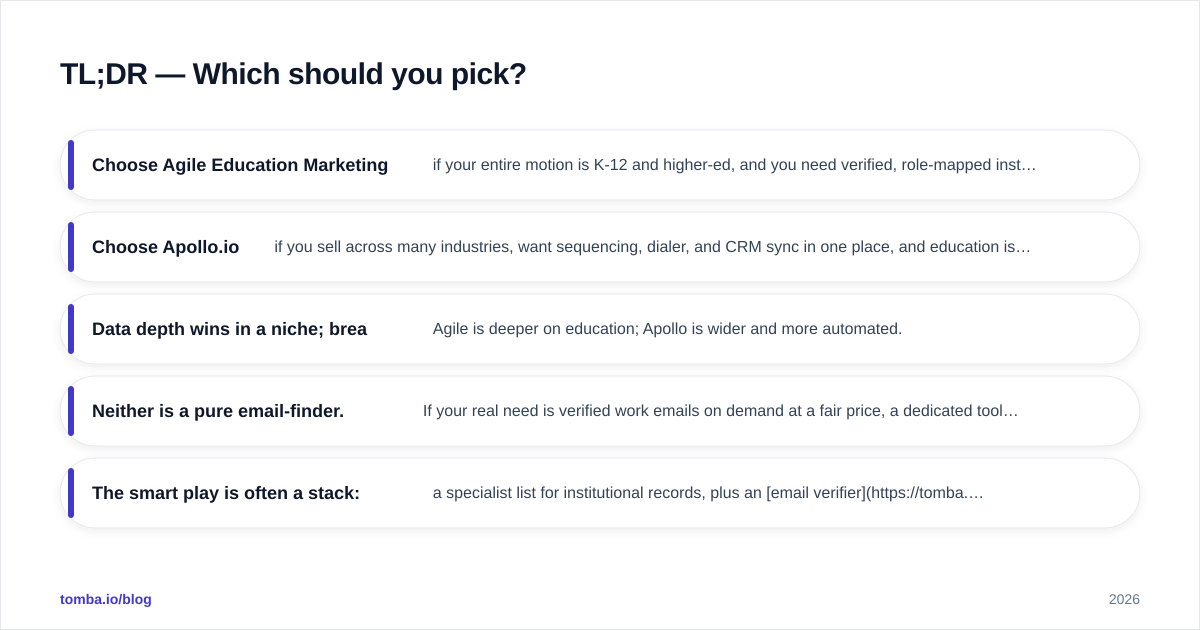
- Choose Agile Education Marketing if your entire motion is K-12 and higher-ed, and you need verified, role-mapped institutional contacts (superintendents, principals, deans, IT directors) you cannot reliably build elsewhere.
- Choose Apollo.io if you sell across many industries, want sequencing, dialer, and CRM sync in one place, and education is just one of several segments you cover.
- Data depth wins in a niche; breadth and workflow win across niches. Agile is deeper on education; Apollo is wider and more automated.
- Neither is a pure email-finder. If your real need is verified work emails on demand at a fair price, a dedicated tool like Tomba's email finder often beats both on cost-per-valid-contact.
- The smart play is often a stack: a specialist list for institutional records, plus an email verifier to keep bounce rates low before you send.
What is Agile Education Marketing?#
Agile Education Marketing (now part of the Market Data Retrieval / Agile family) is a data and marketing-services vendor built specifically for the education vertical. Think of it as a specialist tailor rather than a department store: it does one category of suit, and it does it with a level of fit a general retailer can't match.
Its core asset is a curated database of U.S. education institutions and the people inside them — public and private K-12 schools, districts, colleges, universities, and the administrative, instructional, and technology roles that buy products and services. Records are mapped to job function (curriculum director, special-ed coordinator, CTO, procurement) and enriched with institution-level attributes like enrollment size, grade span, funding, and Title I status.
For an ed-tech vendor or a curriculum publisher, that institutional context is the whole point. You are not just buying an email — you are buying the ability to segment by "districts over 10,000 students in three states with a 1:1 device program." Apollo's general firmographics rarely carry that kind of education-specific signal.
The trade-off: it is a list-and-services business. You buy data, sometimes bundled with email deployment or display campaigns. It is not designed as a self-serve, real-time prospecting engine the way modern sales tools are. Pricing is quote-based and oriented to marketing teams, not individual reps doing daily outbound.
You can confirm current offerings and segments on the official Agile Education Marketing site, since packaging shifts as the product line evolves.
What is Apollo.io?#
Apollo.io is a broad B2B sales intelligence and engagement platform. If Agile is the tailor, Apollo is the department store with its own checkout, delivery fleet, and loyalty program. It combines a large contact and company database (hundreds of millions of records globally) with the workflow tooling reps actually live in: list building, email sequences, a dialer, LinkedIn tasks, and bi-directional CRM sync.
The value is consolidation. A rep can find a contact, verify the email, drop them into a multi-step sequence, and log activity to the CRM without leaving the tab. For teams running outbound across SaaS, finance, manufacturing, and education all at once, that single-pane workflow is hard to beat.
Apollo's education coverage exists, but it is a slice of a generalist database rather than a purpose-built education product. You will find school-domain contacts and many administrators, but the segmentation is firmographic-first — title, company size, location, industry tags — not the granular institutional taxonomy Agile maintains. You can read more on the official Apollo.io site and cross-check user sentiment on G2.
Agile Education Marketing vs Apolloio: how do they compare?#
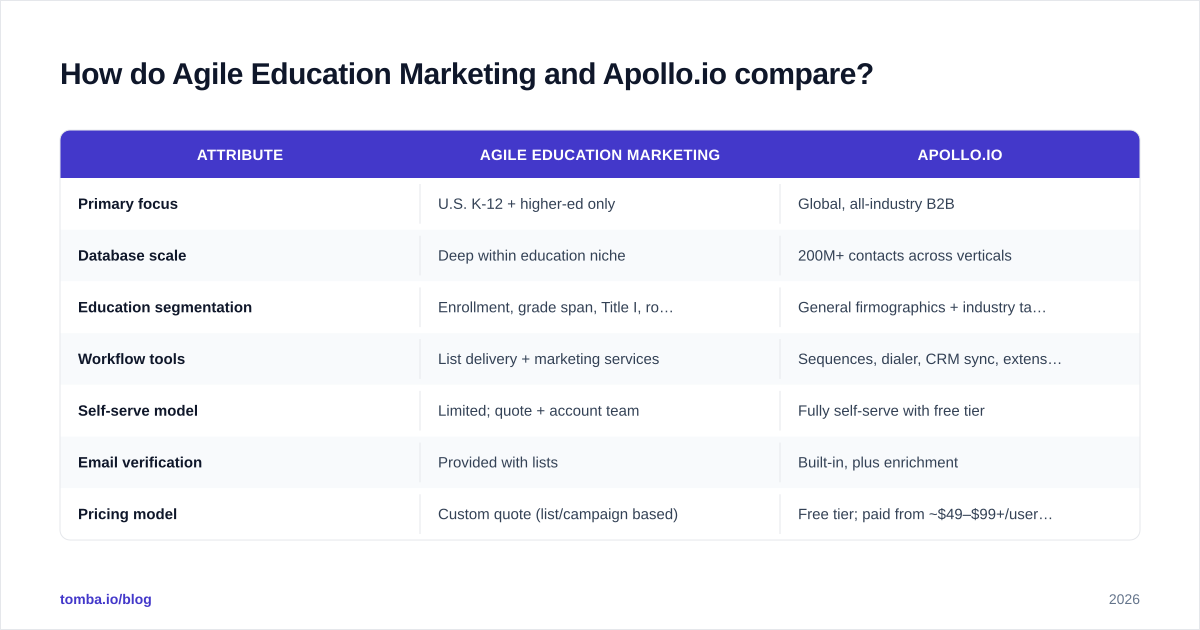
Here is the head-to-head Agile Education Marketing vs Apolloio comparison on the attributes that change a buying decision. Treat the specifics as directional. Both vendors revise packaging, but the shape of the trade-off is stable.
| Attribute | Agile Education Marketing | Apollo.io |
|---|---|---|
| Primary focus | U.S. K-12 + higher-ed only | Global, all-industry B2B |
| Database scale | Deep within education niche | 200M+ contacts across verticals |
| Education segmentation | Enrollment, grade span, Title I, role mapping | General firmographics + industry tags |
| Workflow tools | List delivery + marketing services | Sequences, dialer, CRM sync, extension |
| Self-serve model | Limited; quote + account team | Fully self-serve with free tier |
| Email verification | Provided with lists | Built-in, plus enrichment |
| Pricing model | Custom quote (list/campaign based) | Free tier; paid from ~$49–$99+/user/mo |
| Best for | Education-only marketing teams | Multi-segment sales teams |
The pattern is consistent with any specialist-vs-generalist matchup. Agile wins where the niche taxonomy matters. Apollo wins where breadth, automation, and per-seat economics matter.

Which has better data accuracy for education outreach?#
For institutional records, Agile typically has the edge. Its analysts maintain education data as a primary product, not a byproduct of broad web crawling. So the role mapping and institution attributes tend to be cleaner and more current for schools and districts. If you need to reach "the assistant superintendent for instruction in a specific district," that's Agile's home turf.
For individual contact reachability — does this email actually deliver today? — the answer is murkier, and both tools leave gaps. Apollo's contact emails are crowdsourced and inferred at scale, so accuracy varies by region and seniority. Agile's emails are verified at list-build time. But a list bought in Q1 decays through the school year as staff move, retire, or change roles. Education data is unusually seasonal. Turnover clusters around the academic calendar, so a "verified" address in August may bounce by November.
That decay is why a verification step belongs in your stack, no matter which vendor you choose. Running any list through an email verifier before a send catches the addresses that went stale since the data was sourced. Catch-all domains are their own headache — they are extremely common in school districts that route everything through a single mail server. A catch-all verifier helps you decide which catch-all addresses are worth the risk.
If you want the underlying methodology behind how a finder sources and scores addresses, Tomba documents its data sources openly, which is a useful benchmark when you evaluate any vendor's accuracy claims.
How does pricing compare?#
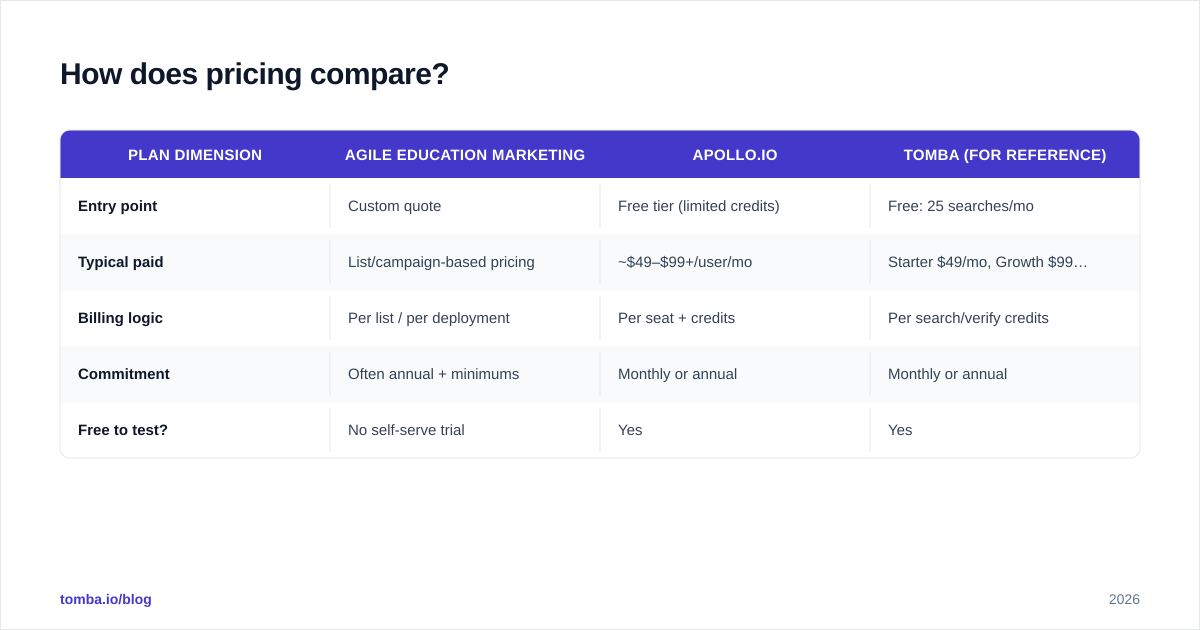
Pricing is where the two diverge most, and it maps directly to who each tool is built for.
| Plan dimension | Agile Education Marketing | Apollo.io | Tomba (for reference) |
|---|---|---|---|
| Entry point | Custom quote | Free tier (limited credits) | Free: 25 searches/mo |
| Typical paid | List/campaign-based pricing | ~$49–$99+/user/mo | Starter $49/mo, Growth $99/mo |
| Billing logic | Per list / per deployment | Per seat + credits | Per search/verify credits |
| Commitment | Often annual + minimums | Monthly or annual | Monthly or annual |
| Free to test? | No self-serve trial | Yes | Yes |
Agile's quote-based, list-oriented model fits a marketing team running a few large campaigns a year. Apollo's per-seat model fits a sales org where every rep needs daily access. If you only need verified emails — not a full platform and not a packaged campaign — a credit-based finder is usually the cheapest path; see Tomba's pricing for how per-credit economics compare to per-seat.
A blunt rule of thumb: count your cost per valid, delivered contact, not per seat or per list. That single metric reframes most "which is cheaper" debates.
Which should you choose? A decision framework#
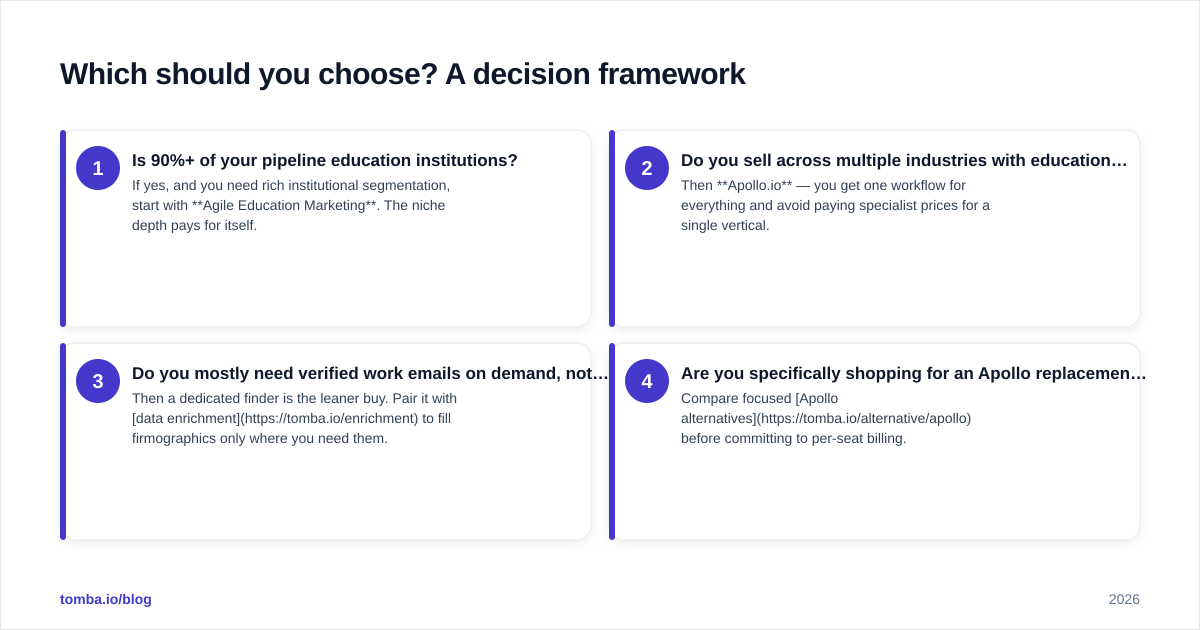
Run through these in order. The first "yes" usually settles it.
- Is 90%+ of your pipeline education institutions? If yes, and you need rich institutional segmentation, start with Agile Education Marketing. The niche depth pays for itself.
- Do you sell across multiple industries with education as one segment? Then Apollo.io — you get one workflow for everything and avoid paying specialist prices for a single vertical.
- Do you mostly need verified work emails on demand, not a platform? Then a dedicated finder is the leaner buy. Pair it with data enrichment to fill firmographics only where you need them.
- Are you specifically shopping for an Apollo replacement on price or data freshness? Compare focused Apollo alternatives before committing to per-seat billing.
The honest answer for many teams is "more than one tool." Use a specialist list as your institutional source of truth, a finder to fill gaps and enrich new accounts, and a verifier as the gate before every send.
Where does a dedicated email finder fit alongside these?#
Neither Agile nor Apollo is optimized for the narrow, high-frequency task of "give me this person's verified work email right now, cheaply." That is the gap a focused finder fills. When a rep finds a new principal on LinkedIn or a district posts a new IT director, you don't want to buy a fresh list or burn platform credits. You want a fast, accurate lookup.
This is where Tomba slots in cleanly: not as a replacement for a deep education list, but as the connective tissue. Use the domain search to pull every reachable contact at a district domain, the finder for one-off names, and the verifier to keep your bounce rate under control. Because it's credit-based, you pay for what you use instead of a per-seat minimum.
Final verdict and recommendation#
Pick Agile Education Marketing for depth, Apollo.io for breadth — and add a dedicated finder to cover what both miss. That is the core of the Agile Education Marketing vs Apolloio decision. If education is your whole business, Agile's institutional data is genuinely hard to replicate. If education is one lane of a multi-segment engine, Apollo's all-in-one workflow wins on convenience and per-seat economics. In both cases, contact decay and catch-all domains mean a verification layer is non-negotiable.
If your bottleneck is simply finding and verifying real work emails — without a platform contract or a packaged list buy — start with the Tomba Email Finder. The free tier gives you 25 searches a month to test accuracy on your own target accounts, and paid plans start at $49/mo with transparent per-credit pricing. Run a sample district or college domain through it, check the deliverability, and let the bounce rate decide.
// get started
Find, verify and enrich your first contacts today
Start on the free plan with 25 searches a month, then scale when your team is ready.
Free plan · No credit card required · GDPR & CCPA
// about the author