AI BDR in 2026: What It Is, Best Tools, and How to Deploy One
An AI BDR automates prospecting, research, and first-touch outreach around the clock. Here's how the technology works in 2026, what it costs, and where it still needs a human.
TL;DR
- An AI BDR (business development representative) is software that handles the top-of-funnel grind — finding prospects, researching them, writing personalized first-touch messages, and managing follow-up — with little to no human input per contact.
- It is not a replacement for your whole sales team. It replaces the repetitive 60% of an SDR's day, freeing humans for live conversations, objection handling, and closing.
- The 2026 tool landscape splits into three buckets: full autonomous agents (11x, Artisan), platform add-ons (Apollo, Outreach), and "assistant" copilots that draft but don't send.
- Data quality decides everything. An AI BDR firing at bad emails just burns your domain faster. Verified contact data is the non-negotiable input.
- Realistic outcome: 2-4x more qualified meetings per rep-equivalent at a fraction of headcount cost — if you gate it behind verification and human review.
What is an AI BDR?#
An AI BDR is an autonomous or semi-autonomous software agent that performs the work a human business development representative normally does at the top of the funnel: building target lists, enriching contact records, researching accounts, writing tailored outreach, and sequencing follow-ups.
Think of it like a self-driving car for prospecting. A human still sets the destination (your ICP, your offer, your guardrails) and grabs the wheel for the tricky parts (a hot reply, a nuanced negotiation). But the long, dull highway stretch — the list-building and the first three emails — runs on its own.
The distinction that matters in 2026 is autonomy level. Most vendors say "AI BDR," but they mean very different things:
- Copilot — drafts messages and suggests next steps; a human approves and sends.
- Co-pilot with autopilot lanes — sends low-risk touches automatically, escalates anything ambiguous.
- Full agent — runs an entire play end to end and only pings a human on a positive reply.
Knowing which tier you're buying prevents the most common disappointment: expecting a $99/month tool to replace a $70k/year hire.
How does an AI BDR actually work?#
Under the hood, every credible AI BDR runs the same five-stage loop. The quality of each stage determines whether you book meetings or get blacklisted.
- Targeting — It reads your ICP (industry, size, title, tech stack, signals) and pulls a matching list from a B2B database or live web sources.
- Enrichment & verification — It finds and confirms work emails, phone numbers, and LinkedIn profiles for each contact. This is where most "AI BDR" demos quietly cut corners.
- Research — It scrapes recent triggers: funding rounds, job changes, product launches, 10-Ks, podcast appearances. The good ones cite the source so a human can sanity-check.
- Generation — A language model drafts personalized openers and a multi-step sequence, matched to the trigger and your value prop.
- Orchestration — It schedules sends across mailboxes, throttles volume to protect sender reputation, reads replies, and routes positives to a human or a calendar link.
The weakest link is stage two. A model can write a flawless email, but if the address bounces, you've just told inbox providers your domain sends to dead mailboxes. That's why pairing any AI BDR with a real email verifier isn't optional — it's the difference between a warm pipeline and a cold spam folder.
Is an AI BDR better than a human SDR?#
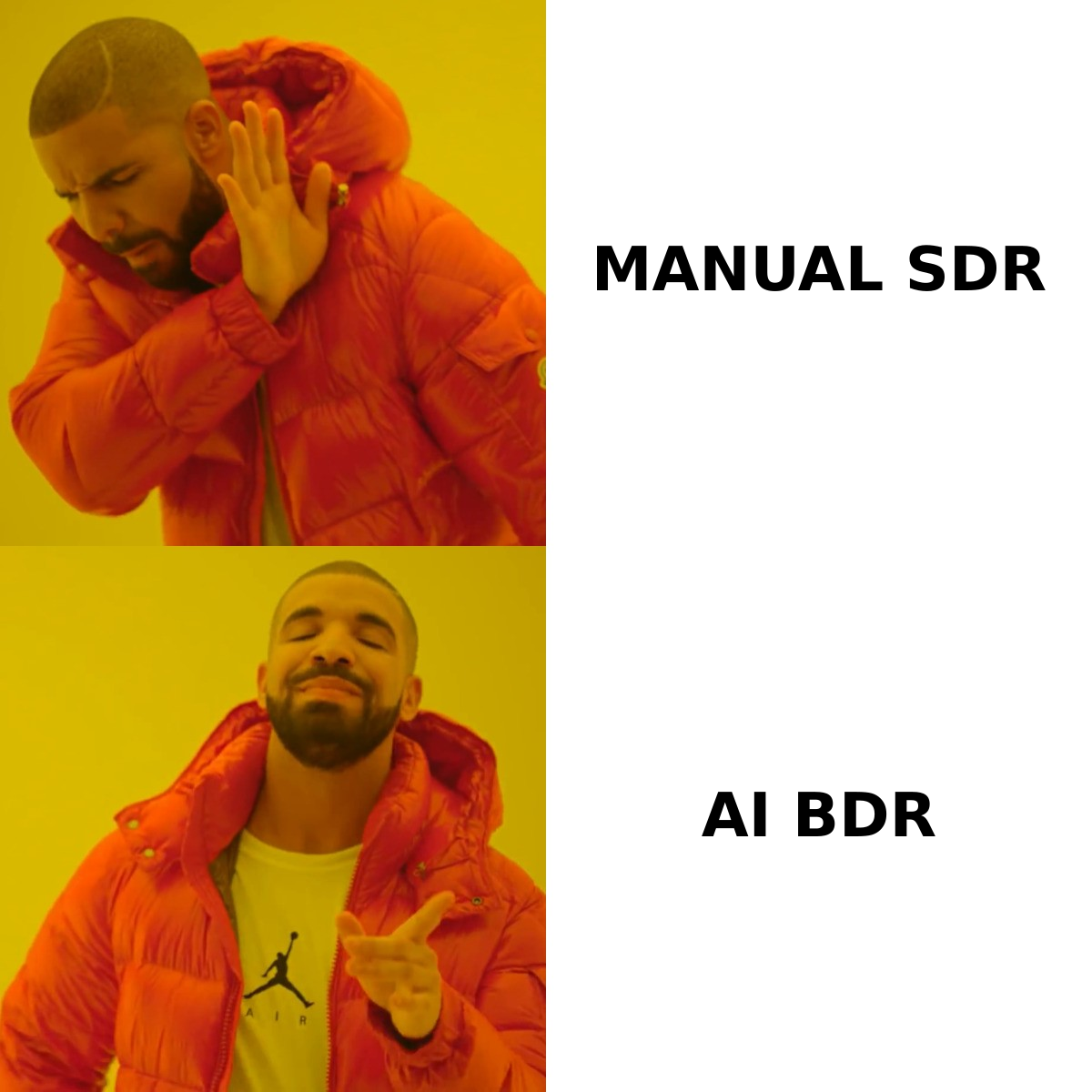
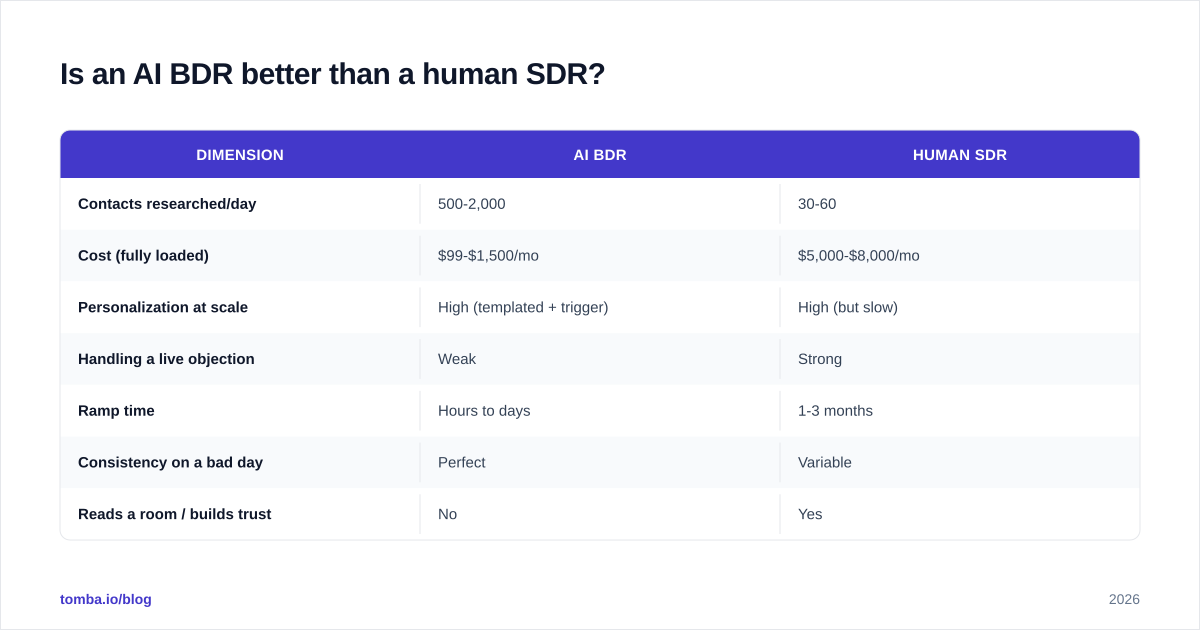
Short answer: for different things. An AI BDR wins on volume, consistency, and cost-per-touch. A human SDR wins on judgment, rapport, and anything requiring a real conversation.
| Dimension | AI BDR | Human SDR |
|---|---|---|
| Contacts researched/day | 500-2,000 | 30-60 |
| Cost (fully loaded) | $99-$1,500/mo | $5,000-$8,000/mo |
| Personalization at scale | High (templated + trigger) | High (but slow) |
| Handling a live objection | Weak | Strong |
| Ramp time | Hours to days | 1-3 months |
| Consistency on a bad day | Perfect | Variable |
| Reads a room / builds trust | No | Yes |
The teams getting real value in 2026 don't pick one. They run a hybrid: the AI BDR owns stages one through four and the first two automated touches, then hands any engaged prospect to a human the moment there's a reply worth a conversation. You get machine throughput on the boring part and human warmth where it actually moves a deal.
This mirrors what Gartner has flagged across sales tech — automation lifts rep productivity most when it removes administrative load, not when it tries to fake the human moments buyers can smell.
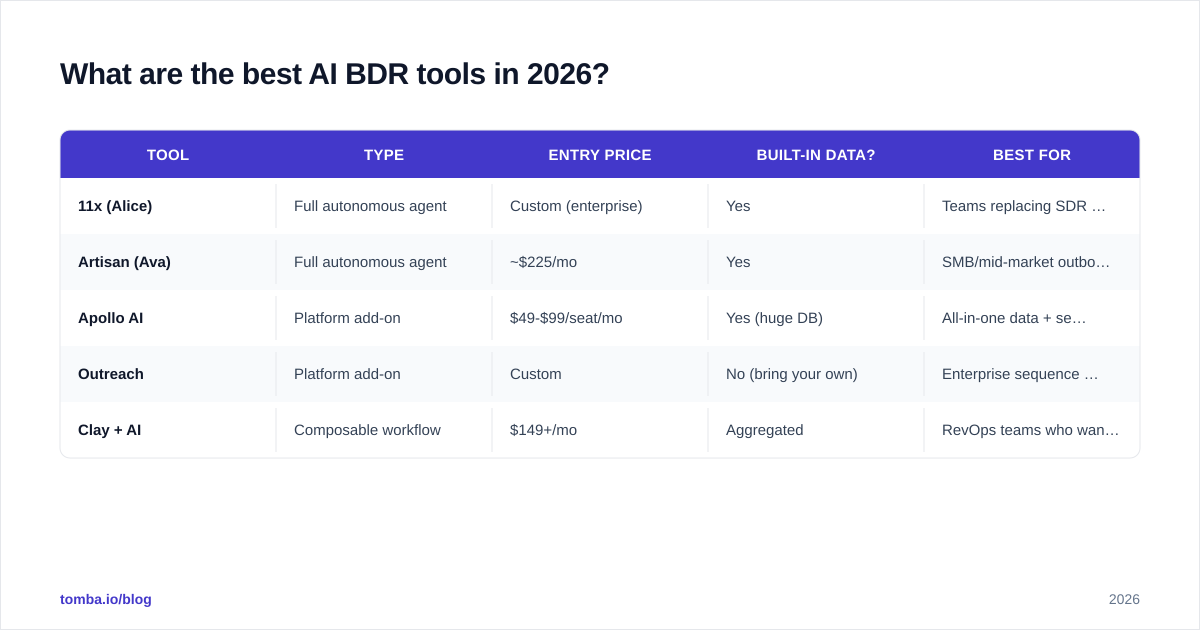
What are the best AI BDR tools in 2026?#
The market sorts into three tiers. Pricing below reflects publicly listed entry points as of 2026; always confirm on the vendor's own page since this category re-prices constantly.
| Tool | Type | Entry price | Built-in data? | Best for |
|---|---|---|---|---|
| 11x (Alice) | Full autonomous agent | Custom (enterprise) | Yes | Teams replacing SDR headcount |
| Artisan (Ava) | Full autonomous agent | ~$225/mo | Yes | SMB/mid-market outbound |
| Apollo AI | Platform add-on | $49-$99/seat/mo | Yes (huge DB) | All-in-one data + sequencing |
| Outreach | Platform add-on | Custom | No (bring your own) | Enterprise sequence governance |
| Clay + AI | Composable workflow | $149+/mo | Aggregated | RevOps teams who want control |
A few honest caveats:
- Full agents (11x, Artisan) are the closest thing to "hire a robot." They're powerful but opaque — you trust their data and their judgment, and switching costs are high.
- Platform add-ons like Apollo bolt AI onto an existing sequencer and database. Convenient, but the bundled data accuracy varies by region and seniority.
- Composable stacks (Clay-style) give RevOps teams the most control and the best data — at the cost of having to build the plumbing yourself.
Whichever tier you choose, the AI is only as good as the contact data feeding it. Many teams keep their outreach platform but swap in a dedicated source for the find-and-verify step, using something like Tomba's domain search and bulk email finder to build clean, verified lists before a single message goes out.
How do you deploy an AI BDR without burning your domain?#
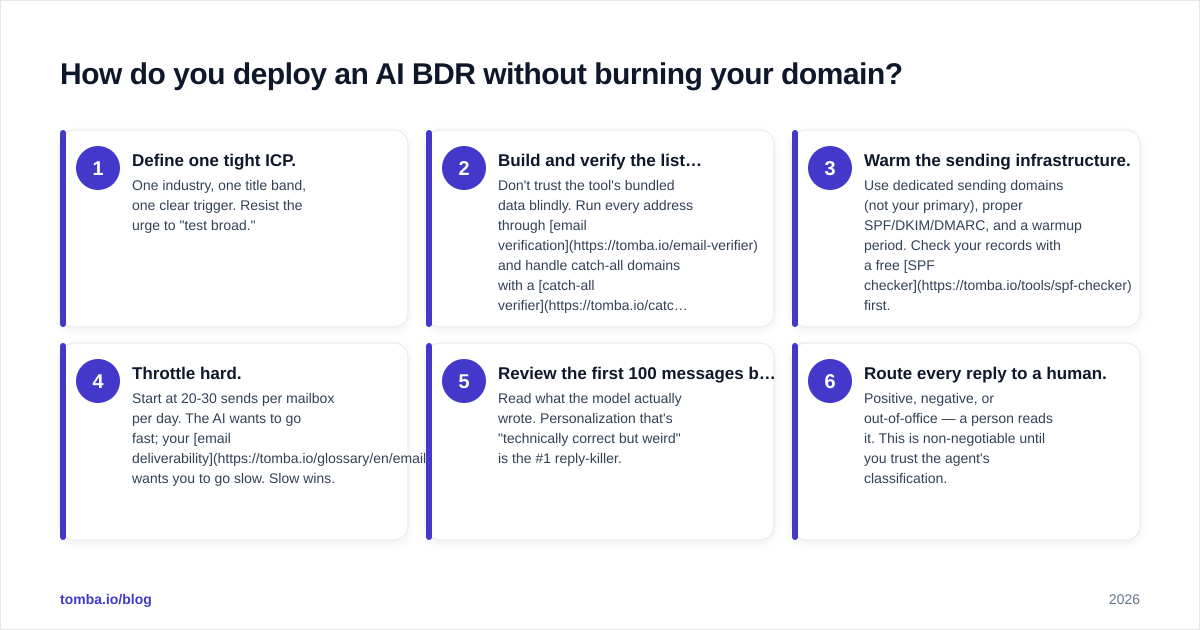
Here's the conclusion first: start narrow, gate on data quality, and keep a human on replies. The fastest way to waste money on an AI BDR is to point it at a 50,000-row list on day one.
Follow this rollout sequence:
- Define one tight ICP. One industry, one title band, one clear trigger. Resist the urge to "test broad."
- Build and verify the list separately. Don't trust the tool's bundled data blindly. Run every address through email verification and handle catch-all domains with a catch-all verifier before importing. A bounce rate under 2% is the goal.
- Warm the sending infrastructure. Use dedicated sending domains (not your primary), proper SPF/DKIM/DMARC, and a warmup period. Check your records with a free SPF checker first.
- Throttle hard. Start at 20-30 sends per mailbox per day. The AI wants to go fast; your email deliverability wants you to go slow. Slow wins.
- Review the first 100 messages by hand. Read what the model actually wrote. Personalization that's "technically correct but weird" is the #1 reply-killer.
- Route every reply to a human. Positive, negative, or out-of-office — a person reads it. This is non-negotiable until you trust the agent's classification.
Teams that skip steps two and three are the ones posting "AI outbound doesn't work" six weeks later. It works. Bad data and reckless volume don't.
What can an AI BDR not do (yet)?#
Setting expectations honestly is the difference between a tool that sticks and shelfware:
- It can't run a discovery call. Live, multi-turn conversation with a skeptical buyer is still human territory.
- It can't read genuine intent. A sarcastic "sure, I'd love another sales email" gets logged as a positive by weaker classifiers.
- It can't fix a broken offer. If your value prop doesn't land, the AI just helps you fail faster and at a larger scale.
- It can't self-correct on data drift. People change jobs constantly; without continuous data enrichment, your AI BDR is emailing ghosts within a quarter.
- It can't own compliance. GDPR, CAN-SPAM, and CCPA obligations stay with you. The agent will happily email someone who opted out unless you wire the suppression list correctly.
None of these are reasons to avoid an AI BDR. They're reasons to deploy it as a force multiplier for a thoughtful team, not a substitute for one.
How much should an AI BDR cost — and what's the ROI?#
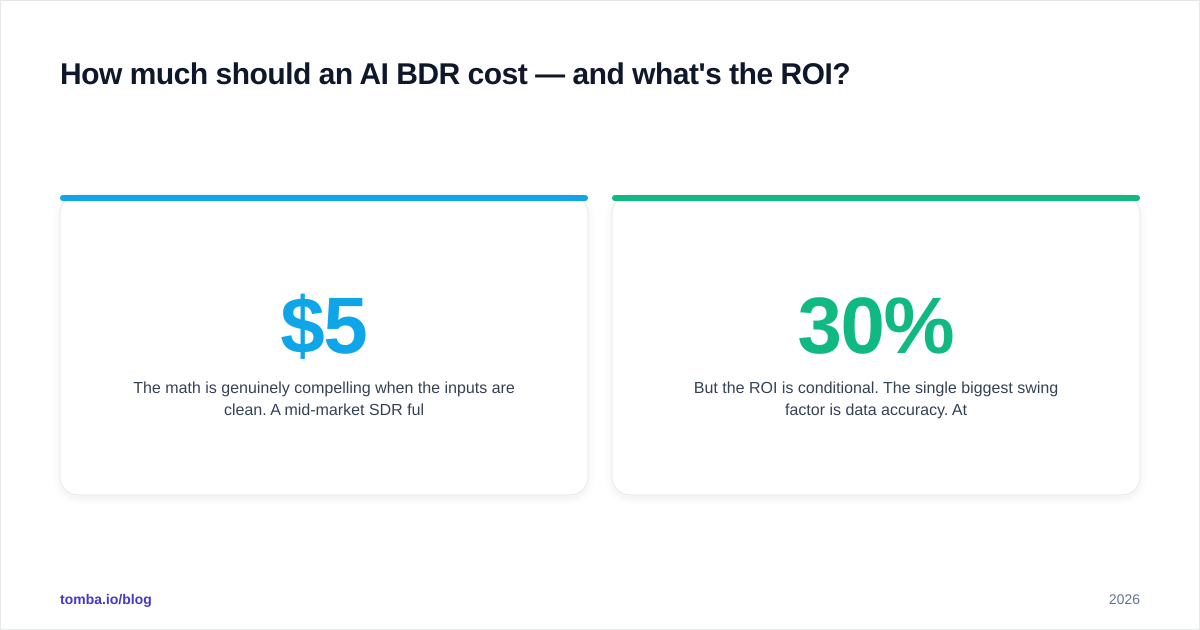
The math is genuinely compelling when the inputs are clean. A mid-market SDR fully loaded runs $5,000-$8,000/month and books, optimistically, 8-12 qualified meetings. An AI BDR stack — agent plus verified data — often lands between $300 and $1,500/month and can match or exceed that meeting count on volume alone.
But the ROI is conditional. The single biggest swing factor is data accuracy. At a 30% bounce rate, your domain reputation tanks, your "free" sends stop landing, and the apparent savings evaporate. At a sub-2% bounce rate on verified data, the economics are hard to argue with.
That's why the smartest 2026 buyers treat data and the AI agent as two line items, not one. They'll pay for the autonomous outreach engine and a dedicated find-and-verify layer, because the second protects the investment in the first. Compare a few B2B database options on accuracy and coverage before you commit — the cheapest bundled data is rarely the cheapest in total.
Frequently asked questions#
Will an AI BDR replace my sales team? No. It replaces the repetitive top-of-funnel work, not the relationship-building or closing. Teams that frame it as a layoff lever tend to fail; teams that frame it as capacity expansion tend to win.
How fast can I see results? With a tight ICP and verified data, first meetings typically land within 2-4 weeks. The bottleneck is almost never the AI — it's list quality and warmup.
Do I still need a separate email finder and verifier? Yes, in most cases. Bundled data quality varies wildly by tool and region. A dedicated email finder and verifier act as the quality gate that keeps your AI BDR from torching your domain.
Get your AI BDR the data it deserves#
An AI BDR is only as good as the contacts you feed it. Before you wire up an autonomous agent, make sure every prospect on the list is real, reachable, and verified — because a brilliant AI writing to dead inboxes is just an expensive way to get blacklisted.
The Tomba Email Finder gives your AI BDR a clean, verified foundation: find professional emails by domain, name, or company, confirm them before send, and enrich records so your outreach lands in inboxes instead of spam folders. Start free with 25 searches a month, scale to the Starter plan at $49/mo, and see full Tomba pricing when you're ready to grow. Feed your AI BDR good data, and let it do the heavy lifting.
Ready to find emails that actually work?
Join 150,000+ professionals who stopped guessing and started sending. Free credits on signup — no credit card required.
Get the Tomba newsletter
Practical outbound tactics and product updates — once every two weeks.
About the author