AroundDeal vs LFBBD Lead for Business: 2026 Data Showdown
AroundDeal vs LFBBD Lead for Business compared on data accuracy, coverage, pricing, and compliance — plus where a dedicated finder beats both for clean B2B leads.
AroundDeal vs LFBBD Lead for Business: Which B2B Data Source Wins in 2026?
If you are weighing AroundDeal vs LFBBD Lead for Business, the short answer is this: AroundDeal is a mature, well-funded B2B contact-data platform with a large database and browser-extension prospecting, while "LFBBD Lead for Business" is the kind of low-profile, list-style lead source you find on marketplaces and reseller sites — cheap, opaque about sourcing, and risky on accuracy. For most revenue teams the real decision is not just "which of these two," but "do either of them give me verified, compliant, deliverable contacts on demand." Often the honest answer is no, and a dedicated finder-plus-verifier stack fills the gap.
This is a neutral teardown. We will look at where AroundDeal genuinely shines, where bulk "lead for business" packages fall apart, and how to think about data quality so you stop paying for bounces.
TL;DR#
- AroundDeal is a legitimate, established B2B contact platform (database, Chrome extension, enrichment, intent signals). Good coverage, subscription pricing, GDPR/CCPA posturing.
- LFBBD Lead for Business behaves like a generic bulk-list / reseller offering: low upfront cost, unclear sourcing, no transparent verification, high bounce risk.
- The metric that matters is not list size — it's deliverable, verified, recently-refreshed contacts. Big stale databases lose ~22–30% of records to job changes every year.
- Best practice in 2026: pull targeted contacts, then verify before you send. Never blast a raw purchased list.
- A dedicated email finder plus an email verifier usually beats both a broad database subscription and a cheap list dump on cost-per-deliverable-lead.
What is AroundDeal?#
AroundDeal is a B2B sales-intelligence platform built around a contact and company database, a browser extension for LinkedIn prospecting, and enrichment/intent features. You can read its own positioning on the AroundDeal homepage. Reviewers on G2 generally describe it as an Apollo-style alternative: solid coverage in some regions, a usable extension, and credit-based exports.
In practice, teams reach for AroundDeal when they want to:
- Find direct dials and business emails while browsing LinkedIn profiles.
- Build target-account lists filtered by title, industry, headcount, and geography.
- Enrich an existing CRM record with firmographics.
That is a real product with a real company behind it. The trade-offs are the same ones every database vendor faces: coverage varies wildly by region and seniority, and any static database decays the moment it's compiled.
What is "LFBBD Lead for Business"?#
Here is where you should slow down. "LFBBD Lead for Business" is not a recognized, transparent SaaS brand in the way AroundDeal is. The name pattern — an acronym plus "Lead for Business" — is typical of marketplace listings, reseller bundles, and pre-scraped CSV packages sold as "X million business leads."
That does not automatically make it useless, but it raises questions you must answer before spending a dollar:
- Where did the data come from? Scraped public profiles? Recycled marketing lists? Co-registration?
- When was it last verified? A list compiled 18 months ago is mostly fiction now.
- Is there consent / a lawful basis? This is the difference between a campaign and a compliance incident.
- Do you get refreshes, or a one-time dump? One-time dumps rot in your CRM.
If a "lead for business" package can't answer those clearly, treat its headline contact count as marketing, not inventory.
How do AroundDeal and LFBBD Lead for Business compare head-to-head?#
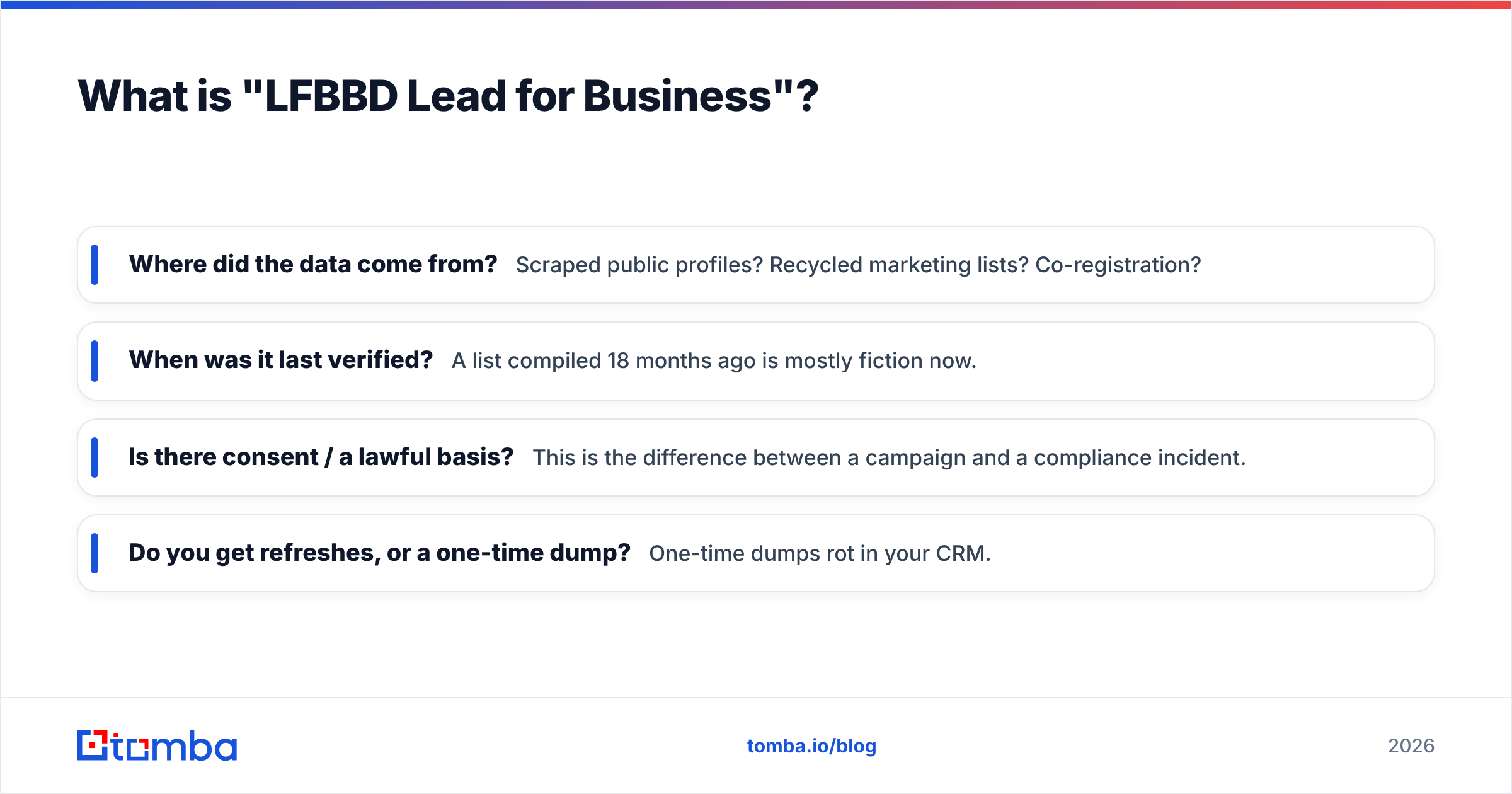
The table below is the honest version. "LFBBD-style" reflects the typical characteristics of bulk lead-for-business packages, since the offering itself publishes little verifiable detail.
| Attribute | AroundDeal | LFBBD Lead for Business (typical) | A finder + verifier stack |
|---|---|---|---|
| Model | Subscription database + extension | One-time / cheap bulk list | On-demand search + verify |
| Data freshness | Continuously updated | Often static, unknown age | Real-time lookup |
| Verification | Built-in, partial | Rarely transparent | Dedicated SMTP verification |
| Sourcing transparency | Documented | Opaque | Documented sources |
| Compliance posture | GDPR/CCPA stated | Unclear | GDPR/CCPA stated |
| Typical accuracy | 80–90% (varies by region) | Highly variable, often <70% | 95%+ on verified results |
| Pricing shape | Credit tiers | Flat low cost | Pay per credit/search |
| Best for | Ongoing prospecting | One-off volume plays | Clean, deliverable outreach |
Two takeaways. First, AroundDeal is the safer, more defensible choice between the two named options — it's a real platform with accountability. Second, neither a broad database nor a bulk list removes your obligation to verify, because deliverability is decided at send time, not at purchase time.

Is AroundDeal accurate enough for cold outreach?#
AroundDeal's accuracy is "good in pockets." Senior titles at mid-to-large companies in well-covered regions tend to resolve well. Long-tail SMBs, non-US regions, and recently-promoted contacts are weaker — that's true of every database, including the biggest names. Independent buyers on Gartner Peer Insights repeatedly note the same pattern across the category: list size is marketing, match rate is reality.
The structural problem is decay. B2B data ages out fast:
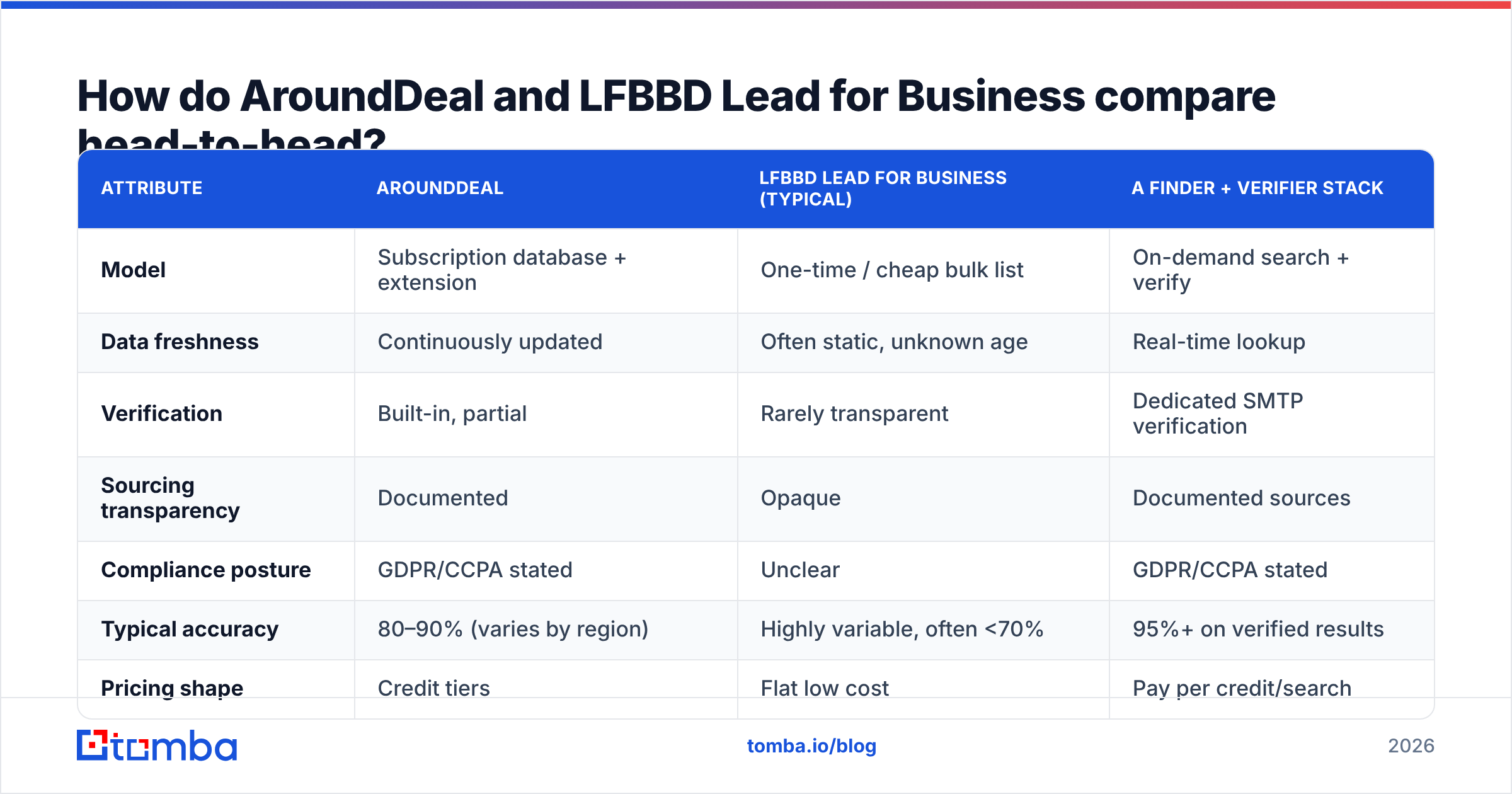
- Roughly 22–30% of contacts change jobs annually.
- Email formats change after rebrands, mergers, and domain migrations.
- Catch-all domains hide whether a mailbox actually exists.
So even a 90%-accurate-at-compile-time record can be a 70%-deliverable record by the time you email it. That is why the verification layer is non-negotiable — and why a dedicated email verifier and catch-all verifier belong in your workflow regardless of which database you license. If you want to see how sourcing affects accuracy, AroundDeal's and Tomba's approaches both hinge on transparent data sources; the bulk-list world usually offers none.

Is LFBBD Lead for Business worth the low price?#
The cheap price is the whole pitch — and the whole risk. A flat fee for "millions of leads" looks efficient until you compute cost per usable lead.
Run the math the way your finance team would:
- Start with 100,000 "leads" at a flat low price.
- Assume a generous 70% are real, current businesses. Now 70,000.
- Assume 65% have a deliverable email after verification. Now ~45,500.
- Strip duplicates, role accounts (info@, sales@), and your suppression list. Now maybe ~35,000.
- The rest is bounce fuel that damages your sender reputation.
That last point is the expensive one. Blasting unverified records spikes bounces, trips spam traps, and tanks email deliverability — which then suppresses the inbox placement of the good contacts you paid AroundDeal or anyone else for. A cheap list can cost you your domain reputation, which is the most expensive thing in cold outreach.
Before importing any purchased list, run it through deduplication and validation. Tools like remove duplicates and a free email checker exist precisely for this triage step.
Which one should you choose for B2B lead generation?#
Pick based on the job, not the brand:
- Choose AroundDeal if you want an ongoing, accountable prospecting platform with an extension and enrichment, and you're comfortable with credit-based pricing and region-variable coverage. Verify before you send.
- Be cautious with LFBBD-style lead packages. Only consider them for low-stakes volume plays where you'll aggressively verify and you accept that a large share is dead. Never make them your primary outbound source.
- Choose a finder + verifier stack when you care about cost-per-deliverable-lead and want clean records on demand instead of renting a giant database or buying a stale dump.
A practical hybrid many teams run in 2026: use a database for discovery (who to target), then use a precise finder to resolve the current email by name and domain, then verify. That sequence beats trusting any single source's stored value.
How do you build a clean lead list that actually converts?#
Treat lead data as a pipeline, not a purchase. Here is the workflow that survives audits and protects deliverability:
- Define the ICP precisely — title, seniority, industry, headcount, region. Narrow beats broad.
- Discover accounts and people — use a database (AroundDeal, LinkedIn) to build the target set.
- Resolve current emails on demand — use domain search to pull a company's verified addresses, or the email finder for specific people. Need format help? The email permutator and company email pattern tools confirm the structure.
- Verify everything — run an email verification pass; flag catch-alls separately so you can route them carefully.
- Enrich for personalization — add firmographics and role context with data enrichment so your first line isn't generic.
- Deduplicate and suppress — remove dupes, role accounts, and prior contacts before the first send.
- Warm up and monitor — protect sender reputation and watch bounce/complaint rates.
This is the difference between "I bought leads" and "I built a deliverable pipeline." The second one compounds; the first one decays.

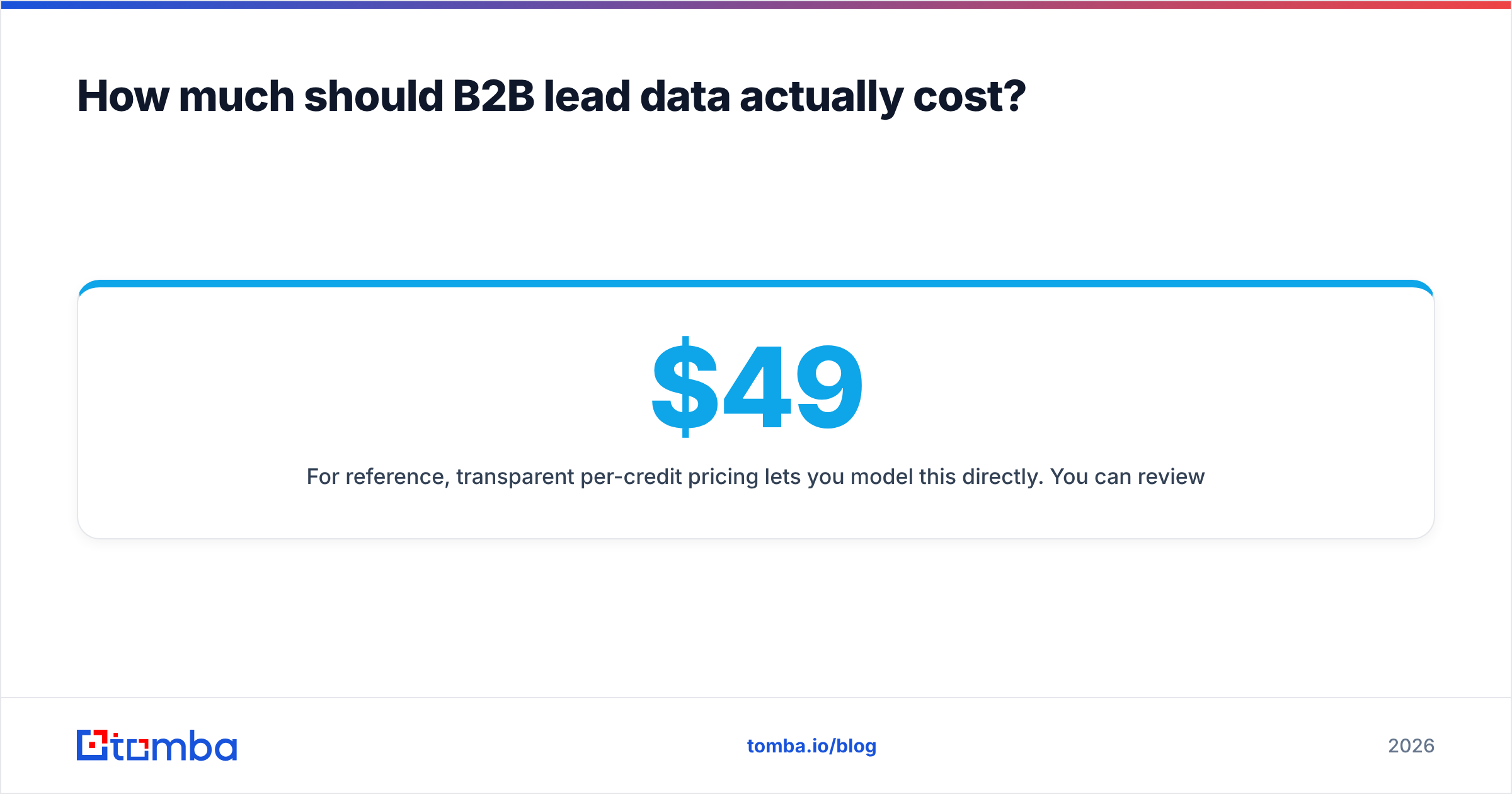
How much should B2B lead data actually cost?#
There's no single right number, but there is a right unit: cost per deliverable, verified, ICP-matched contact. Judge every option — AroundDeal, an LFBBD-style list, or a finder stack — on that unit, not on headline volume or sticker price.
For reference, transparent per-credit pricing lets you model this directly. You can review Tomba pricing to see how a usage-based finder stacks up: a Free tier with 25 searches/month, Starter at $49/mo, Growth at $99/mo, Pro at $249/mo, and custom Enterprise. The point isn't that one number wins — it's that you can predict cost-per-lead instead of discovering it after a list dump bounces.
A quick gut check before you buy anything:
- Can the vendor tell you where the data came from? (If no → walk.)
- Is there built-in or easy verification? (If no → budget for it separately.)
- Do you pay for refreshes or a frozen snapshot? (Snapshots rot.)
- What's the realistic deliverable rate, not the claimed database size?
The verdict on AroundDeal vs LFBBD Lead for Business#
Between the two named options, AroundDeal is the more credible choice — it's a real platform with documented sourcing, ongoing updates, and compliance posturing, where "LFBBD Lead for Business" reads like an opaque bulk list whose headline numbers you can't trust. But the bigger lesson is that the source you license matters less than the verification and hygiene you apply after. Deliverability is earned at send time.
If your goal is clean, current, deliverable B2B contacts without renting a giant database or gambling on a cheap dump, run a precise discovery-then-verify workflow. Start with the Tomba Email Finder to resolve verified professional emails by name, company, or domain, layer in the email verifier before every campaign, and you'll spend on contacts that actually reach an inbox — not on bounce fuel. Spin up the free tier, test it against a sample of your ICP, and compare cost-per-deliverable-lead against whatever list you were about to buy. The numbers will make the decision for you.
// get started
Find, verify and enrich your first contacts today
Start on the free plan with 25 searches a month, then scale when your team is ready.
Free plan · No credit card required · GDPR & CCPA
// about the author