B2B Cold Email Agency in 2026: Worth It or DIY?
Should you hire a B2B cold email agency or build the system in-house? A neutral breakdown of pricing, deliverables, risks, and when each model wins in 2026.
You have pipeline targets, a thin SDR bench, and a board asking why outbound is flat. A B2B cold email agency promises to fix all three for a monthly retainer. The pitch is seductive: hand over your ICP, get booked meetings back. But cold email is now a deliverability minefield, and the gap between a good agency and an expensive one is enormous.
This guide breaks down what a B2B cold email agency actually does, what it costs, where the model breaks, and when building in-house with the right tools beats outsourcing.
TL;DR#
- A B2B cold email agency runs your outbound — list building, copy, sending infrastructure, and inbox management — for a retainer that typically lands between $2,000 and $8,000/month.
- The real value is deliverability engineering (domains, warmup, DNS) and volume, not magic copy. If an agency can't explain its sending setup, walk.
- Agencies win when you need speed and have no in-house outbound muscle. In-house wins on cost, control, and data ownership once you're past the experiment phase.
- The cheapest leverage point is data quality. Bad lists wreck deliverability no matter who sends them — verified contacts from a tool like Tomba's email finder protect your domain reputation.
- Most companies should run a hybrid: agency or contractor for setup and infrastructure, in-house for ongoing list building and replies.
What does a B2B cold email agency actually do?#
A B2B cold email agency operates your outbound email channel end to end so your team doesn't have to. Think of it like hiring a contractor to build and run a rental property: they handle the plumbing (infrastructure), the listing (copy), and the tenant calls (replies) — you collect the qualified leads.
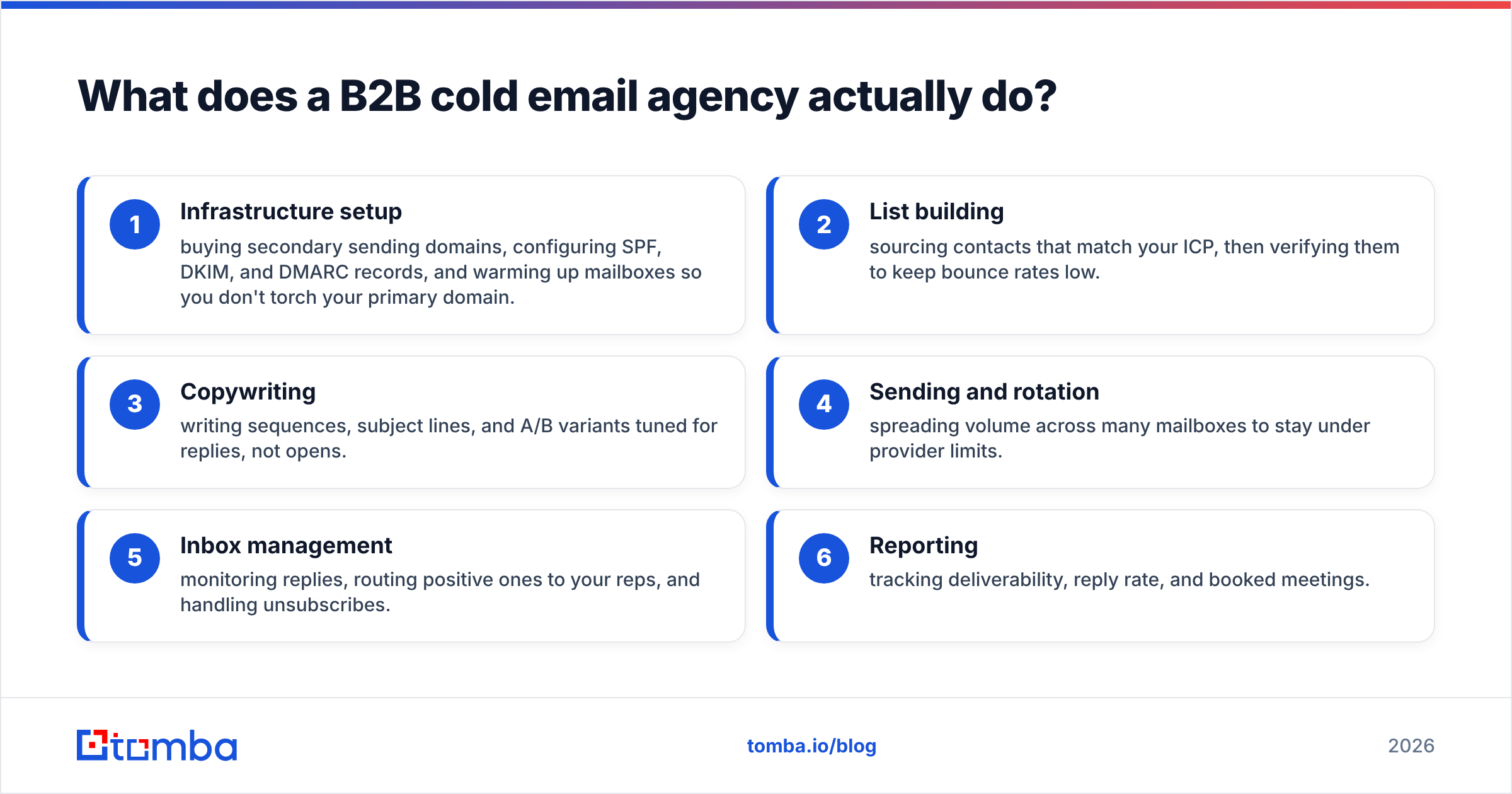
A full-service agency usually owns these six functions:
- Infrastructure setup — buying secondary sending domains, configuring SPF, DKIM, and DMARC records, and warming up mailboxes so you don't torch your primary domain.
- List building — sourcing contacts that match your ICP, then verifying them to keep bounce rates low.
- Copywriting — writing sequences, subject lines, and A/B variants tuned for replies, not opens.
- Sending and rotation — spreading volume across many mailboxes to stay under provider limits.
- Inbox management — monitoring replies, routing positive ones to your reps, and handling unsubscribes.
- Reporting — tracking deliverability, reply rate, and booked meetings.
The dirty secret: the part that drives results most is #1 and #2. Great copy on a blacklisted domain sent to unverified addresses produces nothing. A boring email from a warmed domain to a clean, verified list books meetings. If an agency leads with "our copywriters are world-class" and stays vague on infrastructure, that's a yellow flag.
How much does a B2B cold email agency cost in 2026?#
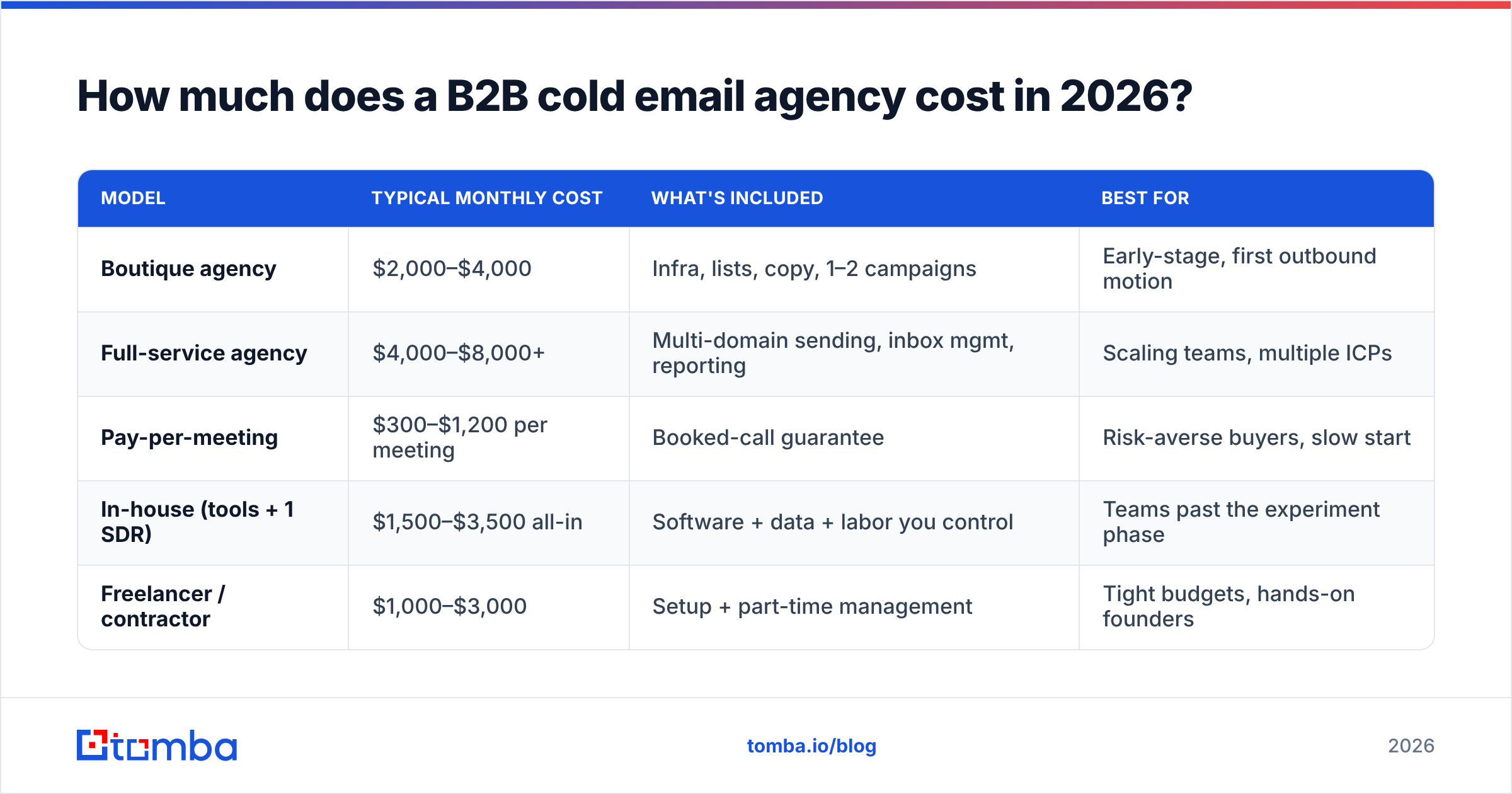
Most agencies price on a monthly retainer, sometimes with a per-meeting or pay-on-results add-on. Here's the realistic 2026 landscape compared against building the same capability in-house.
| Model | Typical monthly cost | What's included | Best for |
|---|---|---|---|
| Boutique agency | $2,000–$4,000 | Infra, lists, copy, 1–2 campaigns | Early-stage, first outbound motion |
| Full-service agency | $4,000–$8,000+ | Multi-domain sending, inbox mgmt, reporting | Scaling teams, multiple ICPs |
| Pay-per-meeting | $300–$1,200 per meeting | Booked-call guarantee | Risk-averse buyers, slow start |
| In-house (tools + 1 SDR) | $1,500–$3,500 all-in | Software + data + labor you control | Teams past the experiment phase |
| Freelancer / contractor | $1,000–$3,000 | Setup + part-time management | Tight budgets, hands-on founders |
A few cost truths the sales deck won't volunteer:
- Retainers rarely include ad-hoc data buys. If your ICP shifts, expect list costs on top.
- Pay-per-meeting sounds safe but inflates "meetings." A no-show or a tire-kicker still counts. Read the qualification criteria in the contract.
- In-house gets cheaper at scale. Once your sending infrastructure is built and your SDR knows the playbook, the marginal cost of another 5,000 emails is mostly data and time — not a rising retainer. Compare that with transparent Tomba pricing where a Growth plan runs $99/month for data you own.
For a deeper benchmark on outbound benchmarks and deliverability terms, HubSpot's sales statistics and the deliverability glossary entry on email deliverability are worth keeping open.
Is a B2B cold email agency better than building in-house?#
It depends on your stage, but the honest answer is: an agency buys you speed, in-house buys you compounding leverage.
Agencies are faster to first meeting because they already own warmed domains and a tested playbook. You're paying to skip the 4–8 week warmup and learning curve. That's genuinely valuable when you need pipeline this quarter and have nobody who's run outbound before.
In-house wins on three dimensions that matter more over time:
- Cost — no markup on data or labor; the system you build is an asset, not a rented one.
- Control — you change ICP, messaging, or cadence the same day instead of filing a request.
- Data ownership — every verified contact and reply lives in your CRM, not the agency's account. When you part ways, agencies keep their lists. You keep what you sourced.
The deliverability piece is the deciding factor for many teams. Agencies are good at the technical setup precisely because most companies underestimate it. But the tooling to do it yourself is now cheap and accessible — warmup calculators, SPF checkers, blacklist monitors, and email verifiers that strip risky addresses before they bounce.

What separates a good agency from an expensive one?#
The market is crowded with agencies that resell the same Instantly-plus-a-VA stack at a 5x markup. Use these criteria to filter.
Green flags:
- They walk you through their domain and DNS strategy unprompted (multiple sending domains, gradual ramp, dedicated IPs where relevant).
- They verify every list and can show you bounce-rate data from past clients.
- They report on reply rate and qualified meetings, not vanity open rates (which are unreliable post-Apple MPP anyway).
- They have a clear unsubscribe and compliance process for CAN-SPAM and GDPR.
- The contract lets you keep the data you paid to source.
Red flags:
- "We guarantee X meetings" with no qualification definition.
- One sending domain for everything (a deliverability time bomb).
- No mention of list verification or sender reputation.
- Locked-in annual contracts before any pilot.
- They won't name the tools in their stack.
A quick test: ask how they keep bounce rates under 2%. A real operator will talk about catch-all handling, verification cadence, and list hygiene. A reseller will change the subject.
How do you build the data layer yourself?#
Whether you hire an agency or go in-house, the list is the foundation — and it's the one piece you should never fully outsource without oversight. Garbage data produces bounces, bounces destroy reputation, and a wrecked domain can take months to recover.
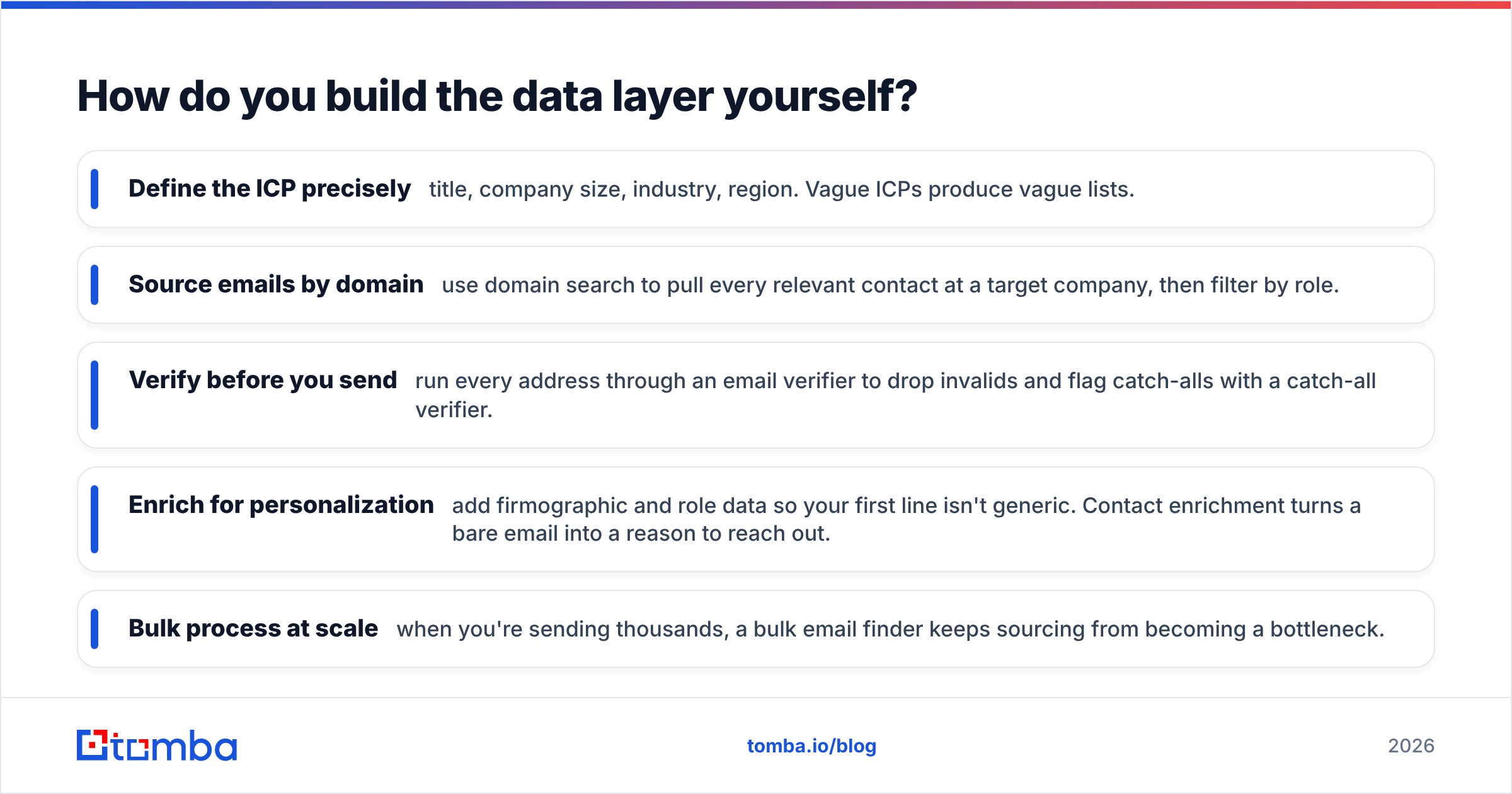
Here's a lean in-house data workflow that rivals what most agencies do:
- Define the ICP precisely — title, company size, industry, region. Vague ICPs produce vague lists.
- Source emails by domain — use domain search to pull every relevant contact at a target company, then filter by role.
- Verify before you send — run every address through an email verifier to drop invalids and flag catch-alls with a catch-all verifier.
- Enrich for personalization — add firmographic and role data so your first line isn't generic. Contact enrichment turns a bare email into a reason to reach out.
- Bulk process at scale — when you're sending thousands, a bulk email finder keeps sourcing from becoming a bottleneck.
This is the layer agencies mark up the most, and it's the layer easiest to own. A verified, enriched list of 2,000 real buyers beats a scraped list of 20,000 strangers every time — for reply rate and for keeping your domain off blacklists.
When should you actually hire an agency?#
Hire a B2B cold email agency when at least two of these are true:
- You have no one in-house who has run outbound and you need pipeline within 30–60 days.
- You're testing a brand-new market and want a fast, low-commitment experiment before investing in headcount.
- Your team's time is genuinely more valuable on product, fundraising, or closing than on building sending infrastructure.
- You can afford a 3-month pilot to evaluate results without betting the quarter on it.
Don't hire an agency when:
- You already have an SDR or growth hire who can own the channel.
- Your budget is tight enough that a $5k retainer crowds out the data and tooling that actually drive results.
- You want long-term control over messaging and data.
- Cold email is core to your GTM motion and will be for years — in that case, build the muscle internally.
The smartest play for most B2B teams is a hybrid: pay a strong agency or contractor to build the infrastructure and prove the playbook in 90 days, then bring list building, sending, and replies in-house once the system works. You get the speed without renting your pipeline forever. If you go this route, agency-comparison resources like G2's lead generation category help you vet providers before signing.
What metrics tell you it's working?#
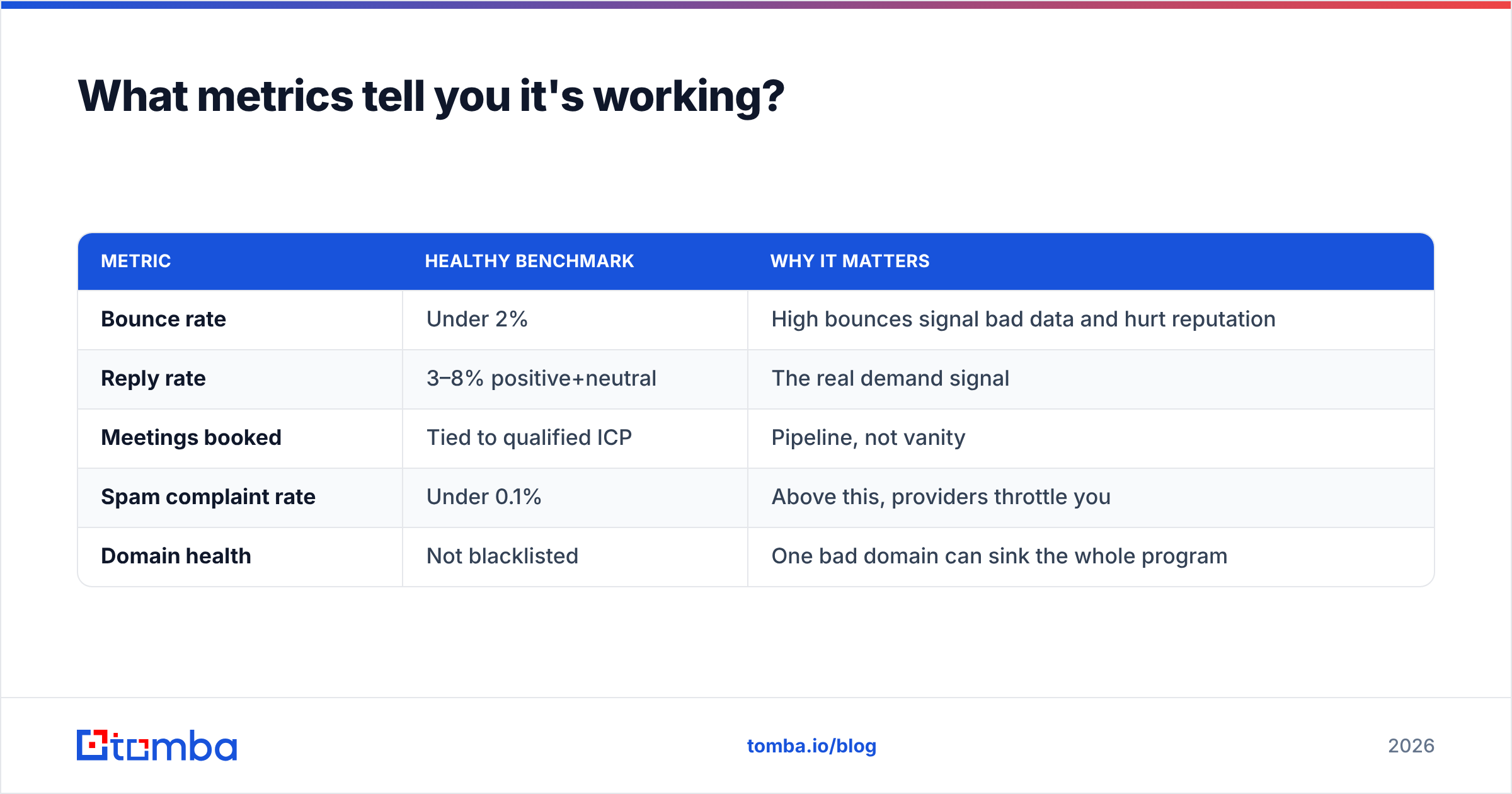
Ignore open rates — Apple Mail Privacy Protection makes them noise. Judge any agency or in-house program on outcomes that survive scrutiny:
| Metric | Healthy benchmark | Why it matters |
|---|---|---|
| Bounce rate | Under 2% | High bounces signal bad data and hurt reputation |
| Reply rate | 3–8% positive+neutral | The real demand signal |
| Meetings booked | Tied to qualified ICP | Pipeline, not vanity |
| Spam complaint rate | Under 0.1% | Above this, providers throttle you |
| Domain health | Not blacklisted | One bad domain can sink the whole program |
Track these weekly. If an agency resists sharing bounce and complaint data, that's the conversation that ends the relationship. Pair the numbers with a periodic sender reputation check and a blacklist scan so you catch problems before they compound.
The bottom line#
A B2B cold email agency is a speed purchase, not a magic one. It's worth the retainer when you need pipeline fast and lack in-house outbound skills — but the results live or die on infrastructure and data quality, both of which you can increasingly own yourself. Past the experiment stage, the math tilts toward building in-house, where you keep the cost savings, the control, and the contacts.
Wherever you land on the agency-versus-in-house question, the data layer is the part you should control. Start with verified, enriched contacts so every email you send — or pay someone to send — reaches a real buyer and protects your domain. Try the Tomba Email Finder to build clean, ICP-matched lists by domain, name, or company, verify them before they hit send, and keep your outbound compounding instead of expiring with a contract.
// get started
Find, verify and enrich your first contacts today
Start on the free plan with 25 searches a month, then scale when your team is ready.
Free plan · No credit card required · GDPR & CCPA
// about the author