B2B Lead Generation Services: The 2026 Buyer's Guide
Outsourced agency, managed service, or in-house stack? Compare B2B lead generation services in 2026 on price, data quality, and ROI before you sign a retainer.
TL;DR
- B2B lead generation services come in three shapes: full-service agencies (done-for-you), managed/appointment-setting providers (done-with-you), and self-serve data tools you run in-house (DIY). Price and control move in opposite directions.
- Agencies typically cost $3,000–$15,000/month on retainer; managed appointment-setting runs $2,000–$8,000/month; a DIY data stack can deliver the same contact volume for under $300/month.
- The single biggest cost driver is not labor — it's data quality. Bad emails sink deliverability no matter who writes the copy.
- For most teams under $20M ARR, a hybrid model wins: run your own data layer (finder + verifier) and buy outside help only for execution you can't staff.
- Before signing any retainer, demand a sample list and verify it yourself. A 5% bounce ceiling is non-negotiable in 2026.
If you're weighing whether to hire an agency, hire a managed provider, or build the pipeline yourself, this guide gives you the comparison framework — and the numbers — to decide without overpaying.
What are B2B lead generation services?#
B2B lead generation services are outside providers that find, qualify, and deliver potential buyers to your sales team so your reps spend time selling instead of researching. Think of it like a fishing guide versus buying your own boat: the guide knows where the fish are and does the work, but you pay per trip; the boat costs more upfront and demands skill, yet every trip after that is nearly free.
The category is broad, and vendors blur the lines on purpose. To buy well, separate them into three operating models:
- Full-service agencies (done-for-you). They own strategy, list building, copywriting, sending infrastructure, and reporting. You get booked meetings or qualified leads. Highest cost, lowest effort, least control over the data.
- Managed / appointment-setting services (done-with-you). They supply SDRs or a calling team that works campaigns you partly direct. Good when you have a message but lack headcount.
- Self-serve data and tooling (DIY). You license an email finder, a verifier, and an outreach platform, then run campaigns with your own team. Lowest cost, full control, requires operational discipline.
A fourth bucket — pure data providers — sells contact lists or database access without doing outreach. That overlaps heavily with the DIY model, because the tooling that powers good agencies is the same tooling you can license directly. If you want to understand the raw input that every model depends on, start with how data enrichment turns a thin lead into a sales-ready record.

How much do B2B lead generation services cost in 2026?#
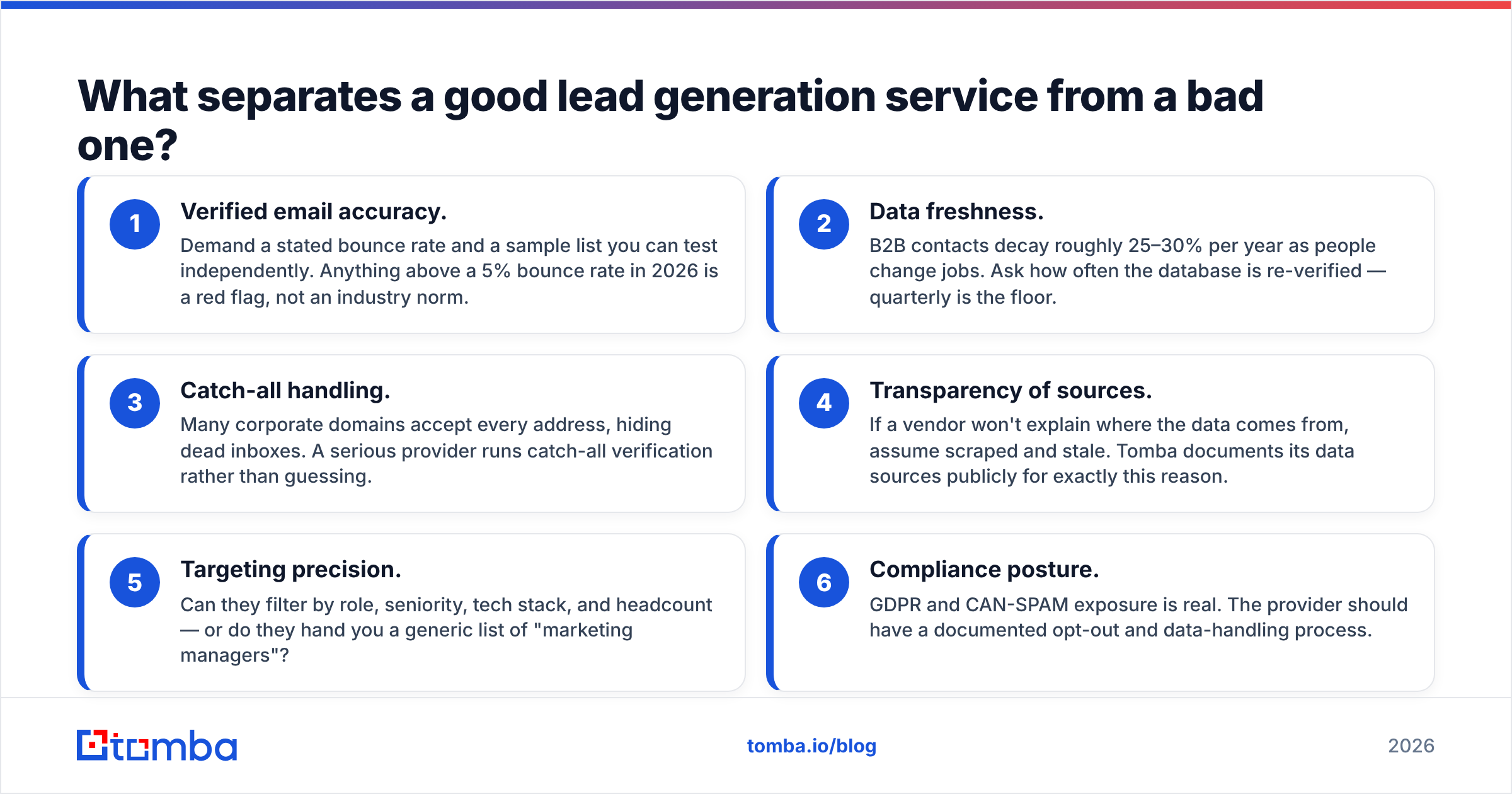
Expect $2,000–$15,000 per month for outsourced services, versus under $300 per month for a DIY data stack that produces comparable contact volume. The gap is labor and margin, not magic. Here's how the three models compare across the attributes that actually affect ROI.
| Attribute | Full-service agency | Managed appointment-setting | DIY data stack |
|---|---|---|---|
| Typical monthly cost | $3,000–$15,000 | $2,000–$8,000 | $49–$249 |
| Setup time | 3–6 weeks | 2–4 weeks | 1–3 days |
| Data ownership | Agency-controlled | Shared | You own it |
| Lead volume control | Capped by retainer | Capped by SDR hours | Scales with credits |
| Copy/strategy control | Low | Medium | Full |
| Best for | Teams with budget, no GTM staff | Teams with a proven message | Teams that can operate tools |
| Lock-in risk | High (3–6 mo contracts) | Medium | None (monthly) |
The math is unforgiving. A mid-tier agency at $6,000/month costs $72,000 a year. The same year of a Growth plan email-finding subscription plus an outreach tool lands closer to $3,000–$4,000 total. The agency is buying you time and expertise; just be honest about whether you're paying $68,000 for strategy or for tasks an SDR with the right tools could do in a few hours a week.
That doesn't make agencies a bad deal. If you're a founder selling a $50,000 ACV product and one extra meeting a month pays the retainer ten times over, outsourcing execution is rational. The trap is paying agency prices for commodity list-building you could automate.
What separates a good lead generation service from a bad one?#
Data quality, not headcount or slick decks. Every downstream metric — deliverability, reply rate, meetings booked — sits on top of accurate contact data. A beautiful sequence sent to stale emails bounces, tanks your sender reputation, and gets your domain throttled. No amount of copywriting recovers from that.
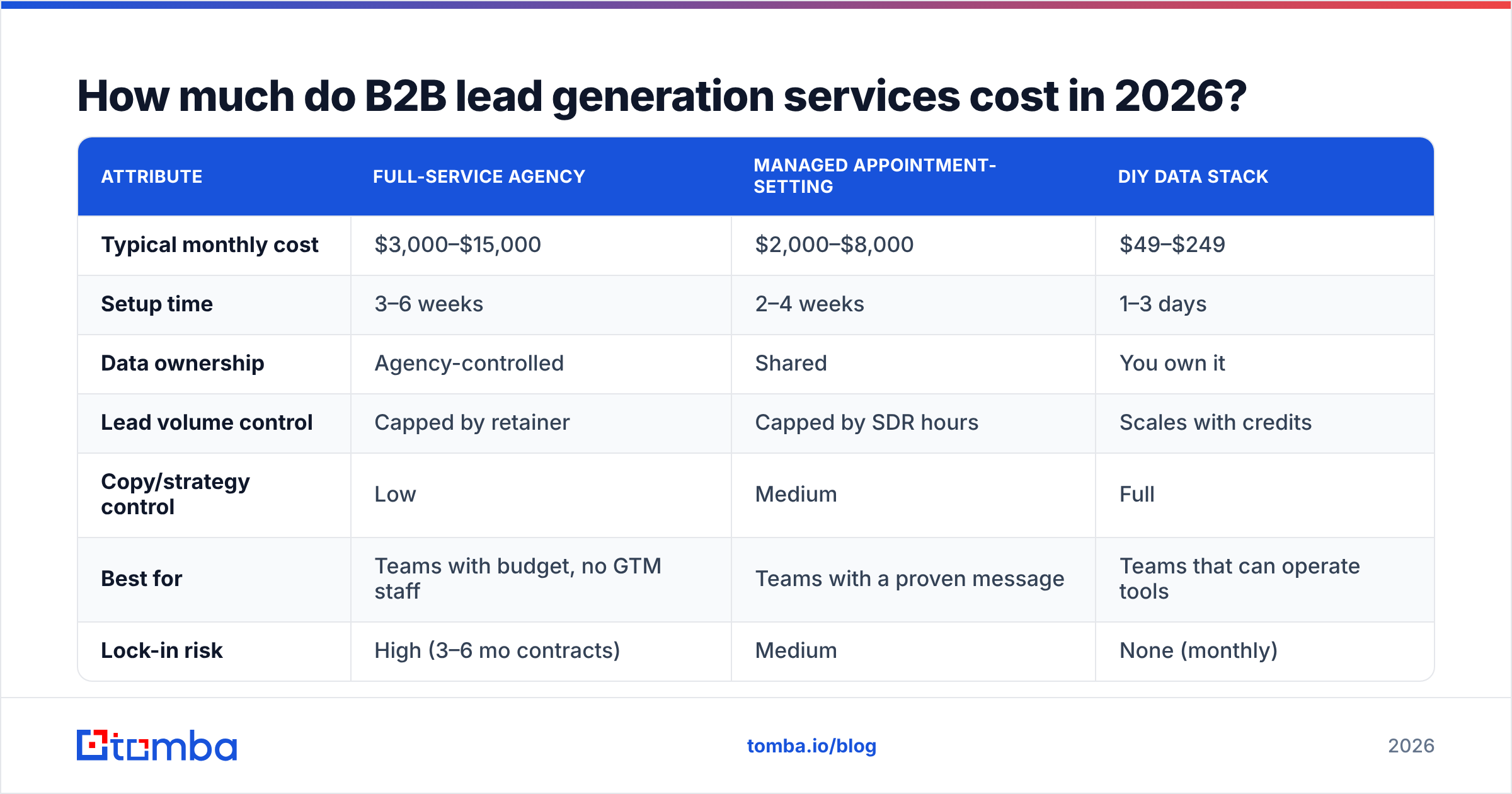
Use these six checks to grade any provider before you sign:
- Verified email accuracy. Demand a stated bounce rate and a sample list you can test independently. Anything above a 5% bounce rate in 2026 is a red flag, not an industry norm.
- Data freshness. B2B contacts decay roughly 25–30% per year as people change jobs. Ask how often the database is re-verified — quarterly is the floor.
- Catch-all handling. Many corporate domains accept every address, hiding dead inboxes. A serious provider runs catch-all verification rather than guessing.
- Transparency of sources. If a vendor won't explain where the data comes from, assume scraped and stale. Tomba documents its data sources publicly for exactly this reason.
- Targeting precision. Can they filter by role, seniority, tech stack, and headcount — or do they hand you a generic list of "marketing managers"?
- Compliance posture. GDPR and CAN-SPAM exposure is real. The provider should have a documented opt-out and data-handling process.
Run those checks and most of the market eliminates itself. According to independent reviews aggregated on G2, the providers that retain customers longest are the ones that lead with verification, not volume.
Should you outsource lead generation or build it in-house?#
Outsource execution you can't staff; own the data layer either way. This is the decision that saves teams the most money, so spend real time on it. The right answer depends on three variables: deal size, internal bandwidth, and how repeatable your motion is.
- High deal size, low bandwidth: Outsource. When one meeting can return five figures, an agency retainer is cheap insurance against an empty calendar.
- Repeatable motion, some bandwidth: Hybrid. Run your own email finder and verifier, then hire a managed SDR team to execute volume.
- Low deal size, technical team: DIY. Margins on small contracts evaporate under agency fees; automation is the only model that pencils out.
The hybrid path is where most growing companies land, and for good reason. You keep ownership of your contact data — the asset that compounds — while renting the labor that doesn't. When you control the data, switching outreach vendors or bringing work in-house costs you nothing. When the agency controls it, leaving means starting over.

There's a quieter benefit too: feedback loops. When your own team runs campaigns against your own data, every bounce and every reply teaches you something about your ICP. Hand the whole process to an agency and that learning lives in their account manager's head, not yours.
What does a DIY B2B lead generation stack look like?#
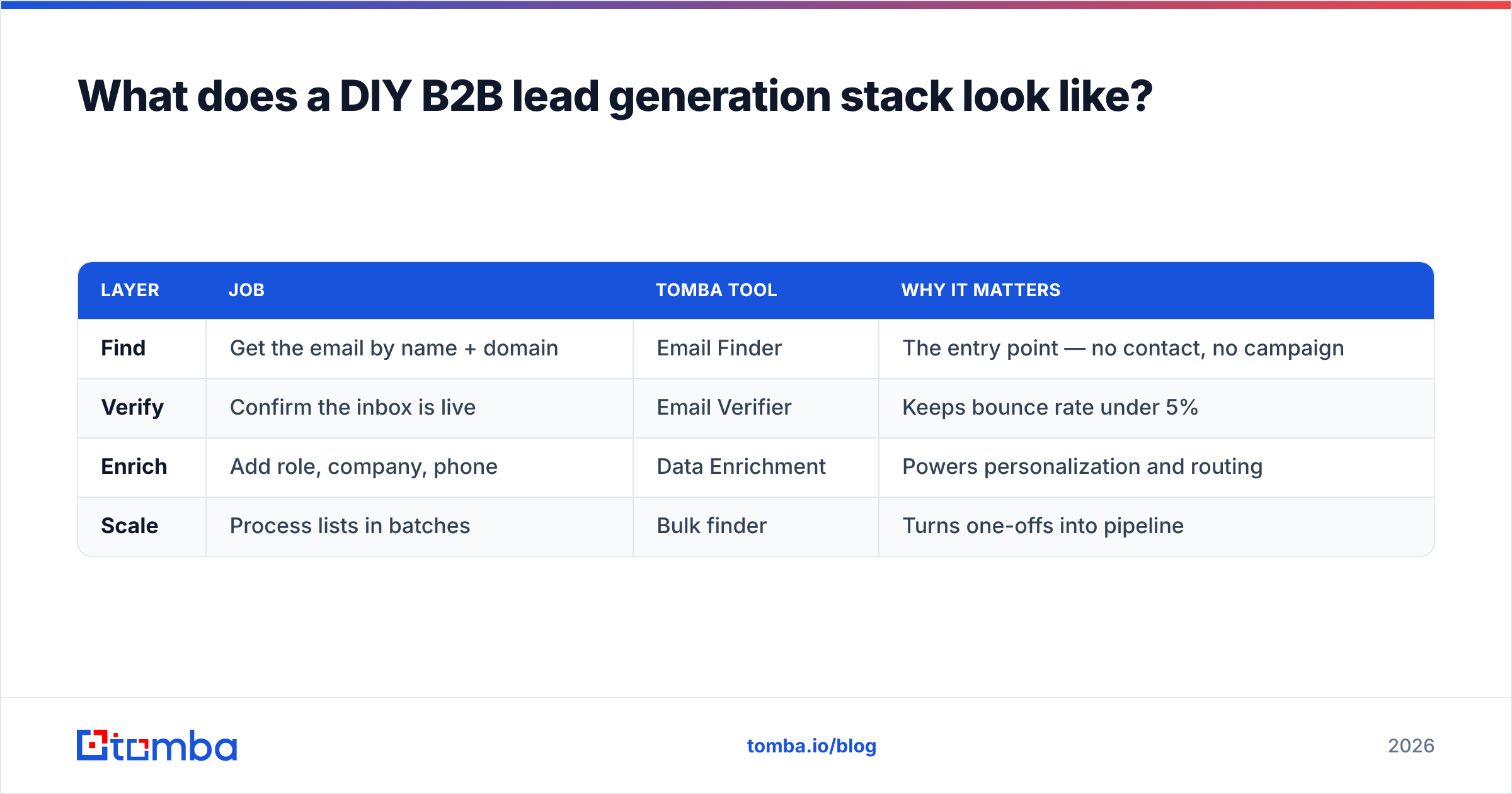
Four layers: find, verify, enrich, and send. You can assemble a credible in-house engine for a fraction of an agency retainer, and you'll own every record it produces. Here's the structure.
| Layer | Job | Tomba tool | Why it matters |
|---|---|---|---|
| Find | Get the email by name + domain | Email Finder | The entry point — no contact, no campaign |
| Verify | Confirm the inbox is live | Email Verifier | Keeps bounce rate under 5% |
| Enrich | Add role, company, phone | Data Enrichment | Powers personalization and routing |
| Scale | Process lists in batches | Bulk finder | Turns one-offs into pipeline |
Start with domain search to pull every public email pattern at a target company, then run names through the finder, pass results to the verifier, and enrich the survivors. For teams living in spreadsheets, the Google Sheets add-on and Tomba API let you wire this into existing workflows without manual copy-paste.
The discipline that makes DIY work is the verify step. Skipping it is the single most common reason in-house programs fail — reps build a big list, blast it, and torch their domain in a week. Verification is not optional housekeeping; it's the difference between a deliverable list and an expensive mistake. Pair it with a free email warmup calculator to ramp sending volume safely on new domains.
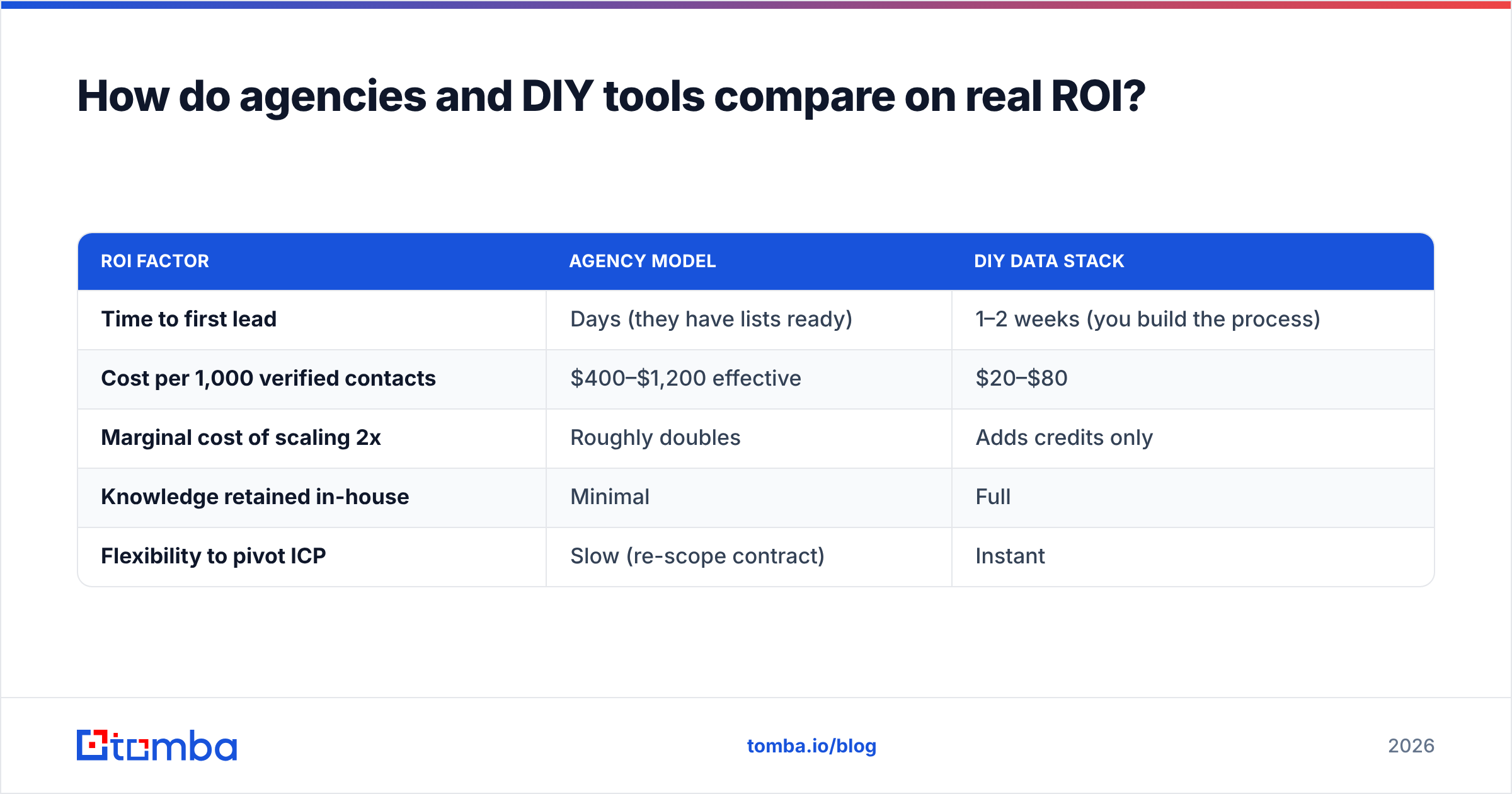
How do agencies and DIY tools compare on real ROI?#
Agencies win on speed-to-first-meeting; DIY wins on cost-per-lead at scale. The honest comparison isn't "which is better" — it's "which is better for your stage." Below is the trade-off most buyers miss when they only look at the monthly invoice.
| ROI factor | Agency model | DIY data stack |
|---|---|---|
| Time to first lead | Days (they have lists ready) | 1–2 weeks (you build the process) |
| Cost per 1,000 verified contacts | $400–$1,200 effective | $20–$80 |
| Marginal cost of scaling 2x | Roughly doubles | Adds credits only |
| Knowledge retained in-house | Minimal | Full |
| Flexibility to pivot ICP | Slow (re-scope contract) | Instant |
The pattern is clear: agencies front-load value and DIY back-loads it. In month one, the agency looks like a genius because meetings appear while your in-house process is still being built. By month six, the DIY stack has paid for itself many times over and left you with an owned asset and a trained team. Vendors like HubSpot have built entire platforms on this realization — that the durable advantage is owning your funnel, not renting it.
If you want a neutral third-party view of the category before committing, the buyer reviews on Capterra are a useful sanity check against any single vendor's pitch.
What questions should you ask before signing a contract?#
Treat the sales call like a data audit, not a demo. The providers worth your money will answer these without flinching. The ones to avoid will deflect.
- "What's your verified bounce rate, and can I test a 100-contact sample myself?"
- "How recently was this data re-verified, and how do you handle catch-all domains?"
- "Do I own the contacts and campaign data if I leave?"
- "Can you filter by [your exact ICP criteria], or only broad categories?"
- "What's the minimum contract length and the real cancellation terms?"
- "Who writes and approves the copy — and do I see it before it sends?"
If a provider can't give you a sample list to verify independently, walk away. You can validate any list in minutes with a free email checker or run the whole file through bulk verification. A vendor confident in their data has no reason to refuse — and one that refuses is telling you exactly what you need to know.
Which model is right for your team?#
Match the model to your constraint, not the hype. Three quick profiles:
- Pre-revenue / first 10 customers: Go DIY. You need to learn your ICP firsthand, and you can't afford retainers. Start on a free tier, find and verify your first few hundred contacts, and talk to every reply.
- Scaling SMB ($1M–$20M ARR): Go hybrid. Own the data with a finder-plus-verifier stack and add a managed SDR team only when volume outpaces your reps.
- Enterprise or zero GTM staff: A full-service agency can be worth it — but insist on data ownership and a verification SLA in the contract.
Across all three, the constant is the same: the data layer is yours to control. Whether you write the emails or someone else does, the value compounds in the contact database you build and keep.
The bottom line#
B2B lead generation services aren't a single product — they're a spectrum from fully outsourced to fully owned, and the right point on that spectrum depends on your deal size, your bandwidth, and how much you value owning your pipeline. The one mistake every team should avoid is paying premium prices for commodity data, or letting an agency hold the asset that should be yours.
Whichever model you choose, the foundation is accurate, verified contact data. Start there. The Tomba Email Finder lets you find professional email addresses by name, domain, or company and verify them before they ever hit a sequence — so your reps reach real inboxes, your sender reputation stays clean, and your cost-per-lead stays where it belongs. Spin up a free account, test it against any agency's sample list, and let the bounce rate make the decision for you.
// get started
Find, verify and enrich your first contacts today
Start on the free plan with 25 searches a month, then scale when your team is ready.
Free plan · No credit card required · GDPR & CCPA
// about the author