How to Book Meetings With Cold Email in 2026: A Playbook
Cold email still books meetings in 2026 — if you target the right people, write for replies, and protect deliverability. Here's the full playbook.
Cold email is not dead. Bad cold email is dead. In 2026 a tightly targeted, well-researched, deliverability-safe campaign still books meetings at a lower cost than almost any other outbound channel — you just can't fake it anymore with a 5,000-contact blast and a "Quick question?" subject line.
This playbook breaks down exactly how to book meetings with cold email: who to target, how to source verified contacts, what to write, how to follow up, and which numbers tell you whether it's working.
TL;DR#
- Meetings come from relevance, not volume. A 200-person list of perfectly matched prospects beats a 5,000-person scrape every time.
- Deliverability is the silent killer. If you land in spam, copy and targeting don't matter. Warm up, authenticate, and verify every address.
- One clear ask per email. You're selling the meeting, not the product. Make saying "yes" a 10-second decision.
- Follow-ups book more meetings than first sends. Most replies arrive on email two through four.
- Track reply rate and meeting rate, not open rate. Opens are noise in 2026; replies and booked calls are signal.
Does cold email still book meetings in 2026?#
Yes — but the bar is higher. Inboxes filter harder, buyers ignore anything generic, and Google and Microsoft tightened bulk-sender rules. The teams still winning treat cold email as precision outreach, not spray-and-pray.
The math is simple. Suppose you send 1,000 well-targeted, verified emails:
- 1,000 delivered → ~40% reply-worthy targeting and copy
- 8% reply rate = 80 replies
- 30% of replies positive = 24 conversations
- ~50% of positive conversations booked = 12 meetings
Now compare that to a 5,000-contact unverified blast that lands half in spam, burns your domain reputation, and books three meetings before your deliverability collapses. Fewer, better emails win on every axis — cost, reputation, and pipeline.
What does it take to book meetings with cold email?#
Four things have to line up. Miss one and the whole campaign underperforms — you can have perfect copy and still fail if half your list bounces.
- Right target. A tight Ideal Customer Profile and the specific person who feels the pain you solve.
- Reachable inbox. Verified, deliverable addresses plus a warmed-up, authenticated sending domain.
- Reply-worthy message. Relevant, short, one ask, written like a human.
- Persistent cadence. A multi-step follow-up sequence that adds value instead of nagging.
The rest of this guide is each layer in order, because they build on each other. There's no point polishing subject lines if your list is full of catch-all guesses.
How do you build a list that actually converts?#
Start with the person, not the company. Define your ICP by firmographics (industry, size, region), then identify the specific role that owns the problem. A "VP of Sales" cares about pipeline; a "RevOps lead" cares about data hygiene. Same company, different email entirely.
Once you know who, you need their verified work email. This is where most campaigns quietly break: scraped lists are full of outdated, role-based, and catch-all addresses that bounce and torch your sender reputation. Use a dedicated email finder to pull addresses by name and company domain, then run every one through an email verifier before it touches your sequence.
For account-based plays where you want every relevant contact at a target company, a domain search returns the email pattern and known addresses for a whole organization in one pass. Build the list in a spreadsheet, dedupe it, and only then move to copy.
A quick reputation rule of thumb: keep your bounce rate under 2%. Above that, mailbox providers start throttling you. Verification is not optional housekeeping — it's the difference between landing in the inbox and landing on a blocklist. See Google's own bulk sender guidelines for the thresholds that now apply.
How do you write a cold email that gets replies?#
Sell the meeting, not the product. Your only job is to earn a 15-minute conversation. Every sentence should move the reader toward "sure, let's talk."
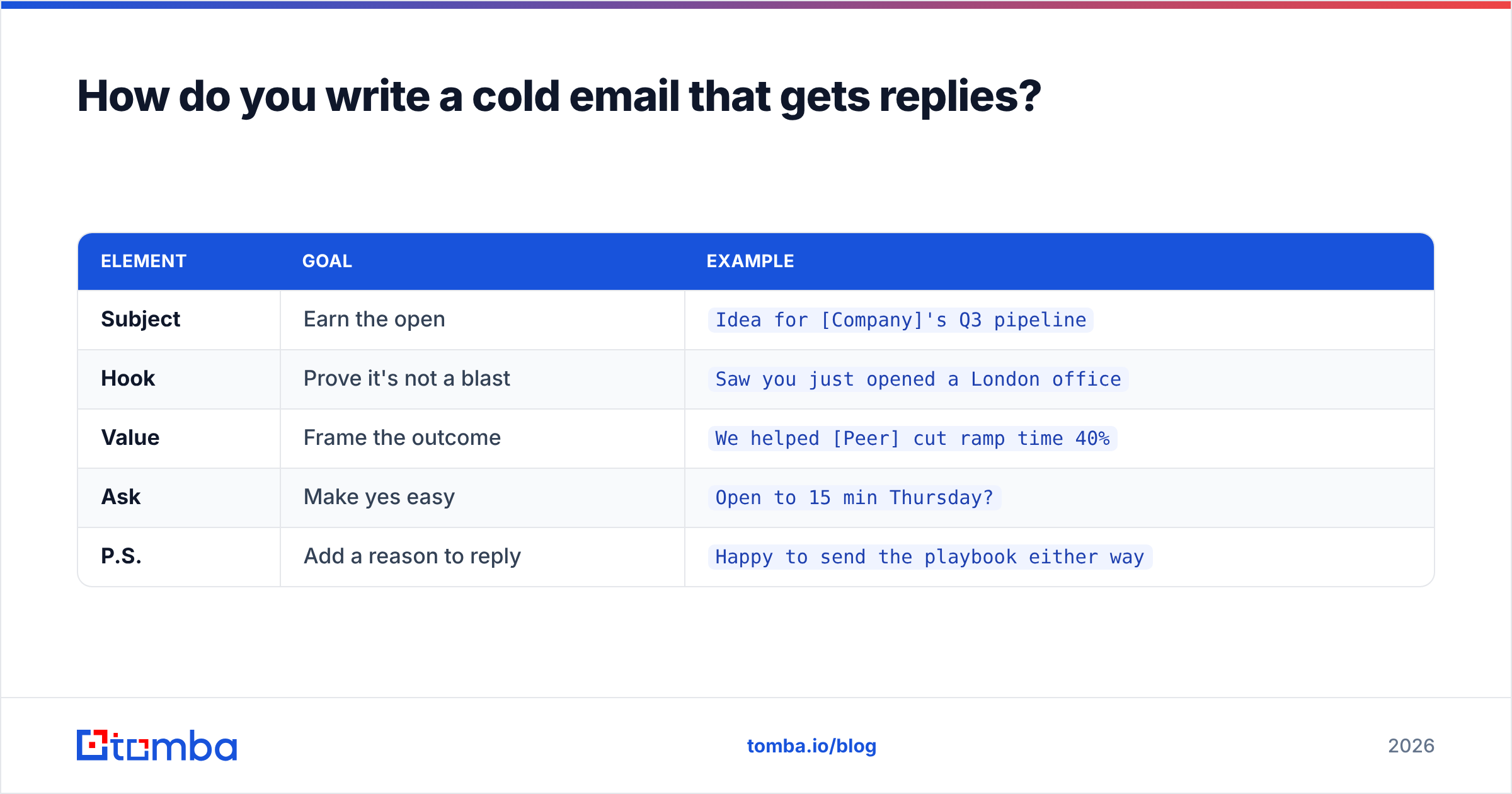
A reply-worthy cold email has five parts:
- Subject line: 2–5 words, specific, no clickbait. "Question about [Company]'s onboarding" beats "Boost revenue 300%." Test variants with a subject line generator if you're stuck.
- Opening line: A genuine, researched observation about them — a recent hire, launch, or post. Never "I hope this email finds you well."
- The pitch: One or two sentences on the problem you solve and the outcome, framed for their role.
- Social proof: One concrete result from a similar company. Numbers beat adjectives.
- The ask: A single, low-friction call to action. "Worth a quick 15 minutes next Tuesday?" converts better than "Let me know your availability."
Keep the whole thing under 120 words. Buyers read on phones; a wall of text gets archived. If you want a starting framework, browse proven cold email templates and rewrite them in your own voice — never send a template verbatim.
A simple structure that books calls#
| Element | Goal | Example |
|---|---|---|
| Subject | Earn the open | Idea for [Company]'s Q3 pipeline |
| Hook | Prove it's not a blast | Saw you just opened a London office |
| Value | Frame the outcome | We helped [Peer] cut ramp time 40% |
| Ask | Make yes easy | Open to 15 min Thursday? |
| P.S. | Add a reason to reply | Happy to send the playbook either way |
How many follow-ups should you send?#
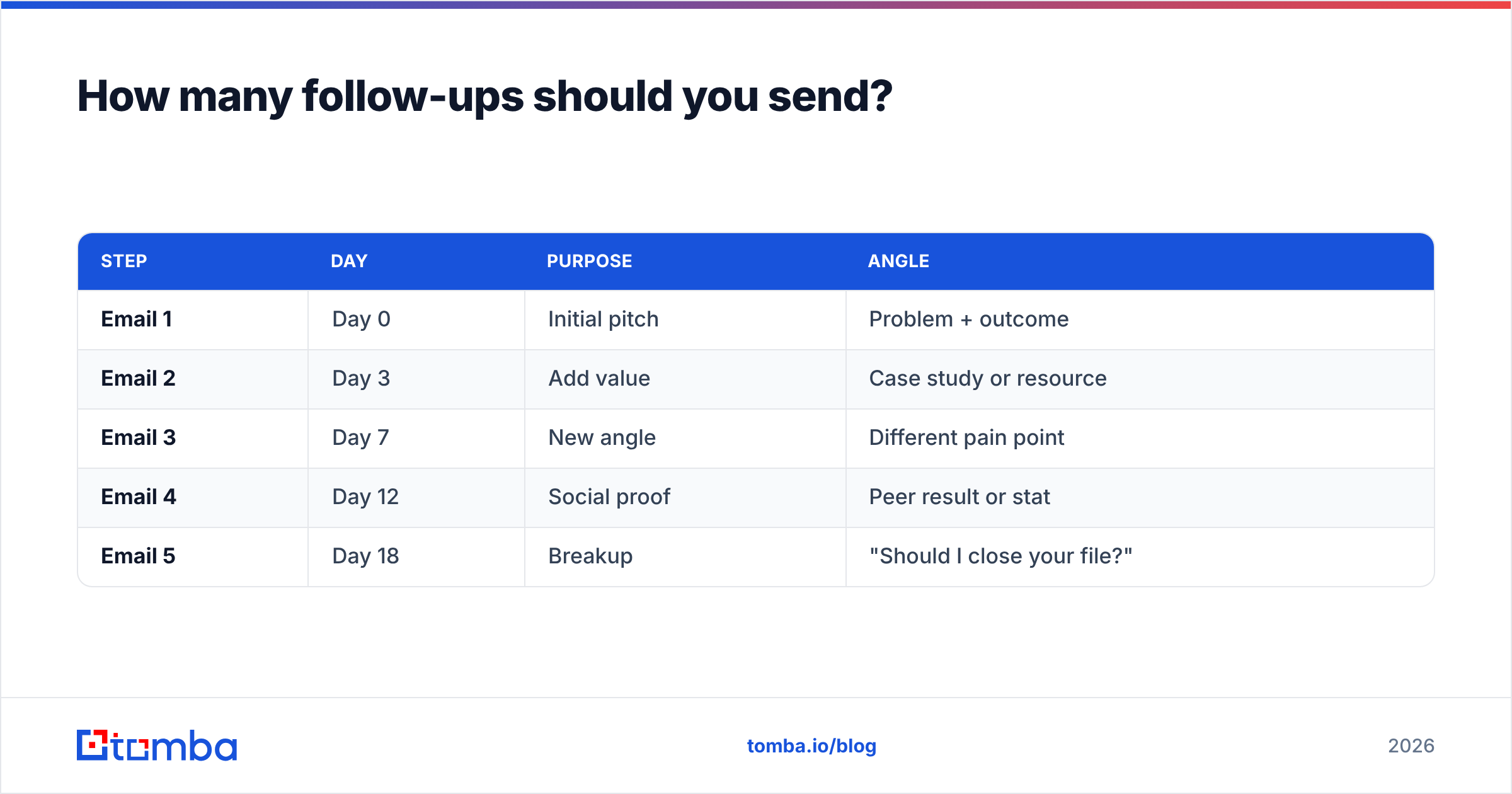
Most meetings come from follow-ups, not the first email. A single send captures the small slice of people who were ready at that exact moment. The rest need reminding — politely, and with new value each time.
A proven cadence looks like this:
| Step | Day | Purpose | Angle |
|---|---|---|---|
| Email 1 | Day 0 | Initial pitch | Problem + outcome |
| Email 2 | Day 3 | Add value | Case study or resource |
| Email 3 | Day 7 | New angle | Different pain point |
| Email 4 | Day 12 | Social proof | Peer result or stat |
| Email 5 | Day 18 | Breakup | "Should I close your file?" |
The breakup email is quietly one of the highest-converting messages in the sequence — loss aversion gets replies that polite nudges don't. Stop the cadence the instant someone responds, and never send more than one email per thread per few days. Persistence books meetings; pestering books spam complaints.
Cold email tools compared: what do you actually need?#
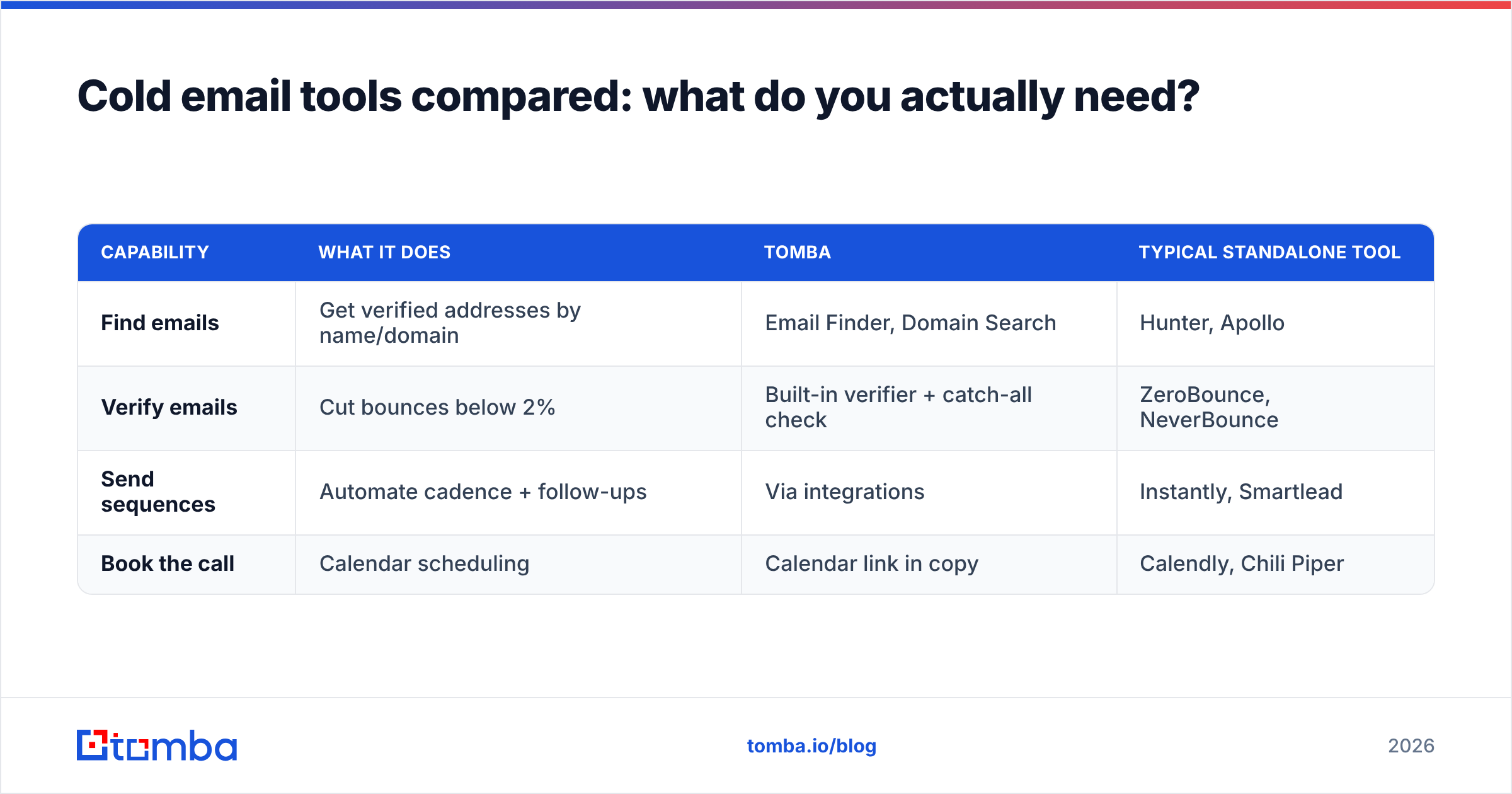
You don't need a 12-tool stack. You need four capabilities: find contacts, verify them, send sequences, and book the call. Here's how the core categories stack up.
| Capability | What it does | Tomba | Typical standalone tool |
|---|---|---|---|
| Find emails | Get verified addresses by name/domain | Email Finder, Domain Search | Hunter, Apollo |
| Verify emails | Cut bounces below 2% | Built-in verifier + catch-all check | ZeroBounce, NeverBounce |
| Send sequences | Automate cadence + follow-ups | Via integrations | Instantly, Smartlead |
| Book the call | Calendar scheduling | Calendar link in copy | Calendly, Chili Piper |
The data layer is where campaigns live or die, so it's worth consolidating. Tomba covers finding and verifying in one platform — including a catch-all verifier for those tricky domains that accept everything — and connects to your sending tool through native integrations. Plans start free (25 searches/month) and scale up; see full Tomba pricing for the Starter ($49/mo) and Growth ($99/mo) tiers.
For a broader market view, check independent review sites like G2 before you commit budget — but weight verified-data accuracy heavily, because it's the input every other tool depends on.
How do you keep cold email out of spam?#
Deliverability is the layer nobody sees until it breaks. You can do everything else perfectly and still fail if mailbox providers don't trust your domain. Lock these down before you scale sends:
- Authenticate your domain. Set up SPF, DKIM, and DMARC. This is now a hard requirement for bulk senders, not a nice-to-have. Use an SPF checker to confirm your record is valid.
- Warm up the inbox. New domains and addresses need 2–4 weeks of gradual volume ramp before real campaigns. Cold-starting at 500/day gets you flagged.
- Use a separate sending domain. Protect your primary domain by sending cold outreach from a lookalike (e.g.,
tryyourcompany.com). - Verify every address. Bounces are the fastest way to wreck sender reputation. This loops back to verification — it's both a list-quality and a deliverability control.
- Watch your complaint rate. Keep spam complaints under 0.3%. One bad segment can poison the domain.
If you treat email deliverability as an ongoing discipline rather than a one-time setup, your meeting rate compounds instead of decaying.
Which metrics tell you it's working?#
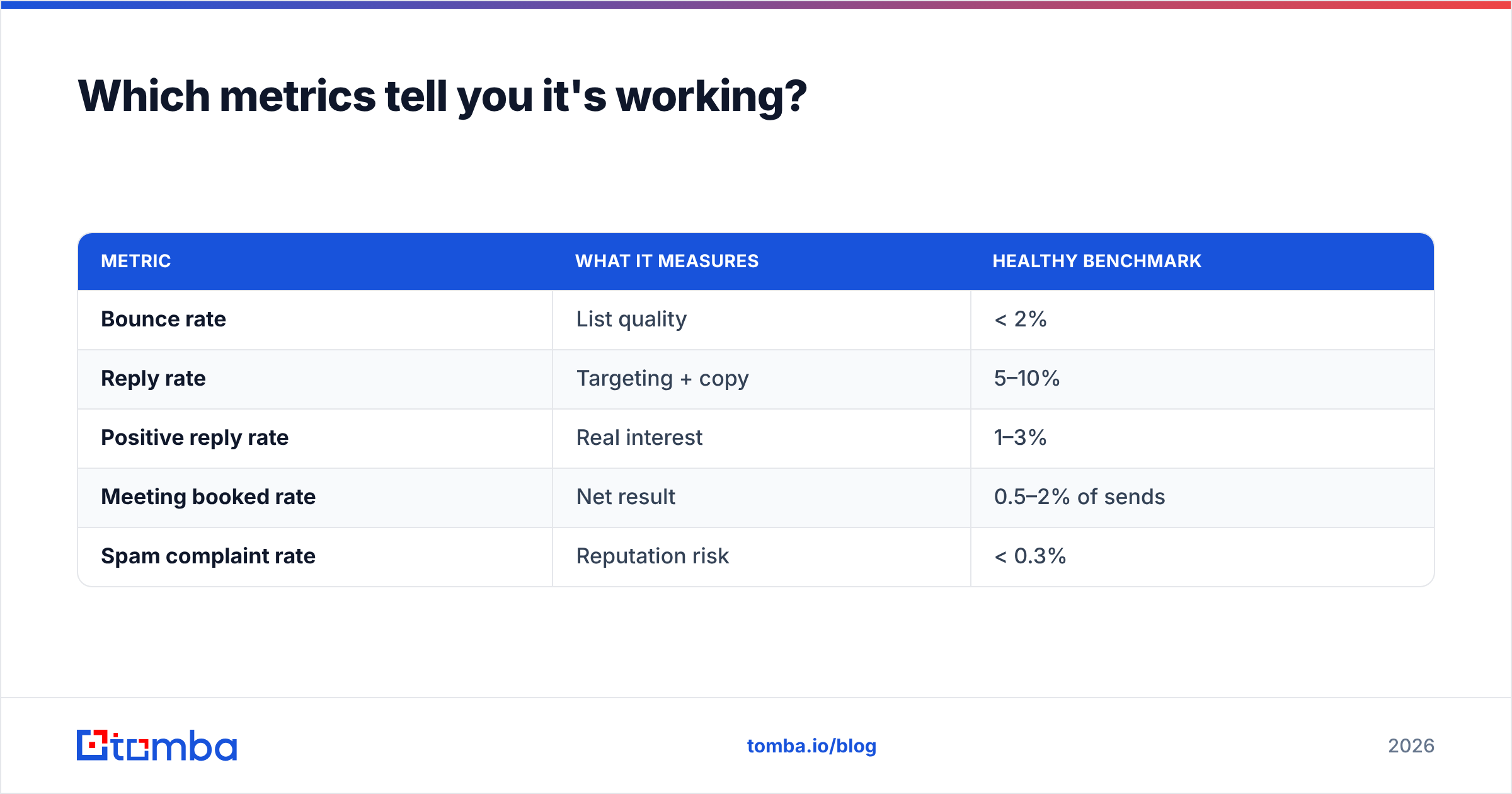
Stop staring at open rates. Apple Mail Privacy Protection and bot prefetching inflated opens into meaningless noise years ago. The metrics that actually predict booked meetings are further down the funnel.
| Metric | What it measures | Healthy benchmark |
|---|---|---|
| Bounce rate | List quality | < 2% |
| Reply rate | Targeting + copy | 5–10% |
| Positive reply rate | Real interest | 1–3% |
| Meeting booked rate | Net result | 0.5–2% of sends |
| Spam complaint rate | Reputation risk | < 0.3% |
Track these per segment and per sequence step. If reply rate is healthy but meetings aren't booking, your ask is weak. If bounce rate is high, your data is stale — go back and re-verify. Reading your response rate by step also tells you which follow-up is pulling its weight and which to cut.
What are the most common cold email mistakes?#
The failure patterns are predictable. Avoid these and you're ahead of most senders:
- Buying or scraping unverified lists. High bounces, instant reputation damage.
- Writing about yourself. Buyers care about their problem, not your feature list.
- Multiple asks. "Book a call, or download this, or reply, or visit our site" — pick one.
- Skipping follow-up. Quitting after one email leaves most of your meetings on the table.
- Ignoring deliverability. No authentication, no warmup, no verification = spam folder.
- Sending Monday 9am with everyone else. Test off-peak windows; mid-morning Tuesday–Thursday often wins.
Frequently asked questions#
How many cold emails should I send per day? Start at 20–50 per inbox per day during warmup, scaling to a few hundred across multiple authenticated inboxes once reputation is established. Volume should follow deliverability, never lead it.
What reply rate is good for cold email? A 5–10% reply rate signals solid targeting and copy. Below 3%, fix your list or your message before sending more.
Do I need a separate domain for cold outreach? Yes. Sending cold campaigns from a dedicated lookalike domain protects your primary domain's reputation if something goes wrong.
How long until cold email books meetings? Allow 2–4 weeks for domain warmup, then expect meetings within the first full cadence cycle (about 2–3 weeks of live sending).
Start with the data layer#
Every booked meeting traces back to one thing: reaching the right person in their inbox. Copy, cadence, and timing only matter once that's true. Get your list right and the rest of the playbook compounds.
The fastest way to build a clean, verified, meeting-ready list is to start at the source. Use the Tomba Email Finder to pull accurate professional emails by name or company, verify them in the same platform, and feed a deliverability-safe sequence that actually books calls. Spin up the free tier, build your first 25-prospect list today, and send something worth replying to.
// get started
Find, verify and enrich your first contacts today
Start on the free plan with 25 searches a month, then scale when your team is ready.
Free plan · No credit card required · GDPR & CCPA
// about the author