Cold Email Outreach in 2026: The Complete B2B Playbook
Cold email outreach still books meetings in 2026 — if you nail list quality, deliverability, and copy. Here's the full B2B playbook, with a framework, benchmarks, and a tool-stack comparison.
Cold email outreach is not dead in 2026 — but lazy cold email is. Inboxes are smarter, spam filters are AI-driven, and buyers ignore anything that smells templated. The reps still booking meetings have quietly changed how they build lists, warm domains, and write the first line. This playbook walks through the whole system, end to end.
TL;DR#
- Cold email outreach still works, but the bar moved: clean data + warm domains + relevant copy are now table stakes, not differentiators.
- List quality beats volume. Sending 50 verified, well-researched emails outperforms blasting 5,000 scraped addresses — and protects your sender reputation.
- Deliverability is half the game. SPF, DKIM, DMARC, domain warmup, and bounce control decide whether your message is even seen.
- Copy that earns replies is short, specific, and about the prospect — not your feature list.
- The right tool stack (finder + verifier + sending platform + CRM) compounds results; the wrong one quietly burns your domain.
What is cold email outreach in 2026?#
Cold email outreach is sending a relevant, personalized message to a prospect who hasn't opted in — with the goal of starting a business conversation, not making an instant sale. Think of it less like a billboard and more like introducing yourself at a conference: you lead with why they should care, not with your résumé.
What changed in 2026 is enforcement. Google and Yahoo's bulk-sender requirements (authentication, low spam complaint rates, one-click unsubscribe) are now strictly applied, and inbox providers score every domain in real time. The result: spray-and-pray campaigns get filtered before a human ever sees them, while disciplined senders see higher reply rates than five years ago because the noise around them is being suppressed.
Three pillars hold up every successful program:
- Data — who you contact and how accurate the contact details are.
- Deliverability — whether the message lands in the primary inbox.
- Copy — whether the human replies.
Skip any one and the other two stop mattering.
How do you build a list that actually converts?#
Start narrow. The single biggest predictor of campaign performance is how tightly your list matches your ideal customer profile (ICP). A list of 200 contacts who genuinely have the problem you solve will beat 20,000 random titles every time.
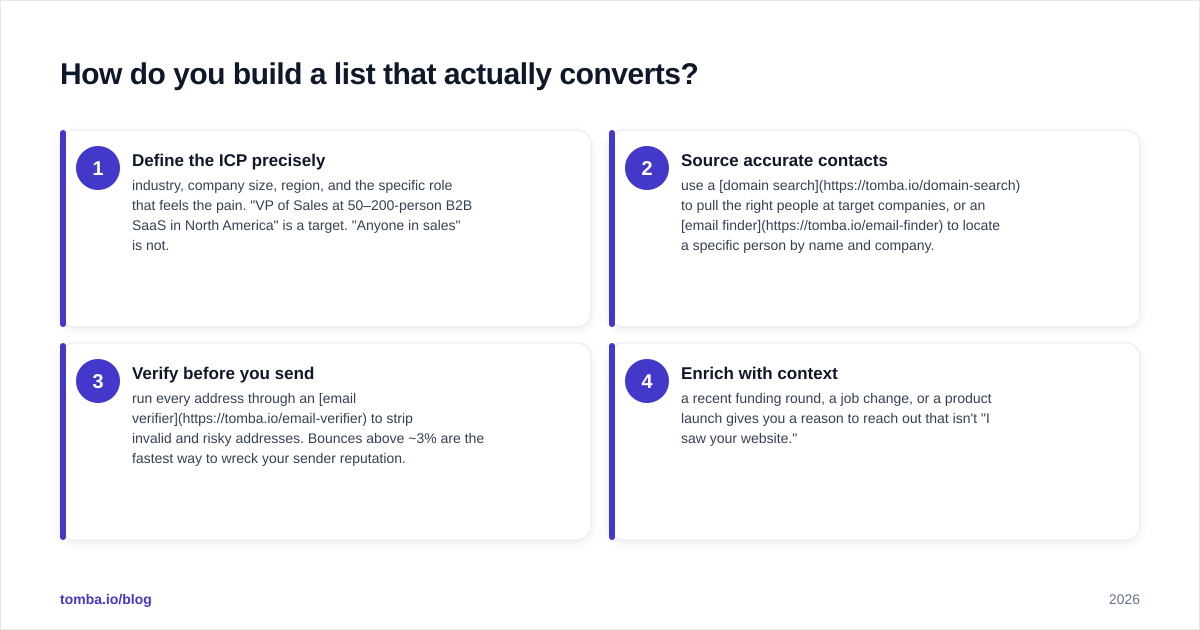
Here's the build sequence that works:
- Define the ICP precisely — industry, company size, region, and the specific role that feels the pain. "VP of Sales at 50–200-person B2B SaaS in North America" is a target. "Anyone in sales" is not.
- Source accurate contacts — use a domain search to pull the right people at target companies, or an email finder to locate a specific person by name and company.
- Verify before you send — run every address through an email verifier to strip invalid and risky addresses. Bounces above ~3% are the fastest way to wreck your sender reputation.
- Enrich with context — a recent funding round, a job change, or a product launch gives you a reason to reach out that isn't "I saw your website."
Resist the temptation to buy a static list. Purchased lists are stale, shared across hundreds of senders, and packed with spam traps.
Why does deliverability decide everything?#
Because the best email in the world earns zero replies from the spam folder. Email deliverability is the discipline of getting your message into the primary inbox, and in 2026 it's mostly mechanical — which is good news, because mechanical problems have mechanical fixes.
Cover these fundamentals before you send a single campaign:
- Authenticate the domain. Set up SPF, DKIM, and DMARC records. Missing authentication is an instant filter in most inbox providers now.
- Use a separate sending domain. Send cold outreach from a domain variant (e.g.,
try-yourbrand.com), never your primary corporate domain — so a reputation hit doesn't take down your real email. - Warm the domain and mailboxes. New domains need weeks of gradual volume ramp. Use a warmup calculator to plan the ramp instead of guessing.
- Keep volume per mailbox low. 20–40 sends per mailbox per day is the safe band; scale by adding mailboxes, not by hammering one.
- Watch your signals. Bounce rate, spam complaints, and reply rate are the metrics inbox providers actually score. Keep bounces under 3% and complaints under 0.1%.
For a deeper reference on the technical side, Google's official bulk sender guidelines lay out exactly what the major providers expect.
What makes cold email copy that gets replies?#
Short, specific, and about them. The reader is scanning on a phone, deciding in under three seconds whether to reply, ignore, or report. Your job is to make replying the easiest option.
A reliable structure:
- Subject line: 2–5 words, lowercase, no hype. "quick question, {firstName}" or "{company} + onboarding" beats "Revolutionize Your Sales Today!!!" Test variants with a subject line generator if you're stuck.
- First line: about the prospect, not you. Reference something specific — their role, a company event, a recent post.
- The ask: one clear, low-friction call to action. "Worth a 15-minute call next week?" converts better than "Let me know if you'd like to learn more about our platform."
- Length: 50–125 words. If they have to scroll, you've lost.
- Signature: plain, human, with an easy unsubscribe.
Personalization at scale is where most teams break. The fix isn't writing 500 unique emails — it's building one strong template with two or three personalized variables (role, company trigger, pain point) that you can populate from your enriched data. HubSpot's research on cold email response rates consistently shows relevance, not length, drives replies.
Then follow up. Most replies come from emails two through four, not the first touch. A three- to four-step sequence spaced three to five business days apart, each adding a new angle (not just "bumping this"), roughly doubles total reply rate versus a single send.
How does cold email outreach compare to other channels?#
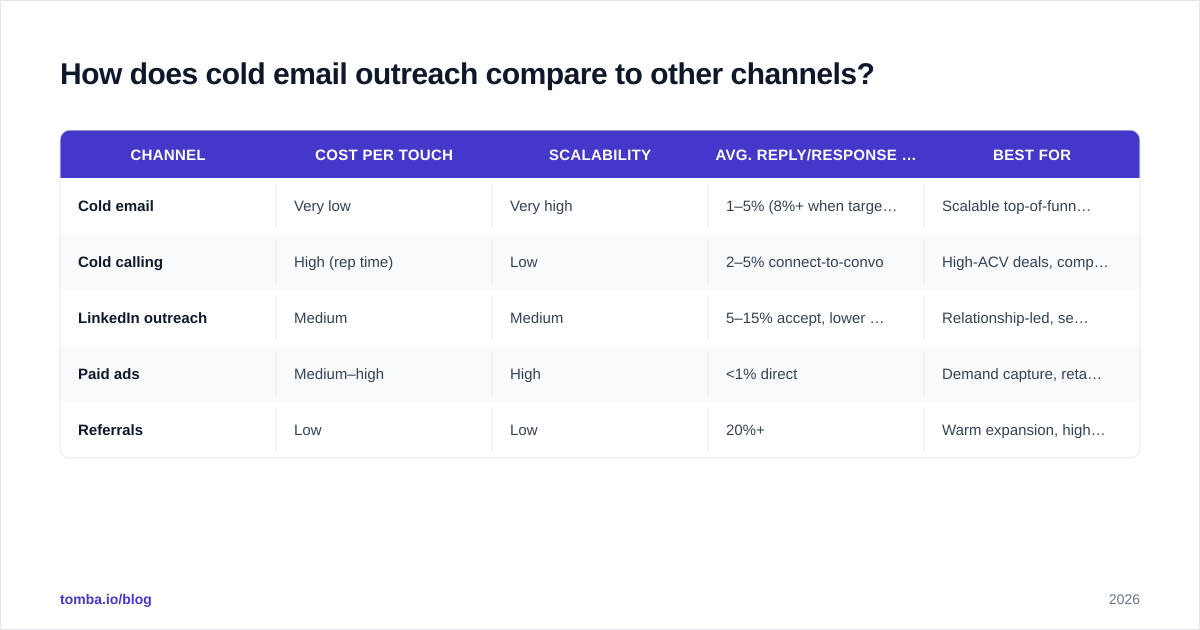
Cold email isn't the only outbound play, and the strongest teams blend channels. Here's how the main options stack up for B2B in 2026:
| Channel | Cost per touch | Scalability | Avg. reply/response rate | Best for |
|---|---|---|---|---|
| Cold email | Very low | Very high | 1–5% (8%+ when targeted) | Scalable top-of-funnel, ABM at volume |
| Cold calling | High (rep time) | Low | 2–5% connect-to-convo | High-ACV deals, complex sales |
| LinkedIn outreach | Medium | Medium | 5–15% accept, lower reply | Relationship-led, senior buyers |
| Paid ads | Medium–high | High | <1% direct | Demand capture, retargeting |
| Referrals | Low | Low | 20%+ | Warm expansion, highest trust |
The takeaway: cold email wins on cost and scale, which is why it remains the backbone of most outbound motions. But pair it with a phone touch for high-value accounts — a phone finder lets you add a call step to your best prospects without leaving your workflow.
Which tools do you actually need?#
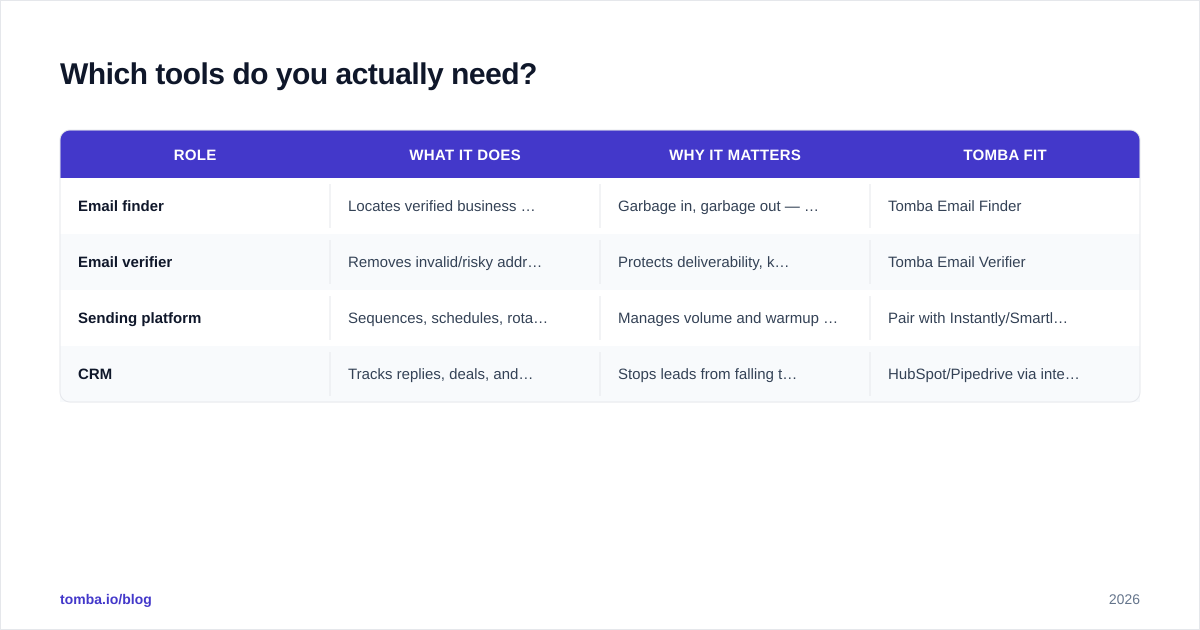
You need four roles filled. They can be four tools or one platform that covers several, but every role must be covered.
| Role | What it does | Why it matters | Tomba fit |
|---|---|---|---|
| Email finder | Locates verified business emails by name/domain | Garbage in, garbage out — accuracy drives everything | Tomba Email Finder |
| Email verifier | Removes invalid/risky addresses before send | Protects deliverability, keeps bounces low | Tomba Email Verifier |
| Sending platform | Sequences, schedules, rotates mailboxes | Manages volume and warmup safely | Pair with Instantly/Smartlead |
| CRM | Tracks replies, deals, and follow-up | Stops leads from falling through cracks | HubSpot/Pipedrive via integrations |
Two principles when assembling the stack:
- Don't let shiny tools distract you from fundamentals. A new AI personalization widget won't save a campaign built on an unverified list and a cold domain. Fix data and deliverability first.
- Favor tools that integrate. Disconnected tools mean copy-paste errors and leaked leads. Tomba connects to HubSpot, Pipedrive, and dozens of others so the finder-to-CRM handoff is automatic.
You can compare seat-based and credit-based options on the Tomba pricing page; the free tier (25 searches/month) is enough to validate the workflow before committing.
What metrics tell you it's working?#
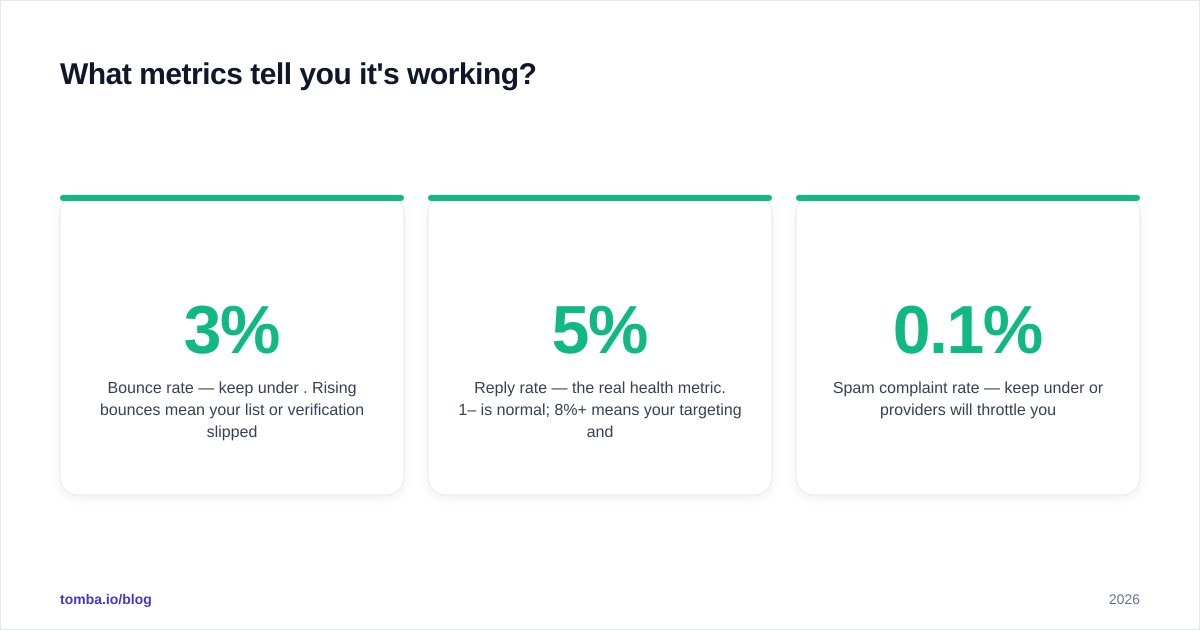
Track the funnel, not just the open rate (which is increasingly unreliable thanks to privacy proxies inflating opens). The numbers that matter:
- Bounce rate — keep under 3%. Rising bounces mean your list or verification slipped.
- Reply rate — the real health metric. 1–5% is normal; 8%+ means your targeting and copy are dialed in.
- Positive reply rate — replies that want to talk, not just "unsubscribe." This is your true signal.
- Meetings booked — the only number your pipeline cares about.
- Spam complaint rate — keep under 0.1% or providers will throttle you.
Review weekly. If reply rate drops, the problem is usually copy or targeting. If bounces spike, it's data. If everything lands in spam, it's deliverability. Diagnosing by metric saves hours of guessing.
Is cold email outreach worth it in 2026?#
Yes — for B2B, it remains one of the highest-ROI channels available, provided you treat it as a system rather than a numbers game. The teams that struggle are the ones still running 2019 playbooks: huge unverified lists, no domain warmup, generic templates. The teams that win send fewer, better emails to tightly-targeted prospects from properly authenticated domains.
The economics are simple. If verified data and disciplined sending lift your reply rate from 1% to 4%, you've quadrupled pipeline from the same effort — without spending a dollar more on ad inventory. That leverage is why cold email keeps earning its place in the outbound stack.
You can dig into how providers actually score senders on resources like G2's deliverability category and the broader concept of email deliverability on Wikipedia if you want the underlying mechanics.
Where should you start?#
Start with the part that gates everything else: your data. A campaign built on a clean, verified, well-targeted list forgives a lot of copy mistakes; a campaign built on a scraped list fails no matter how good the writing is.
Use the Tomba Email Finder to build accurate, ICP-matched lists by domain, name, or company, then verify every address before it enters a sequence. With the free tier you can test the full find-verify-enrich loop, prove the workflow against a small target account list, and scale up on the Starter plan ($49/mo) once the meetings start landing. Get the data right, protect your domain, write like a human — and cold email outreach will keep booking pipeline well past 2026.
// get started
Find, verify and enrich your first contacts today
Start on the free plan with 25 searches a month, then scale when your team is ready.
Free plan · No credit card required · GDPR & CCPA
// about the author