Abstract API Alternatives: 7 Better Picks for 2026
Abstract API is cheap and broad, but accuracy gaps and shallow B2B data push teams to switch. Here are seven Abstract API alternatives worth testing in 2026.

Abstract API Alternatives: 7 Better Picks for 2026
TL;DR
- Abstract API is a generalist API toolkit — cheap, broad, and easy to wire up, but its email verification and lead-data endpoints lag specialists on accuracy and B2B depth.
- Teams switch when bounce rates creep past 3%, when catch-all domains stop returning useful signal, or when they need email finding (not just validation) in the same call.
- The seven Abstract API alternatives below cover the real use cases: email verification, email finding, phone validation, IP/geolocation, and lead enrichment.
- For B2B email workflows, Tomba is the closest "do everything in one API" replacement; for pure validation at scale, ZeroBounce and NeverBounce remain the safer picks.
- Skip any vendor that won't show you a public accuracy benchmark or a real free tier.
What does Abstract API actually do?#
Abstract API is a suite of 13+ small REST APIs sold under one account: email validation, phone validation, IP geolocation, VAT lookup, exchange rates, holidays, company enrichment, and a few more. The pitch is "one vendor, one bill, one SDK" for engineers who don't want to integrate a different SaaS for each utility.
That works fine when you need a sprinkle of validation inside a signup form. It stops working when email is the core of your business — outbound, lead routing, deliverability, CRM hygiene — because Abstract's verification accuracy and B2B data are middle-of-the-pack and the lead-generation endpoint barely qualifies as B2B data.
The Abstract API alternatives in this guide are the ones teams actually migrate to when they hit those ceilings.
Why do teams look for Abstract API alternatives?#
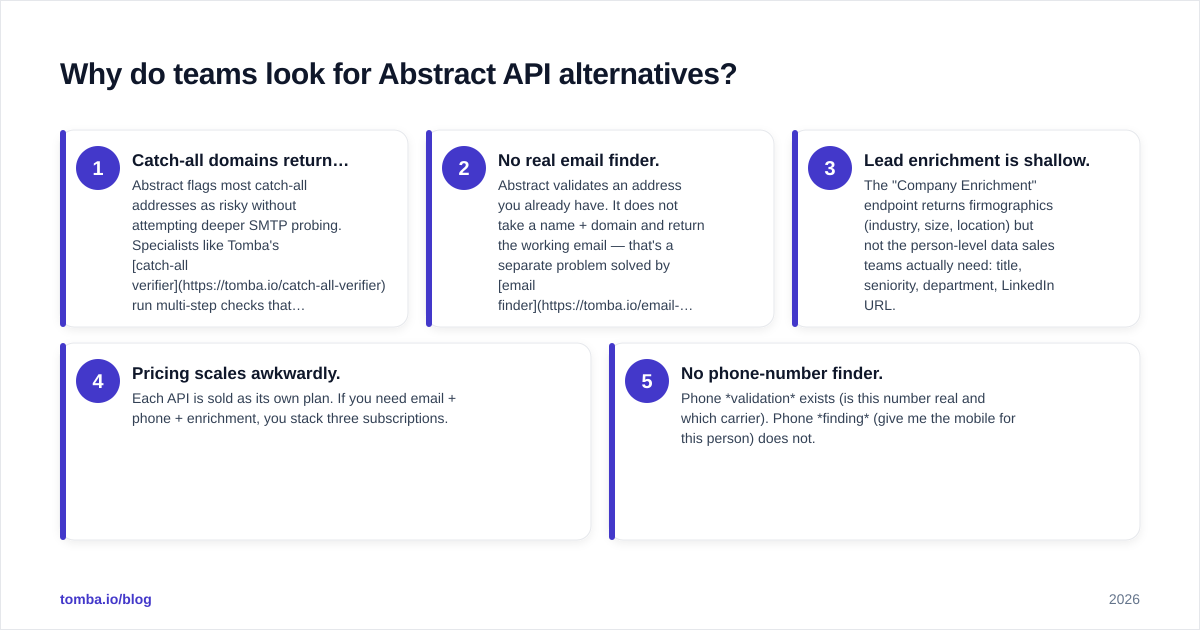
Five recurring complaints, ranked by how often they come up in migration calls:
- Catch-all domains return "unknown." Abstract flags most catch-all addresses as risky without attempting deeper SMTP probing. Specialists like Tomba's catch-all verifier run multi-step checks that recover a meaningful chunk of those addresses.
- No real email finder. Abstract validates an address you already have. It does not take a name + domain and return the working email — that's a separate problem solved by email finder tools.
- Lead enrichment is shallow. The "Company Enrichment" endpoint returns firmographics (industry, size, location) but not the person-level data sales teams actually need: title, seniority, department, LinkedIn URL.
- Pricing scales awkwardly. Each API is sold as its own plan. If you need email + phone + enrichment, you stack three subscriptions.
- No phone-number finder. Phone validation exists (is this number real and which carrier). Phone finding (give me the mobile for this person) does not.
Whether any of these matter depends on your use case. If you only need format-and-MX validation on a contact form, Abstract is fine. If email is a revenue channel, keep reading.

Which Abstract API alternatives matter in 2026?#
Seven tools cover most migrations away from Abstract. I've grouped them by primary job-to-be-done.
1. Tomba — best all-in-one B2B email API#
Tomba is the closest single-vendor replacement when your workflow needs both finding and verifying, plus enrichment, in the same API surface. The endpoints overlap with Abstract's email tools but add what Abstract lacks: an email finder, domain search, author finder, LinkedIn finder, phone finder, and full data enrichment.
- Best for: B2B sales, lead gen tools, CRM enrichment products
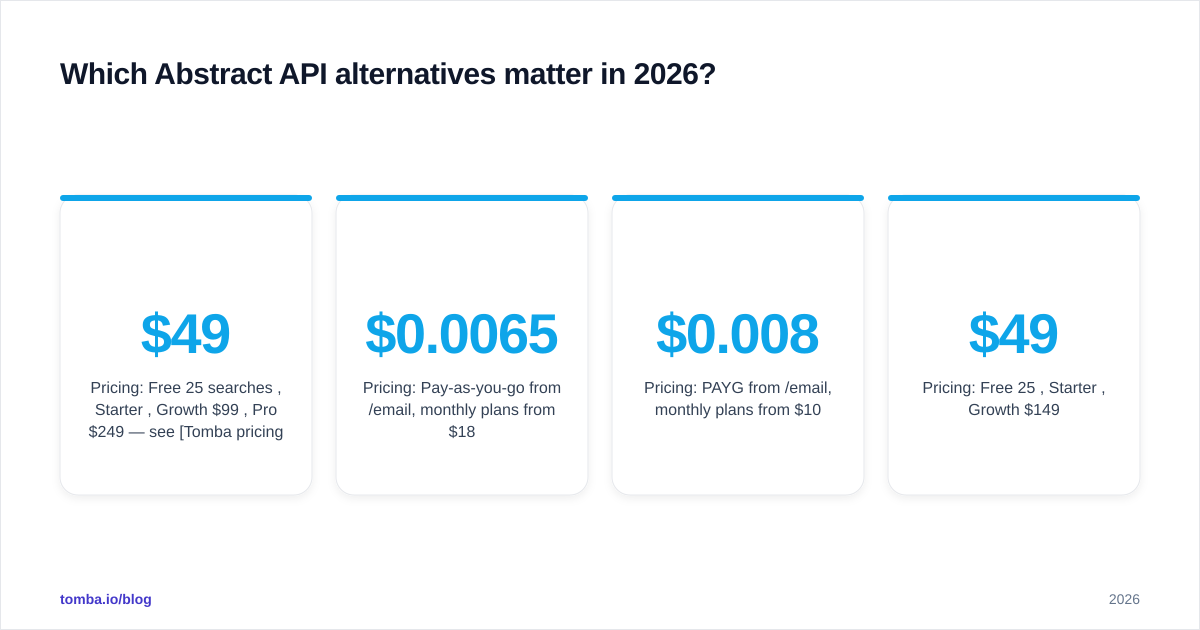
- Pricing: Free 25 searches/mo, Starter $49/mo, Growth $99/mo, Pro $249/mo — see Tomba pricing
- Free tier: Yes (25 credits/mo, no card)
- Where it beats Abstract: Email finder, deep B2B data, catch-all logic, LinkedIn-to-email
2.#
ZeroBounce — best for pure email validation at scale
ZeroBounce is the safer pick if you only validate, never find, and you process millions of addresses a month. Their A.I. scoring on catch-all and role accounts is well-documented and tuned for ESP cleaning.
- Best for: ESP list hygiene, marketing ops, pre-send cleanup
- Pricing: Pay-as-you-go from $0.0065/email, monthly plans from $18/mo
- Where it beats Abstract: Verification accuracy on cleaning workloads, abuse/spam-trap detection
- Compared: ZeroBounce alternative
3. NeverBounce — best for real-time signup validation#
NeverBounce's edge is sub-second response on signup forms and an explicit "real-time" SLA. Abstract is fast too, but NeverBounce's JS widget and accept/reject scoring are more polished for in-form validation.
- Best for: Lead capture forms, gated content, app signups
- Pricing: PAYG from $0.008/email, monthly plans from $10/mo
- Where it beats Abstract: Form latency, dedicated JS widget, retry queuing
4. Hunter — best brand-recognized email finder#
Hunter is the household name in email finding. If your stakeholders already know Hunter, justifying the spend is easier — but you pay for the brand. Tomba and Findymail beat it on price and often on accuracy for non-US domains.
- Best for: Teams with budget approval inertia
- Pricing: Free 25/mo, Starter $49/mo, Growth $149/mo
- Where it beats Abstract: Email finder, domain search, Chrome extension
5. Clearbit / HubSpot Breeze Intelligence — best for firmographic enrichment#
After HubSpot acquired Clearbit, the product became "Breeze Intelligence." Use it when you specifically need company-level firmographics inside HubSpot. Outside that ecosystem the value drops. See Clearbit alternative for non-HubSpot options.
- Best for: HubSpot customers, ABM scoring, reveal traffic
- Pricing: Quote-based, expensive
- Where it beats Abstract: Firmographic depth, intent signals
6. Numverify / Twilio Lookup — best phone validation alternative#
If the only Abstract endpoint you actually use is phone validation, swap in Twilio Lookup (premium accuracy) or Numverify (cheaper). For B2B phone finding, use Tomba's phone finder.
- Best for: SMS senders, fraud prevention, KYC
- Pricing: Twilio Lookup from $0.008/lookup; Numverify free tier + paid plans
7. Bouncer / EmailListVerify — value picks for verification only#
Both are budget-friendly verification engines popular with European teams. Accuracy is competitive with ZeroBounce; UX is less polished. See Bouncer alternative and EmailListVerify alternative for direct comparisons.
How do these Abstract API alternatives compare on the basics?#
The honest version, side by side:
| Vendor | Email finder | Email verifier | Phone finder | Enrichment | Starter price | Free tier |
|---|---|---|---|---|---|---|
| Abstract API | No | Yes | No (validation only) | Shallow | $9/mo per API | 100 calls/mo |
| Tomba | Yes | Yes | Yes | Yes (deep B2B) | $49/mo | 25/mo, no card |
| ZeroBounce | No | Yes | No | Limited | $18/mo | 100 free |
| NeverBounce | No | Yes | No | No | $10/mo | 1,000 free (one-time) |
| Hunter | Yes | Yes | No | Light | $49/mo | 25/mo |
| Clearbit / Breeze | No | Limited | No | Yes | Quote | No |
| Numverify | No | No | No | No | $14.99/mo | 100/mo |
| Bouncer | No | Yes | No | No | €29/mo | 100 free |
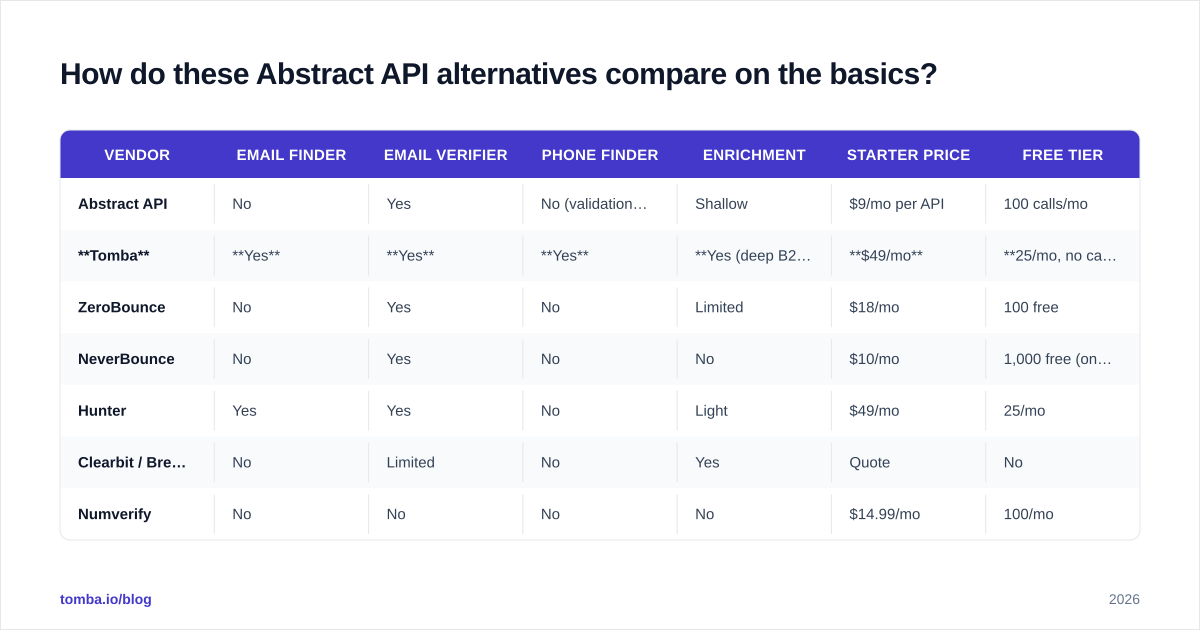
Three takeaways from that table:
- Abstract's main selling point — "one vendor for many APIs" — only holds if shallow data is acceptable. The moment you need real email finding or B2B enrichment, you're stacking another vendor anyway.
- Tomba is the only one in this list that natively covers find + verify + phone + enrichment under a single key. That's the Abstract pitch, executed properly.
- For pure list cleaning at scale, ZeroBounce and Bouncer stay competitive because their entire business is verification accuracy.

How does email verification accuracy actually break down?#
Verification is not one thing. Accuracy claims on vendor homepages collapse three checks into one number:
- Syntax + MX check — does the address parse, does the domain accept mail. Every vendor passes this. Abstract included.
- SMTP handshake — does the mailbox actually exist. This is where vendors diverge: timeouts, IP rotation, greylisting handling, retry logic.
- Catch-all resolution — when a domain accepts every address, can the vendor still tell you which mailboxes are real. This is the hardest signal and the one Abstract handles weakest. Tomba's catch-all finder and catch-all verifier exist precisely because the rest of the market treats catch-alls as unknown.
If your bounce rate exceeds 3% after verification, the failing layer is almost always #2 or #3, not #1. That's where Abstract underperforms specialists.

Is Tomba really a drop-in Abstract API replacement?#
For the email and B2B data endpoints, yes — and it covers gaps Abstract doesn't fill at all. For IP geolocation, VAT lookup, or holidays, no — those aren't Tomba's job. The realistic migration pattern:
- Email validation → swap Abstract's
/v1/email/validatefor Tomba's/v1/email-verifier. Same JSON shape, more granular status codes (valid,invalid,accept_all,webmail,disposable,unknown). - Email finding (new) → Tomba's
/v1/email-finderaccepts{ first_name, last_name, domain }and returns a verified address with a confidence score. Abstract has no equivalent. - Bulk operations → bulk endpoints for list cleaning and lead enrichment.
- Phone validation → keep Abstract or move to Twilio Lookup. For phone finding, use Tomba's phone finder.
- Geolocation / utility APIs → stay on Abstract or move to a dedicated provider; Tomba doesn't compete here.
The SDKs cover the languages you'd expect: Node, Python, Ruby, PHP, Go, Java, .NET. There's also a Tomba CLI, Tomba MCP server for AI agents, and a Chrome extension for sales reps who don't live in the API.

How should you choose between these alternatives?#
A short decision tree that matches how migrations actually go:
- You need find + verify + enrich in one API: Tomba. Nothing else in this list bundles all three with a real free tier.
- You only clean lists, never find addresses, and you process millions/month: ZeroBounce or Bouncer.
- You only validate at signup, in-form, sub-second: NeverBounce.
- You're in the HubSpot ecosystem and need firmographics: Breeze Intelligence.
- You only use Abstract's phone validation endpoint: Twilio Lookup or Numverify.
- You stay on Abstract: when the only endpoints you call are IP geolocation, VAT, or exchange rates. Those are still Abstract's strongest products.
Two things to verify regardless of which vendor you pick:
- Test on your own data. Pull 500 real addresses from your CRM, run them through the trial, and measure deliverability after sending. Vendor benchmarks are marketing.
- Read the SLA, not the homepage. Look for explicit uptime targets, retry policy on greylisting, and what "credit" means on a bulk run that fails halfway.
How much will switching cost you?#
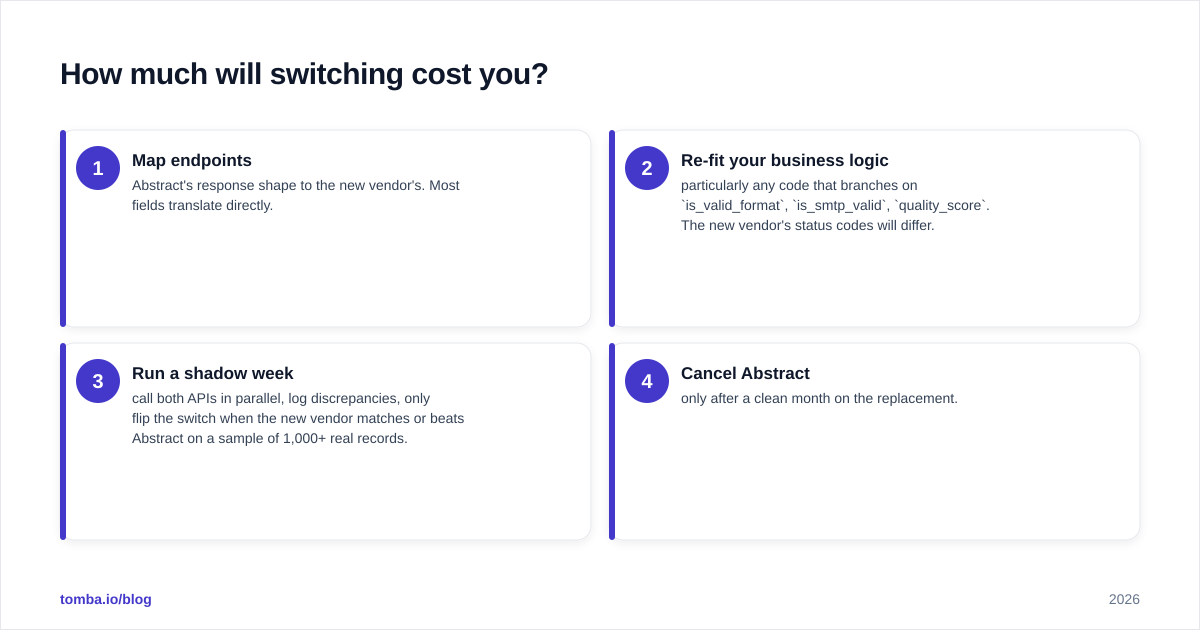
Honest answer: a week of engineer time and one month of overlapping invoices. The work breaks down to:
- Map endpoints — Abstract's response shape to the new vendor's. Most fields translate directly.
- Re-fit your business logic — particularly any code that branches on
is_valid_format,is_smtp_valid,quality_score. The new vendor's status codes will differ. - Run a shadow week — call both APIs in parallel, log discrepancies, only flip the switch when the new vendor matches or beats Abstract on a sample of 1,000+ real records.
- Cancel Abstract — only after a clean month on the replacement.
The cost is small. The accuracy lift on verification, and the time saved by having a real email finder in the same API, almost always pays back inside the first quarter.
Final pick#
If your reason for leaving Abstract is "I need real B2B email data and I want one vendor," start a free trial of the Tomba Email Finder — the free tier covers 25 searches a month with no card, and the same key works for finding, verifying, domain search, and enrichment. If you only ever clean lists, ZeroBounce or Bouncer is the safer bet. Either way, run the parallel test on your own data before you commit. Vendors look identical on landing pages and diverge sharply on your CRM.
// get started
Find, verify and enrich your first contacts today
Start on the free plan with 25 searches a month, then scale when your team is ready.
Free plan · No credit card required · GDPR & CCPA
// about the author