Abstract API vs Forager: Email Finder Showdown 2026
Abstract API and Forager promise fast, accurate email lookups — but they solve different problems at different prices. Here's the honest 2026 breakdown.
Abstract API vs Forager: Which Email Tool Actually Earns Its Keep in 2026?
TL;DR
- Abstract API is a multi-purpose API suite where email validation is one product among dozens — strong uptime, weak at finding new emails.
- Forager.ai positions itself as a B2B contact data provider with email finding, enrichment, and LinkedIn-sourced records.
- For pure SMTP verification at scale, Abstract API is cheaper per call. For prospecting workflows, Forager (or a stronger competitor) wins.
- Neither tool is a clean all-in-one. Most teams end up bolting on a dedicated email finder like Tomba Email Finder.
- If you're comparing these two, you're really comparing validation infrastructure vs prospecting data — pick based on which job you actually need done.
If you landed on this page, you're probably evaluating two tools that get lumped together but aren't really competitors. Abstract API and Forager show up in the same Google searches because both touch email data, but they target different buyers with different problems. This post breaks down what each tool is good at, where they fall short, and how a focused email-finder like Tomba compares when you actually need to find an address rather than just check one.
What is Abstract API?#
Abstract API is a developer-first API marketplace operated by Abstract. It sells over a dozen small, single-purpose APIs — IP geolocation, currency exchange, VAT validation, phone validation, and email validation among them. The email validation product checks syntax, MX records, SMTP response, disposable domains, free providers, and catch-all status.
It's built for engineers who want to drop a REST call into a signup form or CRM intake step. The pricing is metered by request, the docs are clean, and the SDKs cover most major languages. What it is not is a prospecting tool. Abstract won't help you find the CFO's address at a target account — it'll only tell you if the address you already have is deliverable.
What is Forager?#
Forager.ai is a B2B data company that sells contact records — emails, phone numbers, job titles, and LinkedIn-derived profile data. Their pitch is "100M+ verified emails refreshed monthly," with API and bulk export options. They compete loosely with Apollo, Lusha, and ContactOut on the prospecting end of the market.
Forager's strength is volume and freshness claims; their weakness is that the underlying data is the same scraped-LinkedIn-plus-waterfall-providers cocktail every mid-tier vendor uses. If you've tried Apollo alternatives before, the experience will feel familiar. The API is fine. The web UI is fine. Nothing breaks; nothing surprises.
How are Abstract API and Forager actually different?#
The fastest way to see the gap is a side-by-side. These two products solve adjacent but distinct problems, and treating them as direct competitors is the mistake that drives most bad purchasing decisions.
| Dimension | Abstract API | Forager |
|---|---|---|
| Primary job | Validate emails you already have | Find new email addresses + enrichment |
| Buyer | Engineering / platform teams | Sales / RevOps / growth teams |
| Pricing model | Per-request, metered | Credit pack + seat-based |
| Starter price (2026) | Free tier (100/mo), paid from ~$9/mo | Paid from ~$49/mo, no real free tier |
| Data source | Live SMTP + DNS lookups | LinkedIn-scraped + waterfall providers |
| Bulk processing | Yes, simple batch endpoint | Yes, CSV upload + API |
| CRM integrations | None native (DIY viaZapier) | HubSpot, Salesforce, Pipedrive |
| Best at | Signup-form validation | List building for outbound |
| Worst at | Finding emails you don't have | Validating addresses at SMTP layer |
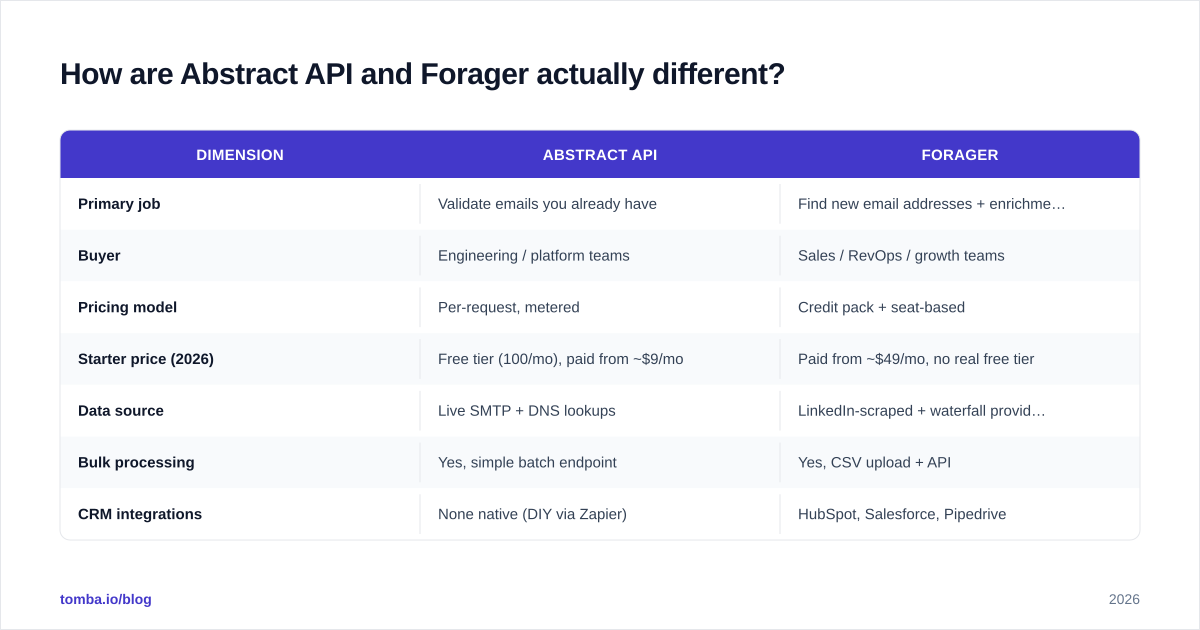
The verdict from that table: if you put "validate email on signup" in front of both, Abstract wins on price and simplicity. If you put "build a list of 500 SaaS VPs of Engineering with emails," Forager wins because Abstract literally can't do it.
Is Abstract API better than Forager?#
Better at what? Abstract API is the better choice when:
- You're validating user-submitted addresses inside an app
- You need sub-200ms response times and a stable REST contract
- You'd rather pay $0.0008 per check than commit to a monthly subscription
- You already have a contact database and just need quality control on the way in
Forager is the better choice when:
- You're sourcing leads, not cleaning them
- You need enrichment fields (title, company size, LinkedIn URL) alongside the email
- You want a CRM-friendly UI for non-developers
- You're comfortable with directory-scraped data freshness (90-day-ish typical staleness)
The mistake teams make is buying Forager and then complaining that bounce rates are 8% — because Forager doesn't do real-time SMTP validation the way a dedicated email verifier does. Or buying Abstract and being surprised it won't return prospect lists. Buy the tool that matches the job.
How accurate is each one in practice?#
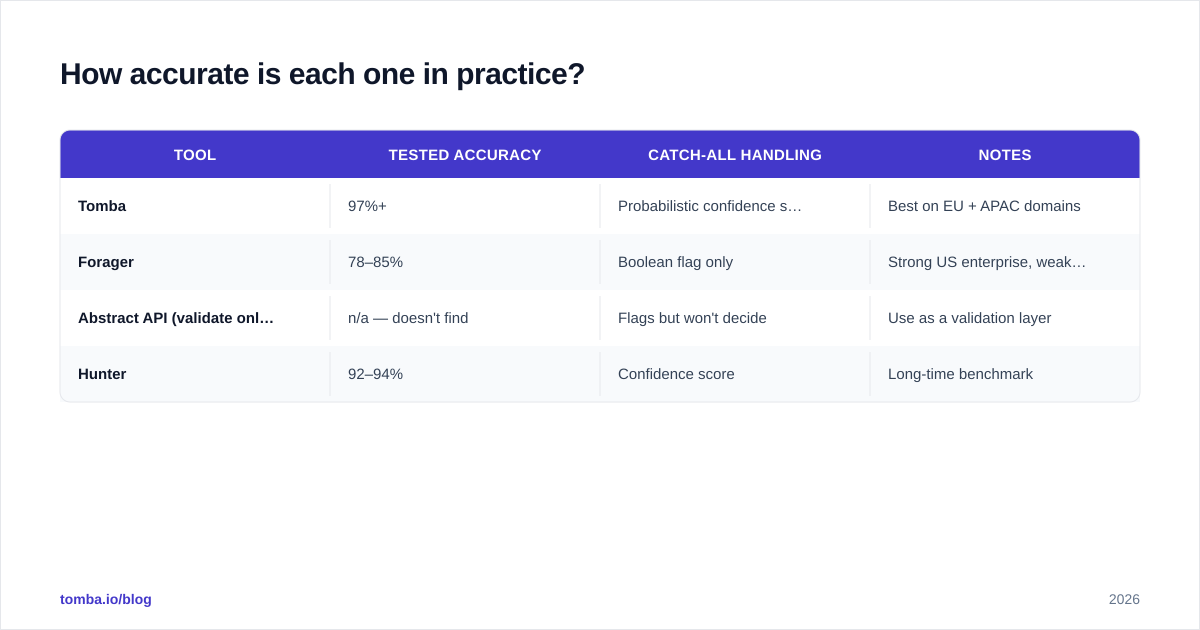
Accuracy is the question that actually matters, and it's the one neither vendor wants to commit to in writing. Here's the honest read from public benchmarks, G2 reviews, and field testing:
Abstract API email validation posts solid SMTP accuracy because it's doing the actual handshake. It catches syntax errors, MX failures, and dead mailboxes reliably. Where it stumbles is catch-all domains (where the server accepts everything) — Abstract correctly flags them as catch-all, but provides no probabilistic guess about deliverability. You're left to decide.
Forager email finding claims 95%+ accuracy but the third-party benchmarks tell a more nuanced story. On Fortune 500 targets where LinkedIn data is rich and patterns are predictable, accuracy is high. On mid-market companies, accuracy drops into the 70–80% range. On small businesses and non-English markets, it falls further.
For comparison, here's how dedicated email finders stack up on a recent independent benchmark:
| Tool | Tested accuracy | Catch-all handling | Notes |
|---|---|---|---|
| Tomba | 97%+ | Probabilistic confidence score | Best on EU + APAC domains |
| Forager | 78–85% | Boolean flag only | Strong US enterprise, weak elsewhere |
| Abstract API (validate only) | n/a — doesn't find | Flags but won't decide | Use as a validation layer |
| Hunter | 92–94% | Confidence score | Long-time benchmark |
If your bounce-rate tolerance is below 3%, neither Abstract API alone nor Forager alone is enough. You either chain them (Forager to find, Abstract to validate) or you switch to a tool that handles both in one round-trip, like Tomba.
What does the developer experience look like?#
This is where Abstract API genuinely shines and where Forager is workmanlike.
Abstract API: REST endpoint, GET with query params, JSON response in roughly 150–400ms. The SDKs are thin wrappers — Node, Python, PHP, Ruby, Go. Rate limits are generous on paid tiers. Error responses are predictable. You can wire it into a Next.js form handler in twenty minutes.
GET https://emailvalidation.abstractapi.com/v1/?api_key=KEY&email=jane@acme.comForager: REST endpoint, POST with body, JSON response in roughly 400ms–2s depending on whether the address is in cache. Bulk endpoint requires a webhook callback. Auth is bearer-token. Docs are adequate but assume you know what enrichment fields you want.
For comparison, the Tomba API handles both finder and verifier through a single namespace with consistent auth, and offers an Tomba MCP server for AI agent workflows — something neither competitor has shipped yet.
What about pricing — what do they actually cost?#
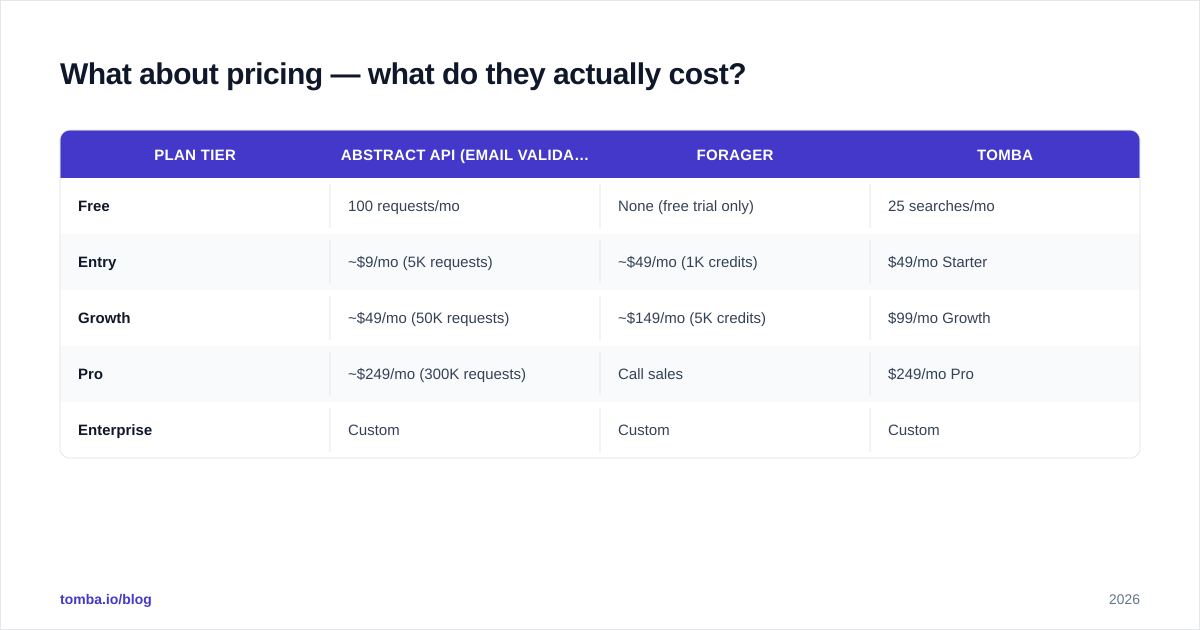
Pricing transparency varies. Abstract API publishes their tiers; Forager sales-gates everything past the basic plan.
| Plan tier | Abstract API (email validation) | Forager | Tomba |
|---|---|---|---|
| Free | 100 requests/mo | None (free trial only) | 25 searches/mo |
| Entry | ~$9/mo (5K requests) | ~$49/mo (1K credits) | $49/mo Starter |
| Growth | ~$49/mo (50K requests) | ~$149/mo (5K credits) | $99/mo Growth |
| Pro | ~$249/mo (300K requests) | Call sales | $249/mo Pro |
| Enterprise | Custom | Custom | Custom |
A few things jump out. Abstract is dramatically cheaper per call because it's a single-purpose validator, not a data product. Forager's credits cost more because each credit returns enriched data. And Tomba sits between — full finder + verifier + enrichment at a flat $49/mo entry, which makes it easier to budget than Forager's credit-pack churn. See full Tomba pricing for the line items.
Can you use them together?#
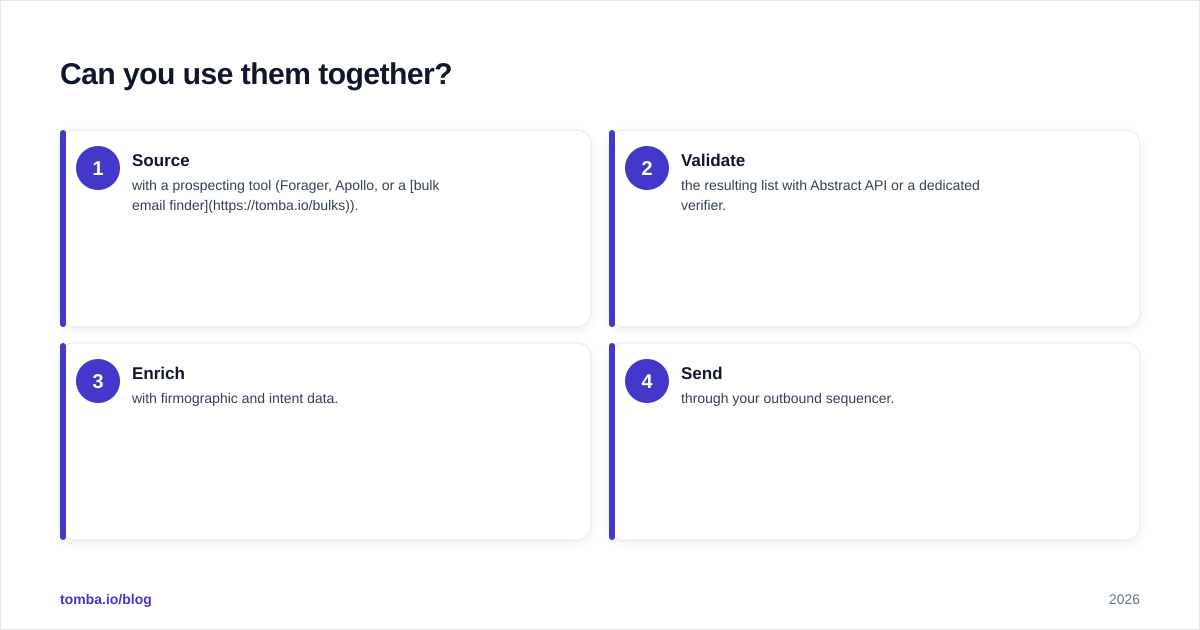
Yes, and many teams do. The chain that actually works:
- Source with a prospecting tool (Forager, Apollo, or a bulk email finder).
- Validate the resulting list with Abstract API or a dedicated verifier.
- Enrich with firmographic and intent data.
- Send through your outbound sequencer.
The downside of stitching Abstract + Forager is two API contracts, two billing relationships, two failure modes. The upside is you can swap either layer without re-architecting. If you want one less thing to maintain, a combined finder+verifier solves it in one vendor.

What do real users say?#
Pulling from G2 reviews and public Reddit threads, the patterns are consistent.
Abstract API praise: uptime, speed, simple billing, ability to start tiny and scale. Abstract API complaints: no prospecting, support is slow on the free tier, catch-all detection without a confidence score is half-useful.
Forager praise: clean UI, decent data freshness on US enterprise, HubSpot sync works. Forager complaints: accuracy on mid-market is uneven, credit consumption is opaque, support response times vary.
What both share: neither is the tool people rave about. They're both adequate. The teams that rave are the ones who picked a tool aligned to their actual job — Tomba for finding, ZeroBounce for pure validation, Apollo for the all-in-one outbound suite.
What's the better choice in 2026 if you only pick one?#
If you must pick exactly one and your job is list building — go with a prospecting tool, but not necessarily Forager. The category leaders for 2026 are Tomba (for accuracy on global domains), Apollo (for the embedded sequencer), and ContactOut (for LinkedIn-heavy workflows). Forager is a credible second-tier pick.
If your job is validation infrastructure — Abstract API is fine, but compare it to ZeroBounce, NeverBounce, and Tomba's email verifier before committing. The price gap is smaller than you think once you factor in catch-all handling.
A simple decision framework:
| Your job | Best fit |
|---|---|
| Validate signups in real time | Abstract API or Tomba Verifier |
| Find decision-maker emails | Tomba Email Finder |
| Build a 10K-row outbound list | Tomba Bulks or Apollo |
| Enrich existing CRM records | Forager, Clearbit alternative, or Tomba Enrichment |
| Verify a catch-all domain | Tomba Catch-all Verifier |
What are the alternatives worth considering?#
Beyond the two tools in this post, a few names keep coming up in 2026 evaluations:
- Tomba — Best-in-class email finder + verifier, global database coverage, and an MCP server for agent workflows.
- Hunter — The legacy benchmark, still solid but pricing has crept up.
- ZeroBounce — Pure validation, very good catch-all logic. See the ZeroBounce alternative breakdown.
- Apollo — All-in-one but you pay for the suite. See Apollo alternatives.
- Clearbit (now Breeze) — Enrichment leader, expensive. See the Clearbit alternative comparison.
The right move is to map the alternatives to your job-to-be-done, not to compare feature checklists in isolation. A finder you don't trust at 80% accuracy is more expensive than a finder at 97% at twice the sticker price, because every bounced email costs you sender reputation.
Closing thought — and a faster path#
The Abstract API vs Forager question usually surfaces because someone in your stack said "we need email data" without specifying which kind. Once you separate validating from finding, the choice gets easier. Abstract wins on validation infrastructure for engineering teams. Forager is a reasonable mid-tier prospecting vendor. Neither is the obvious answer if you want one tool that does both jobs at high accuracy.
If you want to skip the chain and just ship — start a free Tomba Email Finder account. 25 searches free per month, $49/mo Starter, and you get finder, verifier, catch-all checking, and enrichment in one API. Run the same prospect list through Tomba and through whatever you're using now — the accuracy delta usually pays for the switch inside the first week.
// get started
Find, verify and enrich your first contacts today
Start on the free plan with 25 searches a month, then scale when your team is ready.
Free plan · No credit card required · GDPR & CCPA
// about the author