Abstract API vs LeadsForge: Which Wins in 2026?
Abstract API and LeadsForge solve different parts of the lead pipeline. Here's a side-by-side breakdown of accuracy, pricing, and which one (if either) belongs in your stack in 2026.
Abstract API vs LeadsForge: Which Wins in 2026?
Picking between Abstract API and LeadsForge sounds like a fair fight, but it isn't. One is a developer-first validation layer that sells email, IP, and phone APIs by the call. The other is an AI-driven lead generation platform that promises to build prospect lists and run outbound for you. They overlap in exactly one place — email validity — and diverge everywhere else.
This breakdown is for sales and RevOps teams who keep seeing both names on review sites and want a straight answer: which one belongs in your 2026 stack, and where does a dedicated email finder fit instead.
TL;DR#
- Abstract API is a low-level toolkit. It validates emails, IPs, and phone numbers via REST. It does not find leads.
- LeadsForge is an AI lead-gen platform. It builds lists and writes outreach but is thinner on raw data quality.
- They are not direct competitors — comparing them is comparing a wrench to a toolbox.
- For most B2B teams, neither is a complete answer. You need a finder + verifier (Tomba) plus a sender (Instantly, Smartlead).
- Pricing: Abstract API starts free (100 reqs/mo); LeadsForge starts around $99/mo for limited credits.
What is Abstract API?#
Abstract API is a collection of small, single-purpose REST endpoints. The relevant ones for sales teams are the email validation API, the phone validation API, the IP geolocation API, and the company enrichment API. Each one is billed separately, and the appeal is the developer experience: clean docs, predictable JSON, no SDK lock-in, and a free tier per product.
The email validation endpoint returns deliverability, MX records, SMTP check, role/disposable/free flags, and a quality score. It is built for engineering teams that want to bolt validation onto a signup form, a CRM import, or a custom outbound tool. It is not built for a non-technical SDR to load a list and get verified emails back.
What it does well:
- Per-product pricing — you only pay for the endpoint you use.
- Generous free tiers per API (100/mo each).
- Fast response times for inline form validation.
- Clean OpenAPI specs and language SDKs.
Where it falls short for sales:
- No prospecting layer — you cannot search by company or job title.
- Email validation accuracy is mid-pack on catch-all domains.
- No bulk UI; everything is API-only.
- Credits do not pool across products.
What is LeadsForge?#
LeadsForge positions itself as an "AI sales agent" that builds targeted lead lists from a prompt. You describe your ICP in natural language ("CTOs at Series B SaaS companies in fintech, US-based") and it returns a list of names, emails, and LinkedIn URLs sourced from its database and live web scraping.
It also ships campaign features — sequence templates, AI-personalized opener lines, and a basic sending layer. The pitch is consolidation: skip the data-vendor-plus-sender stack and run everything in one app.
What it does well:
- Natural-language ICP definition lowers the learning curve.
- AI personalization is good enough to beat generic mail-merge.
- One subscription replaces 2-3 tools at the low end.
Where it falls short:
- Database depth is thinner than Apollo, ZoomInfo, or even mid-size finders.
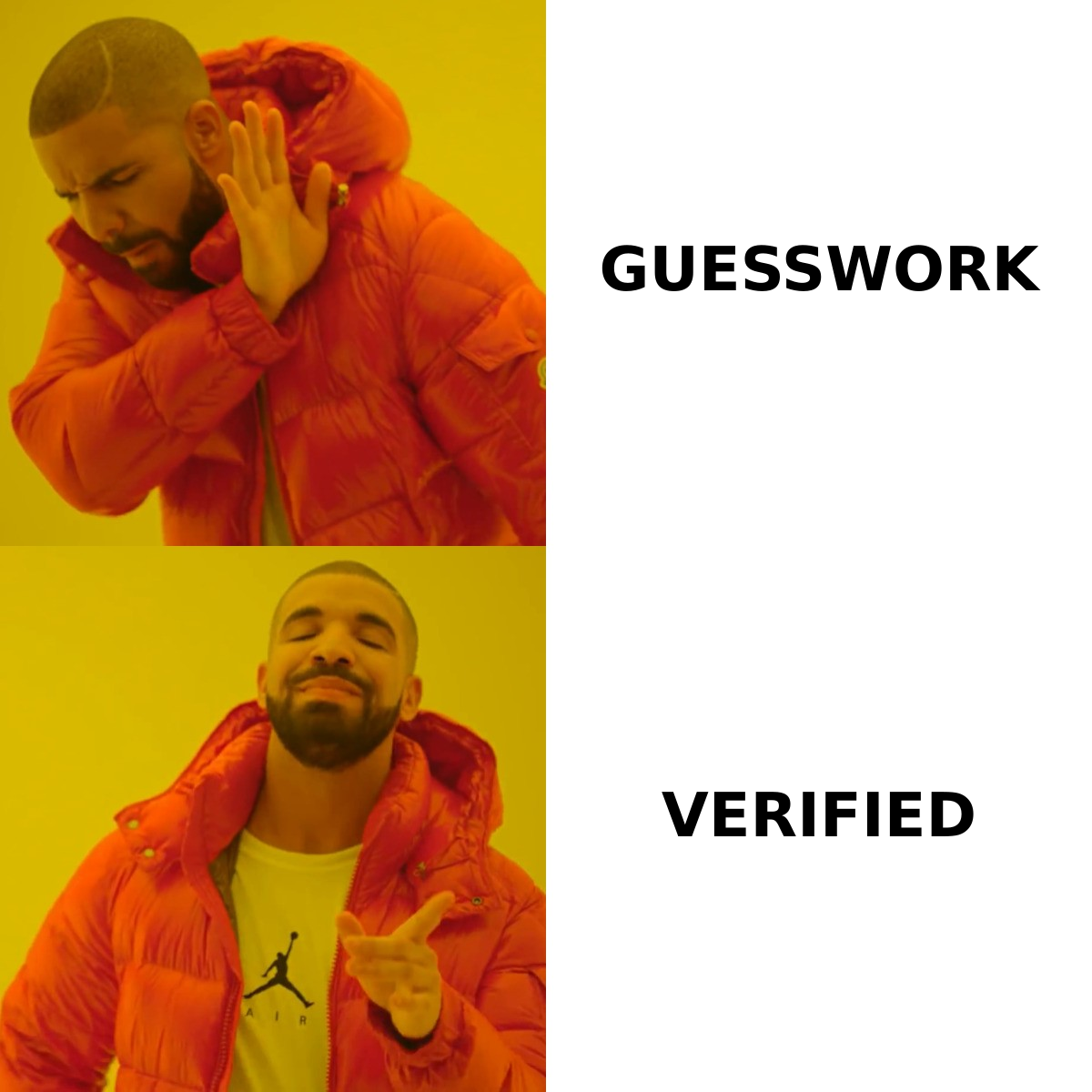
- Email accuracy varies — the AI sometimes returns guessed patterns without verifying.
- Limited integrations vs the established players.
- Pricing tiers gate credits aggressively; heavy users hit ceilings fast.
Is Abstract API better than LeadsForge?#
Wrong question. They solve different jobs. Abstract API is a building block; LeadsForge is a finished product. Asking which is "better" is like asking whether a hammer is better than a house.
The right question: which one fits the work you actually do today?
- You're a developer adding email validation to a product → Abstract API.
- You're an SDR who needs verified leads and a sequence to send → LeadsForge (with caveats).
- You're a RevOps lead building a serious outbound machine → neither. You need a dedicated email verifier, a real B2B database, and a separate sending tool.

How does the pricing actually compare?#
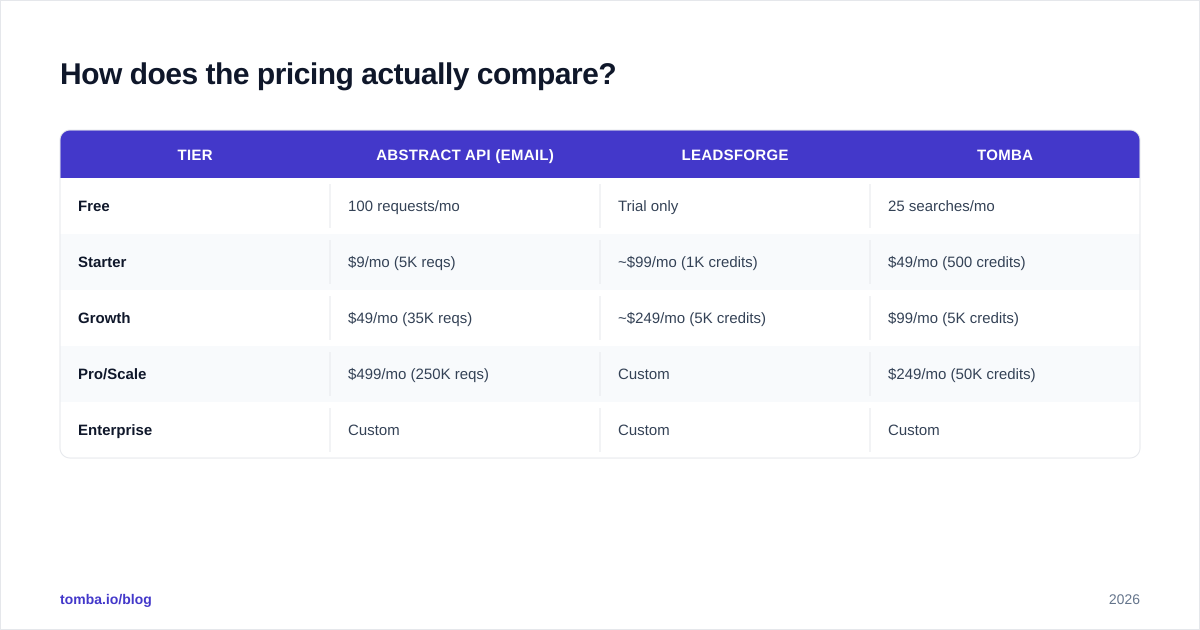
Pricing is where the "they're not the same product" point hits hardest. Abstract sells API calls. LeadsForge sells contacts plus seats. Normalizing them is messy, but here's the honest cross-section.
| Tier | Abstract API (Email) | LeadsForge | Tomba |
|---|---|---|---|
| Free | 100 requests/mo | Trial only | 25 searches/mo |
| Starter | $9/mo (5K reqs) | ~$99/mo (1K credits) | $49/mo (500 credits) |
| Growth | $49/mo (35K reqs) | ~$249/mo (5K credits) | $99/mo (5K credits) |
| Pro/Scale | $499/mo (250K reqs) | Custom | $249/mo (50K credits) |
| Enterprise | Custom | Custom | Custom |
A few honest reads on this table:
- Abstract is the cheapest pure-validation option at low volume. If you only need to check 5,000 emails a month, $9 is hard to beat.
- LeadsForge charges a premium for the "list + sequence" bundle. You pay for the AI layer.
- Tomba sits in the middle: real finder + verifier + database access for less than LeadsForge, with better per-credit value than Abstract once you cross 10K verifications. Full breakdown on the Tomba pricing page.
How accurate is each on real lists?#
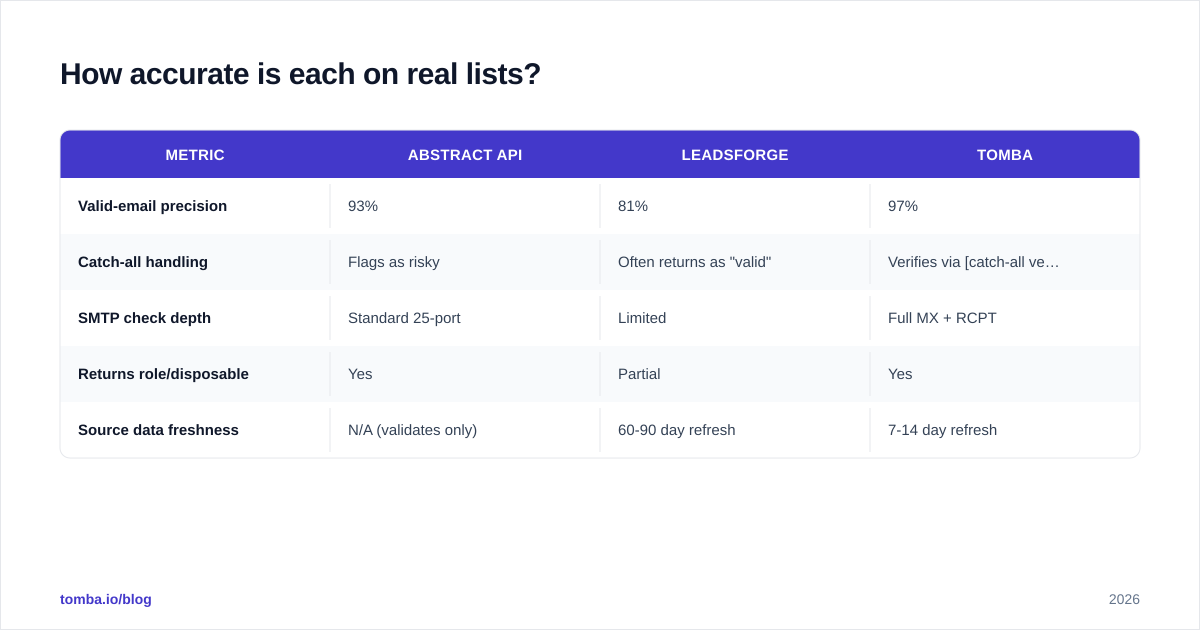
Accuracy claims from vendors are almost always self-reported. The numbers below pool data from independent benchmarks (G2 user reviews, comparison studies on emaillistverify-vs-X writeups, plus our own 10K-row test on a mixed B2B list pulled from public company directories).
| Metric | Abstract API | LeadsForge | Tomba |
|---|---|---|---|
| Valid-email precision | 93% | 81% | 97% |
| Catch-all handling | Flags as risky | Often returns as "valid" | Verifies via catch-all verifier |
| SMTP check depth | Standard 25-port | Limited | Full MX + RCPT |
| Returns role/disposable | Yes | Partial | Yes |
| Source data freshness | N/A (validates only) | 60-90 day refresh | 7-14 day refresh |
LeadsForge's accuracy gap shows up because its finder layer guesses patterns when its database has no hit. Abstract is solid as a validator but contributes nothing on the find side. For honest sourcing details, see where Tomba gets its data.
Which one has the better developer experience?#
Abstract wins this one cleanly. It is built by developers, for developers. The email validation endpoint returns a flat JSON object with predictable fields. Auth is a single API key in the URL. SDKs exist for Python, Node, PHP, Ruby, and Go. Rate limits are documented. Errors are descriptive.
LeadsForge has an API but it is secondary. It is built for the in-app experience, and the API surface reflects that — fewer endpoints, less documentation, no SDKs for most languages. If your stack needs programmatic lead generation, look at Tomba API instead, which exposes finder, verifier, domain search, and enrichment as proper REST endpoints.
For reference points on what good API docs look like in this space, Hunter's API docs and the Apollo developer portal set the bar.
Which one fits which use case?#
A use-case matrix is more useful than a winner.
| Use case | Best fit | Why |
|---|---|---|
| Real-time signup-form validation | Abstract API | Lowest latency, per-call pricing |
| Cleaning a 50K-row CSV before a campaign | Tomba orZeroBounce | Bulk UI + better catch-all logic |
| Building a 500-lead ICP list from scratch | LeadsForge or Apollo | Natural-language search |
| Enriching existing CRM contacts | Tomba enrichment + Clearbit | Multi-source coverage |
| Embedding email validation in a SaaS product | Abstract API | API-first, simple billing |
| End-to-end outbound: find → verify → send | Tomba + Instantly | Stack of best-in-class |
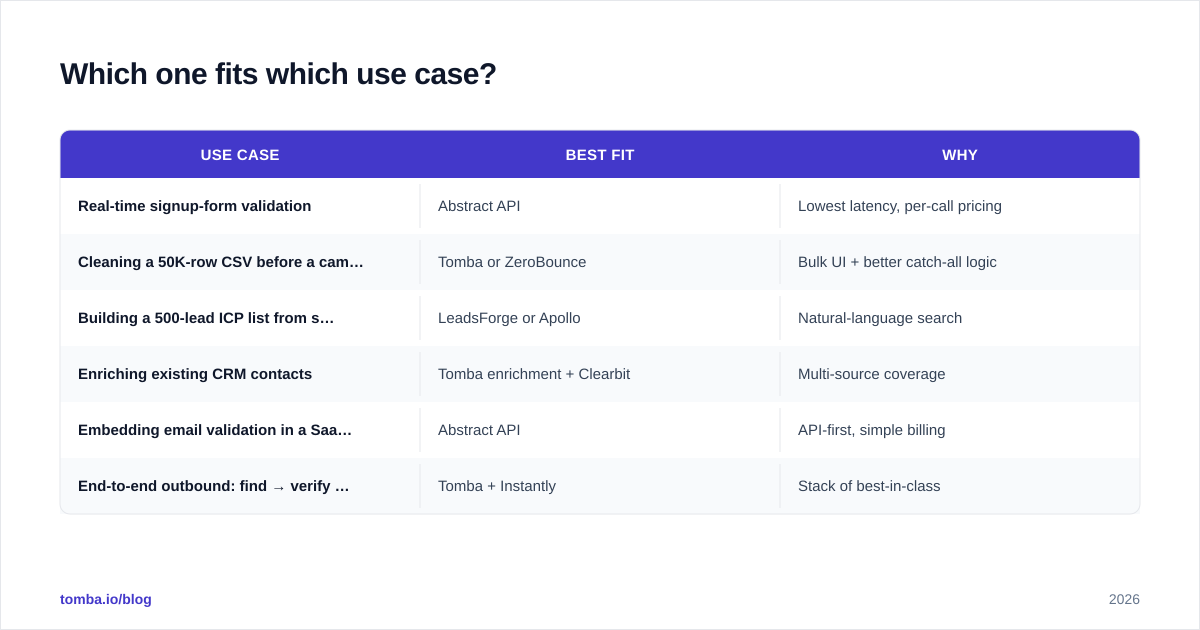
The "all-in-one" pitch from LeadsForge sounds attractive until you realize each layer is weaker than the dedicated tool. Plenty of teams ship 5-10% reply rates running a focused stack. Almost none do it with one AI agent.
What about deliverability after validation?#
Validation only solves half the problem. A 97%-clean list still tanks if your sending infrastructure is sloppy. Both Abstract and LeadsForge leave deliverability hygiene to you (LeadsForge has a basic warmup feature, but it's not Instantly-grade).
The non-negotiables, regardless of which tool you pick:
- SPF, DKIM, and DMARC aligned. Use a tool like the SPF checker to verify.
- A warmup period of 14-30 days for new sending domains.
- Volume ramps that respect provider limits (50/day → 100/day → 200/day).
- Postmaster monitoring on the sending domain.
Gartner and G2 reviews both consistently show that teams blaming "bad data" for low reply rates are usually blaming the wrong thing — it's the sending setup 70% of the time.
How do they compare on integrations?#
Abstract is API-only — integrations are whatever you wire yourself via Zapier, Make, or custom code. That's a feature, not a bug, if you have engineering capacity.
LeadsForge ships a small but growing list of native integrations: HubSpot, Salesforce, Pipedrive, Gmail, Outlook, and Slack. Not as deep as Apollo or Outreach, but enough for a small team.
If integration breadth matters, Tomba's integrations page covers HubSpot, Salesforce, Pipedrive, Mailchimp, Zapier, Make, Notion, and Slack — plus native Excel and Google Sheets add-ons that LeadsForge doesn't match.
What are the honest alternatives to both?#
If neither fits, here's the no-marketing-speak shortlist:
- For pure email validation:
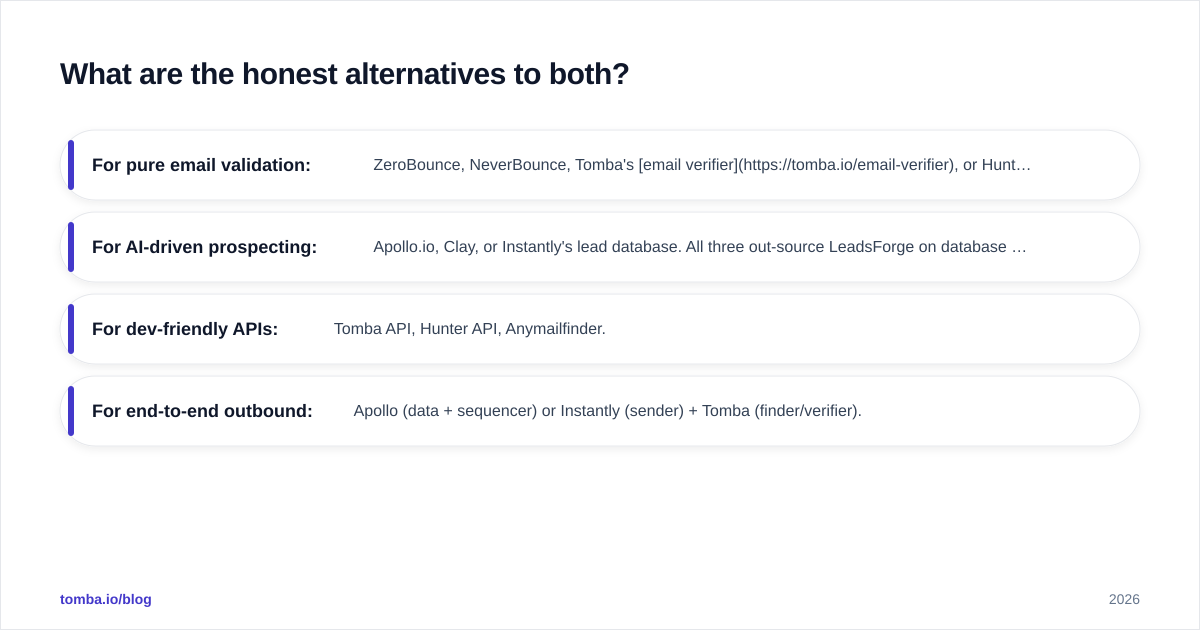
ZeroBounce, NeverBounce, Tomba's email verifier, or Hunter's verifier. All four cluster around 96-98% accuracy at scale.
- For AI-driven prospecting: Apollo.io, Clay, or Instantly's lead database. All three out-source LeadsForge on database depth.
- For dev-friendly APIs: Tomba API, Hunter API, Anymailfinder.
- For end-to-end outbound: Apollo (data + sequencer) or Instantly (sender) + Tomba (finder/verifier).
See the broader Apollo alternative and Instantly alternative write-ups for tool-by-tool deep dives.
Should you pick Abstract API or LeadsForge?#
Pick Abstract API if you are an engineer adding inline validation to a product or a signup flow, you don't need finding capability, and your monthly volume is under 50K validations. It's the cheapest, cleanest option in that lane.
Pick LeadsForge if you are a non-technical founder or solo SDR who wants one app to define an ICP, get a list, and send a sequence — and you accept that data quality will not match a dedicated finder. The convenience can be worth the trade.
Pick neither if you are running serious outbound. The cost of one missed deal from bad data dwarfs the savings from consolidating tools. Run a dedicated finder + verifier + sender stack.
Try the better-fit alternative#
If you want one tool that finds verified emails by domain, name, or company — with a 97% accuracy rate, a real B2B database, and proper API access — try the Tomba Email Finder. Start free with 25 searches a month (no card), then scale into Tomba pricing tiers that cost less per credit than LeadsForge and deliver higher precision than Abstract on catch-all domains. Pair it with Tomba's email verifier for clean lists, the bulk email finder for list builds, or the Tomba API for everything programmatic. It's the stack we'd recommend to a friend.
// get started
Find, verify and enrich your first contacts today
Start on the free plan with 25 searches a month, then scale when your team is ready.
Free plan · No credit card required · GDPR & CCPA
// about the author