Accutrend vs Ampliz 2026: B2B Data Provider Comparison
Accutrend vs Ampliz compared on data coverage, accuracy, pricing, and use cases — plus where a verification-first stack beats both for cold outreach in 2026.
You are choosing between two B2B data providers that look similar on a feature grid but solve different problems. This breakdown cuts through the marketing copy so you can pick the right one — or skip both for a leaner stack.
TL;DR#
- Accutrend Data is a bulk B2B list and append vendor — strong for large static prospecting files and CRM data appends, weaker on real-time freshness.
- Ampliz is a B2B intelligence platform with a notable healthcare and life-sciences dataset, plus APIs for enrichment and contact discovery.
- Neither is primarily an email-verification engine, so list decay and bounce risk are real on both unless you re-verify before sending.
- On pricing, both lean toward quote-based or list-volume models rather than transparent monthly SaaS tiers.
- If your core need is finding and verifying professional emails on demand, a finder-plus-verifier tool like Tomba Email Finder is cheaper and faster to operationalize than a full data-append contract.
What is Accutrend Data?#
Accutrend Data is a US-focused B2B data compiler. Its core offer is bulk contact and company lists — you specify firmographic filters (industry, geography, company size, title) and buy a file, or send your existing CRM records for an append (filling missing phone numbers, emails, and titles).
Think of Accutrend like a wholesale grocery supplier: you order data in volume, by the pallet, and the value is in the breadth of the warehouse. That model suits direct-mail campaigns, account-based seed lists, and CRM hygiene projects where you need many rows at once rather than a handful of precise lookups.
The trade-off with any compiled-list model is freshness. Compiled B2B data is a snapshot. People change jobs roughly every 2–3 years, so a static file starts decaying the moment it's exported. That's why the smart workflow is to treat a purchased list as raw material, not a finished send-ready asset.
What is Ampliz?#
Ampliz positions itself as a B2B data intelligence platform, and its differentiator is depth in healthcare and life sciences — physician records, hospital and provider data, NPI-style attributes — alongside a general B2B contact database. It ships a Chrome extension, a contact/company search UI, and APIs for data enrichment so you can push records into your own systems.
If Accutrend is the wholesale supplier, Ampliz is closer to a specialist distributor: narrower in some areas, but with curated inventory in a vertical that generic providers handle poorly. For medical-device, pharma, and provider-targeting GTM teams, that healthcare angle is the whole reason to look at Ampliz.
For general B2B SaaS prospecting, though, Ampliz competes head-to-head with every other contact database, and the healthcare edge stops mattering.
Accutrend vs Ampliz: how do they compare?#
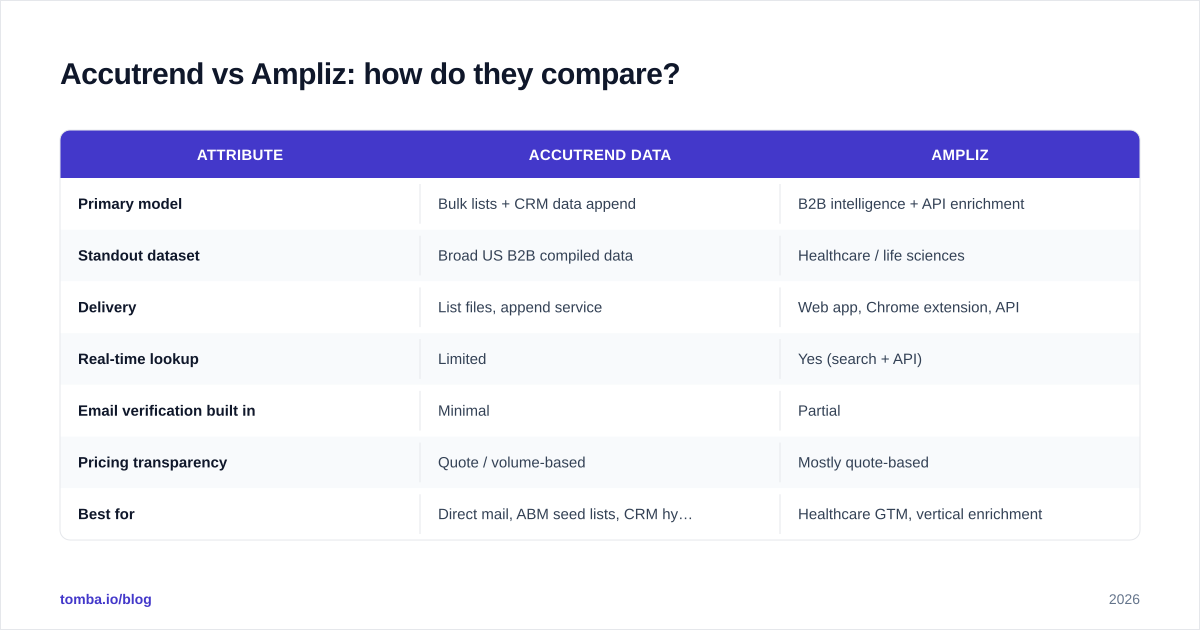
Here's the side-by-side on the attributes that actually change a buying decision. Treat any vendor-published coverage number as a marketing ceiling, not a guarantee — your real match rate depends on your target segment.
| Attribute | Accutrend Data | Ampliz |
|---|---|---|
| Primary model | Bulk lists + CRM data append | B2B intelligence + API enrichment |
| Standout dataset | Broad US B2B compiled data | Healthcare / life sciences |
| Delivery | List files, append service | Web app, Chrome extension, API |
| Real-time lookup | Limited | Yes (search + API) |
| Email verification built in | Minimal | Partial |
| Pricing transparency | Quote / volume-based | Mostly quote-based |
| Best for | Direct mail, ABM seed lists, CRM hygiene | Healthcare GTM, vertical enrichment |
| Free self-serve trial | No | Limited credits |
The honest read: these tools are not really competing for the same buyer. You choose Accutrend when you need volume and append at scale, and Ampliz when you need healthcare-grade vertical data or live API enrichment. The overlap — generic US B2B contacts — is exactly the commodity layer where dozens of providers, including cheaper ones, are good enough.
)
Which one is more accurate?#
Accuracy is the wrong single question — you care about deliverable accuracy at send time, and that's a function of two things: how good the source data was, and how recently it was verified.
Both Accutrend and Ampliz invest in data quality, but neither is built primarily as a verification engine. A compiled record that was accurate six months ago can still hard-bounce today. Independent reviews on G2 for B2B data vendors consistently show the same pattern: coverage claims are high, but real-world bounce rates climb whenever buyers skip a re-verification step.
The fix is not to argue about whose database is 2% more accurate. It's to add a verification pass before every campaign. Run any purchased or enriched list through an email verifier and a catch-all verifier so you catch dead mailboxes and risky catch-all domains before they tank your sender reputation. This single habit does more for deliverability than picking the "better" data vendor.

How do they price?#
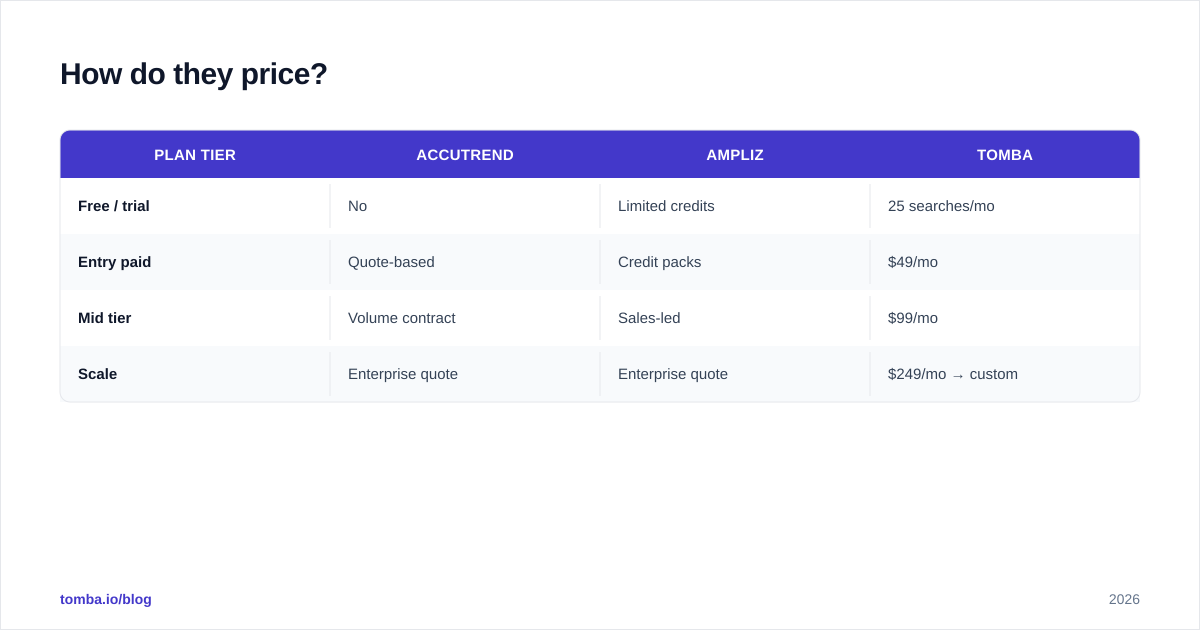
Both vendors lean on quote-based or volume pricing rather than published SaaS tiers, which makes apples-to-apples comparison hard and locks smaller teams out of fast self-serve testing.
- Accutrend typically prices by list size and append volume. Good economics at scale; awkward if you only need a few hundred precise contacts a month.
- Ampliz offers credit-based access with some self-serve entry, but serious volume and the healthcare dataset move you into sales-led contracts.
If you want predictable monthly cost with a real free tier, that's where dedicated finder tools win. For reference, transparent Tomba pricing runs a Free tier (25 searches/month), Starter at $49/mo, Growth at $99/mo, and Pro at $249/mo — you can test the data quality yourself before talking to anyone.
| Plan tier | Accutrend | Ampliz | Tomba |
|---|---|---|---|
| Free / trial | No | Limited credits | 25 searches/mo |
| Entry paid | Quote-based | Credit packs | $49/mo |
| Mid tier | Volume contract | Sales-led | $99/mo |
| Scale | Enterprise quote | Enterprise quote | $249/mo → custom |
When should you choose Accutrend or Ampliz over a finder tool?#
Choose a full data provider when your workflow genuinely needs bulk, append, or vertical-specialist data:
- You're running direct mail or large ABM seed campaigns and need thousands of firmographic records at once.
- Your CRM is full of half-empty records and you need a one-time append of phones, titles, and firmographics.
- You sell into healthcare and need provider-level data that generic databases botch — that's Ampliz's lane.
Choose a finder-plus-verifier tool when your motion is precision outbound:
- You're targeting specific named accounts and need the email for a known person at a known company.
- You want to verify deliverability before sending, not after bouncing.
- You need predictable per-seat pricing and an email finder API you can wire into your own sequencing.
)
How do you build a hybrid stack that actually works?#
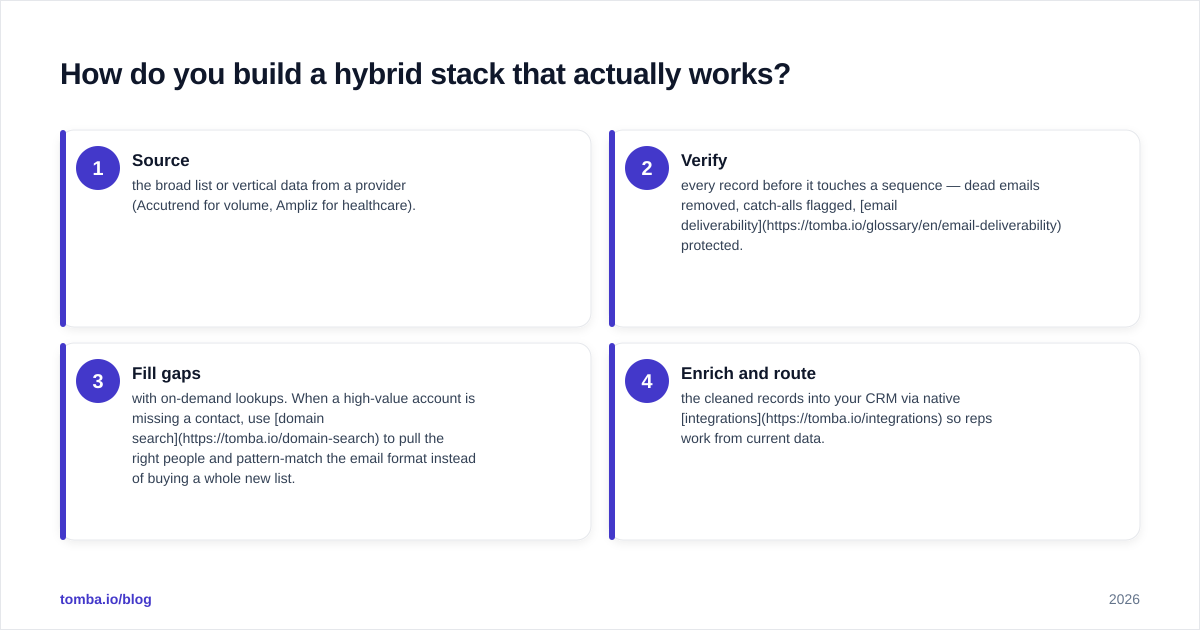
The best-performing teams don't treat this as either/or. They layer it:
- Source the broad list or vertical data from a provider (Accutrend for volume, Ampliz for healthcare).
- Verify every record before it touches a sequence — dead emails removed, catch-alls flagged, email deliverability protected.
- Fill gaps with on-demand lookups. When a high-value account is missing a contact, use domain search to pull the right people and pattern-match the email format instead of buying a whole new list.
- Enrich and route the cleaned records into your CRM via native integrations so reps work from current data.
This is the part most "Accutrend vs Ampliz" comparisons miss: the data vendor is only step one. Verification and targeted gap-filling are where deliverability and reply rates are won. Industry guidance from sources like HubSpot repeatedly stresses list hygiene as the single highest-leverage email habit — and that's vendor-agnostic.
What are the pros and cons of each?#
Accutrend Data
- Pros: deep US B2B coverage, strong append service, efficient at volume.
- Cons: static-snapshot freshness risk, opaque pricing, no real self-serve trial, minimal built-in verification.
Ampliz
- Pros: standout healthcare/life-sciences data, live search and API, Chrome extension, some self-serve credits.
- Cons: general B2B coverage is commodity-level, healthcare value doesn't help non-medical GTM, mostly sales-led pricing at scale.
The shared gap: neither is a verification-first tool, so both demand a re-verify step before send. Budget for that in time and cost regardless of which you pick.
Frequently asked questions#
Is Ampliz better than Accutrend? Only for the right job. Ampliz wins decisively if you sell into healthcare or need live API enrichment. For broad bulk lists and CRM appends, Accutrend's volume model is the more natural fit. Neither is universally "better."
Do I still need an email verifier if I buy data from them? Yes. Compiled and enriched data decays continuously. Always run a fresh verification pass with an email verifier before any campaign to keep bounce rates low and protect sender reputation.
Which is cheaper? Both are quote-heavy, so true cost depends on volume. If you want transparent, testable pricing with a free tier, a dedicated finder like Tomba is easier to budget and trial.
Can I just use a finder tool instead of either? For precision outbound to named accounts — usually yes. For bulk direct mail or healthcare-specific data, a specialist provider still earns its place.
The bottom line#
Accutrend and Ampliz are solving volume and vertical problems, not precision-outbound problems. If your team's real job is finding the right contact at the right company and reaching them without bouncing, you don't need a heavyweight data contract — you need accurate lookups plus verification on demand.
Start free with the Tomba Email Finder: find professional emails by domain, name, or company, verify them in the same workflow, and skip the quote-based negotiation entirely. Test 25 searches on the free tier, confirm the data quality against your own targets, and scale only when it's working. That's the fastest path from "which vendor?" to "reps are booking meetings."
Get the Tomba newsletter
Practical outbound tactics and product updates — once every two weeks.
About the author