Accutrend vs Cognism 2026: B2B Data Provider Compared
Accutrend and Cognism both promise clean B2B contact data, but they serve very different buyers. Here's how their accuracy, compliance, coverage, and pricing actually stack up in 2026.
You found two B2B data vendors on your shortlist with almost nothing in common except the promise of "accurate contact data." Accutrend is a direct-mail and list-data house that has quietly powered marketing campaigns for decades. Cognism is a venture-backed sales intelligence platform built for outbound SDR teams in the GDPR era. Picking between them is less about which is "better" and more about which problem you're actually solving.
This breakdown compares Accutrend vs Cognism on the axes that change your pipeline: data accuracy, compliance, phone coverage, integrations, pricing, and the buyer each one is genuinely built for.
TL;DR: Accutrend vs Cognism in one screen#
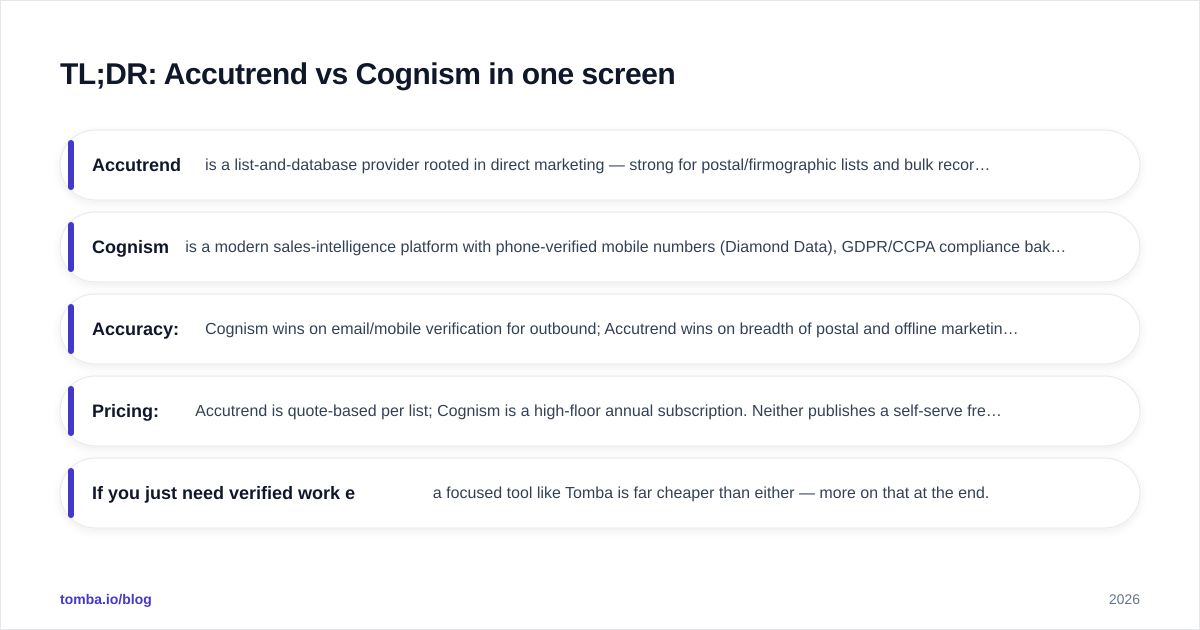
- Accutrend is a list-and-database provider rooted in direct marketing — strong for postal/firmographic lists and bulk records, weaker for real-time, verified outbound email and mobile data.
- Cognism is a modern sales-intelligence platform with phone-verified mobile numbers (Diamond Data), GDPR/CCPA compliance baked in, and native CRM sync — but it carries an enterprise price tag and annual contracts.
- Accuracy: Cognism wins on email/mobile verification for outbound; Accutrend wins on breadth of postal and offline marketing records.
- Pricing: Accutrend is quote-based per list; Cognism is a high-floor annual subscription. Neither publishes a self-serve free tier.
- If you just need verified work emails on demand, a focused tool like Tomba is far cheaper than either — more on that at the end.
What is Accutrend?#
Accutrend Data is a B2B data compiler and list provider. Its core business is supplying marketing databases — company records, executive contacts, postal addresses, SIC/industry codes, and demographic selects — for direct mail, telemarketing, and email campaigns. Think of it as a wholesale data warehouse: you tell them the audience (industry, geography, company size, title), and they hand you a list.
That model is built for campaign marketers and agencies who buy audiences in bulk rather than prospect account-by-account. Accutrend's strength is the long tail of offline and firmographic attributes that pure sales-intelligence tools often ignore. Its weakness is that list-compiled data ages quickly: a postal record stays valid far longer than a work email or a direct dial, and bulk lists are rarely re-verified at the moment you export them.
What is Cognism?#
Cognism is a sales intelligence platform aimed at outbound revenue teams. Its headline feature is Diamond Data — mobile numbers that are phone-verified by a human research team, which dramatically lifts connect rates for SDRs. Cognism layers on intent data, company event triggers, technographics, and a Chrome extension that pulls contacts straight off LinkedIn and company sites.
Crucially, Cognism markets itself as compliance-first: it checks contacts against Do-Not-Call registries across regions and positions itself as GDPR- and CCPA-aligned, which is why it landed hard in the European market where many US-built databases stumble. It's a platform you live inside daily, not a list you buy once.
How accurate is the data — Accutrend vs Cognism?#
Accuracy is where these two diverge most, because they verify data in fundamentally different ways.
Cognism re-verifies a meaningful slice of its mobile dataset through live phone calls, and its email records pass through automated validation. For an SDR dialing prospects, that human-verified layer is the entire value proposition — a bad number wastes a call slot; a verified one books a meeting.
Accutrend's compiled-list model optimizes for coverage and selectability across millions of records, but bulk lists are a snapshot. By the time a list is delivered, work emails may have churned through job changes, and direct dials may be stale. For postal and firmographic data — which changes slowly — this matters far less. For outbound email and mobile, it matters a lot.
The honest takeaway: no vendor's database is "98% accurate" the day it reaches you unless it's verified at export time. That's why teams increasingly run any list — from either provider — through a dedicated email verifier before sending, instead of trusting a vendor's headline accuracy number.

Accutrend vs Cognism: side-by-side comparison#
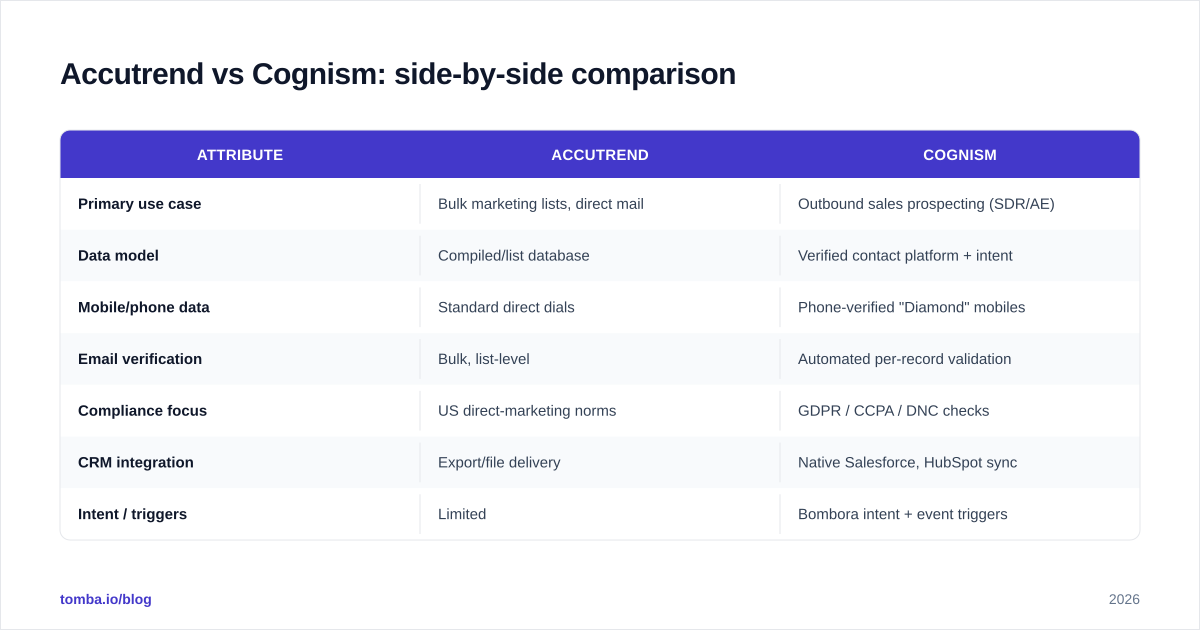
Here's how the two stack up on the attributes that actually drive a buying decision. Use it as a scan, not gospel — verify current specifics against each vendor before you sign.
| Attribute | Accutrend | Cognism |
|---|---|---|
| Primary use case | Bulk marketing lists, direct mail | Outbound sales prospecting (SDR/AE) |
| Data model | Compiled/list database | Verified contact platform + intent |
| Mobile/phone data | Standard direct dials | Phone-verified "Diamond" mobiles |
| Email verification | Bulk, list-level | Automated per-record validation |
| Compliance focus | US direct-marketing norms | GDPR / CCPA / DNC checks |
| CRM integration | Export/file delivery | Native Salesforce, HubSpot sync |
| Intent / triggers | Limited | Bombora intent + event triggers |
| Pricing | Quote per list | Annual subscription (enterprise) |
| Free / self-serve tier | No | No |
| Best fit | Marketers buying audiences | Revenue teams running outbound |

Which is better for compliance and GDPR?#
Cognism, clearly — if you sell into Europe. It was engineered around GDPR from the start, runs Do-Not-Call register checks, and gives revenue teams a defensible story for where contact data originated and how it's processed. If your motion is cold outbound across the EU or UK, that compliance posture isn't a nice-to-have; it's the difference between a legal program and a liability.
Accutrend operates in the traditional US direct-marketing world, where the compliance bar (CAN-SPAM, list hygiene) is real but different. For a US postal or telemarketing campaign, it's well within norms. For pan-European cold email and mobile dialing, Cognism's framework is the safer default. If compliance terms drive your shortlist, read each vendor's DPA and current certifications directly — and cross-reference verified reviews on G2 rather than relying on sales decks.
)
(If that image link looks odd, it's a meme placeholder — your CMS swaps it for the rendered graphic.)

How does pricing compare?#
Neither vendor is cheap, and neither shows you a price before a call.
Accutrend prices per list or per data project — you scope an audience and get a quote, often with cost-per-record or volume tiers. That's economical when you need one large audience occasionally, and awkward when you need fresh records continuously.
Cognism sells annual platform subscriptions, typically with a per-seat structure and a meaningful floor (often quoted in the low-to-mid five figures per year for a team). You're paying for a living platform — refreshed data, intent, the Chrome extension, CRM sync — not a one-time file.
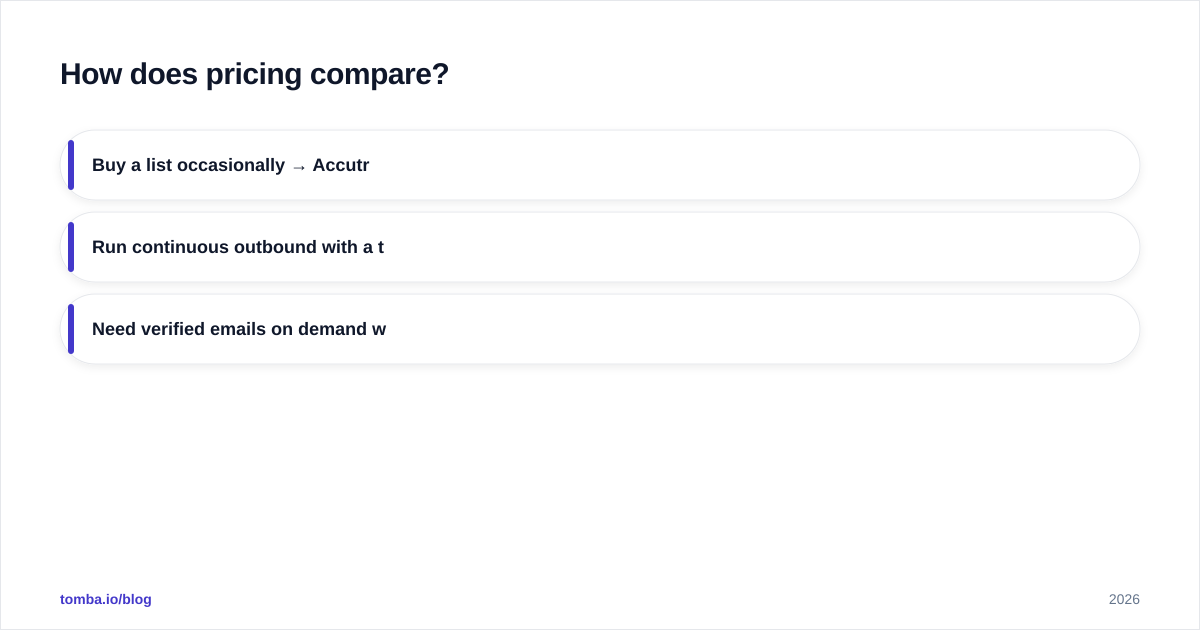
The decision frame:
- Buy a list occasionally → Accutrend's project pricing fits.
- Run continuous outbound with a team → Cognism's subscription amortizes.
- Need verified emails on demand without an annual contract → a usage-based email finder is the cheaper third path.
This is the gap most "Accutrend vs Cognism" comparisons miss: many teams don't need either a bulk list house or a five-figure platform. They need a precise, verified work email for a specific person at a specific company — and they need it to cost cents, not thousands.
Who should choose Accutrend?#
Choose Accutrend if you're a direct-marketing or demand-gen team that thinks in audiences, not accounts. If your campaigns run on postal mail, broad email blasts to compiled segments, or telemarketing lists selected by firmographics and demographics, Accutrend's depth of compiled attributes is hard to match with a sales-intelligence tool. You're trading real-time freshness for breadth and selectability — a fair trade when the channel (postal, especially) tolerates older data.
Who should choose Cognism?#
Choose Cognism if you run outbound sales at scale, particularly into Europe. The phone-verified mobile data lifts dial connect rates, the GDPR framework de-risks the program, and the native CRM sync means reps work without exporting CSVs. If you have SDRs whose day is dials and sequences, Cognism is built for exactly that workflow — and the price reflects that it's a daily platform, not a periodic purchase.
Is there a lighter, cheaper alternative to both?#
Yes — and for a large share of teams, it's the right answer. If your real need is "find and verify professional email addresses on demand," a focused email-finder platform beats both a bulk list house and an enterprise suite on cost and speed.
That's where Tomba fits. Instead of a quote-based list or a five-figure annual contract, you get usage-based access to find emails by name, company, or domain, plus verification built in. A few concrete differences:
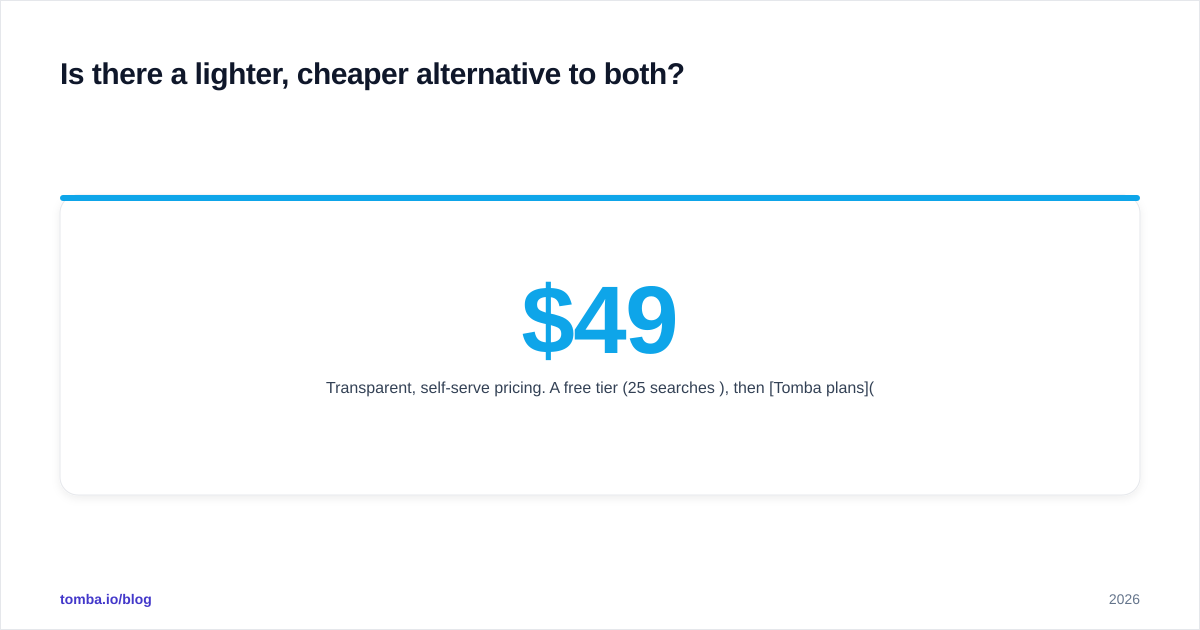
- Transparent, self-serve pricing. A free tier (25 searches/mo), then Tomba plans at Starter $49/mo, Growth $99/mo, and Pro $249/mo — no sales call to see a number.
- Verify before you send. Pair the finder with the verifier to scrub any list — including one you bought from Accutrend or exported from Cognism — and protect your sender reputation.
- Find by company, not just by person. Use domain search to pull every public email pattern at a target account in one query.
- Enrich what you already have. Push thin records through data enrichment to fill missing emails, titles, and company fields.
You can read more about where Tomba sources its data if accuracy provenance is part of your evaluation — the same question you should ask Accutrend and Cognism.
Accutrend vs Cognism: the verdict#
There's no single winner, because they're not really competing for the same job.
- For bulk, offline-friendly marketing audiences — Accutrend.
- For compliant, phone-verified outbound at team scale — Cognism.
- For precise, verified work emails on a usage-based budget — neither; use a dedicated email finder.
Map the tool to the motion. If you buy audiences a few times a year, Accutrend's list model is efficient. If you run a European outbound engine, Cognism's verification and compliance justify the spend. And if you're a founder, marketer, or rep who just needs the right email — verified, now, without a contract — start with the lighter option.
Start finding verified emails today#
If the honest answer to "Accutrend vs Cognism" is "I just need accurate emails without an enterprise commitment," skip the sales calls. The Tomba Email Finder lets you find professional email addresses by domain, name, or company, verify them on the spot, and scale from a free tier up to bulk — with pricing you can see before you buy. Run your first 25 searches free, then upgrade only when the pipeline proves it's worth it.
// get started
Find, verify and enrich your first contacts today
Start on the free plan with 25 searches a month, then scale when your team is ready.
Free plan · No credit card required · GDPR & CCPA
// about the author