Accutrend vs Kipplo: B2B Sales Tool Comparison (2026)
Accutrend vs Kipplo, broken down for 2026: pricing, data accuracy, integrations, and a simple framework to pick the B2B sales tool that actually fits your team.
Choosing between Accutrend and Kipplo usually comes down to one question your free trial won't answer: which one fits the way your team already prospects? Both promise cleaner data, faster list-building, and more booked meetings. The difference shows up in pricing structure, data accuracy, and how painlessly each tool drops into your existing stack.
This breakdown gives you a side-by-side comparison, a reusable framework for scoring any sales tool, and an honest look at where a focused alternative makes more sense than an all-in-one suite.
TL;DR#
- Accutrend leans toward larger teams that want an all-in-one platform — broad data coverage, heavier admin, higher price floor.
- Kipplo targets lean, fast-moving teams with a lighter UI and a lower entry price, but a narrower data footprint.
- Pricing is the biggest practical separator: total cost depends on seats and enrichment credits, not the sticker price.
- Data accuracy matters more than feature count — a bigger database with stale records loses to a smaller, verified one.
- If your core need is finding and verifying business email addresses, a focused tool like Tomba Email Finder often beats paying suite pricing for features you won't touch.
What are Accutrend and Kipplo?#
Accutrend and Kipplo are both B2B sales intelligence tools — software that helps sales and marketing teams find prospects, enrich contact records, and feed clean data into outreach campaigns.
Accutrend positions itself as a broad platform: contact and company data, list-building, enrichment, and reporting bundled together. The pitch is consolidation — one login instead of five point tools. That breadth is genuinely useful for larger revenue teams with the budget and the admin time to configure it.
Kipplo takes the opposite stance. It's a lighter, faster tool built around quick prospecting and contact discovery, with a simpler interface and a lower starting price. It's aimed at founders, small SDR teams, and agencies that want to move fast without a procurement cycle.
Neither is "better" in the abstract. The right pick depends on team size, how much data you actually consume per month, and how much of an all-in-one suite you'll realistically use. Before going further, it's worth grounding yourself in what these categories even mean — sites like G2 and Gartner Peer Insights maintain large, user-reviewed directories of sales intelligence tools that are useful sanity checks against any vendor's own marketing.
How do Accutrend and Kipplo compare at a glance?#
Here's a side-by-side on the attributes that change the decision. Treat the pricing rows as representative tiers — always confirm current numbers on each vendor's live pricing page, since plans shift often.
| Attribute | Accutrend | Kipplo |
|---|---|---|
| Best for | Mid-market & enterprise revenue teams | Founders, small SDR teams, agencies |
| Entry price | Higher floor, annual-leaning | Lower monthly entry |
| Free tier | Limited trial credits | Small free plan |
| Core strength | Broad data + reporting suite | Fast prospecting UI |
| Email verification | Built-in, suite-gated | Add-on / lighter |
| Integrations | Wide (CRM, automation, BI) | Core CRMs +Zapier |
| Bulk enrichment | Yes, credit-metered | Yes, smaller caps |
| Learning curve | Steeper (admin-heavy) | Shallow (self-serve) |
| Support | Tiered, CSM at higher plans | Email/chat, community |
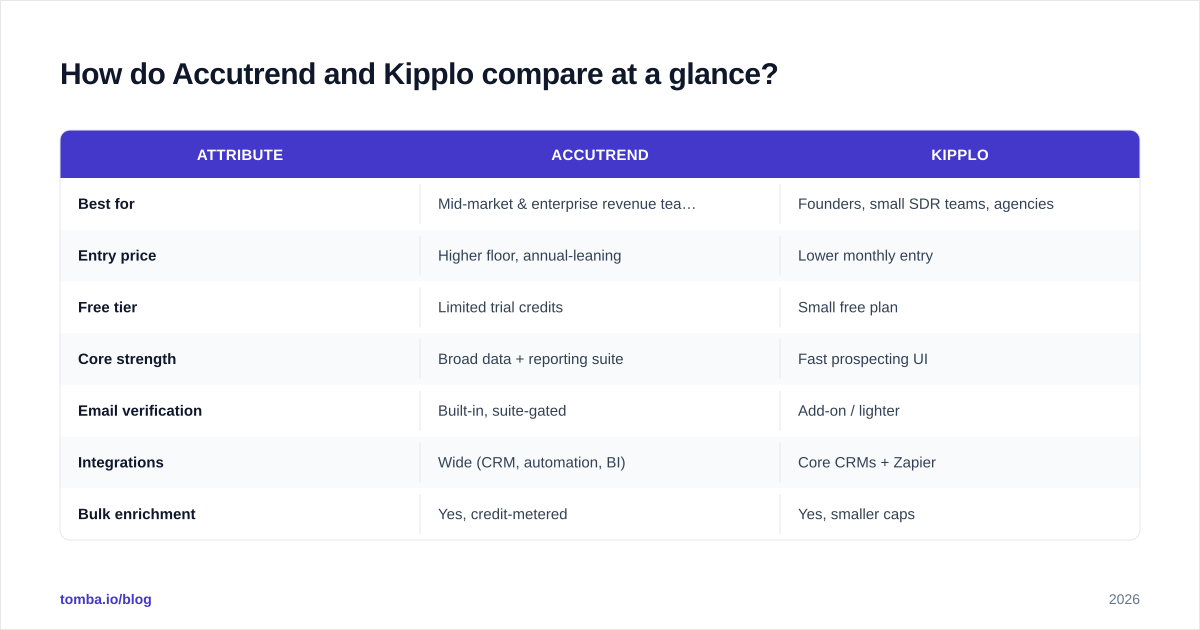
The table tells you the shape of each tool, but it can't tell you the fit. For that you need a scoring method, not a feature list.
How should you evaluate a B2B sales tool?#
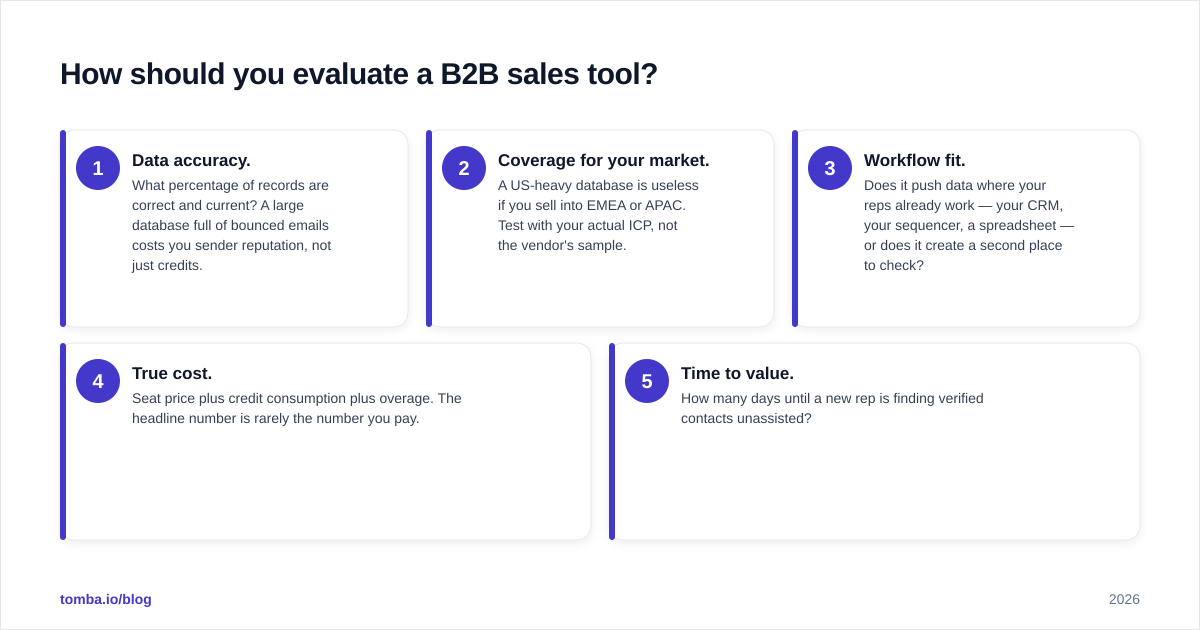
Score any tool — Accutrend, Kipplo, or a third option — across five criteria instead of counting features. A tool with 40 features you don't use is worse than one with 8 you use daily.
- Data accuracy. What percentage of records are correct and current? A large database full of bounced emails costs you sender reputation, not just credits.
- Coverage for your market. A US-heavy database is useless if you sell into EMEA or APAC. Test with your actual ICP, not the vendor's sample.
- Workflow fit. Does it push data where your reps already work — your CRM, your sequencer, a spreadsheet — or does it create a second place to check?
- True cost. Seat price plus credit consumption plus overage. The headline number is rarely the number you pay.
- Time to value. How many days until a new rep is finding verified contacts unassisted?
Run both trials against the same target account list. Pull 50 prospects in each, then verify the results. The tool that returns more reachable, correct contacts wins — regardless of which has the prettier dashboard.

Which has better data accuracy?#
Accuracy beats volume, every time. A database advertising "200M contacts" means nothing if a third of the emails bounce — and high bounce rates quietly wreck your email deliverability and sender reputation.
Accutrend typically markets larger total coverage, which helps when you're prospecting into broad or niche segments. The risk with any large aggregated database is staleness: people change jobs roughly every two to three years, so records decay fast unless they're continuously re-verified.
Kipplo's smaller footprint can actually work in its favor if its data is fresher and more tightly verified, but you'll hit coverage gaps on harder-to-find or international contacts.
The only honest test is your own. Take a known list — 50 contacts you can independently confirm — and run it through both. Measure three things:
- Match rate: how many contacts each tool found at all.
- Accuracy rate: how many returned emails are actually valid.
- Bounce risk: how many are catch-all or risky addresses.
Whatever either tool returns, verify before you send. Running results through a dedicated email verifier catches dead addresses before they hit your sending domain. This is also where a catch-all verifier earns its keep — catch-all domains accept everything at the SMTP layer, so they need deeper checks than a standard ping.
How do pricing and value compare?#
Pricing is where most Accutrend vs Kipplo decisions are actually won or lost — and where the sticker price misleads you most.
Accutrend's value proposition is consolidation: if you genuinely replace three or four tools with it, the higher price can pencil out. The trap is paying suite pricing while using one module. Kipplo's lower entry point is friendlier to small teams, but credit caps and add-ons can push the real monthly cost up once you scale volume.
Three line items decide your true spend:
- Seats. Per-user pricing punishes growing teams. Confirm whether inactive seats still bill.
- Credits. Enrichment and verification are usually metered. Estimate your real monthly volume, then check overage rates — that's where surprise bills live.
- Contract length. Annual lock-in often hides the "real" price behind a discount you only get for committing 12 months.
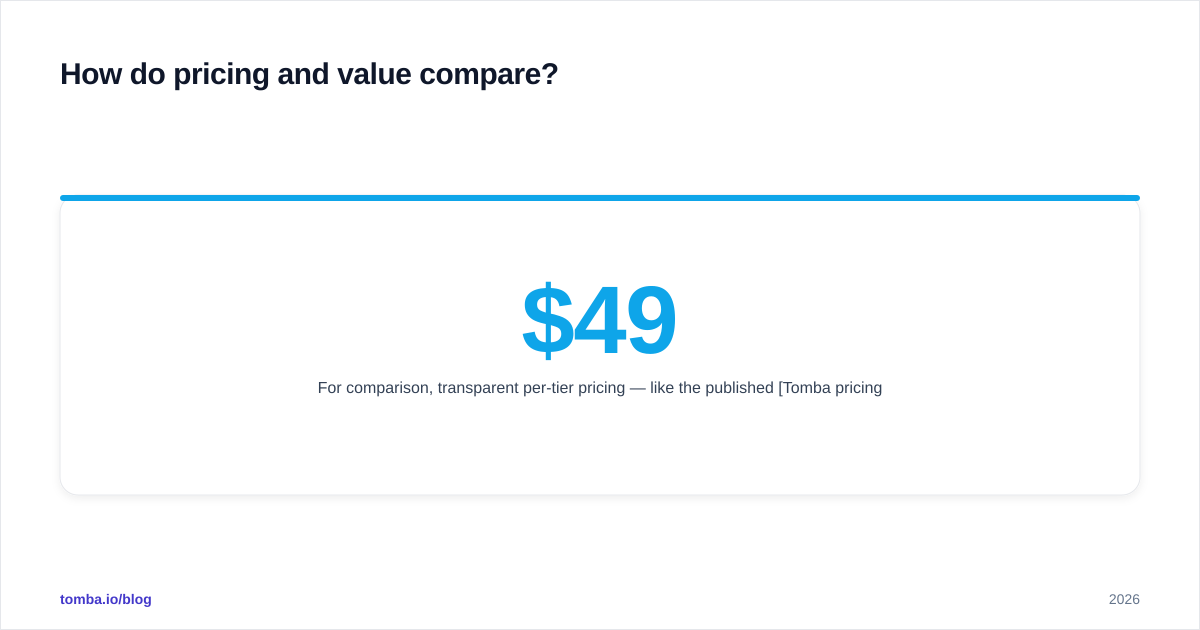
For comparison, transparent per-tier pricing — like the published Tomba pricing (Free at 25 searches/mo, Starter at $49/mo, Growth at $99/mo, Pro at $249/mo) — makes it far easier to model annual cost than credit systems that obscure consumption. When you evaluate Accutrend or Kipplo, rebuild their pricing into a simple "cost per verified contact per month" number. That single figure cuts through most marketing.
Which integrates better with your stack?#
A sales tool that doesn't push data into your CRM creates a second system of record — and reps will quietly abandon it.
Accutrend generally offers wider native integrations: major CRMs, automation platforms, and sometimes BI tools. If you run a complex stack and need data flowing into reporting layers, that breadth matters. Kipplo covers the essentials — common CRMs plus Zapier or similar — which is plenty for a lean team but can feel limiting at scale.
Map your non-negotiables before you trial either one:
- Does it write to your CRM (HubSpot, Salesforce, Pipedrive) natively, not just via export?
- Can it trigger or feed your sequencer automatically?
- Is there an API for the workflows no native integration covers?
If a native connector is missing, an API and a Zapier integration usually bridge the gap. HubSpot's own integration marketplace is a good reference for what a mature connector ecosystem looks like — judge any vendor against that bar.

Is Accutrend or Kipplo better for cold outreach?#
For cold outreach specifically, the winner is whichever tool delivers more deliverable contacts — not more contacts.
Cold email lives and dies on list hygiene. Every invalid address you send to raises your bounce rate, and a high bounce rate tells inbox providers you're not maintaining your list, which lands future emails in spam. So the outreach question collapses back into the accuracy question from earlier.
A practical outreach-ready workflow looks like this regardless of which platform you pick:
- Build the list by company using domain search to pull contacts for target accounts.
- Enrich the records — title, seniority, location — with data enrichment so you can segment and personalize.
- Verify everything through an email verifier before a single send.
- Segment by persona and write to the segment, not the spreadsheet.
If Accutrend or Kipplo handles steps 1–2 well but verification is an afterthought, plug a dedicated verifier into step 3. Skipping it is the single most common reason cold campaigns underperform — long before subject lines or copy ever become the bottleneck.
Where does Tomba fit in the Accutrend vs Kipplo decision?#
If your real need is finding and verifying business emails — not a full sales suite — a focused tool is usually the better economic call.
Accutrend and Kipplo are platforms; you pay for breadth. But many teams buy a sales intelligence suite and then use roughly one feature: finding contact emails. If that's you, paying for reporting dashboards and modules you'll never open is wasted budget.
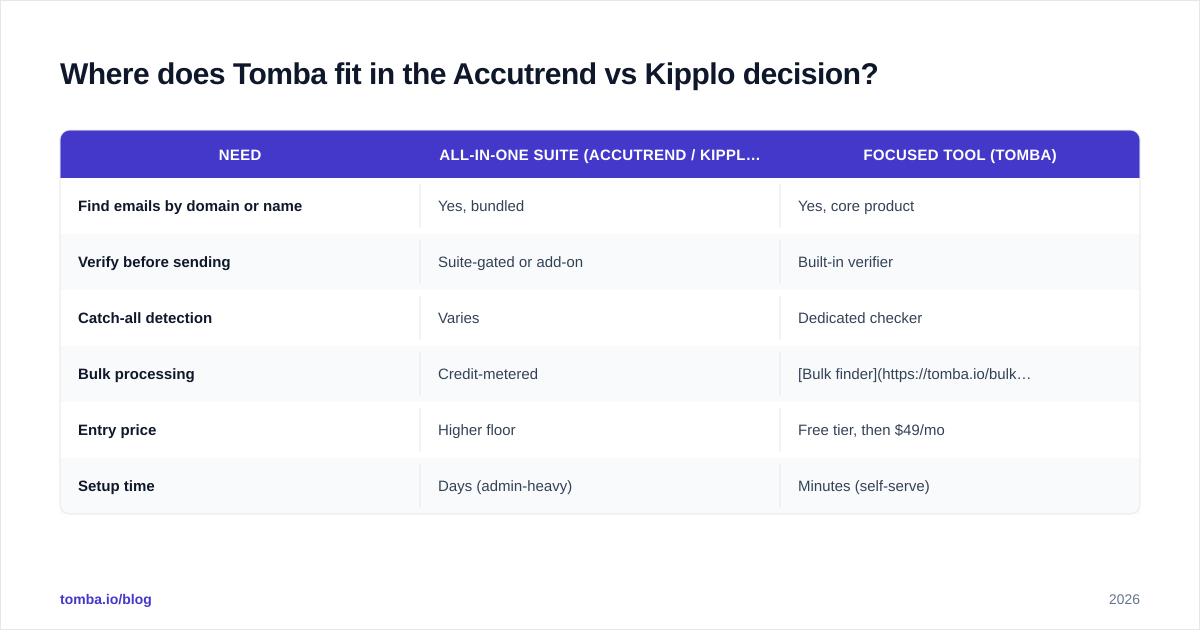
Here's an honest comparison of the focused-tool approach against the all-in-one suites:
| Need | All-in-one suite (Accutrend / Kipplo) | Focused tool (Tomba) |
|---|---|---|
| Find emails by domain or name | Yes, bundled | Yes, core product |
| Verify before sending | Suite-gated or add-on | Built-in verifier |
| Catch-all detection | Varies | Dedicated checker |
| Bulk processing | Credit-metered | Bulk finder |
| Entry price | Higher floor | Free tier, then $49/mo |
| Setup time | Days (admin-heavy) | Minutes (self-serve) |
Tomba won't replace a true all-in-one platform if you genuinely need CRM-grade reporting and a unified data warehouse. But for the most common job — turning a company or a name into a verified, reachable email — it does that one thing accurately, with transparent pricing and no credit-system guesswork.
The verdict#
Pick Accutrend if you're a larger team that will actually use a broad platform and has the admin capacity to run it. Pick Kipplo if you're a lean team that values speed, simplicity, and a lower entry price over maximum coverage. And run both trials against the same 50-contact test list before you commit — the winner on your own data is the only verdict that counts.
But if you stepped back and realized the job you're hiring a tool for is really "find verified business emails, reliably, without overpaying," you don't need a suite. Tomba Email Finder finds professional email addresses by domain, name, or company, verifies them before you send, and starts free with 25 searches a month — no annual lock-in, no credit math. Test it against the same list you used for Accutrend and Kipplo, and let the bounce rate decide.
// get started
Find, verify and enrich your first contacts today
Start on the free plan with 25 searches a month, then scale when your team is ready.
Free plan · No credit card required · GDPR & CCPA
// about the author