Accutrend vs LeadGenius 2026: Which B2B Data Tool Wins?
Accutrend and LeadGenius both sell B2B data, but they solve different problems. Compare pricing, accuracy, coverage, and self-serve fit before you commit budget.
Choosing between Accutrend and LeadGenius is really a choice between two philosophies of B2B data. One sells you lists and database access. The other sells you a managed research team wrapped in software. Picking the wrong one wastes both money and a quarter of pipeline.
This breakdown compares both on pricing, data accuracy, coverage, delivery model, and the kind of team each actually fits. No vendor spin — just where each one earns its keep and where it falls short.
TL;DR#
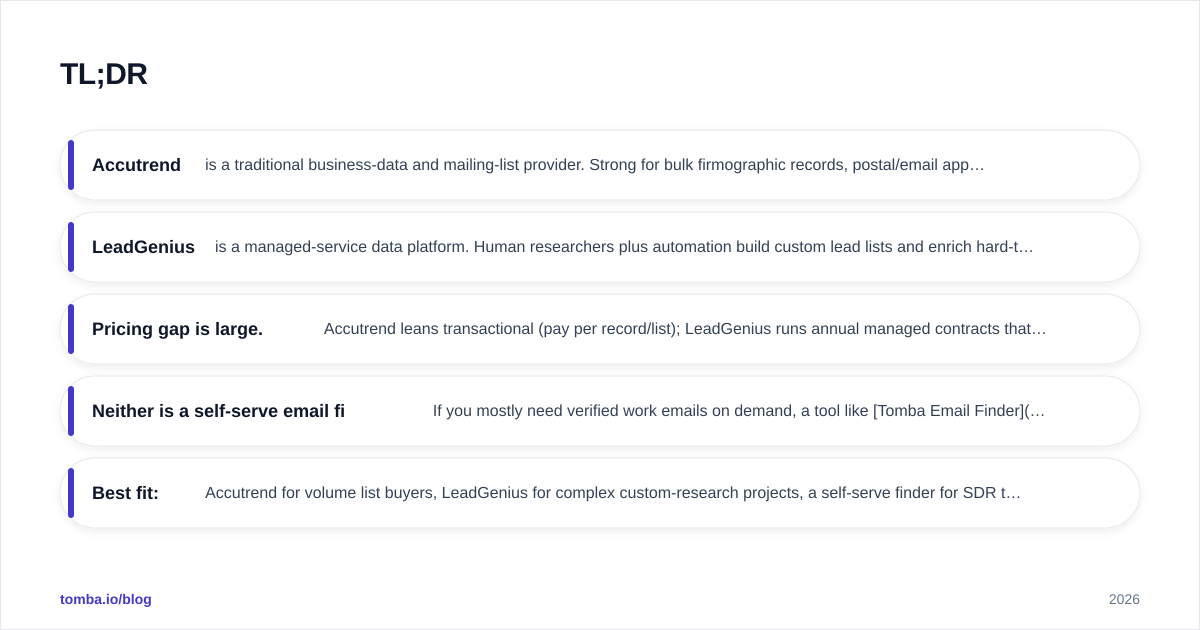
- Accutrend is a traditional business-data and mailing-list provider. Strong for bulk firmographic records, postal/email append, and high-volume direct marketing — weaker on real-time, person-level intent.
- LeadGenius is a managed-service data platform. Human researchers plus automation build custom lead lists and enrich hard-to-find segments — powerful but priced for enterprise and slower to spin up.
- Pricing gap is large. Accutrend leans transactional (pay per record/list); LeadGenius runs annual managed contracts that typically start in the four-to-five-figure-per-month range.
- Neither is a self-serve email finder. If you mostly need verified work emails on demand, a tool like Tomba Email Finder covers that gap at a fraction of the cost.
- Best fit: Accutrend for volume list buyers, LeadGenius for complex custom-research projects, a self-serve finder for SDR teams who need speed and per-seat pricing.
What is Accutrend?#
Accutrend Data Corporation is a long-standing US business-data compiler. Its core product is access to a large database of business records — company names, addresses, phone numbers, SIC/industry codes, employee-size ranges, and contact names — sold as lists or licensed feeds for direct mail, telemarketing, and email campaigns.
Think of Accutrend like a wholesale warehouse for business records. You tell it the filters — geography, industry, company size — and it hands you a pallet of matching records. The model is volume-first: it shines when you need 50,000 manufacturing companies in the Midwest for a postal campaign, not when you need the verified personal email of one VP of Engineering this afternoon.
That makes Accutrend a fit for old-school direct marketers, list resellers, and teams running broad ABM-by-mail or outbound calling at scale. The tradeoff is freshness and person-level precision: compiled databases drift, titles change, and bulk records rarely come with the deliverability guarantees modern cold email demands.
What is LeadGenius?#
LeadGenius sits at the opposite end. It is a managed B2B data and lead-generation service that combines a global researcher network with automation to build custom datasets you usually cannot buy off the shelf — niche segments, hard-to-source contacts, international coverage, and custom data points ("which of these stores carry refrigerated shelving," for example).
The analogy: LeadGenius is less a warehouse and more a research firm on retainer. You brief them, and a blend of people and software returns enriched, validated records mapped to your exact ICP. For enterprise GTM and RevOps teams chasing unusual or deep firmographic signals, that custom muscle is the whole point.
The cost of that muscle is price and speed. LeadGenius is sold as an annual managed engagement, onboarding takes time, and it is overkill if your need is simply "verified emails for a known list of companies."
How do Accutrend and LeadGenius compare head to head?#
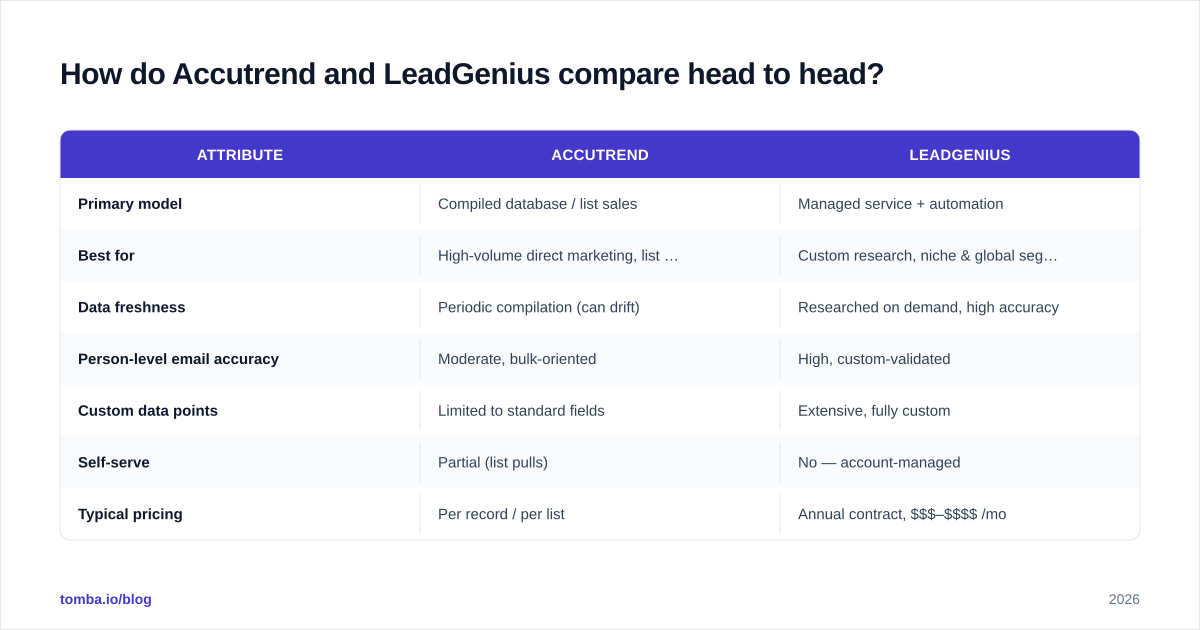
The two tools rarely lose deals to each other because they target different buyers. Here is the practical comparison.
| Attribute | Accutrend | LeadGenius |
|---|---|---|
| Primary model | Compiled database / list sales | Managed service + automation |
| Best for | High-volume direct marketing, list buyers | Custom research, niche & global segments |
| Data freshness | Periodic compilation (can drift) | Researched on demand, high accuracy |
| Person-level email accuracy | Moderate, bulk-oriented | High, custom-validated |
| Custom data points | Limited to standard fields | Extensive, fully custom |
| Self-serve | Partial (list pulls) | No — account-managed |
| Typical pricing | Per record / per list | Annual contract, $$$–$$$$ /mo |
| Time to first data | Fast (hours–days) | Slower (weeks onboarding) |
| Ideal team size | SMB to mid-market marketers | Mid-market to enterprise GTM |
The pattern is clear: Accutrend optimizes for breadth and speed-to-volume; LeadGenius optimizes for depth and accuracy on hard segments. Your choice hinges on whether your bottleneck is "I need many records cheaply" or "I need specific records that don't exist anywhere yet."

Which has better data accuracy?#
LeadGenius wins on accuracy for targeted records; Accutrend wins on raw scale.
Because LeadGenius validates contacts through human researchers as part of the engagement, the records you receive are typically current and verified against your brief. That is exactly what you pay the premium for. Accutrend's compiled model means accuracy is good in aggregate but degrades at the edges — titles, direct dials, and individual emails age faster than the database refresh cycle.
For cold outreach, accuracy is not a nice-to-have. Bounced sends damage your sender reputation and can land your domain on a blocklist. If you buy bulk records from any compiled source, run them through an email verifier before the first send — non-negotiable. Even validated lists benefit from a fresh deliverability check, because mailbox status changes weekly.
A useful third-party sanity check on any vendor's accuracy claims is independent review data on G2 — look at recent reviews mentioning bounce rates and data decay rather than the headline star rating.
How does pricing compare?#
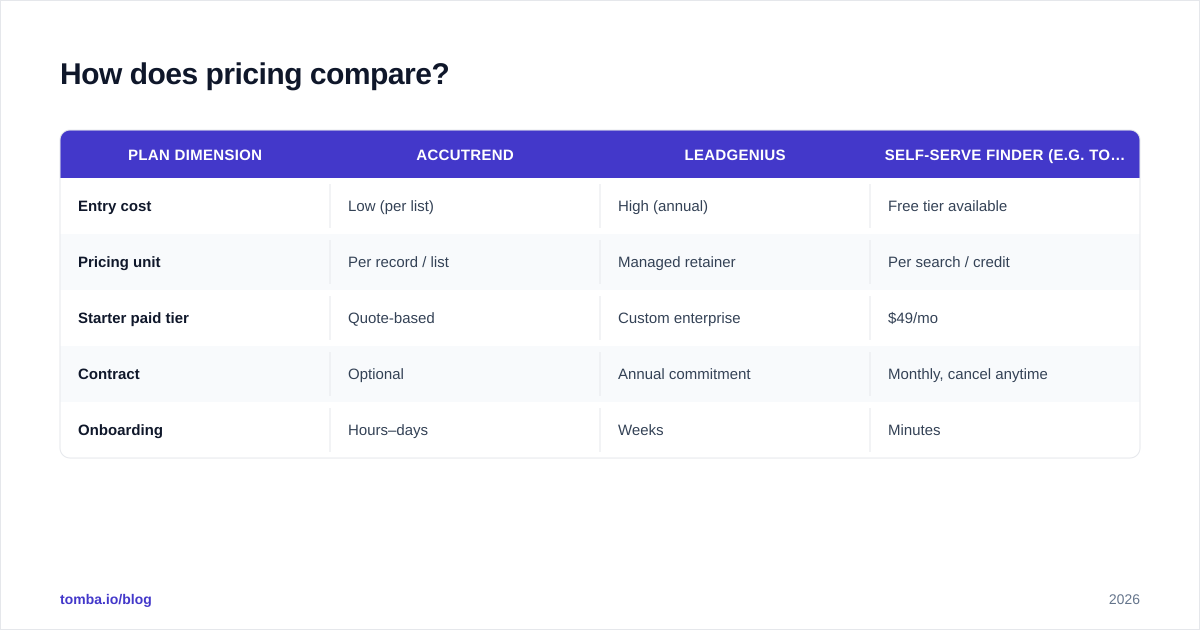
This is where the two diverge most sharply, and where many teams realize neither is the right tool.
Accutrend uses a transactional, volume-based model: you pay per record or per list pull, sometimes with licensing for ongoing feed access. That keeps entry costs low and predictable for a one-time campaign, but per-record economics get expensive if you re-pull frequently or need ongoing freshness.
LeadGenius is a managed annual contract. You are buying a service relationship, not credits, so commitments commonly land in the thousands-to-tens-of-thousands per month depending on scope. For a well-funded enterprise team with a genuinely hard data problem, that ROI can be excellent. For an SDR team that just needs emails, it is far more than the job requires.
| Plan dimension | Accutrend | LeadGenius | Self-serve finder (e.g. Tomba) |
|---|---|---|---|
| Entry cost | Low (per list) | High (annual) | Free tier available |
| Pricing unit | Per record / list | Managed retainer | Per search / credit |
| Starter paid tier | Quote-based | Custom enterprise | $49/mo |
| Contract | Optional | Annual commitment | Monthly, cancel anytime |
| Onboarding | Hours–days | Weeks | Minutes |
If your real need is verified contact data on demand without a procurement cycle, the per-credit model is dramatically cheaper. You can compare transparent Tomba pricing — a free tier with 25 searches, Starter at $49/mo, Growth at $99/mo, Pro at $249/mo — against the quote-and-contract dance both Accutrend and LeadGenius require.

When should you choose Accutrend?#
Choose Accutrend when volume and low per-unit cost matter more than precision. It is a strong pick if you:
- Run direct mail or telemarketing at scale and need broad firmographic coverage.
- Resell or repackage business lists.
- Target by standard fields — industry, geography, employee size — rather than custom signals.
- Need data fast and cheap for a one-off campaign without committing to an annual deal.
Skip it if your outreach is email-led and reputation-sensitive, or if you need person-level accuracy on senior titles. Compiled bulk data and modern cold email are an uneasy match without a heavy verification layer in between.
When should you choose LeadGenius?#
Choose LeadGenius when your data problem is genuinely hard and you have budget to solve it properly. It fits teams that:
- Need custom data points no database sells (store-level attributes, technographic depth, localized signals).
- Target niche or international segments with poor off-the-shelf coverage.
- Have a dedicated RevOps or GTM function that can scope and manage an engagement.
- Treat data as a strategic input worth an annual investment, not a per-campaign expense.
Skip it if you need data this week, if your budget is per-seat rather than per-program, or if your requirement is the common one: verified work emails for a known set of companies. For that last case, a managed-research firm is using a sledgehammer on a thumbtack.
What if you just need verified emails on demand?#
Most teams comparing Accutrend and LeadGenius actually discover their core need is narrower: reliable, verified contact emails for specific people and companies, available instantly and priced per seat. That is a self-serve email-finder job, not a list-buy or a managed-research engagement.
This is the gap a tool like Tomba fills. Instead of pulling a bulk list (Accutrend) or briefing a research team (LeadGenius), you search by person, company, or domain and get a verified result with a confidence score in seconds. Common workflows:
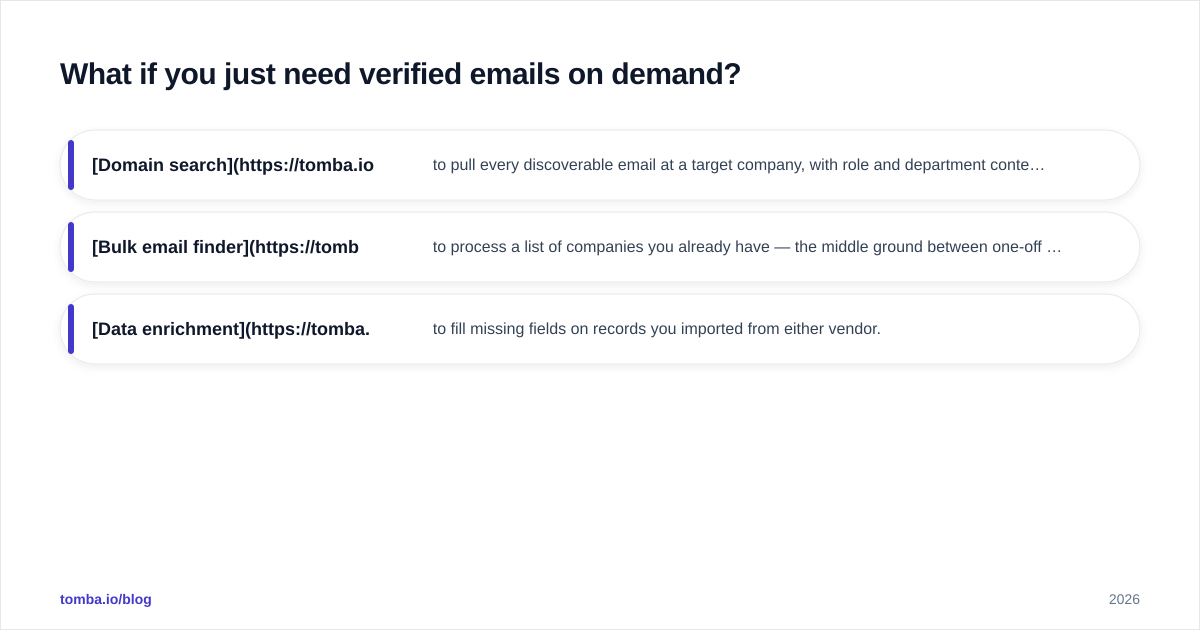
- Domain search to pull every discoverable email at a target company, with role and department context.
- Bulk email finder to process a list of companies you already have — the middle ground between one-off lookups and a full managed project.
- Data enrichment to fill missing fields on records you imported from either vendor.
It is not a replacement for everything Accutrend or LeadGenius do — you will not get LeadGenius-grade custom research or Accutrend's postal-list breadth. But for the daily reality of SDR and growth teams, it covers the highest-frequency need at a fraction of the cost and with no contract.
For deeper background on how the underlying data is sourced and validated, vendor documentation like LeadGenius's own site and neutral category overviews on Wikipedia's lead generation entry are worth reading before you sign anything.
What is the verdict for 2026?#
There is no single winner — there is a winner for your situation:
- Pick Accutrend if you are a volume marketer or list buyer who values low per-record cost and fast access over person-level precision.
- Pick LeadGenius if you are an enterprise GTM team with a hard, custom, or international data problem and the budget to fund a managed solution.
- Pick a self-serve finder if your real need is verified emails on demand, transparent pricing, and zero procurement friction — which describes most outbound teams.
The most expensive mistake is buying the heavy tool for the light job. Audit your actual workflow first: count how often you need data, how custom it must be, and whether reputation-safe email is the goal. That answer usually points more clearly than any feature chart.
Start with the data need you actually have#
If your bottleneck is finding and verifying real, deliverable emails — not buying lists or commissioning research — start there and scale up only if you hit a wall. Tomba Email Finder gives you per-search pricing, a free tier to test accuracy on your own ICP, built-in verification, and integrations with the CRM and tools you already run. Try it on 25 free searches before you commit a dollar to an annual data contract, and let your bounce rate decide.
// get started
Find, verify and enrich your first contacts today
Start on the free plan with 25 searches a month, then scale when your team is ready.
Free plan · No credit card required · GDPR & CCPA
// about the author