Accutrend vs LeadzenAI 2026: Which B2B Data Tool Wins?
A neutral, hands-on breakdown of Accutrend vs LeadzenAI for 2026 — data accuracy, email finding, pricing tiers, and which lead intelligence platform fits your B2B sales motion.
TL;DR
- Accutrend leans toward intent-led account targeting and firmographic enrichment; LeadzenAI leans toward broad contact discovery with a real-time lookup layer. Neither is a pure email finder, and that matters for how you budget.
- On raw email accuracy, both publish optimistic numbers. In practice you should verify every address before sending — independent verification is the only thing that protects your domain.
- Pricing is the sharpest divider: LeadzenAI tends to sell credit bundles aimed at SMB prospectors, while Accutrend targets account-based teams with higher entry points.
- If your core need is simply finding and verifying business emails at a predictable price, a focused tool like Tomba Email Finder often beats paying platform pricing for features you won't use.
- Pick Accutrend for ABM and intent; pick LeadzenAI for volume prospecting; pick a dedicated finder/verifier when accuracy and cost-per-valid-email are the only metrics that matter.
What are Accutrend and LeadzenAI?#
Both Accutrend and LeadzenAI sit in the B2B data and intelligence category, but they solve slightly different problems. Think of it like buying a vehicle: one is a delivery van built to move a defined route efficiently (account-based targeting), the other is a rideshare app built to reach the widest possible set of riders (broad contact discovery). Same road, different cargo.
Accutrend positions itself around firmographic data, account scoring, and buyer signals — the inputs an account-based marketing (ABM) team needs to decide which companies to chase before worrying about individual contacts. LeadzenAI positions itself around contact volume: search a market, pull a list, export names with phone numbers and emails, and feed your outbound machine.
The overlap is the part buyers get confused by. Both promise "verified" contact data. Both promise enrichment. Both will show you a slick dashboard. The difference shows up in three places that this comparison will walk through: data accuracy, workflow fit, and total cost.
If you're new to the category, our B2B database overview explains how contact data is sourced, decayed, and re-verified — useful context before you trust any vendor's accuracy claim.
How accurate is the data in Accutrend vs LeadzenAI?#
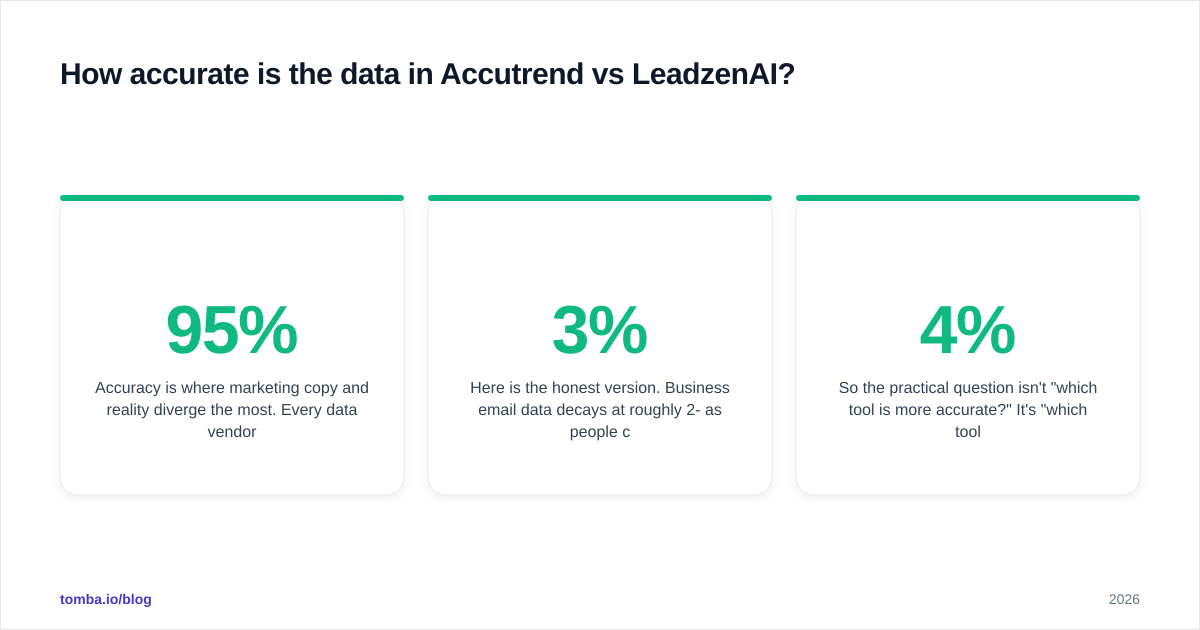
Accuracy is where marketing copy and reality diverge the most. Every data vendor quotes a headline number — "95% accurate," "98% deliverable" — and every one of those numbers is measured under conditions you don't control: a point-in-time snapshot, a favorable test segment, a definition of "accurate" that may just mean "syntactically valid."
Here is the honest version. Business email data decays at roughly 2-3% per month as people change jobs, companies rebrand domains, and inboxes get deactivated. That means a list that was 95% accurate in January is materially worse by June whether the vendor admits it or not. The vendor that re-verifies at the moment of export will always beat the vendor that serves a stale cached record, regardless of whose marketing page claims a higher percentage.

So the practical question isn't "which tool is more accurate?" It's "which tool lets me prove an address is good before I risk my sender reputation on it?" That's why experienced teams treat any platform's email output as a candidate, not a fact, and run it through a dedicated email verifier before the first send. A bounce rate above 3-4% is enough to drag your sender reputation down and push future mail to spam — so the verification step pays for itself.
Both Accutrend and LeadzenAI include some internal validation. Neither replaces a true catch-all and SMTP-level check, especially for the catch-all domains that quietly accept everything and tell you nothing. If your target accounts run catch-all servers, you'll want a dedicated catch-all verifier in the loop no matter which platform you buy.
)
Accutrend vs LeadzenAI: feature and pricing comparison#
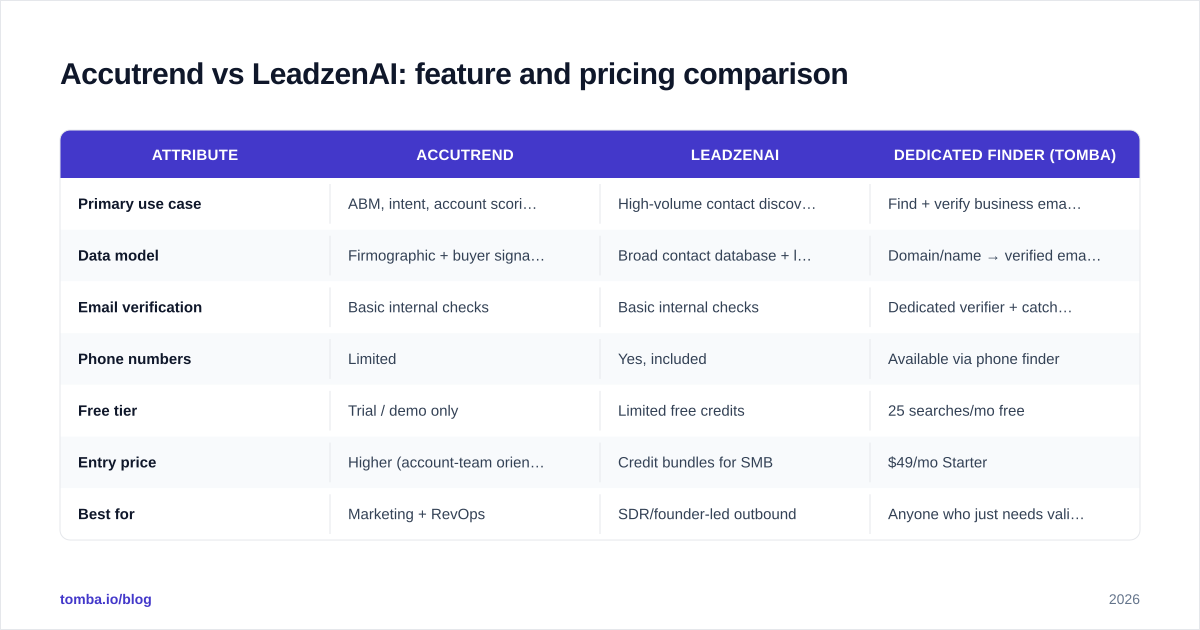
The table below maps the two platforms against the attributes that actually change a buying decision. Treat published pricing as directional — both vendors gate exact numbers behind sales calls and adjust credit bundles frequently — and confirm current figures on their own sites before signing.
| Attribute | Accutrend | LeadzenAI | Dedicated finder (Tomba) |
|---|---|---|---|
| Primary use case | ABM, intent, account scoring | High-volume contact discovery | Find + verify business email |
| Data model | Firmographic + buyer signals | Broad contact database + live lookup | Domain/name → verified email |
| Email verification | Basic internal checks | Basic internal checks | Dedicated verifier + catch-all + SMTP |
| Phone numbers | Limited | Yes, included | Available via phone finder |
| Free tier | Trial / demo only | Limited free credits | 25 searches/mo free |
| Entry price | Higher (account-team oriented) | Credit bundles for SMB | $49/mo Starter |
| Best for | Marketing + RevOps | SDR/founder-led outbound | Anyone who just needs valid emails |
| API access | Yes | Yes | Yes — full email finder API |
A few notes on reading this table honestly:
- "Basic internal checks" is not an insult — it's a scope statement. Platforms built for discovery optimize for breadth, not for the SMTP-level rigor a standalone verifier delivers. That's an architecture choice, not negligence.
- Free tiers are a real differentiator for evaluation. You can test a focused finder against your own known-good list before paying anything; with both platforms here, meaningful testing usually requires a sales conversation first.
- Phone coverage matters if you're multi-channel. If cold calling is part of your motion, factor in a phone finder and validation rather than assuming the platform number is dialable.
For a transparent breakdown of plan limits and credits, you can compare both against published Tomba pricing — useful as a neutral cost anchor even if you ultimately choose a platform.
Which tool fits your sales motion?#
Tool choice should follow your motion, not the other way around. Here's the decision framework, plain.
Choose Accutrend if your team runs account-based marketing and the bottleneck is prioritization, not contact volume. If you have 4,000 target accounts and need to know which 200 are showing buying signals this quarter, intent data earns its keep. Accutrend's value compounds when it feeds a revenue operations process — scoring accounts, routing them, and measuring pipeline by segment. For a single SDR sending 50 emails a day, most of that capability sits unused while you pay for it.
Choose LeadzenAI if you're founder-led or SDR-driven and the bottleneck is raw reach. If you need to build a 2,000-contact list for a new vertical by Friday, a broad discovery tool with credits beats a sophisticated intent platform you don't have time to operationalize. The risk to manage here is list hygiene: high volume plus weak verification equals bounces, so route every export through verification before it touches your sequencer.
Choose a dedicated finder/verifier if your honest need is "give me valid emails for these specific people or domains, at a price I can predict." This is the most common real need and the one most over-served by platform pricing. A domain search to pull every contact at a target company, an email finder for named prospects, and a verifier to clean the result will cover the majority of outbound teams at a fraction of platform cost.
)
The mistake we see most often: a small team buys a heavyweight intelligence platform because the demo was impressive, then uses 10% of it as an expensive email finder. If that's the trajectory you're on, name it before you sign.
What about deliverability and compliance?#
Finding the email is half the job; landing it is the other half, and no data platform handles that for you. Two things sit outside both Accutrend and LeadzenAI:
First, deliverability hygiene. Before you scale sends to a freshly built list, your own domain needs to be in shape — authenticated, warmed, and reputable. If you're standing up a new sending domain, walk through proper authentication and warmup; our notes on email deliverability and the warmup process are a sane starting point. A pristine list sent from a cold, misconfigured domain still lands in spam.
Second, compliance. Both platforms aggregate data that may include personal information governed by GDPR, CAN-SPAM, and similar regimes. Vendor "compliance" claims describe how they source data — not whether your use of it is lawful. You're responsible for lawful basis, opt-outs, and suppression. Authoritative guidance from GDPR.eu and the FTC's CAN-SPAM rules is worth reading before any large outbound campaign, regardless of which tool produced the list.
Independent review sites like G2 are also useful for sanity-checking vendor accuracy claims against what real users report on support, billing surprises, and data freshness — the stuff that never makes the feature page.
How do you actually evaluate them without wasting a month?#
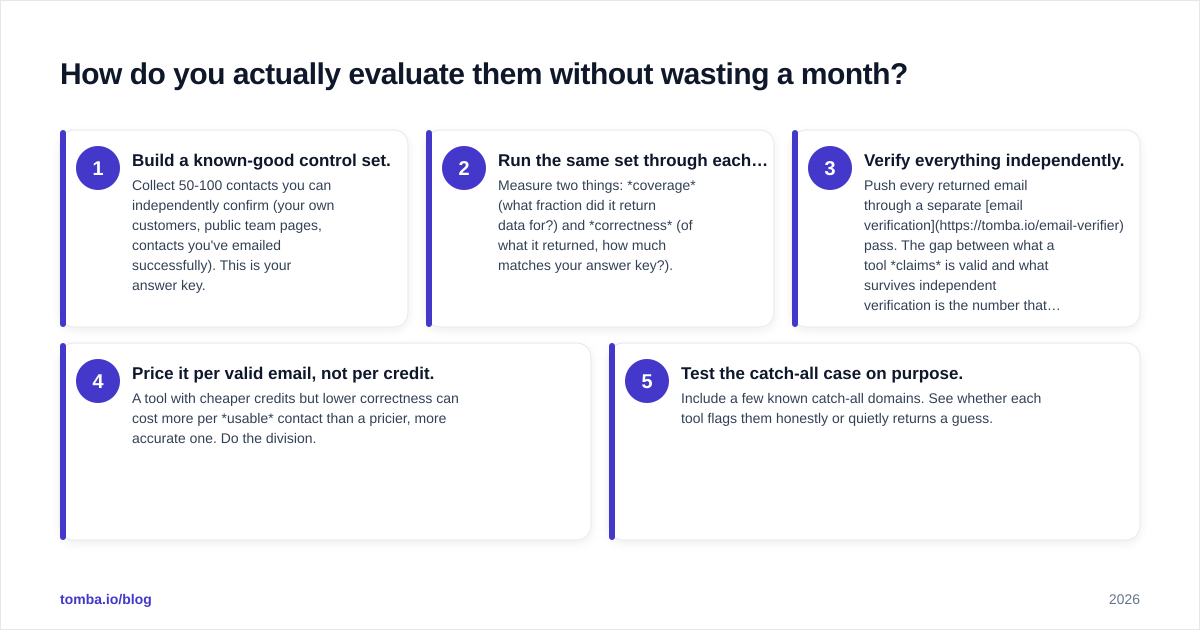
Run a controlled test instead of trusting any dashboard. The protocol is simple and takes an afternoon:
- Build a known-good control set. Collect 50-100 contacts you can independently confirm (your own customers, public team pages, contacts you've emailed successfully). This is your answer key.
- Run the same set through each tool. Measure two things: coverage (what fraction did it return data for?) and correctness (of what it returned, how much matches your answer key?).
- Verify everything independently. Push every returned email through a separate email verification pass. The gap between what a tool claims is valid and what survives independent verification is the number that actually predicts your bounce rate.
- Price it per valid email, not per credit. A tool with cheaper credits but lower correctness can cost more per usable contact than a pricier, more accurate one. Do the division.
- Test the catch-all case on purpose. Include a few known catch-all domains. See whether each tool flags them honestly or quietly returns a guess.
This protocol cuts through marketing because it uses your data and your definition of success. It's also vendor-neutral: run it against Accutrend, LeadzenAI, and a dedicated finder in the same week and let the per-valid-email cost decide. If you'd rather automate the verification leg, the bulk email finder and bulk verify flows let you score whole lists at once.
Frequently asked questions#
Is Accutrend or LeadzenAI better for cold email? Neither is a deliverability tool. LeadzenAI gets you volume faster; Accutrend gets you better targeting. For cold email specifically, the deciding factor is verification quality and your domain health — not the platform's contact count. Verify before you send, every time.
Are the "verified" emails really verified? Treat "verified" as "validated at some point under the vendor's definition." Because business email decays 2-3% monthly, re-verify at send time with a dedicated email verifier. This is the single highest-leverage step for protecting your sender reputation.
Can I just use a cheaper email finder instead? Often, yes. If your real need is finding and verifying business emails — not intent scoring or account analytics — a focused email finder with a transparent free tier and a real verifier usually delivers a lower cost-per-valid-email than a full intelligence platform.
Do they integrate with my CRM? Both offer API access and common CRM connections; confirm your specific stack (HubSpot, Salesforce, Pipedrive) is supported on a current plan. If you build custom workflows, a documented email finder API matters more than a long logo wall of integrations.
The verdict: Accutrend vs LeadzenAI#
There's no universal winner, and any "review" that declares one is selling something. Accutrend wins for account-based teams that need intent and prioritization. LeadzenAI wins for high-volume prospectors who need reach now and will discipline their list hygiene. And for the large middle — teams whose honest job is find the email, confirm it's real, send from a healthy domain — a dedicated finder and verifier beats paying platform pricing for analytics you'll never operationalize.
Whatever you choose, anchor the decision on per-valid-email cost from your own control test, and never let any tool's "verified" label substitute for an independent verification pass.
If your core need is finding accurate business emails at a predictable price, start with the Tomba Email Finder. The free tier gives you 25 searches a month to run the control test above — find emails by domain, name, or company, verify them with the built-in checks, and compare the cost-per-valid-email head to head against Accutrend and LeadzenAI before you commit a dollar. Let the numbers, not the demo, pick your tool.
// get started
Find, verify and enrich your first contacts today
Start on the free plan with 25 searches a month, then scale when your team is ready.
Free plan · No credit card required · GDPR & CCPA
// about the author