Accutrend vs Reachstream: B2B Data Compared (2026)
Accutrend and Reachstream both sell B2B contact data, but they fit very different teams. Here is an honest 2026 breakdown of accuracy, pricing, and the gaps both leave open.
Accutrend vs Reachstream: Which B2B Data Provider Actually Fits Your Team in 2026?
TL;DR
- Accutrend Data is a mailing-list and direct-marketing data house — strong for postal campaigns, broad consumer-plus-business coverage, and bulk list buys.
- Reachstream is a self-serve B2B contact platform — better for SDRs who want filtered email/phone lists inside a dashboard with credit-based pulls.
- Neither tool re-verifies emails at send time, so both can hand you stale addresses that quietly wreck deliverability.
- For pure email accuracy, pair either provider with a live verifier — or skip the list buy entirely and build targeted lists with a search-and-verify tool.
- Pick Accutrend for offline/multichannel volume, Reachstream for digital prospecting, and treat verification as a separate, non-negotiable step.
If you are weighing Accutrend vs Reachstream, you are really asking one question: which one hands my team usable contacts without burning budget on bounces? Both sell B2B data. They sell it to different people, in different shapes, at different price logic. This breakdown keeps it concrete.
What is Accutrend Data?#
Accutrend Data is a long-running list-and-data provider rooted in direct marketing. Think postal lists, business and consumer files, and append services — the kind of data that historically powered mailers, telemarketing, and multichannel campaigns. Its strength is breadth: large compiled files spanning firmographics, industry codes, and contact records you can license in bulk.
That heritage matters. Accutrend's model is closer to a data brokerage than a modern SaaS dashboard. You often specify a target audience, get a count, and buy a list. For teams running offline channels — direct mail, event invites, regional outreach — that's a natural fit.
The trade-off is freshness. Compiled list data ages fast. Job changes, domain switches, and role turnover mean a file that looked clean at purchase can decay 20–30% within a year. That's not unique to Accutrend; it's the structural weakness of any list-buy model.
What is Reachstream?#
Reachstream is a self-serve B2B contact-data platform. You log into a dashboard, apply filters (industry, title, company size, geography, tech stack), and pull contact records — emails and direct dials — against a credit allowance. It targets sales and marketing teams that want to build prospect lists without talking to a salesperson first.
In practice, Reachstream sits in the same competitive set as tools like Apollo, Lusha, and ZoomInfo's lighter tiers: a searchable database plus export. It leans digital-first — the records are built for cold email and calling, not postal mail.
Reachstream's appeal is speed and self-service. You can go from filter to CSV in minutes. The catch is the same one that haunts every database vendor: the quality of any single record depends on when it was last refreshed, and "database accuracy" claims rarely survive contact with a real send.
Accutrend vs Reachstream: how do they compare head-to-head?#
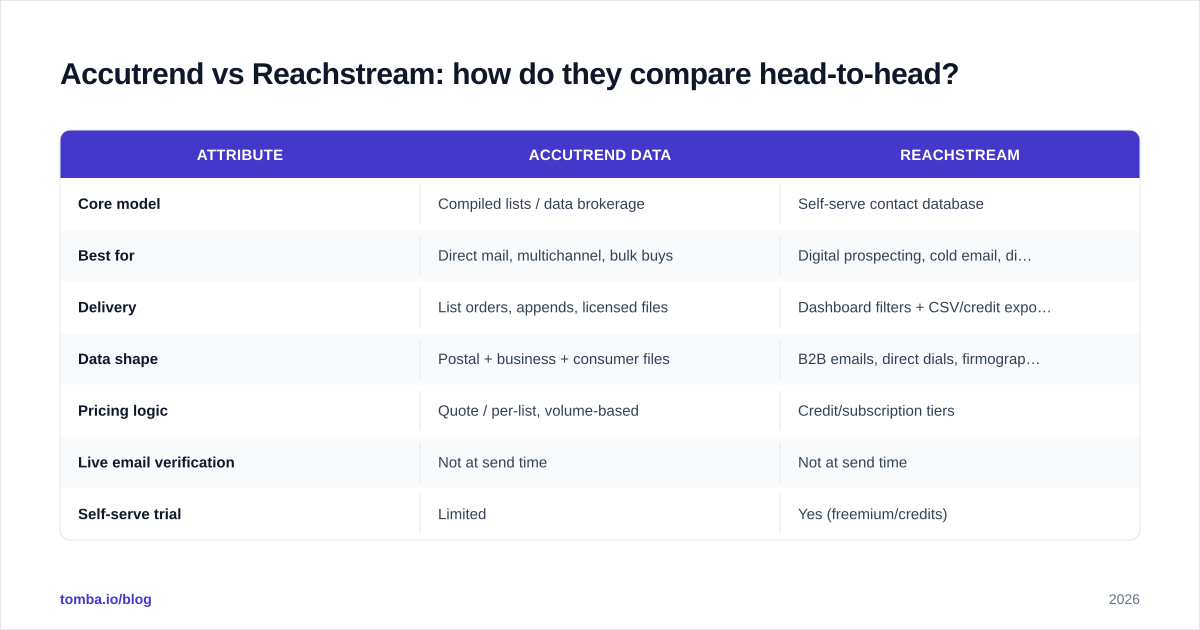
Here's the side-by-side. Treat vendor-published accuracy numbers as marketing claims, not audited benchmarks — independent reviews on G2 and Capterra tell a messier story for almost every data provider.
| Attribute | Accutrend Data | Reachstream |
|---|---|---|
| Core model | Compiled lists / data brokerage | Self-serve contact database |
| Best for | Direct mail, multichannel, bulk buys | Digital prospecting, cold email, dialing |
| Delivery | List orders, appends, licensed files | Dashboard filters + CSV/credit export |
| Data shape | Postal + business + consumer files | B2B emails, direct dials, firmographics |
| Pricing logic | Quote / per-list, volume-based | Credit/subscription tiers |
| Live email verification | Not at send time | Not at send time |
| Self-serve trial | Limited | Yes (freemium/credits) |
| Ideal user | Direct-marketing & ops teams | SDRs, growth, demand gen |
The honest summary: Accutrend wins on offline breadth and volume licensing; Reachstream wins on self-serve digital prospecting speed. Neither solves the verification problem, which is the part that actually costs you deliverability.
)
Which one is more accurate?#
Accuracy is the wrong question if you stop at the database. The right question is: how fresh is the record at the moment you send?
Both Accutrend and Reachstream sell point-in-time snapshots. The instant a contact changes jobs — and roughly 1 in 4 B2B professionals change roles each year — that record is wrong, regardless of how accurate it was at export. This is why a list that benchmarks well on paper can still bounce 8–15% on a real campaign.

The fix isn't choosing the "more accurate" vendor. It's adding a verification layer that checks each address against live mail servers before you hit send. A real-time email verifier catches the decay that any static list — Accutrend's or Reachstream's — can't. Run your purchased list through verification, drop the dead and risky addresses, and your sender reputation survives the campaign.
If you want to understand why this matters mechanically, the relationship between list hygiene and inbox placement is covered well in general resources on email deliverability — bounces and spam traps directly degrade sender reputation, and degraded reputation drags down even your verified sends.
How should you choose between them?#
Use a simple decision framework instead of a feature checklist. The channel you're feeding should drive the pick.
Choose Accutrend if:
- You run direct mail, telemarketing, or multichannel campaigns where postal data matters.
- You buy in volume and want licensed files rather than per-seat dashboards.
- Your ops team is comfortable specifying audiences and working with list counts.
Choose Reachstream if:
- Your SDRs need to self-serve filtered B2B lists for cold email and calling.
- You want a dashboard-and-export workflow with predictable credit pricing.
- You're digital-first and don't need postal records.
Choose neither (build instead) if:
- You target a specific, known set of companies and want emails verified on the spot.
- You're tired of paying for stale records and re-cleaning every list.
That last case is more common than vendors admit. When you already know which companies you want, you don't need to rent a giant compiled file — you need to find and verify the right people at those domains. That's a domain search and verify workflow, not a list buy.
What do Accutrend and Reachstream both miss?#
Three gaps show up no matter which side of the Accutrend vs Reachstream debate you land on.
1. Send-time verification. Both deliver snapshots. Neither re-checks the address when you actually email it. You own that step — or you eat the bounces.
2. On-demand precision finding. List platforms are built for breadth ("give me 5,000 SaaS marketers"). They're weaker when you need one specific person — the VP of Eng at a named 40-person startup. For that, a targeted email finder that resolves a name + domain into a verified address beats scrolling a database.
3. Transparent sourcing. Buyers increasingly want to know where data comes from and how it's refreshed. Vendors vary widely here; you should ask directly and check independent reviews before committing budget. Transparency about data sources is a fair thing to demand from any provider.
)
Where does Tomba fit in this comparison?#
Tomba isn't a replacement for a bulk postal-list house like Accutrend if direct mail is your channel — be clear-eyed about that. But for the digital prospecting use case that Reachstream targets, Tomba approaches the problem from the verify-first angle that both providers leave open.
Instead of renting a static file, you:
- Run a domain search to pull the contacts at companies you actually care about.
- Resolve specific people by name with the email finder.
- Verify every address live before export, so bounces are caught up front.
- Enrich the keepers with firmographic and role data via data enrichment.
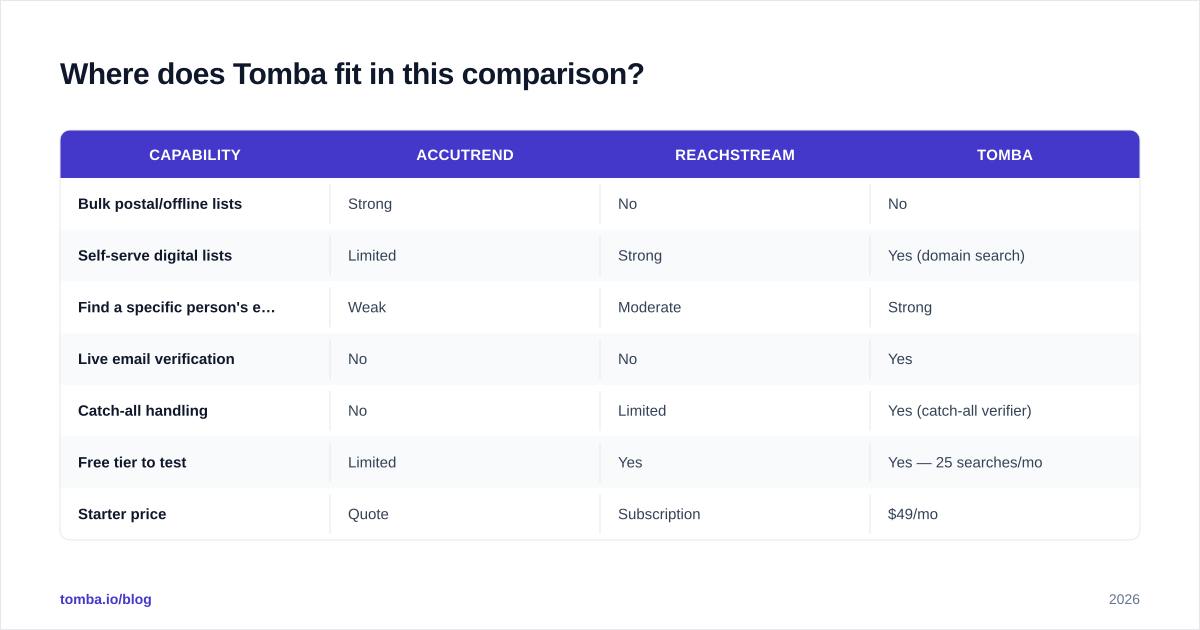
Here's how the workflows line up:
| Capability | Accutrend | Reachstream | Tomba |
|---|---|---|---|
| Bulk postal/offline lists | Strong | No | No |
| Self-serve digital lists | Limited | Strong | Yes (domain search) |
| Find a specific person's email | Weak | Moderate | Strong |
| Live email verification | No | No | Yes |
| Catch-all handling | No | Limited | Yes (catch-all verifier) |
| Free tier to test | Limited | Yes | Yes — 25 searches/mo |
| Starter price | Quote | Subscription | $49/mo |
On pricing, Tomba is transparent and public: a free tier with 25 searches per month, then Starter at $49/mo, Growth at $99/mo, and Pro at $249/mo, with Enterprise custom. You can see the full breakdown on the Tomba pricing page. That predictability is a contrast to quote-based list buys where the per-record cost is hard to compare until you're already in a sales call.

Is buying a list ever the right call?#
Yes — when the channel demands it. If you're mailing 50,000 physical postcards to a regional industry, a compiled file from a brokerage like Accutrend is the correct tool, and a dashboard credit model would be painful. List buys also make sense for one-off market sizing or audience modeling where you need breadth over precision.
But for cold email and outbound calling — the bread and butter of most SDR teams in 2026 — the economics have shifted. A purchased list that bounces at 12% doesn't just waste credits; it damages the sending domain you'll use for every future campaign. The cost of bad data isn't the list price. It's the recovery time after your domain reputation tanks.
That's the core reason verify-first workflows have eaten share from pure list vendors: the math on deliverability finally caught up with the convenience of a big CSV.
What's the verdict on Accutrend vs Reachstream?#
Conclusion first: pick by channel, then add verification no matter what.
- Accutrend is the better choice for offline, multichannel, and high-volume licensed data — direct mail and ops-driven campaigns.
- Reachstream is the better choice for self-serve digital prospecting where SDRs build and export filtered lists themselves.
- Both leave send-time verification and precise single-contact finding to you.
If your real job is cold outreach that lands in the inbox, the provider you choose matters less than the verification step you bolt on after. The teams getting the best response rates in 2026 aren't the ones with the biggest list — they're the ones whose every address was checked the day it was sent.
Build verified lists instead of renting stale ones#
Stop paying to re-clean someone else's snapshot. With the Tomba Email Finder, you can target the exact companies you want, resolve real people by name and domain, and verify every address live before it ever reaches your sequence — starting free with 25 searches a month, no quote call required. Run your next Accutrend or Reachstream export through it first, and watch your bounce rate drop before you hit send.
// get started
Find, verify and enrich your first contacts today
Start on the free plan with 25 searches a month, then scale when your team is ready.
Free plan · No credit card required · GDPR & CCPA
// about the author