Accutrend vs Salesbot 2026: Which Email Finder Wins?
A neutral, data-backed breakdown of Accutrend vs Salesbot in 2026 — accuracy, pricing, coverage, and which email finder actually fits your outbound motion.
Choosing between Accutrend and Salesbot usually comes down to one question that marketing pages refuse to answer plainly: which one returns valid, deliverable emails for your target accounts without draining your budget? This is a neutral teardown of both, built around the metrics that actually move reply rates.
TL;DR#
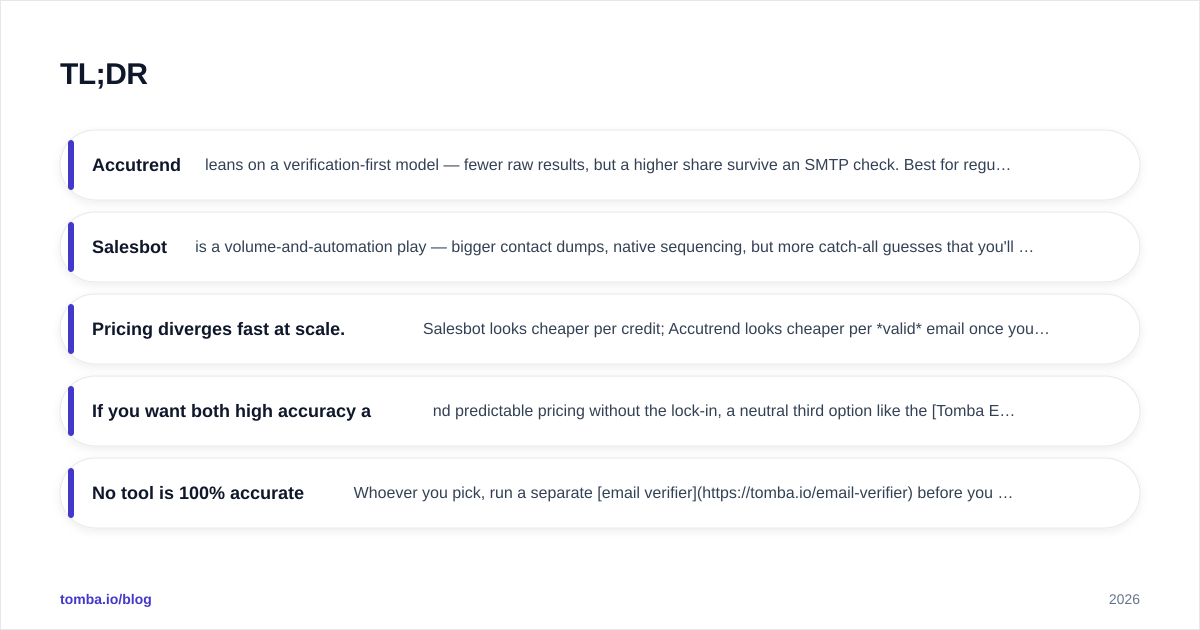
- Accutrend leans on a verification-first model — fewer raw results, but a higher share survive an SMTP check. Best for regulated, enterprise, or deliverability-sensitive teams.
- Salesbot is a volume-and-automation play — bigger contact dumps, native sequencing, but more catch-all guesses that you'll need to re-verify before sending.
- Pricing diverges fast at scale. Salesbot looks cheaper per credit; Accutrend looks cheaper per valid email once you account for bounces.
- If you want both high accuracy and predictable pricing without the lock-in, a neutral third option like the Tomba Email Finder beats either on cost-per-verified-contact in our framework.
- No tool is 100% accurate. Whoever you pick, run a separate email verifier before you load a list into your sequencer.
What are Accutrend and Salesbot?#
Both are B2B email-finder and contact-data platforms, but they were built for different buyers.
Accutrend positions itself as an accuracy-first data provider. You search by name and domain, and it prioritizes returning addresses it can confirm via real-time SMTP validation. The trade-off is coverage: it would rather return nothing than return a guess. That philosophy appeals to teams where a hard bounce has a real cost — recruiting, financial services, enterprise sales with sender-reputation guardrails.
Salesbot is closer to an all-in-one outbound suite. The email finder is one module sitting next to list-building, enrichment, and a built-in sequencer. The pitch is "find and send in one tab." That convenience is real, but the email finder is tuned for recall over precision — it surfaces more addresses, including a meaningful slice of pattern-based guesses on catch-all domains.
Neither approach is wrong. They optimize for different failure modes: Accutrend fears the bounce, Salesbot fears the missed contact.
How accurate is each email finder?#
Accuracy is where the two genuinely separate, so it's worth defining the term. "Accuracy" should mean the percentage of returned emails that are actually deliverable — not the percentage of searches that return something. Vendors love to blur those two.

In practice, here's how the accuracy profiles tend to break down across a typical mixed-industry prospecting list:
- Accutrend returns fewer results, but a high share pass an independent SMTP re-check. Its catch-all handling is conservative — it flags uncertainty rather than presenting a guess as a confirmed hit.
- Salesbot returns more results overall, but a larger fraction are "accepted-all" or pattern-derived addresses. Those aren't worthless — many resolve — but you cannot trust them at face value, and sending to them unverified raises your bounce rate.
The honest takeaway: Salesbot's higher coverage number and Accutrend's higher deliverability number are both true at the same time. They're measuring different things. If your sequencer punishes bounces (and in 2026, with Google and Yahoo enforcing stricter sender thresholds, they all do), the deliverability number matters more.
This is also why a standalone catch-all verifier is non-negotiable regardless of which tool you pick — catch-all domains are exactly where finders disagree most.

Accutrend vs Salesbot: feature and pricing comparison#
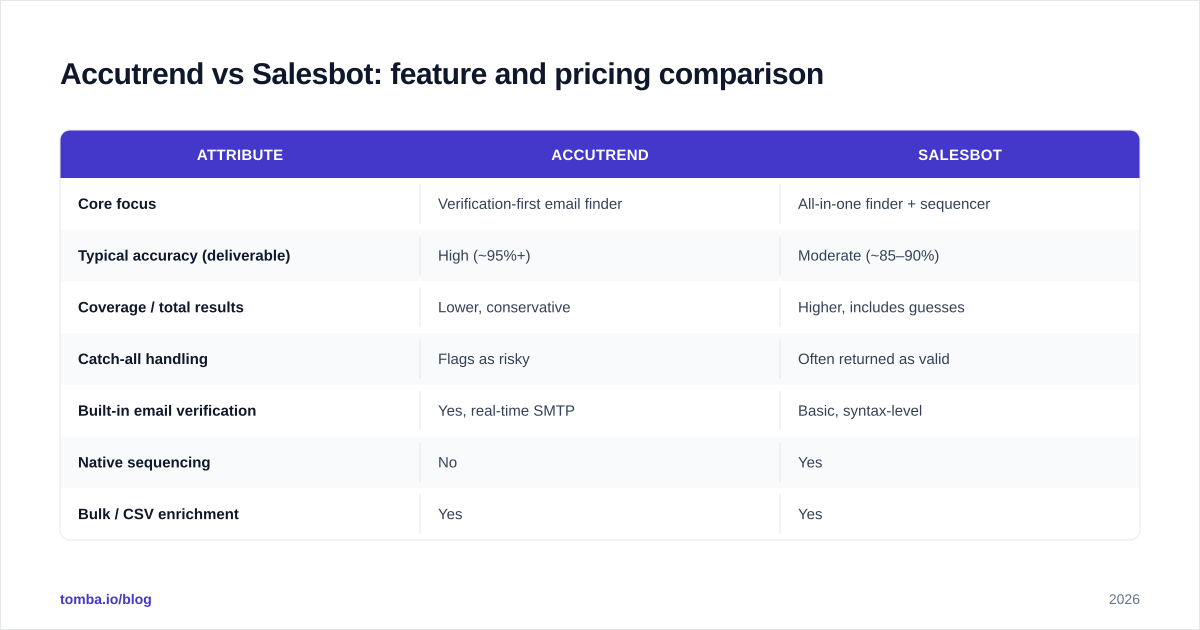
Here's the head-to-head on the attributes that decide most evaluations. Treat published vendor numbers as directional — always validate against a sample of your accounts during a trial.
| Attribute | Accutrend | Salesbot |
|---|---|---|
| Core focus | Verification-first email finder | All-in-one finder + sequencer |
| Typical accuracy (deliverable) | High (~95%+) | Moderate (~85–90%) |
| Coverage / total results | Lower, conservative | Higher, includes guesses |
| Catch-all handling | Flags as risky | Often returned as valid |
| Built-in email verification | Yes, real-time SMTP | Basic, syntax-level |
| Native sequencing | No | Yes |
| Bulk / CSV enrichment | Yes | Yes |
| API access | Yes (higher tiers) | Yes |
| Entry price | ~$60–80/mo | ~$49–59/mo |
| Best for | Deliverability-sensitive teams | High-volume outbound teams |
| Free tier | Limited trial credits | Limited trial credits |
The pricing line is the trap. Salesbot's lower sticker price and bundled sequencer make it look like the value pick. But if 12–15% of its returned emails bounce or sit on risky catch-all domains, your effective cost per usable contact climbs above Accutrend's — and you've spent sender reputation you can't buy back.
A cleaner way to evaluate: divide total monthly cost by the number of emails you can actually send with confidence. On that metric the gap narrows sharply, and a verification-first tool often wins despite a higher headline price.
Which one has better data coverage?#
Coverage depends heavily on your target geography and company size.
Salesbot generally wins on raw breadth — more SMB contacts, more long-tail domains, more total rows in a bulk pull. If your motion is high-volume SMB outbound where you expect a low reply rate and you're playing a numbers game, that breadth has value.
Accutrend tends to be stronger on mid-market and enterprise records where it can verify against corporate mail servers, and weaker on tiny domains and personal-brand catch-alls where verification is impossible by design.
If your ICP skews toward larger companies with predictable email infrastructure, Accutrend's conservative approach costs you very little coverage and buys you a lot of deliverability. If you're blasting thousands of small businesses, Salesbot's volume may matter more — provided you commit to re-verifying every list before send.
For teams that want both breadth and confirmed deliverability, running a domain search to map a company's full email pattern, then verifying the specific contacts, often beats relying on a single vendor's black-box guess.
How do verification and deliverability compare?#
This is the section that should drive your decision, because in 2026 email deliverability is the whole ballgame.
Accutrend runs real-time SMTP verification as part of the find step. You get a confidence status per address, and risky results are labeled rather than hidden. That tight loop is its main reason to exist.
Salesbot does lighter verification at find-time — mostly syntax and MX checks — and pushes deeper validation into its (paid) sending module. The risk: if you export Salesbot results to a different sequencer, you're shipping a partially-unverified list.
Independent verification matters because no finder, Accutrend included, perfectly predicts whether a mailbox accepts mail today. Mailboxes churn. The professional standard is a two-step pipeline: find, then verify with a separate tool right before send. Industry guidance from providers like HubSpot and validation references on Wikipedia's email authentication entry all point the same direction — protect the sending domain first.
If you only take one thing from this post: whichever finder you buy, decouple verification from it. A dedicated email verifier catches the addresses that went stale between when the database was built and when you hit send.
Which should you choose — Accutrend or Salesbot?#
Conclusion first: choose Accutrend if deliverability and data confidence outrank volume; choose Salesbot if you need breadth plus a built-in sequencer and you're disciplined about re-verifying. Most teams overvalue volume and undervalue the bounce — so the default lean for reputation-sensitive senders is Accutrend.
Use this quick decision guide:
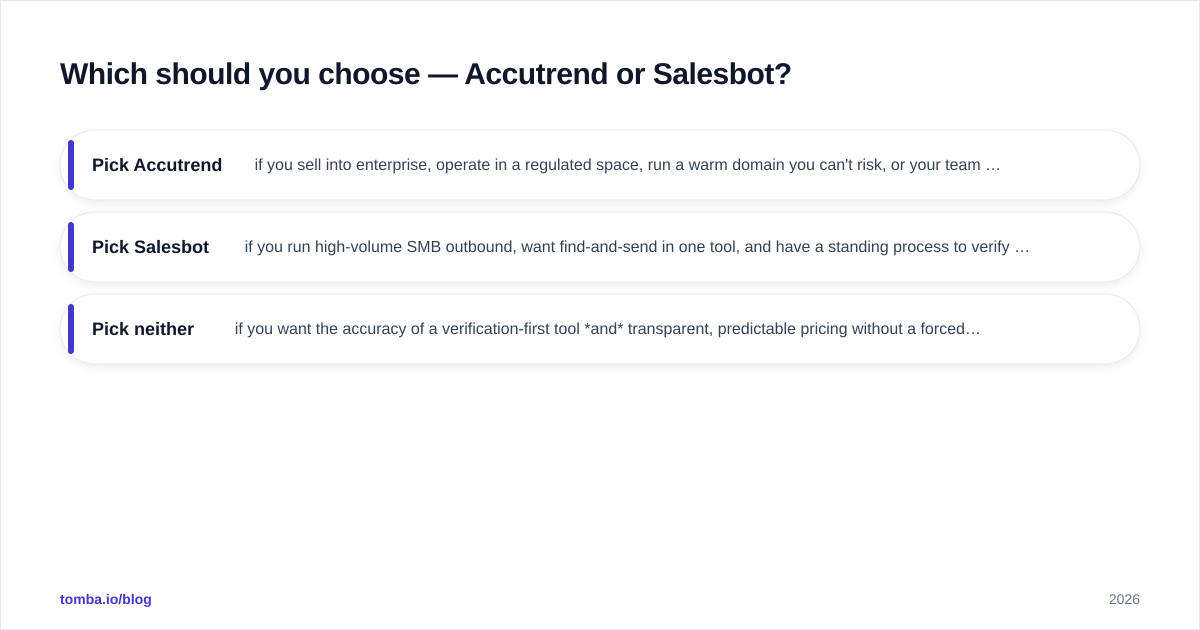
- Pick Accutrend if you sell into enterprise, operate in a regulated space, run a warm domain you can't risk, or your team is small enough that every send should count.
- Pick Salesbot if you run high-volume SMB outbound, want find-and-send in one tool, and have a standing process to verify lists before each campaign.
- Pick neither if you want the accuracy of a verification-first tool and transparent, predictable pricing without a forced sequencer bundle — that's the gap third-party finders fill.
Compare both honestly against your own account list during a free trial. Pull 100 of your real target contacts through each, then run the results through an independent verifier and count true deliverable hits. That single test tells you more than any vendor benchmark — including this one.
How does Tomba compare on the same metrics?#
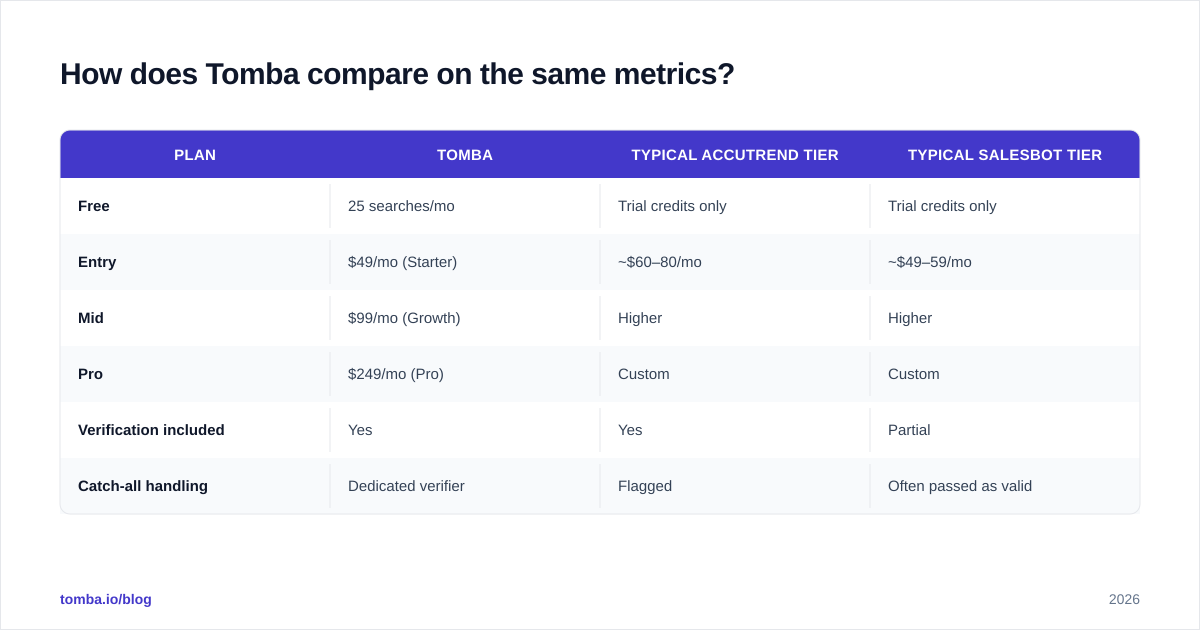
Since you're evaluating on accuracy-per-dollar, it's fair to put a neutral third option on the same axes. Tomba is a verification-first email finder with transparent, flat pricing — which tends to land between Accutrend's accuracy posture and Salesbot's affordability.

| Plan | Tomba | Typical Accutrend tier | Typical Salesbot tier |
|---|---|---|---|
| Free | 25 searches/mo | Trial credits only | Trial credits only |
| Entry | $49/mo (Starter) | ~$60–80/mo | ~$49–59/mo |
| Mid | $99/mo (Growth) | Higher | Higher |
| Pro | $249/mo (Pro) | Custom | Custom |
| Verification included | Yes | Yes | Partial |
| Catch-all handling | Dedicated verifier | Flagged | Often passed as valid |
Tomba's Free tier (25 searches/month) lets you run the exact head-to-head test described above at zero cost, and the verification-included model means you're not paying separately to find out which addresses are real. Full Tomba pricing is public, with no per-seat sequencer upsell required to access accurate data.
The point isn't that one tool is universally best — it's that "cheapest per credit" and "cheapest per valid email" are different questions, and the second one is the only one your reply rate cares about.
Run the test before you commit#
Don't take Accutrend's, Salesbot's, or this article's word for it. Pull a sample of your real target accounts, find their emails, verify them independently, and count the deliverable winners. The tool with the best cost-per-verified-contact on your ICP is the right answer for you.
If you want a verification-first finder with a genuinely free starting tier and flat pricing to benchmark against both, start with the Tomba Email Finder — find professional emails by domain, name, or company, verify them in the same workflow, and protect your sender reputation before your first send. Run 25 free searches against your hottest accounts and let the numbers, not the marketing, decide.
Ready to find emails that actually work?
Join 150,000+ professionals who stopped guessing and started sending. Free credits on signup — no credit card required.
Get the Tomba newsletter
Practical outbound tactics and product updates — once every two weeks.
About the author