Accutrend vs Saleshandy: Which Cold Email Tool Wins in 2026?
Accutrend and Saleshandy both promise cold email at scale, but they solve different problems. Here's an honest breakdown of pricing, data accuracy, deliverability, and which tool actually fits your outbound motion in 2026.
Choosing between Accutrend and Saleshandy usually comes down to one honest question: do you need a cold email engine, or do you need better contacts feeding one? They overlap on the surface — both sit in the outbound stack and both want to be the tool your SDRs open every morning — but they pull from different ends of the funnel.
This breakdown skips the marketing gloss. You get the real trade-offs, a side-by-side table, and a clear recommendation for each buyer profile.
TL;DR — Accutrend vs Saleshandy at a glance#
- Saleshandy is a mature cold email sequencing and deliverability platform — sequences, automated follow-ups, inbox rotation, and a built-in Lead Finder. Best if sending and reply management is your bottleneck.
- Accutrend leans toward lead intelligence and data-led outbound — surfacing accounts and contacts, then pushing them into campaigns. Best if finding the right people is your bottleneck.
- Pricing for both starts in the $25–$40/mo range for entry plans, but credits, inbox limits, and verification costs change the real number fast — always price your actual sending volume.
- Neither tool is a dedicated data provider. If contact accuracy is where your campaigns leak, pairing either platform with a specialist email finder usually beats stretching one tool to do everything.
- Fast pick: sequencing-heavy team → Saleshandy. Data-and-targeting-heavy team → Accutrend. Accuracy-obsessed team → add a dedicated finder/verifier layer on top.
What is Saleshandy?#
Saleshandy is a cold email outreach platform built around deliverability and scale. Its core job is to take a list of prospects and run them through multi-step sequences with automated follow-ups, A/B testing, and reply detection — while keeping you out of the spam folder.
The features that define it:
- Sequences and follow-ups with conditional steps and scheduling.
- Unlimited email accounts on most paid tiers, with automated inbox rotation to spread sending load.
- Built-in email warmup and sender-reputation tooling.
- Lead Finder — a contact database bolted onto the sending engine so you can prospect without leaving the app.
- Unified inbox for managing replies across all connected accounts.
Saleshandy's identity is the send. Everything is engineered so that high-volume outbound lands in the inbox and replies get routed cleanly. You can verify the current feature set and plans on the official Saleshandy site and read peer reviews on G2.
What is Accutrend?#
Accutrend positions itself further up the funnel — as a lead-intelligence and outbound tool where the emphasis is on who you contact, not just how you send. The pitch is data-led: surface the right accounts and contacts, enrich them, and move them into outreach with less manual list-building.
Where Saleshandy assumes you already have a list and need to send it well, Accutrend leans into the part before that — building and qualifying the list itself. In practice that means buyers evaluate it more on data coverage and targeting than on sequencing depth.
Because Accutrend is the newer and less-documented of the two, treat any feature or price claim you read (including in this post) as something to confirm directly with the vendor before you commit budget. That is just good buying hygiene for any fast-moving outbound tool.
How do Accutrend and Saleshandy compare on features?#
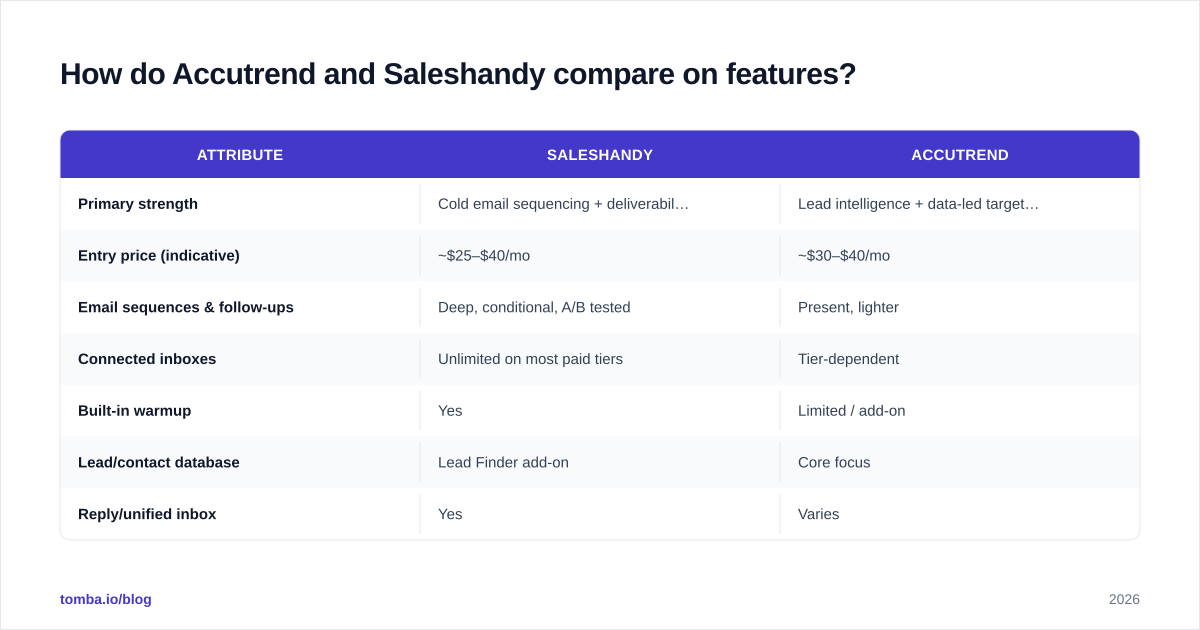
Here is the honest side-by-side. Treat the pricing and credit figures as indicative entry points — both vendors revise plans often, so confirm live numbers before you buy.
| Attribute | Saleshandy | Accutrend |
|---|---|---|
| Primary strength | Cold email sequencing + deliverability | Lead intelligence + data-led targeting |
| Entry price (indicative) | ~$25–$40/mo | ~$30–$40/mo |
| Email sequences & follow-ups | Deep, conditional, A/B tested | Present, lighter |
| Connected inboxes | Unlimited on most paid tiers | Tier-dependent |
| Built-in warmup | Yes | Limited / add-on |
| Lead/contact database | Lead Finder add-on | Core focus |
| Reply/unified inbox | Yes | Varies |
| Best-fit team | SDR teams sending at volume | Teams prioritizing targeting & data |
| Standalone data accuracy | Good enough, not specialist-grade | Data-first, verify coverage |
The pattern is clear: Saleshandy wins on the sending and reply machinery; Accutrend competes on the data and targeting that feed it. Few teams genuinely need both tools maxed out — you'll lean one direction based on where your current outbound actually breaks.

Which one has better data accuracy?#
Short answer: neither is a substitute for a dedicated contact-data layer, and that's the most important thing to understand before you pick.
Both platforms bundle a contact database because buyers like one-tool convenience. But a database that exists to feed a sending tool is optimized for breadth and ease, not for the relentless verification a deliverability-first program needs. The result shows up as bounces, catch-all uncertainty, and stale titles — the quiet killers of sender reputation.
This is why high-performing outbound teams separate concerns:
- Sourcing — find the right people (specialist finder).
- Verification — confirm the address is live before you send (specialist verifier).
- Sending — sequence and deliver (Saleshandy or Accutrend).
When the data layer is weak, every downstream metric suffers regardless of how good your sequences are. A 10% bounce rate doesn't just waste credits — it tanks the domain reputation that decides whether your good sends reach the inbox at all. Running a quick email verification pass over any list — including lists pulled from Saleshandy's Lead Finder or Accutrend — is the cheapest insurance in outbound.

If you regularly build large lists, a bulk email finder and verifier workflow upstream of your sender will usually move reply rates more than any sequence tweak inside Accutrend or Saleshandy.
Is Saleshandy better than Accutrend for cold email?#
For pure cold email execution — yes, in most cases. Saleshandy was built for this exact job and shows it: mature sequencing, unlimited inboxes with rotation, warmup, and a unified reply inbox are all first-class, not afterthoughts.
Choose Saleshandy when:
- You already have a sourcing process and need a reliable, deliverability-focused sending engine.
- You run high-volume outbound across many inboxes and need rotation + warmup.
- Reply management across multiple mailboxes is becoming chaotic.
- You want predictable per-seat pricing without metered data costs dominating the bill.
Choose Accutrend when:
- Your bottleneck is finding and prioritizing the right accounts, not sending.
- You value data and targeting signals over deep sequence logic.
- Your team is smaller and you'd rather consolidate prospecting + light outreach in one place.
- You're testing a new market and need to build lists from scratch quickly.
The deciding question is diagnostic, not feature-count: where does your current pipeline actually leak — at list quality, or at send execution? Fix the leak, don't buy the longer feature list.
How does deliverability differ between the two?#
Deliverability is Saleshandy's home turf. Warmup, inbox rotation, and sending-volume controls are built specifically to protect sender reputation at scale. Accutrend can send, but if your program lives or dies on inbox placement across dozens of mailboxes, the dedicated sender is the safer bet.
That said, deliverability tooling can only protect a clean list. The biggest deliverability lever is upstream of both tools:
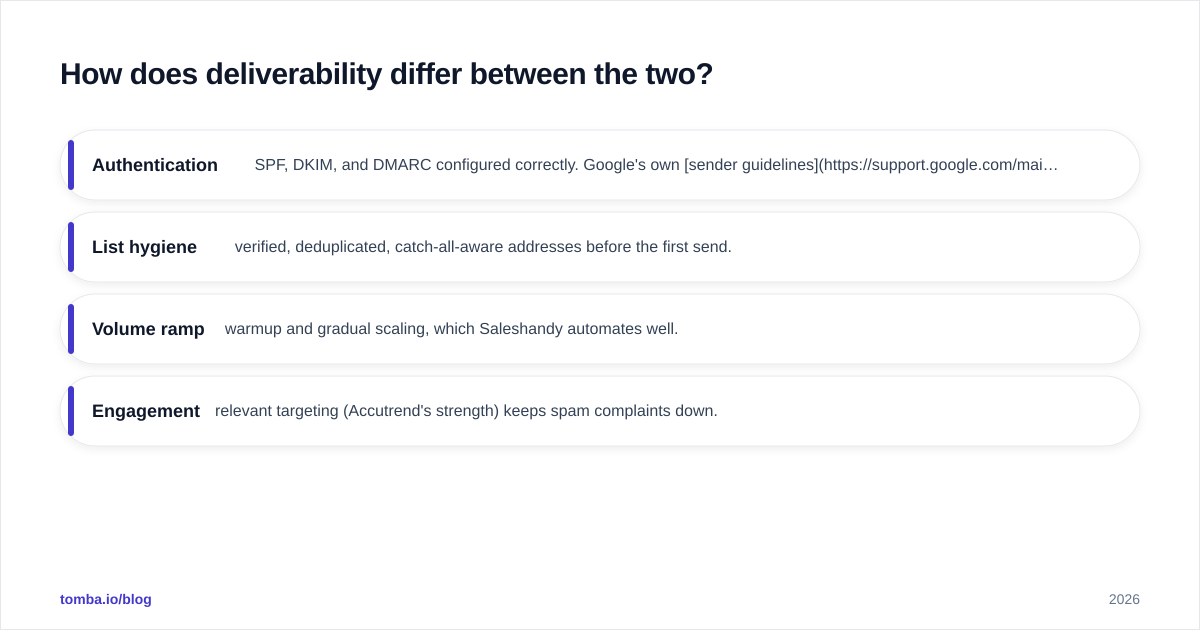
- Authentication — SPF, DKIM, and DMARC configured correctly. Google's own sender guidelines are the canonical reference, and bulk senders now face stricter enforcement.
- List hygiene — verified, deduplicated, catch-all-aware addresses before the first send.
- Volume ramp — warmup and gradual scaling, which Saleshandy automates well.
- Engagement — relevant targeting (Accutrend's strength) keeps spam complaints down.
Notice that two of the four levers — list hygiene and targeting — happen before either tool sends a byte. A great sequencer firing at a bad list still burns your domain. Pair whichever platform you choose with disciplined verification and authentication, and you'll out-deliver teams running far pricier stacks.
What does each tool cost in practice?#
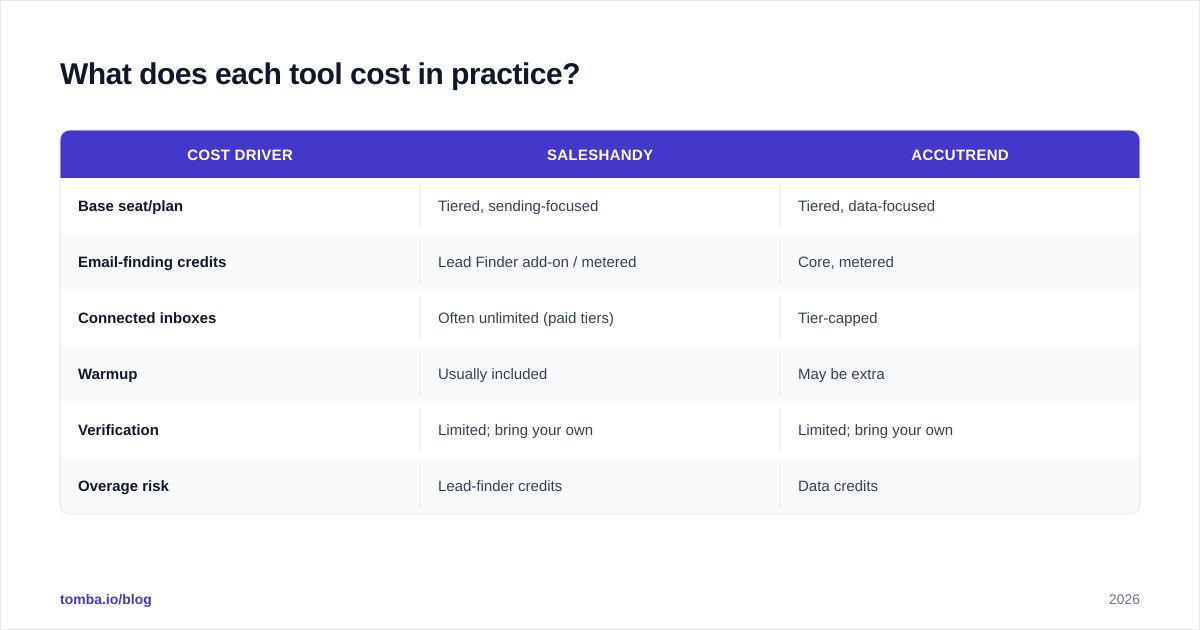
Sticker price is the smallest part of the real cost. Model your actual usage:
| Cost driver | Saleshandy | Accutrend |
|---|---|---|
| Base seat/plan | Tiered, sending-focused | Tiered, data-focused |
| Email-finding credits | Lead Finder add-on / metered | Core, metered |
| Connected inboxes | Often unlimited (paid tiers) | Tier-capped |
| Warmup | Usually included | May be extra |
| Verification | Limited; bring your own | Limited; bring your own |
| Overage risk | Lead-finder credits | Data credits |
Two budgeting traps catch teams on both platforms:
- Credit burn on bad data. Every unverified contact you find and then bounce is paid for twice — once to find it, once in reputation damage. Verifying first is almost always cheaper.
- Tool sprawl. Buying the "all-in-one" tier of either platform to get a mediocre version of a feature you could buy better and cheaper elsewhere (data, in particular).
For a transparent comparison point, Tomba's pricing runs a free tier (25 searches/mo), Starter at $49/mo, Growth at $99/mo, and Pro at $249/mo — a dedicated data layer you can bolt onto either sender so you're not overpaying for bundled credits inside an outreach tool. If you're specifically weighing Saleshandy's bundled data, the Saleshandy alternative breakdown goes deeper on that split.
What's the smartest stack for 2026?#
The best-performing outbound teams in 2026 aren't picking one tool to do everything — they're composing a thin, specialized stack where each layer is best-in-class:
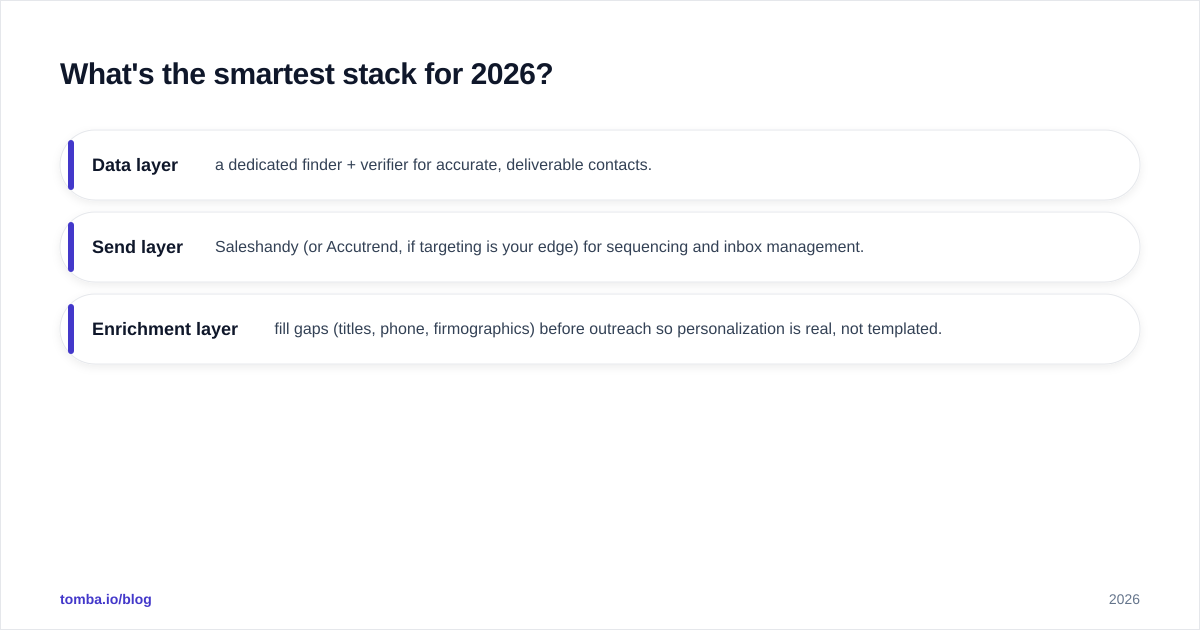
- Data layer — a dedicated finder + verifier for accurate, deliverable contacts.
- Send layer — Saleshandy (or Accutrend, if targeting is your edge) for sequencing and inbox management.
- Enrichment layer — fill gaps (titles, phone, firmographics) before outreach so personalization is real, not templated.
This modular approach beats the monolith for a simple reason: each market shifts at a different pace. Data decays monthly; sequencing best practices shift quarterly; deliverability rules change with mailbox-provider policy. A stack of specialists lets you swap one layer without ripping out the others. The all-in-one bet locks you to one vendor's weakest component.
A practical 2026 setup looks like this: source and verify contacts with a specialist data tool, push the clean list into Saleshandy for sequencing and warmup, and let Accutrend-style intelligence inform which accounts make the list in the first place. You get accuracy, deliverability, and targeting — without paying three times for one bloated suite.
Final verdict: Accutrend or Saleshandy?#
Pick Saleshandy if your outbound bottleneck is sending — sequencing depth, inbox rotation, warmup, and reply management at volume. It's the more mature execution engine and the safer deliverability choice.
Pick Accutrend if your bottleneck is targeting — finding and prioritizing the right accounts and contacts, with lighter but adequate outreach attached.
But here's the takeaway most comparison posts bury: whichever sender you choose, your results are capped by the quality of the data flowing into it. A great sequence aimed at stale, unverified contacts still bounces, still hurts your domain, and still misses the inbox.
That's where a dedicated data layer earns its keep. The Tomba Email Finder finds verified professional email addresses by name, domain, or company — and pairs with a verifier and bulk workflow so the contacts entering Saleshandy or Accutrend are deliverable from day one. Start on the free tier (25 searches/mo), confirm the accuracy yourself, and let your sending tool do what it does best: send to people who actually exist. Fix the data, and both Accutrend and Saleshandy suddenly look a lot more impressive.
// get started
Find, verify and enrich your first contacts today
Start on the free plan with 25 searches a month, then scale when your team is ready.
Free plan · No credit card required · GDPR & CCPA
// about the author