Accutrend vs Warpleads 2026: B2B Lead Data Compared
Accutrend and Warpleads both promise B2B lead data at scale, but they solve different problems. Here's an honest 2026 breakdown of pricing, accuracy, and fit.
Choosing between Accutrend and Warpleads comes down to one question: do you need a managed B2B data list built for you, or a self-serve engine that exports leads in bulk? They look similar on a feature grid, but they serve different buyers. This guide breaks down where each one wins, where each one frustrates, and how to decide without burning a month of trial credits.
TL;DR#
- Warpleads is a self-serve, export-heavy lead platform built for cold-email teams that want volume and unlimited-style exports at a predictable price.
- Accutrend leans toward managed and custom B2B data lists — better when you want a vendor to assemble a targeted file for you rather than mining it yourself.
- Accuracy is the real differentiator. Raw export volume means nothing if 30% of the addresses bounce. Always verify before you send.
- Neither tool is a full verification stack. Pair whichever you pick with a dedicated email verifier to protect your sender reputation.
- Best combined workflow: source with one platform, then run every address through verification and enrichment before it touches your sequencer.
What are Accutrend and Warpleads?#
Both Accutrend and Warpleads sit in the B2B data category — the part of your stack responsible for answering "who do I contact, and what's their email?" But they approach that job from opposite ends.
Warpleads is positioned as a high-volume lead-generation engine. The pitch is simple: build a search, filter by role, industry, geography, and tech stack, then export large batches of contacts to feed cold-email tools. It's designed for outbound teams that measure success in volume and reply rate, and who want exports without per-lead anxiety.
Accutrend leans more toward the managed-data and custom-list model. Instead of you running every query yourself, the workflow is often closer to specifying an ideal customer profile and receiving a built file. That suits marketers and ops teams who'd rather hand off list-building than learn another filtering UI.
The distinction matters because it changes who should own the tool. Warpleads fits an SDR or growth marketer who lives in the platform daily. Accutrend fits a team that wants data delivered and doesn't want to babysit the sourcing step.
How do Accutrend and Warpleads compare on features?#
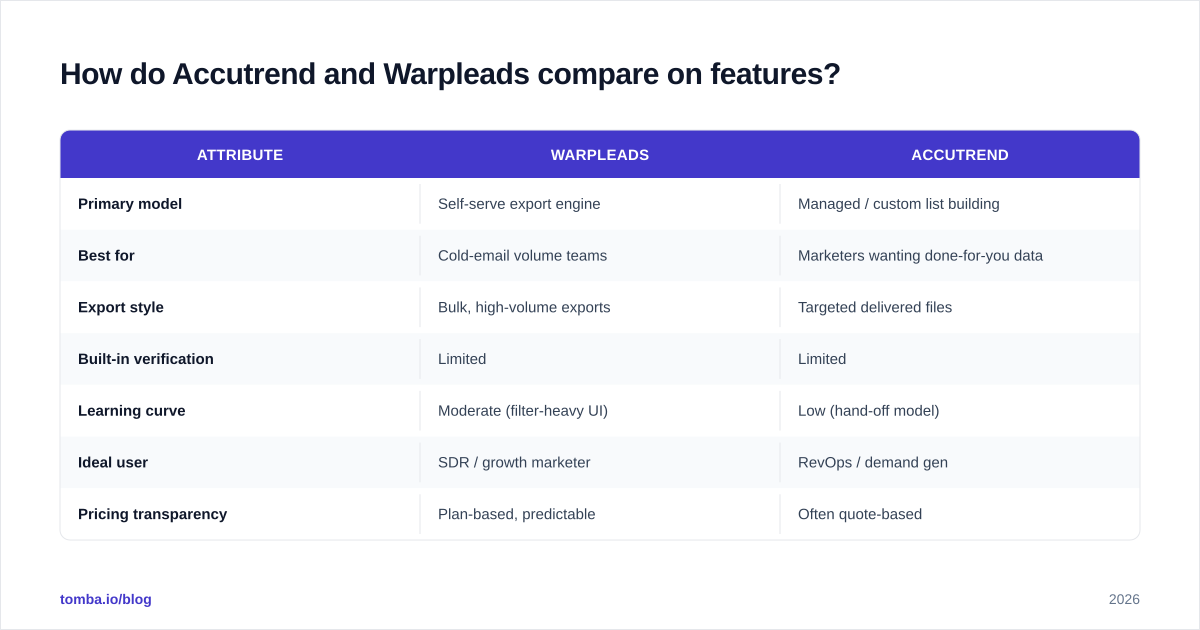
Here's the head-to-head on the attributes that actually change your results.
| Attribute | Warpleads | Accutrend |
|---|---|---|
| Primary model | Self-serve export engine | Managed / custom list building |
| Best for | Cold-email volume teams | Marketers wanting done-for-you data |
| Export style | Bulk, high-volume exports | Targeted delivered files |
| Built-in verification | Limited | Limited |
| Learning curve | Moderate (filter-heavy UI) | Low (hand-off model) |
| Ideal user | SDR / growth marketer | RevOps / demand gen |
| Pricing transparency | Plan-based, predictable | Often quote-based |
The pattern is clear: Warpleads gives you control and throughput, Accutrend gives you convenience and a curated starting point. Neither replaces a verification and data enrichment layer, which is where a lot of teams quietly lose deliverability.
Which tool has better data accuracy?#
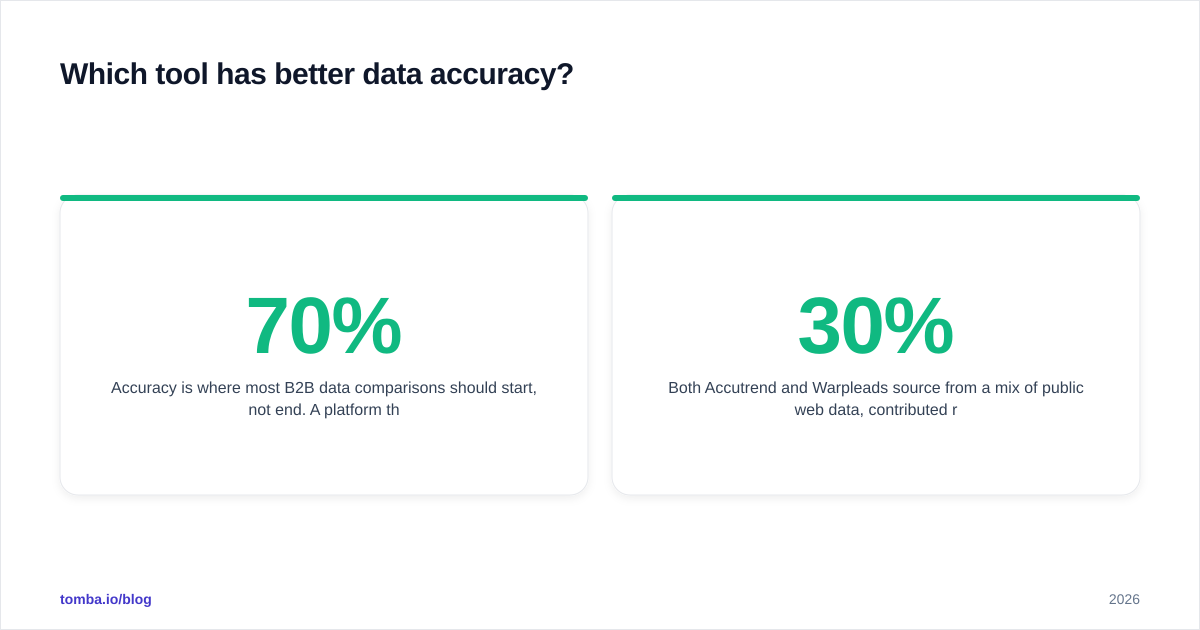
Accuracy is where most B2B data comparisons should start, not end. A platform that exports 10,000 contacts at a 70% valid rate is strictly worse than one that exports 4,000 at 96% — because every bounce drags down your sender reputation and pushes you closer to the spam folder.
Both Accutrend and Warpleads source from a mix of public web data, contributed records, and third-party partnerships. The catch with any large database is decay: B2B contact data goes stale at roughly 25–30% per year as people change jobs. That's an industry constant, not a knock on either vendor — HubSpot and other CRM vendors have published similar decay figures for years. (See HubSpot's research on database decay for context.)
What separates a good outbound program from a blocked one is the verification step after export. Neither tool is built primarily as a verifier, so treat their "valid" flags as a first pass, not gospel. Run exports through a dedicated email verification pipeline, and use a catch-all verifier for domains that accept everything — those are the addresses that silently inflate "valid" counts and then bounce.

If you're benchmarking accuracy across multiple sources, test the same 200 known contacts through each tool and measure the real bounce rate after a verification pass. Self-reported accuracy numbers from any vendor — including the ones in their marketing — should never be your only data point.

How do Accutrend and Warpleads price?#
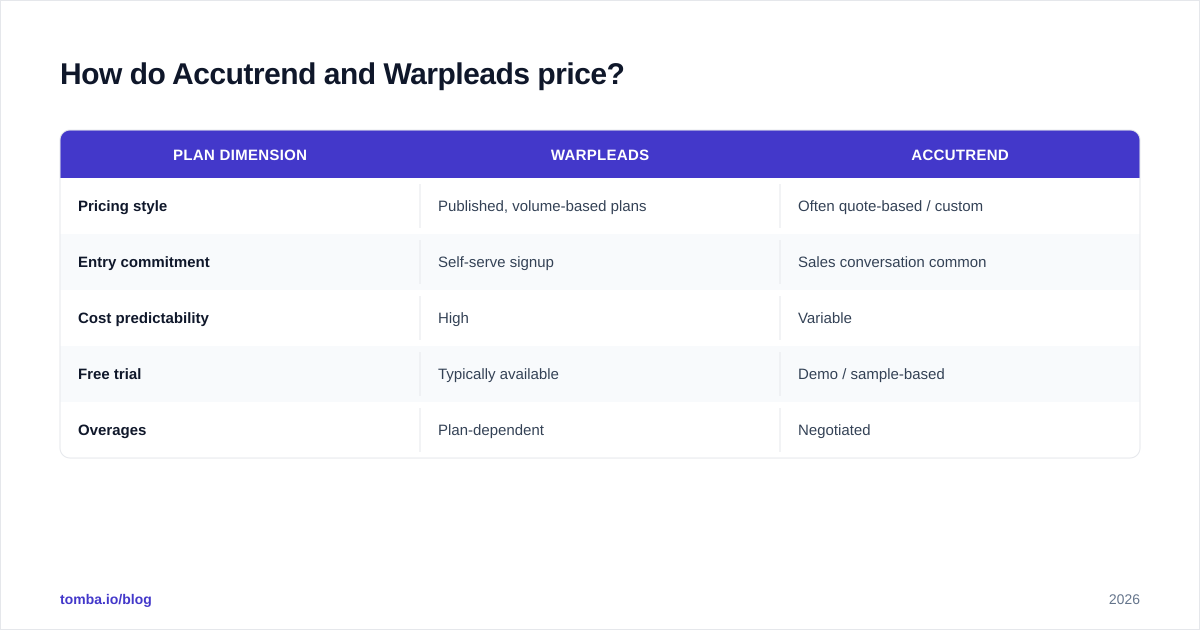
Pricing philosophy follows the product model. Warpleads tends toward transparent, plan-based pricing built around export volume — attractive if you want to forecast cost per month and avoid per-credit math. Accutrend more often works on a quote or custom basis, which fits managed-list buyers but makes quick comparison harder.
| Plan dimension | Warpleads | Accutrend |
|---|---|---|
| Pricing style | Published, volume-based plans | Often quote-based / custom |
| Entry commitment | Self-serve signup | Sales conversation common |
| Cost predictability | High | Variable |
| Free trial | Typically available | Demo / sample-based |
| Overages | Plan-dependent | Negotiated |
Always confirm current numbers on each vendor's own site and on a neutral marketplace like G2 or Capterra, since both update plans frequently. The right question isn't "which is cheaper per lead" — it's "which is cheaper per deliverable, replying lead after verification." A low export price loses its appeal the moment half the list bounces.
When should you choose Warpleads?#
Pick Warpleads if you match this profile:
- You run high-volume outbound and want exports without obsessing over per-lead credits.
- Your SDRs or growth marketers want to own sourcing and iterate on filters daily.
- You already have a verification and warmup process and just need a steady supply of raw contacts.
- Predictable monthly pricing matters more than a hand-delivered list.
Warpleads rewards teams that treat list-building as an in-house muscle. The more comfortable you are tuning ICP filters, the more value you'll extract. If you want to operationalize that, push exports straight into a bulk email finder and verification step so nothing reaches your sequencer unchecked.
When should you choose Accutrend?#
Pick Accutrend if this sounds like you:
- You'd rather specify an ICP and receive a built file than run queries yourself.
- Your team is demand-gen or RevOps-led and values done-for-you over hands-on.
- You're running campaigns where a curated, narrower list beats raw volume.
- You're comfortable with a sales conversation to scope and price the data.
Accutrend's managed angle saves time for teams without a dedicated prospecting researcher. The trade-off is less day-to-day control and pricing that's harder to compare at a glance. As with Warpleads, the delivered file is a starting point — verify it before it goes live.
What's the smarter alternative to picking just one?#
The honest answer most comparison posts won't give you: the sourcing tool matters less than the verification and enrichment layer wrapped around it. A best-in-class export feeding an unverified sequencer still tanks your deliverability.
A resilient 2026 stack looks like this:
- Source breadth from a volume tool (Warpleads) or a managed file (Accutrend).
- Find and fill gaps with a precise email finder when records are missing the contact you actually want.
- Verify everything through an email verifier, including catch-all domains.
- Enrich with firmographics and roles so your messaging is targeted, not generic.
- Search by company using domain search when you have the account but not the people.
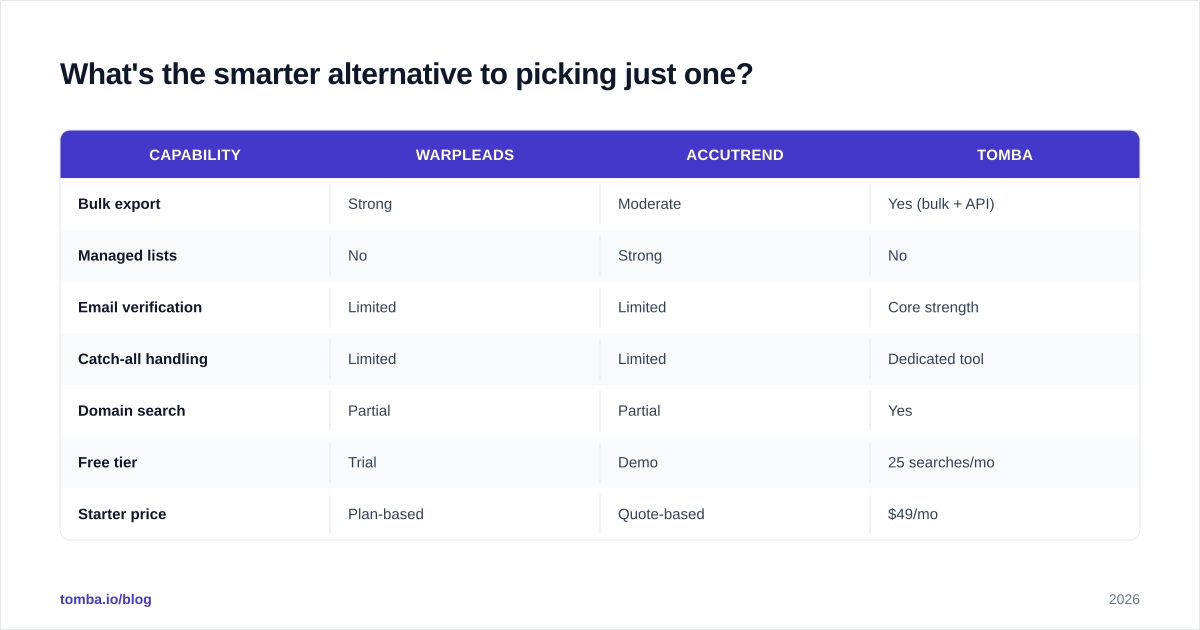
This is where Tomba fits. It isn't trying to be a managed-list vendor or an unlimited-export firehose — it's the accuracy layer that makes whatever you source actually deliverable. Tomba is transparent about where its data comes from, which is exactly the standard you should hold any data vendor to.
| Capability | Warpleads | Accutrend | Tomba |
|---|---|---|---|
| Bulk export | Strong | Moderate | Yes (bulk + API) |
| Managed lists | No | Strong | No |
| Email verification | Limited | Limited | Core strength |
| Catch-all handling | Limited | Limited | Dedicated tool |
| Domain search | Partial | Partial | Yes |
| Free tier | Trial | Demo | 25 searches/mo |
| Starter price | Plan-based | Quote-based | $49/mo |
You can see full Tomba pricing — Free (25 searches/mo), Starter $49/mo, Growth $99/mo, Pro $249/mo, and Enterprise — without a sales call, which keeps the comparison honest.
How do you actually decide?#
Run a 200-contact bake-off. Pull the same target accounts through Warpleads and Accutrend, then verify both exports through the same tool. Measure three numbers: real valid rate after verification, cost per verified contact, and time spent building the list. The winner on your ICP is rarely the one with the loudest accuracy claim — it's the one that survives verification cheapest.
Then, regardless of which sourcing tool you keep, standardize on a verification step. That single habit protects deliverability more than any export-volume upgrade.
The bottom line#
Warpleads wins for hands-on, high-volume cold-email teams that want predictable export pricing. Accutrend wins for teams that want curated data delivered without running the queries themselves. But both are sourcing tools, and sourcing is only half the job — the addresses still have to land.
Whichever you choose, route every contact through verification first. Start free with the Tomba Email Finder to find and verify the exact decision-makers your sourcing tool missed, protect your sender reputation, and turn raw lists into a pipeline that actually replies. Your bounce rate — and your deliverability — will thank you.
// get started
Find, verify and enrich your first contacts today
Start on the free plan with 25 searches a month, then scale when your team is ready.
Free plan · No credit card required · GDPR & CCPA
// about the author