9 Best Acefone Alternatives for Cloud Calling in 2026
Acefone is solid cloud telephony, but it isn't the only option. Compare 9 Acefone alternatives on pricing, dialing power, and CRM fit to pick the right business phone system for your sales team in 2026.
Acefone is a capable cloud phone system, but it is not the obvious winner for every sales team. If you are paying for outbound call volume, dialer features, or contact-center routing you don't use — or you just want better CRM integrations — it is worth comparing the field before you renew.
This guide breaks down nine Acefone alternatives, what each one is actually good at, and how to match a phone system to the way your team sells.
TL;DR#
- Best for outbound sales teams: Aircall and Dialpad lead on power dialing, call coaching, and native CRM logging.
- Best for enterprise UCaaS: RingCentral and 8x8 cover phone, video, and contact center in one suite.
- Best for budget-conscious SMBs: Ooma and Grasshopper undercut Acefone on entry pricing.
- Best for AI-native calling: Dialpad and CloudTalk push real-time transcription and sentiment analysis hardest.
- The hidden lever: No phone system fixes bad numbers. Pair any of these with accurate B2B phone numbers and verified contact data, or you are paying per-minute to dial dead lines.
What is Acefone and why look for alternatives?#
Acefone is a cloud telephony and contact-center provider offering VoIP business lines, IVR, call routing, and outbound dialing, billed on per-user and per-minute plans. It is a reasonable fit for support desks and mid-market call centers that want UK and India coverage with predictable pay-as-you-go pricing.
Teams outgrow it for a few predictable reasons:
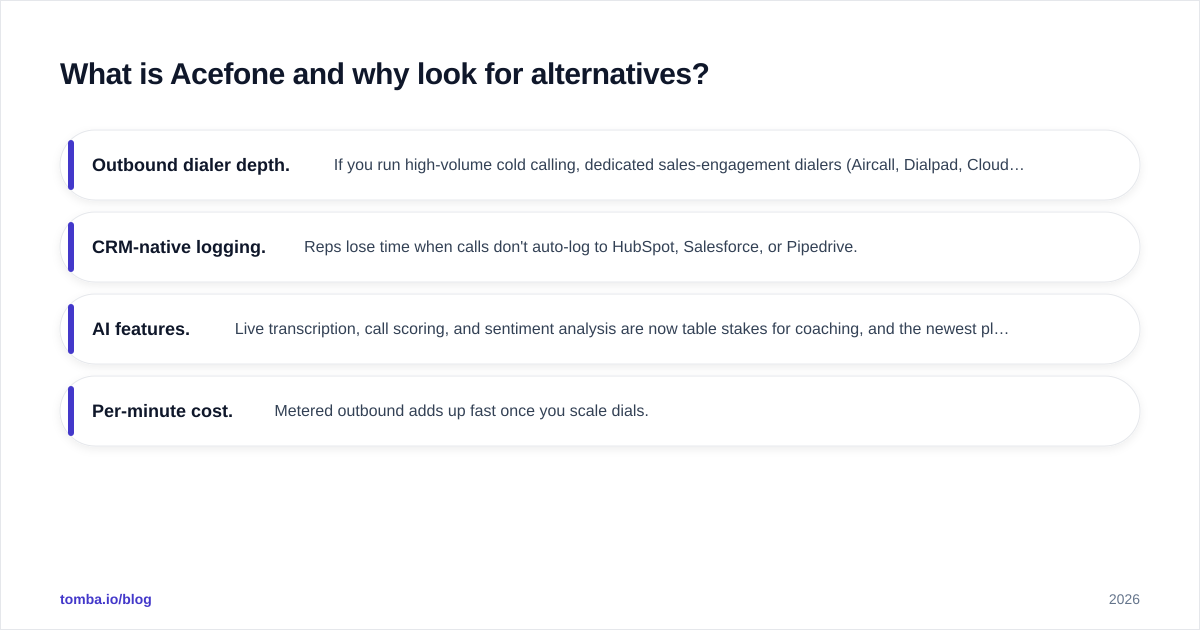
- Outbound dialer depth. If you run high-volume cold calling, dedicated sales-engagement dialers (Aircall, Dialpad, CloudTalk) offer power and parallel dialing that a general PBX doesn't.
- CRM-native logging. Reps lose time when calls don't auto-log to HubSpot, Salesforce, or Pipedrive.
- AI features. Live transcription, call scoring, and sentiment analysis are now table stakes for coaching, and the newest platforms ship them by default.
- Per-minute cost. Metered outbound adds up fast once you scale dials.
Think of a phone system like a car: Acefone is a dependable sedan, but if your job is racing (high-volume outbound) or hauling (enterprise contact center), you want a vehicle built for that load.
)
What should you compare when choosing a business phone system?#
Before you look at logos, fix your evaluation criteria. The phone systems below all make calls — the differences live in five areas:
- Dialing mode. Click-to-call vs. power dialer vs. parallel/predictive dialer. High outbound volume needs the latter.
- CRM integration depth. Native two-way sync beats a
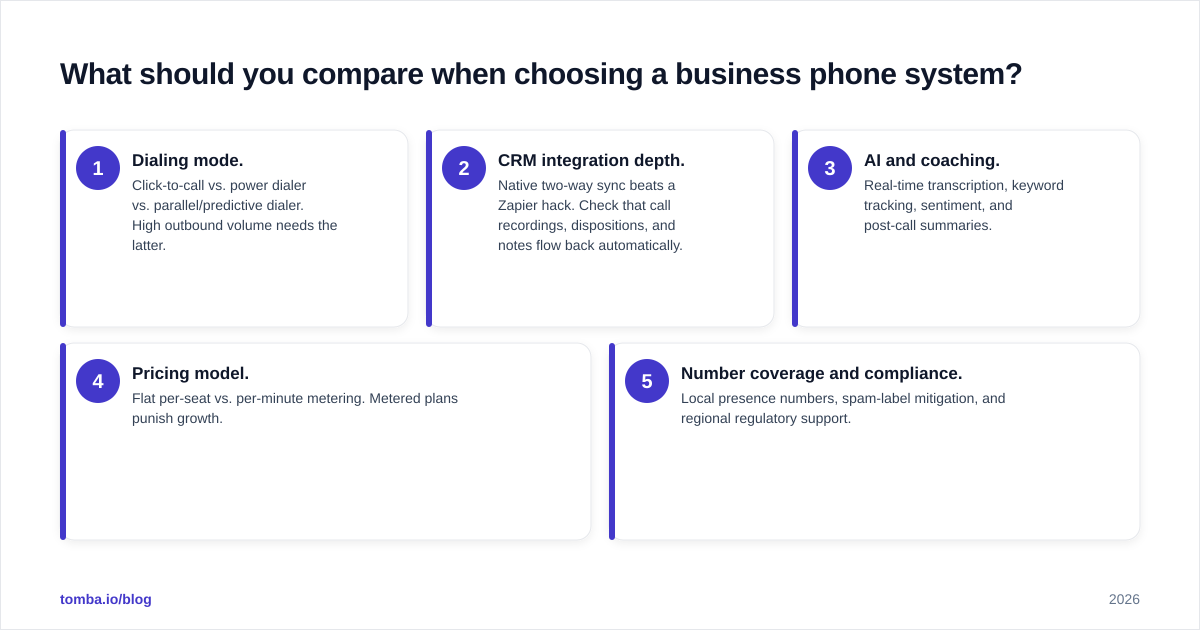
Zapier hack. Check that call recordings, dispositions, and notes flow back automatically. 3. AI and coaching. Real-time transcription, keyword tracking, sentiment, and post-call summaries. 4. Pricing model. Flat per-seat vs. per-minute metering. Metered plans punish growth. 5. Number coverage and compliance. Local presence numbers, spam-label mitigation, and regional regulatory support.
A great dialer calling a list of wrong numbers is just an expensive way to reach voicemail. The data layer underneath your phone system matters as much as the phone system itself — which is why enriching and validating contacts up front beats dialing blind.
What are the best Acefone alternatives in 2026?#
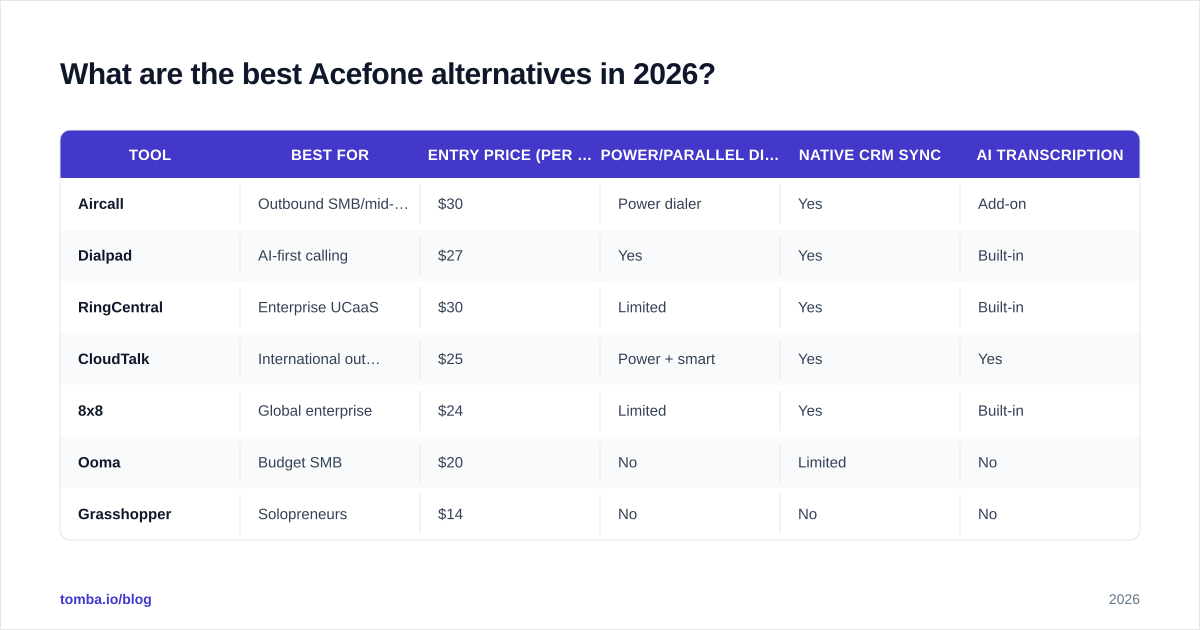
Here is the at-a-glance comparison. Prices are entry-tier list prices and change often — confirm on each vendor's site.
| Tool | Best for | Entry price (per user/mo) | Power/parallel dialer | Native CRM sync | AI transcription |
|---|---|---|---|---|---|
| Aircall | Outbound SMB/mid-market | $30 | Power dialer | Yes | Add-on |
| Dialpad | AI-first calling | $27 | Yes | Yes | Built-in |
| RingCentral | Enterprise UCaaS | $30 | Limited | Yes | Built-in |
| CloudTalk | International outbound | $25 | Power + smart | Yes | Yes |
| 8x8 | Global enterprise | $24 | Limited | Yes | Built-in |
| Ooma | Budget SMB | $20 | No | Limited | No |
| Grasshopper | Solopreneurs | $14 | No | No | No |
| JustCall | Sales + SMS | $29 | Yes | Yes | Yes |
| Nextiva | All-in-one SMB | $25 | No | Yes | Add-on |
1. Aircall — best for outbound sales teams#
Aircall is built for sales and support, not generic telephony. Its power dialer, shared call inbox, and deep HubSpot integration make it a favorite for teams that live in their CRM. Setup is fast and the UI is clean.
- Pros: Strong CRM logging, power dialer, large app marketplace.
- Cons: Per-seat cost climbs; advanced analytics gated to higher tiers.
2. Dialpad — best AI-native calling#
Dialpad leads on AI. Live transcription, real-time call coaching, and automatic post-call summaries are baked in, not bolted on. If you want managers to coach from sentiment scores instead of listening to full recordings, this is the pick. See Dialpad's product pages for the current AI feature set.
- Pros: Best-in-class AI, fair entry pricing, unified voice/video/messaging.
- Cons: Some integrations shallower than Aircall's; AI accuracy varies by accent and audio quality.
3. RingCentral — best for enterprise UCaaS#
RingCentral is the heavyweight: phone, video, team messaging, and contact center in one platform with enterprise-grade reliability and compliance. Overkill for a five-rep startup, ideal for a 500-seat org consolidating vendors.
- Pros: Breadth, uptime, global coverage, mature admin controls.
- Cons: Complexity and cost; the dialer is not its strongest feature for pure outbound.
4. CloudTalk — best for international outbound#
CloudTalk offers local numbers in 160+ countries, smart and power dialing, and solid call analytics. Strong choice for teams running outbound across multiple regions who need local presence to lift answer rates.
- Pros: Wide number coverage, good dialer, transparent analytics.
- Cons: Support response times vary; some users report occasional call-quality dips on cheaper routes.
5. 8x8 — best for global enterprise#
8x8 combines UCaaS and CCaaS with strong international calling bundled into flat plans. A direct RingCentral competitor for larger organizations that want predictable global costs.
- Pros: Generous international minutes, contact-center features, compliance certifications.
- Cons: Admin UI feels dated; onboarding can be slow.
6. Ooma — best budget SMB option#
Ooma Office targets small businesses that want reliable VoIP without contact-center complexity. Lower entry price than most, easy to run.
- Pros: Cheap, simple, good for basic business lines.
- Cons: No real sales dialer or AI; thin integrations.
7. Grasshopper — best for solopreneurs#
Grasshopper turns a single number into a virtual phone system with extensions and call forwarding. Not a sales tool — a professional front for very small teams.
- Pros: Cheapest entry, dead simple, no hardware.
- Cons: No CRM sync, no dialer, no scaling path for outbound.
8. JustCall — best for blended call + SMS#
JustCall pairs a sales dialer with strong two-way SMS and workflow automation, plus native CRM logging. Good for teams that mix calling and texting in cadences.
- Pros: SMS automation, sales dialer, broad CRM coverage.
- Cons: Occasional sync lag; per-seat cost rises with add-ons.
9. Nextiva — best all-in-one SMB suite#
Nextiva bundles voice, video, and team collaboration with a reputation for service. A balanced pick for SMBs that want one vendor for communications without going full enterprise.
- Pros: Reliable, good support, solid core telephony.
- Cons: Advanced sales and AI features cost extra.
Which Acefone alternative is right for your team?#
Match the tool to your motion, not the other way around:
- High-volume outbound (50+ dials/rep/day): Aircall, Dialpad, CloudTalk, or JustCall. You need a real dialer.
- Enterprise consolidation: RingCentral or 8x8. Buy the suite, retire the point tools.
- Tight budget / small team: Ooma, Grasshopper, or Nextiva.
- AI coaching is the priority: Dialpad first, CloudTalk and JustCall close behind.
Cross-check live reviews on G2 before committing — feature parity shifts quarter to quarter, and the right answer depends on which CRM you run.
How do you get more value from any phone system?#
Switching providers improves how you call. It does nothing for who you call. The single biggest lever on cold-calling ROI is the quality of the numbers in your dialer — and most CRMs are full of stale, mistyped, or missing direct dials.
Two fixes that compound with any platform above:
- Source direct dials, not switchboards. Use a phone finder to pull verified B2B mobile and direct numbers tied to the right person, so reps skip gatekeepers.
- Validate before you dial. Run lists through a phone validator to drop disconnected and invalid numbers. Fewer wasted minutes, higher answer rates, cleaner connect-rate metrics.
- Enrich the whole record. Layer in contact enrichment so a rep opening a call already knows title, company, and email — and can follow up by mail the moment a call goes to voicemail.
)
A power dialer firing through bad data just reaches voicemail faster. Fix the list first, and every platform on this page performs better.
How much do Acefone alternatives cost?#
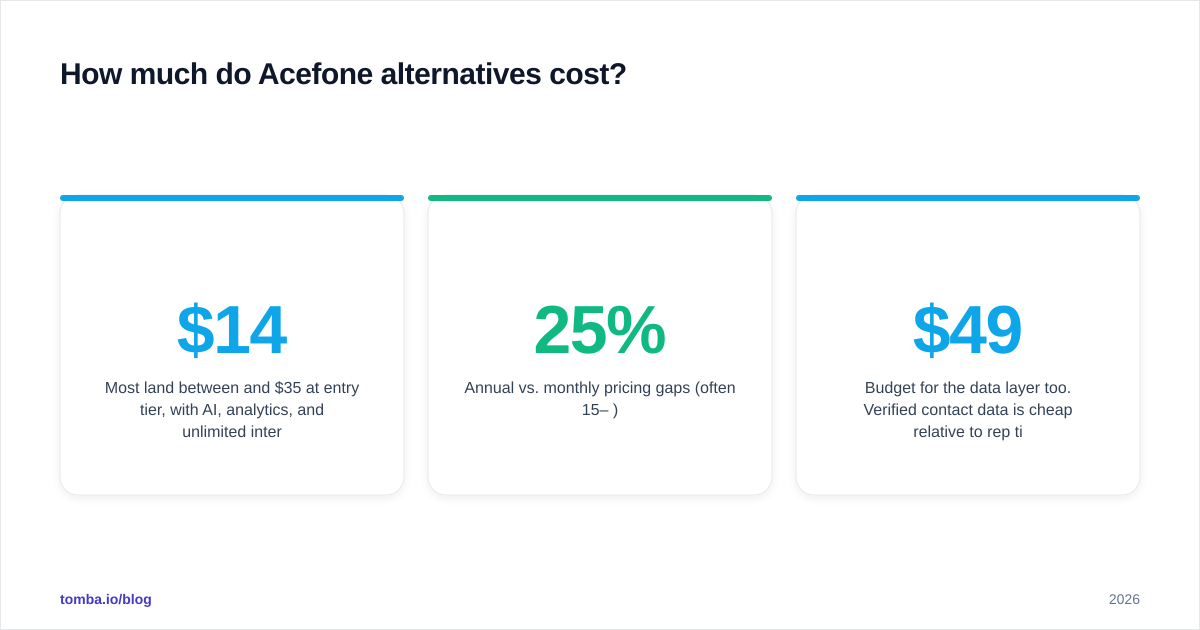
Most land between $14 and $35 per user per month at entry tier, with AI, analytics, and unlimited international calling pushing serious teams into the $40–$60 range. Watch for:
- Per-minute metering on outbound — it can dwarf the per-seat fee at volume.
- Annual vs. monthly pricing gaps (often 15–25%).
- Add-on AI that turns a cheap base plan into a premium one.
Budget for the data layer too. Verified contact data is cheap relative to rep time wasted on dead numbers — and tools like Tomba's plans start free (25 searches/mo) and scale from $49/mo, so you can test data quality before committing.
Final take: pick the dialer, then fix the data#
There is no single best Acefone alternative — there is a best fit for your call volume, CRM, and budget. For most outbound sales teams that means Aircall or Dialpad; for enterprises, RingCentral or 8x8; for lean budgets, Ooma or Nextiva.
Whatever you choose, the phone system is only half the equation. Before your reps make a single dial, make sure they are calling real people at real numbers. Start with Tomba's Email Finder and phone finder to build clean, verified contact lists — then let your new cloud phone platform do what it does best: connect the call. Try it free, no credit card, and stop paying per minute to ring dead lines.
// get started
Find, verify and enrich your first contacts today
Start on the free plan with 25 searches a month, then scale when your team is ready.
Free plan · No credit card required · GDPR & CCPA
// about the author