Actively AI Pricing, Reviews, Pros and Cons (2026 Guide)
A neutral 2026 breakdown of Actively AI pricing, real reviews, and the honest pros and cons — plus how it fits a modern AI-driven prospecting stack.
TL;DR
- This guide breaks down the Actively AI pricing, reviews, pros and cons for 2026. Actively AI is an AI-powered "reasoning" prospecting platform. It ranks accounts and contacts, then drafts and prioritizes outbound for SDR and rep teams. It is built for mid-market and enterprise revenue orgs.
- Pricing is not public. Expect custom annual contracts. Based on user reports, these land in the mid-five-figures-and-up range — far above self-serve tools.
- Reviews praise the pipeline lift and "do the research for me" automation. Criticism centers on cost, onboarding time, and dependence on clean CRM and contact data.
- Biggest hidden cost: Actively AI scores and sequences accounts. But it does not replace a dedicated email finder or verifier — you still need accurate contact data feeding it.
- If you want the AI-prioritization upside without the enterprise price, pair a leaner data layer (like Tomba's email finder) with your existing sequencer.
What is Actively AI?#
Actively AI is an AI sales-technology platform built around what it calls "reasoning." The software reads your CRM, product usage, and market signals. Then it decides which accounts and people your team should work next, and why. Think of it less as a list-builder and more as a tireless analyst. It reads every account overnight. Each morning it hands your reps a ranked, annotated to-do list.
The pitch lands on a real pain. Most outbound teams drown in data but starve for prioritization. Reps spend hours deciding who to contact instead of actually contacting them. Actively AI targets that gap. It combines account scoring, contact selection, and AI-drafted outreach into one layer. That layer sits on top of your existing CRM and engagement tools.
You can read the vendor's own framing on the official Actively AI site, but vendor copy is vendor copy. This guide weighs the Actively AI pricing, reviews, pros and cons the way a buyer should. It asks what you actually pay, what users actually say, and where it fits — or doesn't — in a 2026 stack.
How does Actively AI pricing work in 2026?#
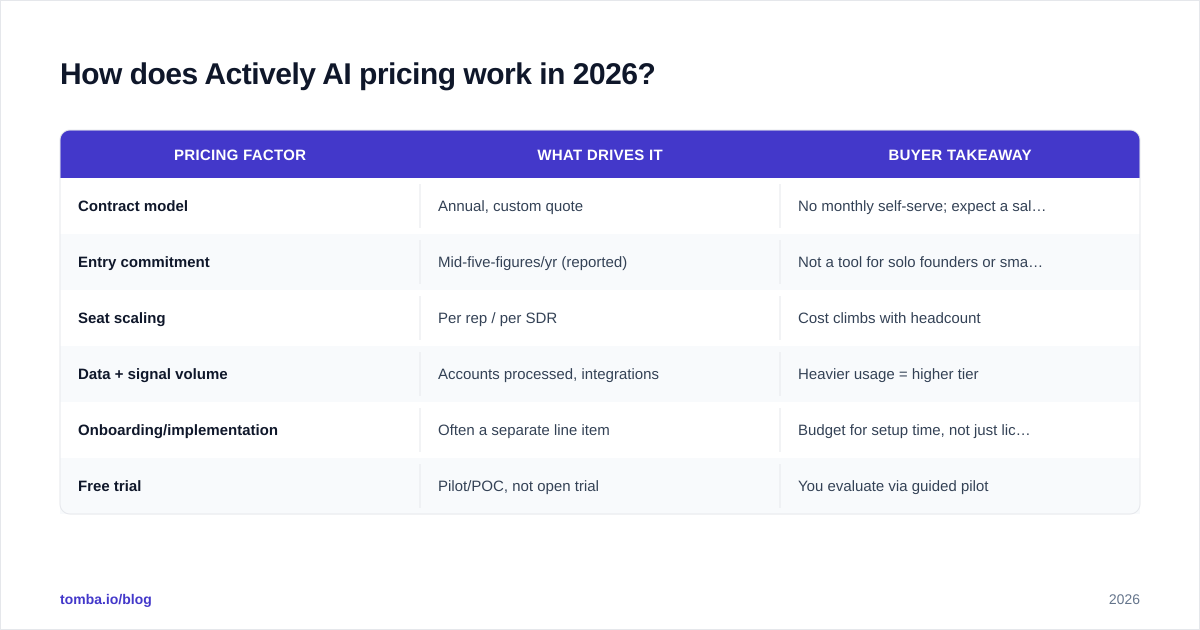
Short answer: Actively AI does not publish pricing, and there is no free tier or public self-serve plan. Pricing is quote-based and annual. It is scoped to seat count, data volume, and the modules you enable.
That puts it in the same commercial bucket as platforms like 6sense and Gong — enterprise GTM software where you talk to sales before you see a number. Based on aggregated buyer reports and analyst-style commentary, here's a realistic framing rather than a fabricated price sheet:
| Pricing factor | What drives it | Buyer takeaway |
|---|---|---|
| Contract model | Annual, custom quote | No monthly self-serve; expect a sales cycle |
| Entry commitment | Mid-five-figures/yr (reported) | Not a tool for solo founders or small teams |
| Seat scaling | Per rep / per SDR | Cost climbs with headcount |
| Data + signal volume | Accounts processed, integrations | Heavier usage = higher tier |
| Onboarding/implementation | Often a separate line item | Budget for setup time, not just license |
| Free trial | Pilot/POC, not open trial | You evaluate via guided pilot |
Compare that to transparent, self-serve tooling. For context, Tomba's pricing runs a Free tier (25 searches/mo), Starter at $49/mo, Growth at $99/mo, and Pro at $249/mo. It is published, month-to-month, and needs no quote. Different product category, but the contrast matters. Actively AI is a strategic platform purchase, not a line-item tool you expense on a card.
If a vendor won't show pricing, treat the first quote as a starting point. Ask for the all-in number: license, implementation, data, and any signal or enrichment add-ons.
)
What do Actively AI reviews say?#
Reviews skew positive on outcomes and cautious on cost and ramp. Public sentiment on platforms like G2 and analyst coverage from firms such as Gartner surface the same themes. Here's the honest distillation.
What reviewers like:
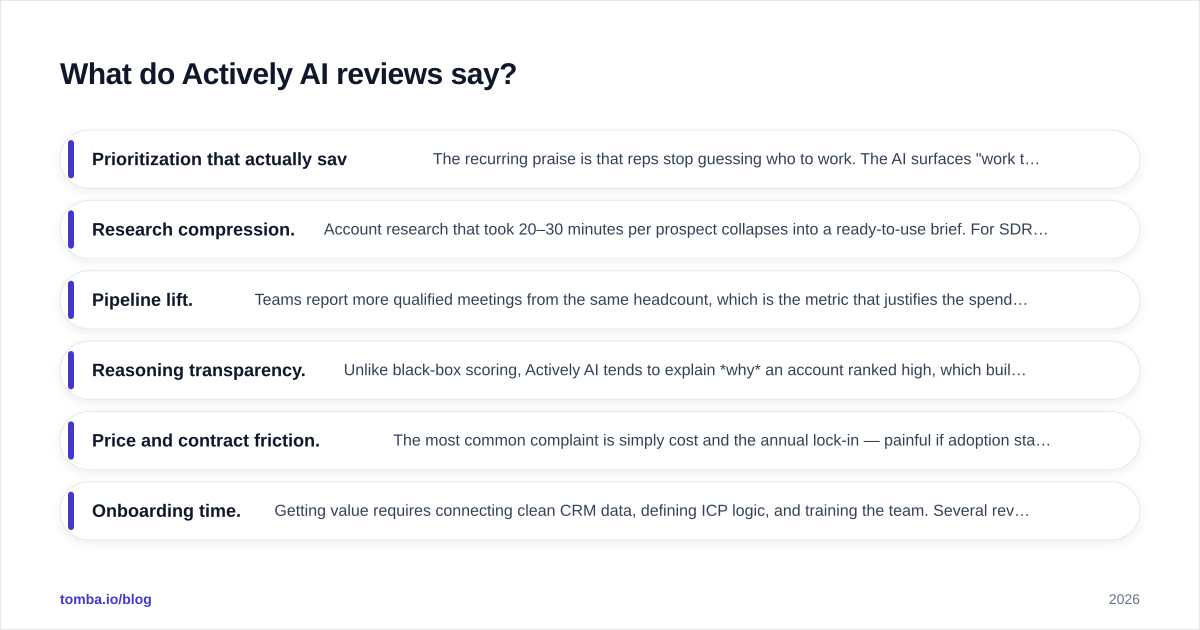
- Prioritization that actually saves time. The recurring praise is that reps stop guessing who to work. The AI surfaces "work this account now, here's why" with supporting signals.
- Research compression. Account research that took 20–30 minutes per prospect collapses into a ready-to-use brief. For SDRs, that's the headline.
- Pipeline lift. Teams report more qualified meetings from the same headcount. That is the metric that justifies the spend internally.
- Reasoning transparency. Unlike black-box scoring, Actively AI tends to explain why an account ranked high. That builds rep trust.
What reviewers criticize:
- Price and contract friction. The most common complaint is simply cost and the annual lock-in. It stings if adoption stalls.
- Onboarding time. Getting value requires connecting clean CRM data, defining ICP logic, and training the team. Several reviewers note a multi-week ramp.
- Garbage-in, garbage-out. The model is only as good as the data feeding it. Stale CRM fields and missing contact data dent results.
- Overlap anxiety. Teams already running an ABM platform or a sequencer sometimes struggle to articulate where Actively AI starts and the incumbent stops.
The pattern is classic enterprise AI sales technology. You get strong upside when it is implemented well. You also get real risk of shelfware when data hygiene and process aren't ready.
Actively AI pricing, reviews, pros and cons: the scorecard#
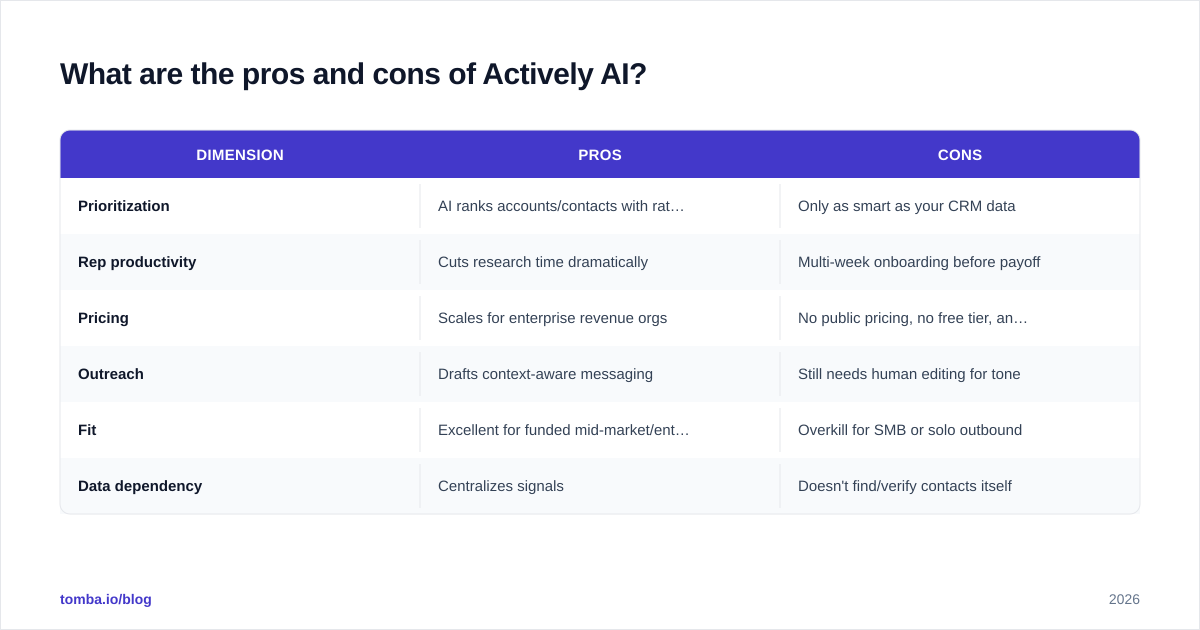
Here's the balanced scorecard. No tool is all upside, and an honest pros and cons read is the whole point of a buyer's guide.
| Dimension | Pros | Cons |
|---|---|---|
| Prioritization | AI ranks accounts/contacts with rationale | Only as smart as your CRM data |
| Rep productivity | Cuts research time dramatically | Multi-week onboarding before payoff |
| Pricing | Scales for enterprise revenue orgs | No public pricing, no free tier, annual lock-in |
| Outreach | Drafts context-aware messaging | Still needs human editing for tone |
| Fit | Excellent for funded mid-market/enterprise | Overkill for SMB or solo outbound |
| Data dependency | Centralizes signals | Doesn't find/verify contacts itself |
The pro that sells it: Actively AI turns a pile of accounts into a ranked, reasoned action list. That reliably lifts pipeline for teams with enough volume to matter.
The con that kills deals: it assumes you already have accurate, deliverable contact data. It prioritizes who to contact. It does not reliably find and verify the email address you'll actually use. That's a separate layer, and skipping it means your beautifully prioritized list bounces.
This is where many buyers get surprised. AI prioritization sitting on top of dirty or incomplete contact data is a fast way to burn sender reputation and torch deliverability.
)
Who should actually buy Actively AI?#
Buy it if you're a funded mid-market or enterprise revenue org with a real SDR/AE motion, a CRM that's reasonably clean, and enough account volume that prioritization is a daily bottleneck. In that scenario, the time savings and pipeline lift can clear the price tag.
Skip it (for now) if you're a startup, a solo founder, or a small team doing fewer than a few hundred touches a month. The contract size and onboarding overhead won't pencil out. A leaner stack will get you 80% of the outcome for a fraction of the cost.
A simple gut check:
- Headcount: 5+ reps/SDRs → worth a pilot. Under 3 → probably not yet.
- Data maturity: clean CRM + defined ICP → green light. Messy data → fix that first.
- Budget model: comfortable with annual GTM software contracts → fine. Prefer month-to-month tools → look elsewhere.
What are the best Actively AI alternatives and complements?#
There are two ways to think about alternatives: full-platform substitutes, and the data layer that every AI prospecting tool quietly depends on.
On the platform side, ABM and revenue-intelligence tools like 6sense, Demandbase, and Gong overlap with parts of Actively AI's value. If you're comparing those, our 6sense alternative breakdown is a useful starting point.
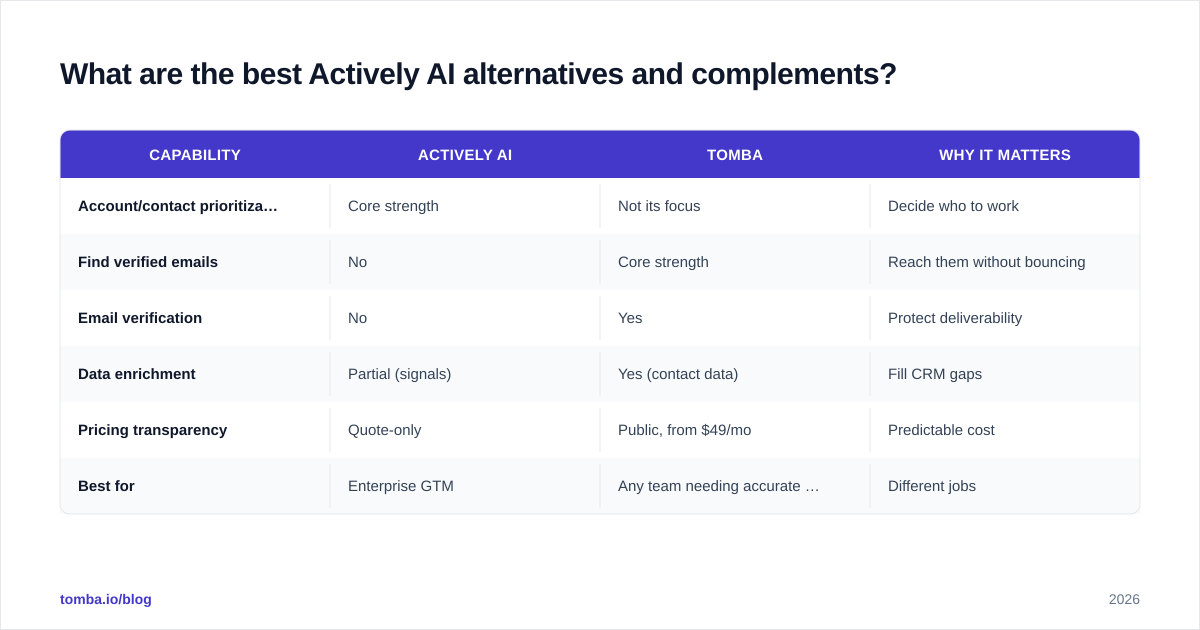
But here's the more important point for most buyers. Prioritization software and contact-data software solve different problems. Actively AI tells you who to reach. A tool like Tomba tells you how to reach them — the verified email, the company pattern, the enriched record. You generally want both.
| Capability | Actively AI | Tomba | Why it matters |
|---|---|---|---|
| Account/contact prioritization | Core strength | Not its focus | Decide who to work |
| Find verified emails | No | Core strength | Reach them without bouncing |
| Email verification | No | Yes | Protect deliverability |
| Data enrichment | Partial (signals) | Yes (contact data) | Fill CRM gaps |
| Pricing transparency | Quote-only | Public, from $49/mo | Predictable cost |
| Best for | Enterprise GTM | Any team needing accurate contacts | Different jobs |
You can layer the two. Let your prioritization engine rank the accounts. Then use data enrichment and a verified email finder to make sure the contacts on that list are real and reachable. For teams building their own workflows, the Tomba API drops that data layer directly into the sequence.
Is Actively AI worth it in 2026?#
When you weigh the Actively AI pricing, reviews, pros and cons together, it's worth it for the right buyer — and an expensive mistake for the wrong one. The deciding variable isn't the AI. It's whether your data and process are ready to feed it.
If you have the volume, the headcount, and clean CRM hygiene, Actively AI's reasoning layer can genuinely compress research time and lift pipeline. The reviews back that up. If you're earlier-stage, the annual contract and onboarding curve will outweigh the benefit. You'll get better ROI assembling a transparent, modular stack.
Either way, remember the unglamorous truth underneath every AI sales platform. Prioritization is only as valuable as the contact data behind it. The fanciest account ranking in the world fails if the email bounces.
Get the data layer right first#
Before you sign any enterprise AI prospecting contract, make sure the contacts on your list are real, current, and deliverable. That's the foundation every prioritization engine sits on. Start with the Tomba Email Finder to find and verify professional email addresses by name, company, or domain. There's a free tier to test it and transparent plans from $49/mo when you scale. Whether you buy Actively AI or build your own motion, accurate data is the cheapest pipeline insurance you'll ever buy.
// get started
Find, verify and enrich your first contacts today
Start on the free plan with 25 searches a month, then scale when your team is ready.
Free plan · No credit card required · GDPR & CCPA
// about the author