Adaptio vs Anymail Finder (2026): Which Email Tool Wins?
Adaptio vs Anymail Finder compared on accuracy, pricing, verification, and workflow fit — plus where each tool wins and a stronger third option for 2026.
Choosing between Adaptio and Anymail Finder usually comes down to one question: do you want an AI-led prospecting workflow, or a lean pay-for-valid-emails finder? This guide breaks down both on accuracy, pricing, verification, and how they fit a real outbound motion in 2026 — then shows where a third option quietly outperforms each.
TL;DR#
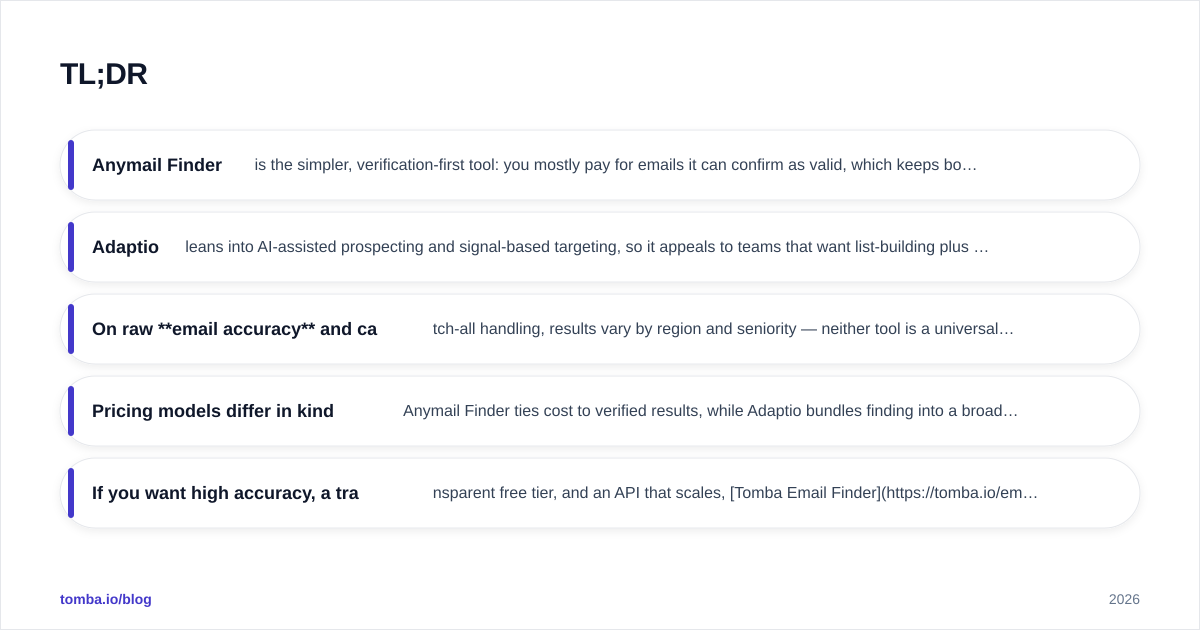
- Anymail Finder is the simpler, verification-first tool: you mostly pay for emails it can confirm as valid, which keeps bounce rates low for straightforward name-and-domain lookups.
- Adaptio leans into AI-assisted prospecting and signal-based targeting, so it appeals to teams that want list-building plus enrichment in one motion rather than a pure finder.
- On raw email accuracy and catch-all handling, results vary by region and seniority — neither tool is a universal winner, so test on your own ICP before committing.
- Pricing models differ in kind: Anymail Finder ties cost to verified results, while Adaptio bundles finding into a broader platform fee. That makes per-email math hard to compare directly.
- If you want high accuracy, a transparent free tier, and an API that scales, Tomba Email Finder is the stronger default for most B2B teams — details in the comparison table below.
What are Adaptio and Anymail Finder?#
Both tools solve the same core problem — turning a name and a company into a usable business email — but they approach it from opposite ends.
Anymail Finder (anymailfinder.com) built its reputation on a single promise: you only get charged for emails it can mark as valid. For high-volume cold outreach where every bounce hurts your sender reputation, that billing model is genuinely useful. You feed it a full name and a domain (or a company name), and it returns either a verified address or nothing. It's a finder, not a sales suite.
Adaptio positions itself further up the funnel as an AI-driven prospecting and go-to-market tool. Instead of just resolving one contact at a time, it leans toward building target lists, surfacing buying signals, and enriching records so a rep can move from "who should I contact" to "here's their email" inside one flow. The trade-off: more surface area, more to learn, and a pricing model built around the platform rather than per verified email.
In short — Anymail Finder is a scalpel, Adaptio is closer to a Swiss Army knife. The right pick depends on whether you already have a list or need help building one.

How do they compare on accuracy?#
Accuracy is the only metric that matters once an email leaves your sequence. A "found" address that bounces costs you twice: the wasted send and the damage to your domain.
Here's the honest framing. Anymail Finder's verification-first model means the addresses it returns are biased toward deliverable, because it filters out the ones it can't confirm. The cost is coverage — on harder targets (small companies, catch-all domains, non-US contacts) it will often return nothing rather than a guess. That's a feature for deliverability and a frustration for coverage.
Adaptio optimizes for pipeline, so it tends to surface more contacts overall, but the verification step is one layer in a broader workflow rather than the headline guarantee. You should run your own email verification pass on anything ambiguous before sending.
A few realities that apply to both tools:
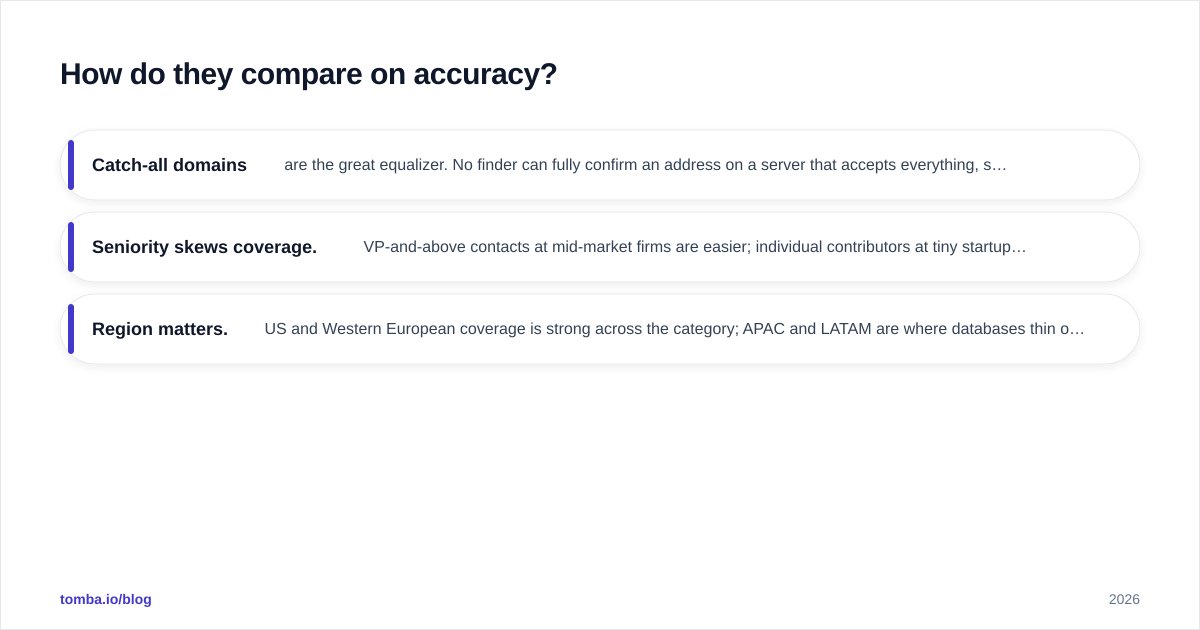
- Catch-all domains are the great equalizer. No finder can fully confirm an address on a server that accepts everything, so look at how each tool labels these. A dedicated catch-all verifier matters more than marketing claims.
- Seniority skews coverage. VP-and-above contacts at mid-market firms are easier; individual contributors at tiny startups are hardest.
- Region matters. US and Western European coverage is strong across the category; APAC and LATAM are where databases thin out.
The takeaway: don't trust a vendor's headline accuracy number. Run 50 of your real prospects through each tool's free credits and measure the bounce rate yourself.

Adaptio vs Anymail Finder: feature and pricing comparison#
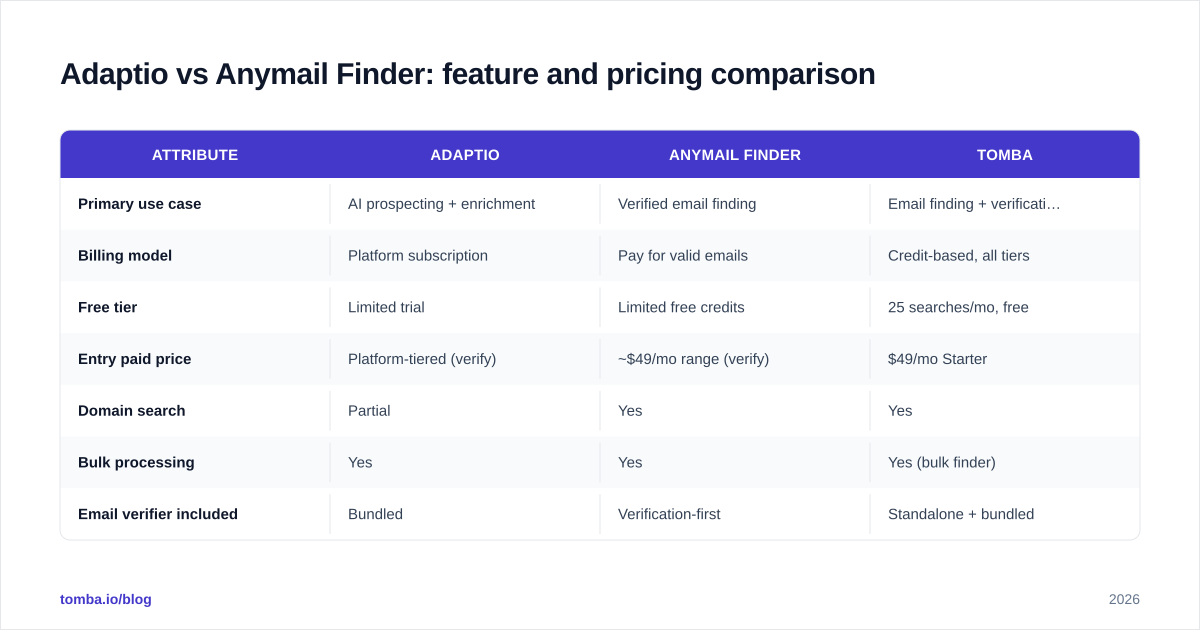
The table below maps the practical differences. Treat pricing as directional — both vendors adjust tiers, so confirm current numbers on their official pages before you buy. Tomba's published pricing details are included as a transparent reference point.
| Attribute | Adaptio | Anymail Finder | Tomba |
|---|---|---|---|
| Primary use case | AI prospecting + enrichment | Verified email finding | Email finding + verification |
| Billing model | Platform subscription | Pay for valid emails | Credit-based, all tiers |
| Free tier | Limited trial | Limited free credits | 25 searches/mo, free |
| Entry paid price | Platform-tiered (verify) | ~$49/mo range (verify) | $49/mo Starter |
| Domain search | Partial | Yes | Yes |
| Bulk processing | Yes | Yes | Yes (bulk finder) |
| Email verifier included | Bundled | Verification-first | Standalone + bundled |
| Phone / data enrichment | Yes (core focus) | Limited | Phone finder + enrichment |
| Public API | Yes | Yes | Yes (REST + SDKs) |
| Best for | Teams building lists with AI | High-volume cold email | Accuracy + scale + budget |
Two things stand out. First, billing model is the real fork in the road: Anymail Finder's "pay for valid" approach is genuinely friendly for unpredictable monthly volume, while Adaptio's platform fee makes more sense if you'll use the prospecting and signals features daily. Second, if you want a bulk email finder plus a verifier under one predictable credit system, that's where a credit-based tool tends to win on cost clarity.
Which one fits your workflow?#
Match the tool to how your team actually works, not to the longest feature list.
Pick Anymail Finder if:
- You already have a list of names and domains and just need clean emails.
- Deliverability is your top concern and you'd rather get nothing than a risky guess.
- Your monthly volume is spiky, so a pay-for-valid model beats a fixed seat fee.
- You want minimal onboarding — paste, find, export.
Pick Adaptio if:
- You need help building the target list, not just resolving contacts.
- Your reps benefit from buying signals and AI-assisted targeting in one place.
- You're consolidating tools and want enrichment, finding, and prospecting together.
- You have the budget and volume to justify a full platform.
Consider a third option if you want the accuracy discipline of a verification-first finder and the scale of a full data platform without the platform price tag. That's the gap Tomba targets — and it's worth a look before you sign an annual contract with either. You can pull emails straight into your stack with the HubSpot integration or via Google Sheets, so the tool fits your existing pipeline instead of forcing a new one.

A framework for choosing an email finder#
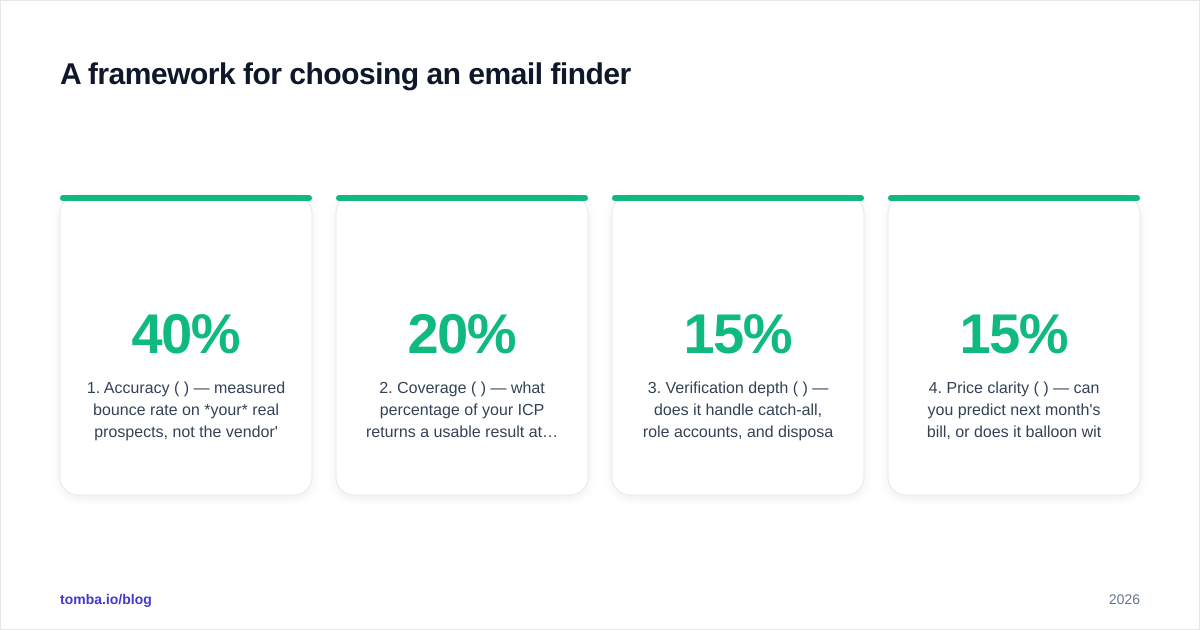
Before you compare any two tools, score them against the criteria that actually move revenue. Use this simple weighting model when you run your own test.
- Accuracy (40%) — measured bounce rate on your real prospects, not the vendor's demo list.
- Coverage (20%) — what percentage of your ICP returns a usable result at all.
- Verification depth (15%) — does it handle catch-all, role accounts, and disposable domains?
- Price clarity (15%) — can you predict next month's bill, or does it balloon with usage?
- Integrations & API (10%) — does it drop into your CRM and automation without glue code?
Run both Adaptio and Anymail Finder through this same scorecard with the same 50-prospect sample. The numbers will tell you more than any review — including this one. The end-to-end process looks like this:
How does verification change the math?#
Verification is where the "cheaper" tool often turns out to be the expensive one.
Think of it like buying produce. A market that sells everything cheap but lets half of it rot (unverified emails) costs more than a slightly pricier stall that only sells what's fresh (verified emails) — because you throw less away and you don't get sick (domain reputation damage). Technically, every hard bounce above roughly 2% signals mailbox providers to throttle or spam-folder your sends, which silently tanks the deliverability of every campaign, not just the bad addresses.
This is why Anymail Finder's pay-for-valid model resonates — it externalizes the verification discipline into the billing. But you can get the same discipline with any finder if you run a dedicated verification pass. Tomba bundles a standalone email verifier and a catch-all finder so you're not forced to choose between coverage and clean lists. If you're sending cold, also confirm your authentication with an SPF record check before scaling volume — the best email list in the world still bounces if your domain isn't set up to send.

What do real buyers say?#
Peer reviews are the fastest sanity check on vendor claims. Both tools have profiles on G2, where you can filter by company size and use case to find reviewers who look like you. A few patterns tend to repeat across the email-finder category:
- Users praise Anymail Finder for predictable billing and low bounce rates, and occasionally flag coverage gaps on smaller or international companies.
- AI-prospecting platforms like Adaptio draw praise for list-building speed and criticism for learning curve and price when teams only needed a finder.
- The most common regret across the category is over-buying — paying for a full platform when a focused finder plus verifier would have covered 90% of the need.
When you read reviews, weight the ones from accounts your size and in your region. A glowing review from a 2,000-seat enterprise tells you little about how the tool performs for a five-person SDR team.
Is there a better alternative for 2026?#
For most B2B teams, a focused, accurate, fairly priced finder beats both a bare-bones lookup tool and a heavy AI platform — and that's the case for Tomba as a default.
Here's the reasoning, conclusion first: Tomba gives you the verification discipline of Anymail Finder and the breadth of a platform like Adaptio, without forcing the trade-off. You get a genuine free tier (25 searches/month — no card), a $49/mo Starter that matches Anymail Finder's entry range, and the full toolkit — domain search, bulk email finder, phone finder, data enrichment, and a developer-friendly email finder API — under one predictable credit system.
That doesn't make Adaptio or Anymail Finder wrong choices. If you live inside an AI-prospecting workflow, Adaptio's signals may pay for themselves. If you want billing that mathematically guarantees you only pay for valid emails, Anymail Finder's model is hard to argue with. But if you're optimizing for accuracy per dollar across a normal outbound motion, the third option deserves a spot in your test.
How should you run the head-to-head test?#
Don't decide on features — decide on a 30-minute experiment.
- Export 50 real prospects you actually want to reach (names + company domains).
- Run the same 50 through Adaptio, Anymail Finder, and Tomba using free credits.
- Send each result set through a neutral email verifier — including the one built into the tool you didn't get them from.
- Record three numbers per tool: hit rate (emails returned), valid rate (passed verification), and cost per valid email.
- Pick the winner on cost per valid email, not cost per email.
This single test cuts through every marketing claim, including the ones in this article. The tool that delivers the most inbox-ready addresses per dollar for your ICP is your answer — and it may differ by segment.
The bottom line#
Adaptio and Anymail Finder solve overlapping problems from opposite directions: one is an AI prospecting platform, the other a verification-first finder. Neither is universally better — your list maturity, volume pattern, and budget decide it.
But if you want one tool that finds, verifies, and enriches with high accuracy, a transparent free tier, and an API that scales with you, start with Tomba Email Finder. Run the 50-prospect test above, compare cost per valid email, and let the bounce rate make the decision for you. Spin up the free 25-search tier today, measure it against your current stack, and only pay once the numbers prove it out.
// get started
Find, verify and enrich your first contacts today
Start on the free plan with 25 searches a month, then scale when your team is ready.
Free plan · No credit card required · GDPR & CCPA
// about the author