Adaptio vs DealSignal 2026: B2B Data Platform Comparison
Adaptio and DealSignal both promise clean B2B data and AI-driven targeting—but they solve different problems. Here's how they compare on coverage, accuracy, pricing, and fit.
Adaptio vs DealSignal: Which B2B Data Platform Fits Your GTM Stack?
If you are choosing between Adaptio and DealSignal, you are really choosing between two philosophies of go-to-market data. One leans into AI-driven account prioritization and signal-based targeting; the other leans into deep, human-verified contact records you can pour into your CRM. They overlap enough to look like rivals on a feature grid, but they win in different situations.
This guide breaks down where each tool actually earns its price, who should pick which, and where a leaner, pay-for-what-you-use approach beats both.
TL;DR#
- Adaptio is best if you want AI-led account scoring, intent signals, and a guided "who to contact next" workflow layered on top of your existing data.
- DealSignal is best if your priority is large volumes of human-verified contacts and firmographics delivered as on-demand lists or CRM enrichment.
- Pricing for both is quote-based and lands in the mid-to-high range; neither publishes a true self-serve free tier for ongoing use.
- Most teams overspend by buying a heavyweight platform when they only need accurate, verified emails on demand—where a tool like Tomba covers the core job for a fraction of the cost.
- Pick on the bottleneck: thin targeting → Adaptio; thin or stale records → DealSignal; thin reach + tight budget → an email finder.
What is Adaptio?#
Adaptio positions itself as an AI go-to-market platform. Instead of just handing you a database, it sits on top of your accounts and tries to answer the harder question: which accounts deserve attention right now, and who should you reach inside them? That means account scoring, buying-signal aggregation, and prioritization workflows aimed at sales and RevOps teams who already have plenty of raw data but struggle to act on it.
The pitch is operational. Adaptio wants to be the layer that turns a messy CRM and a pile of intent signals into a ranked list of next actions. If your reps spend their mornings deciding who to call rather than how to reach them, that is the gap Adaptio targets. It is closer in spirit to revenue operations tooling than to a plain contact database.
What is DealSignal?#
DealSignal is a B2B data provider built around freshness and verification. Its core promise is contact and account records—emails, direct dials, titles, firmographics—that are re-verified on demand rather than served from a stale cache. You can build targeted lists, enrich existing CRM records, and append missing fields like company size, industry, or technologies in use.
Where Adaptio is about deciding, DealSignal is about supplying. It is the raw material: verified people at verified companies, delivered into Salesforce, HubSpot, or a CSV. Teams that burn through lists quickly—high-volume outbound, agencies, demand-gen shops—are the natural buyers. You can see how it stacks up against similar vendors on review sites like G2, which is a useful neutral sanity check before any demo.
How do Adaptio and DealSignal differ at a glance?#
The fastest way to see the split is feature by feature. Note that both vendors use quote-based pricing, so the figures below reflect commonly reported ranges rather than published rate cards—always confirm in a live quote.
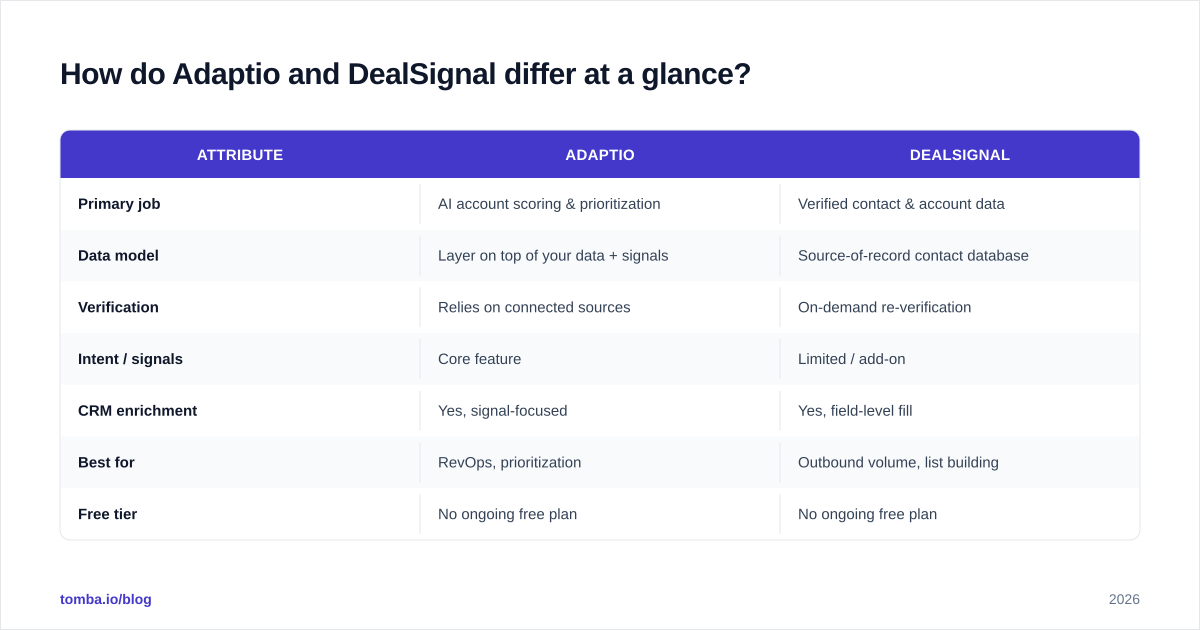
| Attribute | Adaptio | DealSignal |
|---|---|---|
| Primary job | AI account scoring & prioritization | Verified contact & account data |
| Data model | Layer on top of your data + signals | Source-of-record contact database |
| Verification | Relies on connected sources | On-demand re-verification |
| Intent / signals | Core feature | Limited / add-on |
| CRM enrichment | Yes, signal-focused | Yes, field-level fill |
| Best for | RevOps, prioritization | Outbound volume, list building |
| Free tier | No ongoing free plan | No ongoing free plan |
| Pricing model | Annual, quote-based | Annual, quote-based |
| Typical buyer | Mid-market to enterprise | SMB to enterprise |
The pattern is clear: these tools are complements as often as they are competitors. A well-funded team could plausibly run DealSignal for raw records and Adaptio for prioritization. Most teams cannot justify both.
Which one has better data accuracy?#
Conclusion first: DealSignal usually wins on raw record accuracy, because re-verification is its core product, not a side feature. Adaptio's accuracy depends heavily on the quality of the sources you connect to it—garbage in, garbage out. If your CRM is already messy, Adaptio's scoring inherits that mess.
That said, accuracy is not one number. It splits into three questions you should ask any vendor:
- Coverage — what percentage of your target accounts and personas exist in the database at all?
- Correctness — of the records returned, how many are deliverable and current?
- Freshness — how recently was each record verified, and how is decay handled?
DealSignal's on-demand verification model is built to attack #2 and #3 directly. Adaptio's strength is upstream of all three: it helps you decide which accurate records are worth acting on. Neither fully solves the deliverability problem at send time, which is why teams still pair them with a dedicated email verifier before a campaign goes out.
If your bottleneck is bounce rate and wasted sends, accuracy at the record level matters more than fancy scoring—and that is the lane where a focused finder-plus-verifier stack quietly outperforms a heavyweight platform.
How should you choose between them?#
Decide on your actual bottleneck, not the feature list. The framework below maps symptoms to the right tool.
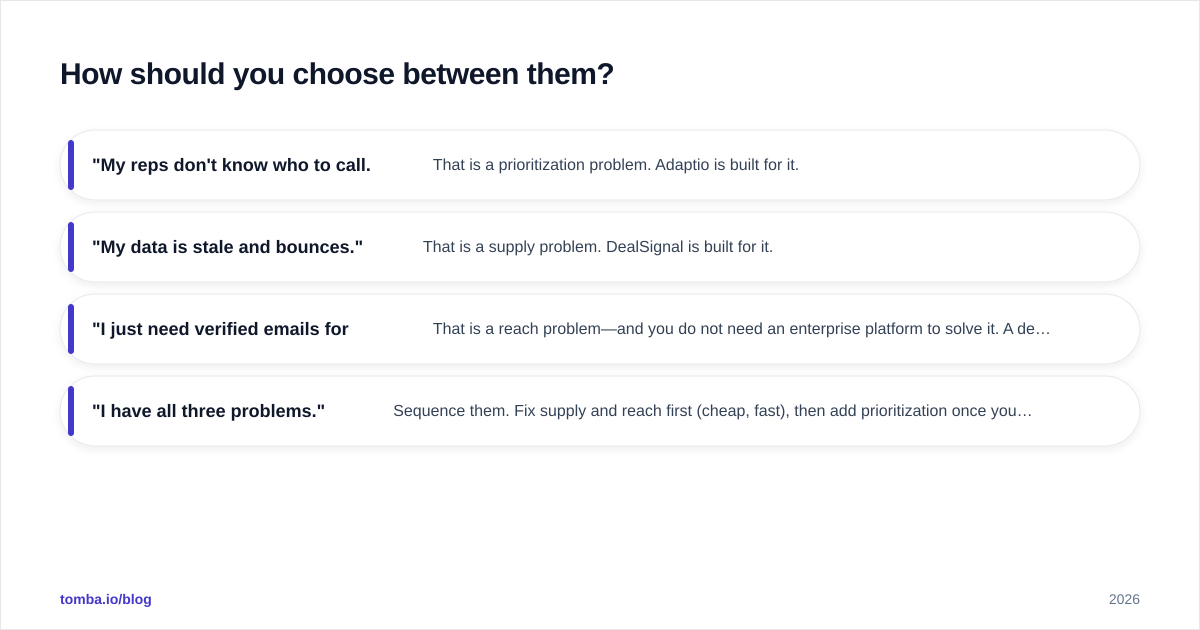
- "My reps don't know who to call." That is a prioritization problem. Adaptio is built for it.
- "My data is stale and bounces." That is a supply problem. DealSignal is built for it.
- "I just need verified emails for the accounts I already picked." That is a reach problem—and you do not need an enterprise platform to solve it. A dedicated email finder plus verification does the job for far less.
- "I have all three problems." Sequence them. Fix supply and reach first (cheap, fast), then add prioritization once you have clean data worth ranking.
The most common mistake is buying the platform that demos best rather than the one that fixes your worst bottleneck. A signal-scoring engine is wasted on a team whose lists bounce 30% of the time.
What does each platform cost in 2026?#
Both Adaptio and DealSignal use annual, quote-based pricing, typically gated behind a demo. Reported deals tend to start in the four-figures-per-year range for smaller teams and climb quickly with seats, credits, and add-ons like intent data. Neither offers a genuine free tier you can run a real campaign on.
That matters for budget-conscious teams. If your core need is verified contact data, paying enterprise platform prices for features you will not use is pure waste. Here is how the value math compares against a focused alternative:
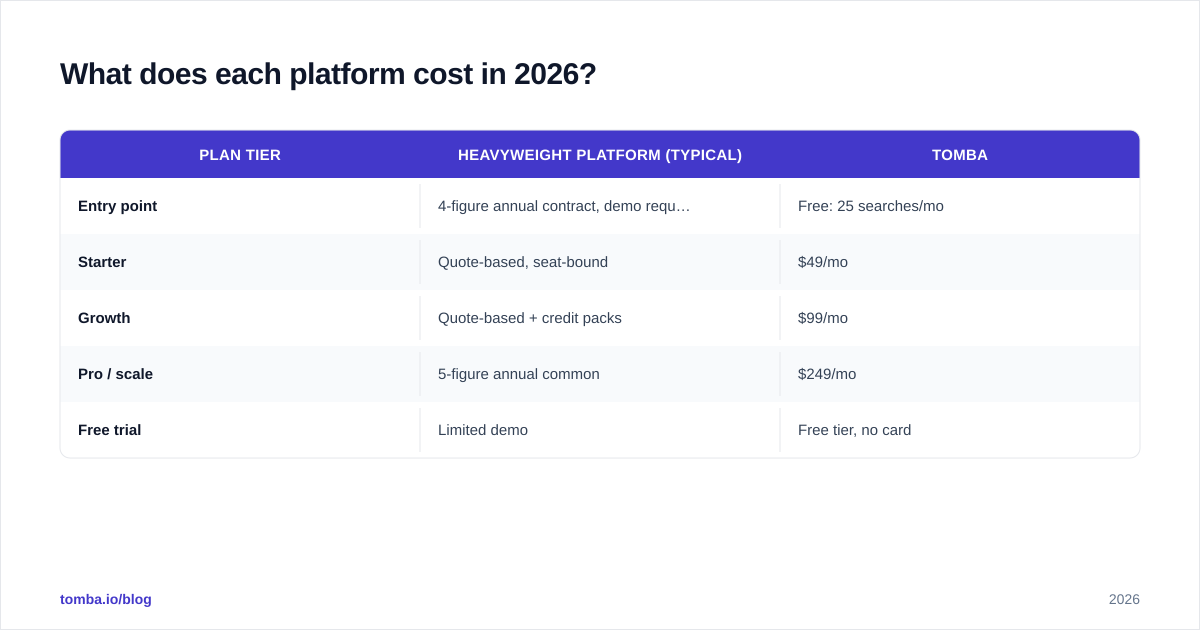
| Plan tier | Heavyweight platform (typical) | Tomba |
|---|---|---|
| Entry point | 4-figure annual contract, demo required | Free: 25 searches/mo |
| Starter | Quote-based, seat-bound | $49/mo |
| Growth | Quote-based + credit packs | $99/mo |
| Pro / scale | 5-figure annual common | $249/mo |
| Free trial | Limited demo | Free tier, no card |
You can see the full Tomba pricing breakdown directly—no demo required. The point is not that Tomba does everything Adaptio or DealSignal does; it is that most teams only ever use the contact-data slice, and that slice is available far cheaper.
Where does a focused email finder fit instead?#
Conclusion first: if your real need is finding and verifying B2B emails at the accounts you already care about, a dedicated finder beats a full platform on both cost and simplicity. Think of it like buying a chef's knife instead of a 20-piece block when you only ever slice vegetables. The extra blades are not free—they cost money and drawer space, and you never reach for them.
A finder-first stack typically covers:
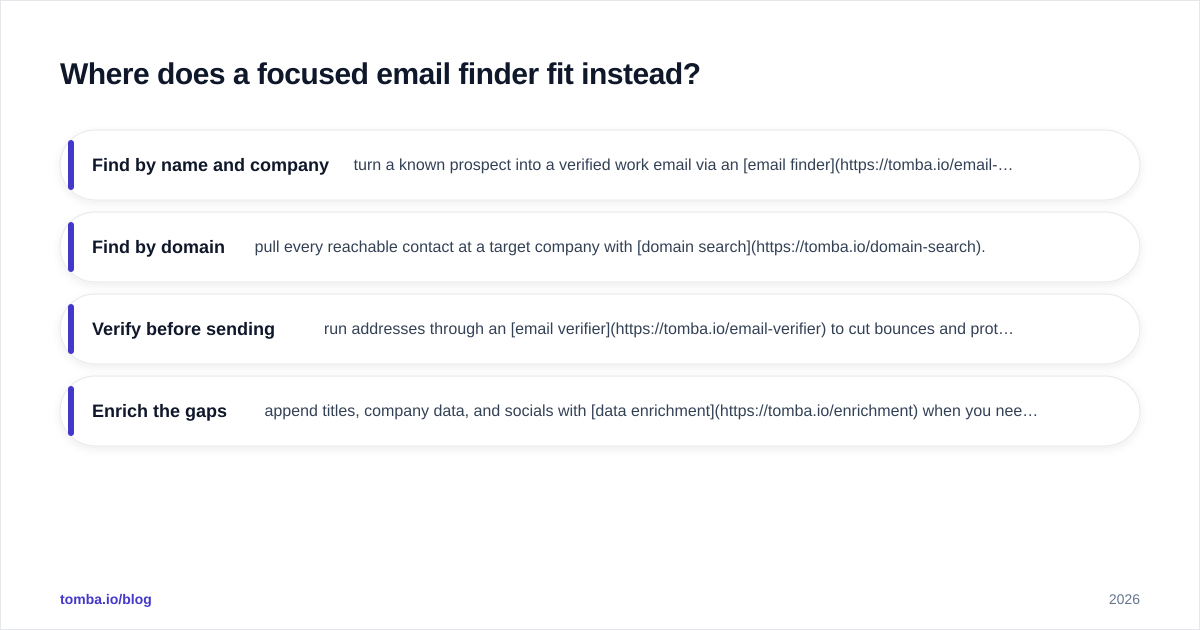
- Find by name and company — turn a known prospect into a verified work email via an email finder.
- Find by domain — pull every reachable contact at a target company with domain search.
- Verify before sending — run addresses through an email verifier to cut bounces and protect sender reputation.
- Enrich the gaps — append titles, company data, and socials with data enrichment when you need more than an email.
This is the workflow most outbound teams actually run day to day. The platforms add prioritization and signal layers on top—valuable for some, overkill for many. If you have already chosen your accounts (a focused list, an event attendee export, a niche vertical), you do not need an AI to re-rank them. You need clean, deliverable contacts, fast.
It is worth noting the platforms know this too: contact data is the gravitational center of every B2B GTM tool, which is why both Adaptio and DealSignal compete partly on the same record-quality ground a finder occupies—just at a much higher price point and with a heavier sales motion. Vendor documentation from established CRMs like HubSpot reinforces the same hierarchy: clean, deliverable data first, intelligence layers second.
Can you use Adaptio, DealSignal, and a finder together?#
Yes, and the smart teams do. The layers are not mutually exclusive:
- Reach layer — an email finder + verifier supplies and validates contacts on demand, including for accounts the big databases miss.
- Supply layer — DealSignal (or similar) provides bulk verified records for high-volume programs.
- Decision layer — Adaptio (or similar) ranks accounts and surfaces signals so reps work the best opportunities first.
Start at the bottom. Most teams discover that once the reach and supply layers are solid, the decision layer is a nice-to-have rather than the thing that was actually holding back pipeline. Build up only when the cheaper layers are saturated and clean.
For teams running outbound at scale, pairing a bulk email finder with native integrations into your CRM often closes the gap that sent them shopping for an enterprise platform in the first place—at a tenth of the contract size.
The verdict#
Adaptio and DealSignal are both solid at what they were built for, and neither is a mistake for the right buyer. Choose Adaptio when your reps drown in undifferentiated accounts and you need AI-led prioritization. Choose DealSignal when stale, incomplete records are bouncing your campaigns and you need verified supply at volume. Just be honest about which problem is actually yours—buying the wrong layer is the most expensive choice on this page.
And if, like most teams, your real bottleneck is simply finding verified emails for the accounts you already want to reach, you do not need a five-figure annual contract to solve it. Start with the Tomba Email Finder: find professional emails by name, company, or domain, verify them before you send, and only graduate to a heavier platform when you have outgrown the basics. Spin up the free tier with 25 searches and test it against your own target list before any demo call—let the deliverability numbers, not the sales deck, make the decision.
// get started
Find, verify and enrich your first contacts today
Start on the free plan with 25 searches a month, then scale when your team is ready.
Free plan · No credit card required · GDPR & CCPA
// about the author