Adaptio vs DiscoverOrg: Which B2B Data Platform Wins in 2026?
DiscoverOrg became ZoomInfo, and Adaptio is the AI-native challenger reshaping GTM data. Here is an honest, side-by-side breakdown of accuracy, signals, pricing, and fit for 2026.
TL;DR
- DiscoverOrg no longer exists as a standalone product — it was absorbed into ZoomInfo after the 2019 merger, so "DiscoverOrg" today effectively means ZoomInfo's data engine and its legacy org-chart depth.
- Adaptio is the AI-native challenger, built around real-time GTM signals, territory planning, and account scoring rather than a static contact database.
- If you need deep org charts, technographics, and a mature enterprise platform, the DiscoverOrg/ZoomInfo lineage still wins on raw coverage.
- If you want signal-driven prioritization and lighter, faster workflows, Adaptio is the more modern bet — but it is younger and less proven at scale.
- Most teams overpay for breadth they never use. A focused email finder plus data enrichment often covers 80% of the job at a fraction of the cost.
What are Adaptio and DiscoverOrg?#
The honest first answer: you are comparing two different eras of B2B data.
DiscoverOrg was, for over a decade, the gold standard for human-verified org charts and technographic data. It built a reputation among enterprise sales teams for knowing exactly who reported to whom inside a target account. In 2019 it merged with ZoomInfo, and the DiscoverOrg brand was folded into the ZoomInfo platform. So when people search "DiscoverOrg" in 2026, they are really evaluating ZoomInfo's data depth and the legacy DiscoverOrg methodology that lives inside it.
Adaptio is a newer, AI-native go-to-market platform. Instead of leading with a giant static contact database, it leans into real-time signals — hiring changes, funding events, technology adoption, and account-level intent — and turns those into territory plans and prioritized account lists. Think of it less as a phone book and more as a recommendation engine for where your reps should spend their next hour.
The mental model: DiscoverOrg is a library card catalog — exhaustive, organized, authoritative. Adaptio is a streaming service's "recommended for you" row — dynamic, opinionated, and built to surface what matters right now. Both have a place; the question is which one fits how your team actually sells.
How do Adaptio and DiscoverOrg compare head-to-head?#
Here is the side-by-side that matters before you sit through a single demo.
| Attribute | Adaptio | DiscoverOrg (nowZoomInfo) |
|---|---|---|
| Core model | AI signal & GTM orchestration | Human-verified contact & org database |
| Org-chart depth | Moderate, signal-inferred | Deep, manually researched lineage |
| Intent / signals | Native, real-time | Available, add-on heavy |
| Technographics | Growing | Mature, broad coverage |
| Territory planning | Built-in | Limited / requires add-ons |
| Data freshness | Continuous re-scoring | Periodic refresh cycles |
| Typical buyer | RevOps-led, mid-market | Enterprise sales orgs |
| Pricing transparency | Moderate | Low (custom, sales-led) |
| Learning curve | Light | Steeper |
| Contract flexibility | More flexible | Annual, enterprise-tier |
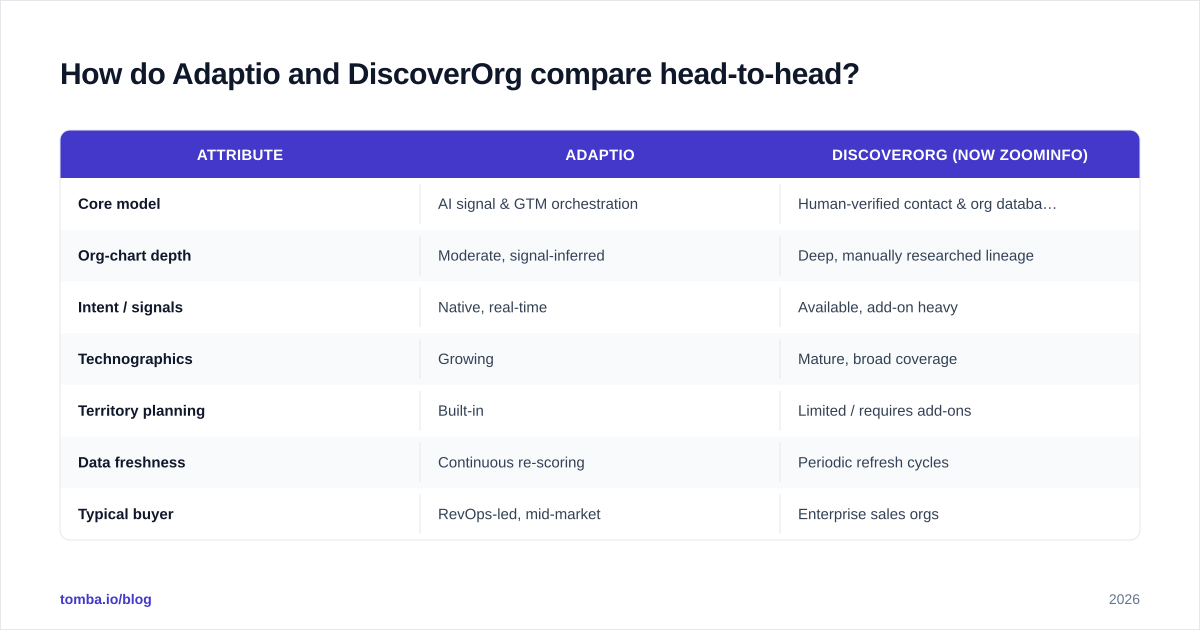
The pattern is consistent: DiscoverOrg's lineage wins on breadth and verified depth, while Adaptio wins on speed, prioritization, and time-to-value. Neither is "better" in the abstract — they optimize for different bottlenecks.
)
Is Adaptio more accurate than DiscoverOrg?#
It depends on what you mean by accurate.
DiscoverOrg built its name on human verification. Researchers confirmed titles, reporting lines, and direct dials, which is why enterprise teams trusted it for complex multi-threaded deals. That methodology, now inside ZoomInfo, still produces some of the deepest org charts in the market. If your motion requires knowing that the VP of Infrastructure reports to the CIO and sits in the Austin office, this lineage is hard to beat.
Adaptio takes a different bet: freshness over exhaustiveness. Its AI continuously re-scores accounts based on live signals, so the data you act on reflects this week's reality — a new funding round, a sudden hiring spike, a technology migration. The trade-off is that signal-inferred org structure is less granular than a manually researched chart.
In practice, "accuracy" splits into two questions:
- Is the contact record correct? Both platforms do well here, though any database decays — studies consistently show B2B contact data going stale at roughly 30% per year. This is why an independent email verifier step matters regardless of which platform you choose.
- Is the timing right? Adaptio is built to answer this; DiscoverOrg's lineage was not. A perfectly accurate contact you reach six months too late is a wasted touch.
If you want third-party signal, both ZoomInfo and emerging AI-GTM tools are reviewed extensively on G2, and analyst coverage from Gartner on revenue and sales technology is a useful sanity check before committing to a contract.
What does Adaptio vs DiscoverOrg pricing look like?#
Both sit at the premium end, and both make you talk to sales — which is its own signal about who they target.
- **DiscoverOrg/
ZoomInfo**: custom, annual contracts that typically start in the low five figures and climb quickly as you add intent, scoops, and seat counts. Powerful, but rarely cheap, and notoriously hard to right-size.
- Adaptio: also sales-led, but generally positioned as more flexible and faster to deploy, targeting RevOps-driven mid-market teams that want value without a year-long rollout.
The uncomfortable truth for most buyers: you are often paying enterprise prices for coverage you will never fully use. If your real need is "find verified emails for a defined list of accounts and enrich them," a purpose-built stack is dramatically cheaper.
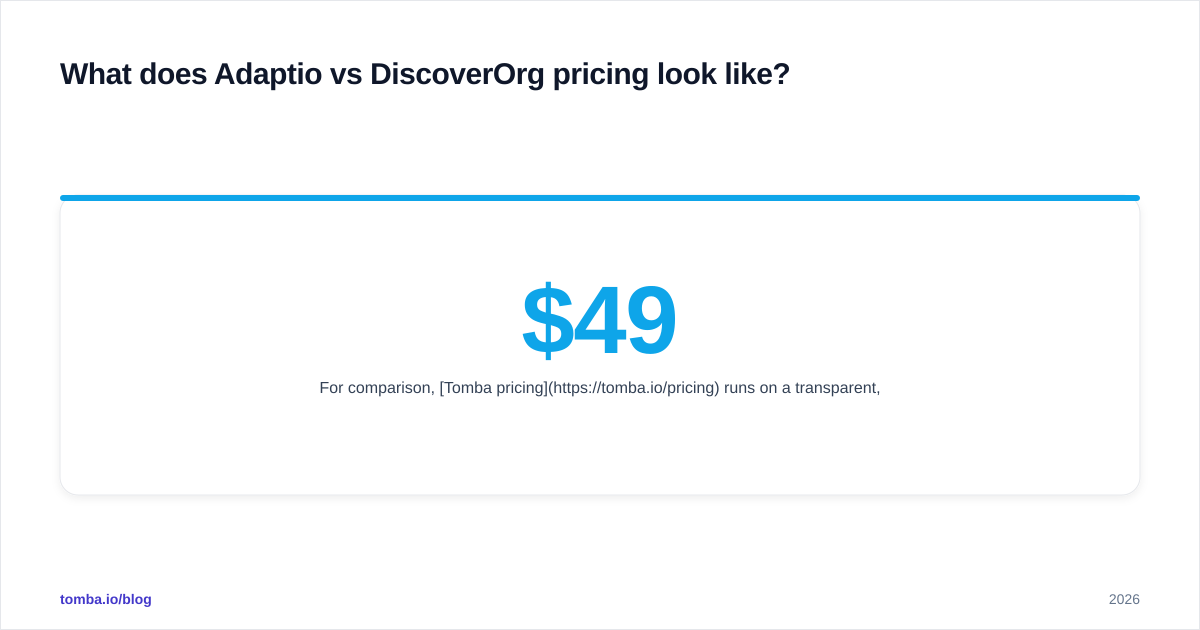
For comparison, Tomba pricing runs on a transparent, self-serve model — a free tier with 25 searches per month, Starter at $49/mo, Growth at $99/mo, and Pro at $249/mo. You can start finding and verifying contacts the same afternoon without a procurement cycle. That is not a like-for-like replacement for a full sales-intelligence suite, but for a large share of teams it covers the work they actually do.
)
Which should you choose for your GTM motion?#
Match the tool to your bottleneck, not to the longest feature list.
Choose DiscoverOrg/ZoomInfo if:
- You sell into large enterprises and need verified, multi-level org charts.
- Technographics drive your targeting (you sell to specific tech stacks).
- You have the budget and a RevOps team to administer a heavy platform.
- Your deals are complex, multi-threaded, and worth six figures.
Choose Adaptio if:
- You are RevOps-led and want signal-based prioritization out of the box.
- Speed-to-value matters more than exhaustive coverage.
- You want territory planning and account scoring without bolting on three add-ons.
- Your team is mid-market and allergic to year-long implementations.
Choose a focused stack (the option nobody pitches you) if:
- Your core need is finding and verifying contact data for known targets.
- You want predictable, transparent pricing.
- You would rather spend the saved budget on outreach and a strong sequence.
This third path is underrated. A combination of a B2B database, an email finder, and an enrichment layer can replicate the part of these platforms you use daily — at a fraction of the cost and complexity.
What do Adaptio and DiscoverOrg get wrong?#
No platform is flawless, and pretending otherwise helps no one.
DiscoverOrg/ZoomInfo weak spots:
- Cost creep. The base price is just the entrance fee; intent, scoops, and extra seats add up fast.
- Complexity. The platform rewards dedicated administration; small teams underutilize it.
- Data decay. Even the best-verified record ages — verification is a moment in time, not a permanent state.
Adaptio weak spots:
- Maturity. It is younger, with a smaller track record at enterprise scale.
- Depth ceiling. Signal-inferred org structure does not match decade-deep manual research.
- Ecosystem. Fewer native integrations than the incumbent, though the gap is closing.
The shared weakness is decay. Any data product, AI-native or human-verified, degrades the moment a person changes jobs. That is why a verification and re-enrichment step belongs in every workflow. Running new contacts through a data enrichment pass and a verification check before outreach protects your sender reputation and your reps' time far more than choosing the "perfect" database ever will.
How do you actually decide?#
Run a 30-day bake-off instead of trusting the demo.
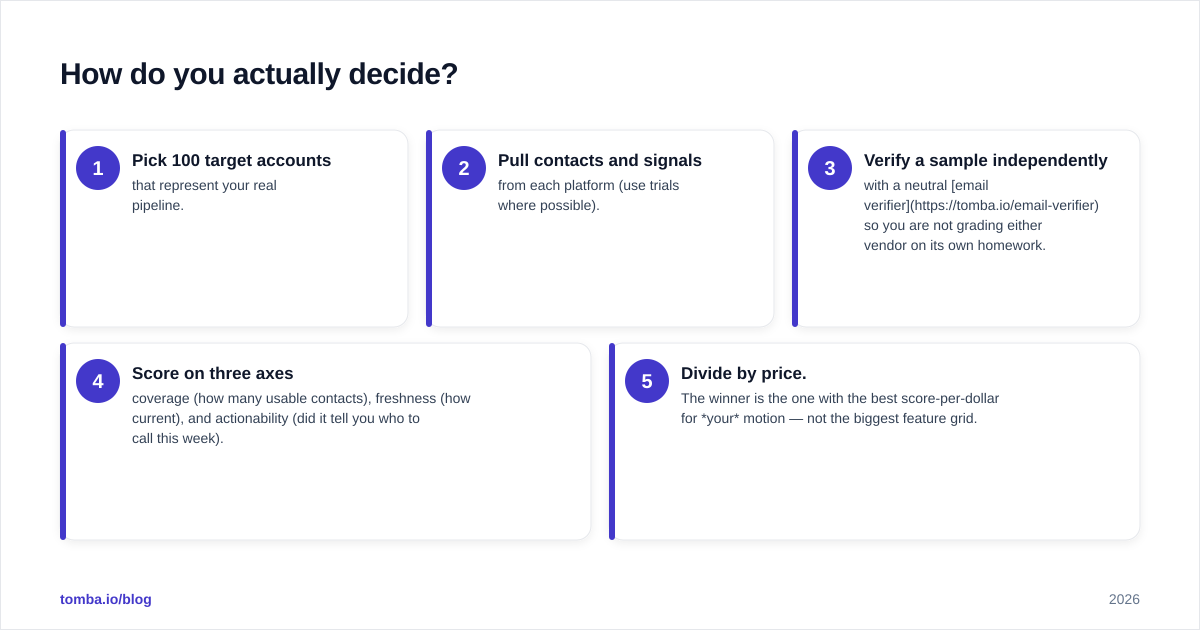
- Pick 100 target accounts that represent your real pipeline.
- Pull contacts and signals from each platform (use trials where possible).
- Verify a sample independently with a neutral email verifier so you are not grading either vendor on its own homework.
- Score on three axes: coverage (how many usable contacts), freshness (how current), and actionability (did it tell you who to call this week).
- Divide by price. The winner is the one with the best score-per-dollar for your motion — not the biggest feature grid.
Most teams discover the same thing: they need a slice of what these platforms sell, and they are paying for the whole pie. Decide what slice you actually eat, then buy that.
The bottom line on Adaptio vs DiscoverOrg#
DiscoverOrg — living on inside ZoomInfo — is still the depth-and-breadth champion for enterprise teams that need verified org charts and technographics. Adaptio is the faster, signal-first, AI-native option for RevOps-led teams that value prioritization and time-to-value over exhaustive coverage. The right choice is whichever one removes your bottleneck.
But before you sign a five-figure annual contract, be honest about how much of either platform you will use. If your day-to-day reality is "find the right people at the right companies and reach them with a clean, verified address," you do not need a battleship — you need a sharp, reliable tool that does exactly that.
That is where Tomba Email Finder fits. Find professional email addresses by domain, name, or company, verify them in the same flow, and enrich the records your CRM is missing — all on transparent pricing that starts free. Pair it with your sequencing tool and you have replaced the part of Adaptio or DiscoverOrg you actually touch every day, without the contract, the rollout, or the bill. Start free, run it against your own target list, and let the score-per-dollar decide.
// get started
Find, verify and enrich your first contacts today
Start on the free plan with 25 searches a month, then scale when your team is ready.
Free plan · No credit card required · GDPR & CCPA
// about the author